
What Is a Rubber Conveyor Belt Cleaning Brush?
A rubber conveyor brush is a mechanical cleaning device that uses rotating or stationary bristles to dislodge and remove carried‐back material from the surface of a rubber conveyor belt. Unlike metal scrapers, these brushes are designed to be gentle on rubber belting while effectively controlling dust, fines, and sticky buildup. They are widely used in industries such as food processing, recycling, mining, and material handling where belt cleanliness affects safety, product quality, and equipment life.
Common Types of Conveyor Belt Cleaning Brushes
Three primary brush designs cover most rubber belt cleaning applications:
- Roller brush – A cylindrical brush mounted on a rotating shaft across the belt width. Driven by friction, a motor, or the belt itself, it delivers continuous cleaning action. Ideal for high-speed belts and large volumes of dry dust or light residue.
- Strip brush – A stationary or adjustable brush strip held in a holder. It scrapes or wipes the belt surface as the belt passes. Simple and low cost, but usually less effective on sticky materials unless combined with tension adjustments or multiple passes.
- Spiral brush – A roller brush with bristles arranged in a helical pattern. The spiral design helps transport debris to one side while cleaning and provides some self-cleaning action. Works well for both dry dust and mildly sticky residues that could clog a straight roller brush.
Roller vs. Strip vs. Spiral Brush: Quick Comparison
| Feature | Roller Brush | Strip Brush | Spiral Brush |
|---|---|---|---|
| Cleaning action | Rotating, continuous | Stationary scraping/wiping | Rotating with lateral material movement |
| Best for | High-volume dry dust, high-speed belts | Light dust or dry fines, low-speed belts | Mixed residue, self-cleaning needs |
| Effectiveness on sticky residue | Moderate – can load up if residue is tacky | Low – tends to smear tacky material | Better than roller due to spiral shedding |
| Self-cleaning ability | Limited | None – must be cleaned manually | Good – spiral helps eject debris |
| Maintenance interval | Regular bristle wear checks, bearing lubrication | Frequent strip replacement or cleaning | Similar to roller, plus inspecting spiral path |
| Initial cost | Moderate to high | Low | Moderate |
How to Choose Based on Belt Material and Residue Type
Focus on two factors: the rubber belt’s surface and the residue you need to remove.
Rubber Belt Surface
- Smooth rubber belts (e.g., food-grade) work well with all brush types, but softer bristles (nylon, TPE) are recommended to avoid scratching.
- Textured or rough-top belts may trap dust; roller or spiral brushes with longer, flexible bristles are better for reaching into the texture.
- Heat-resistant rubber belts require high-temperature-rated bristles (e.g., nylon 6/6 or polyester) to prevent melting.
Residue Type
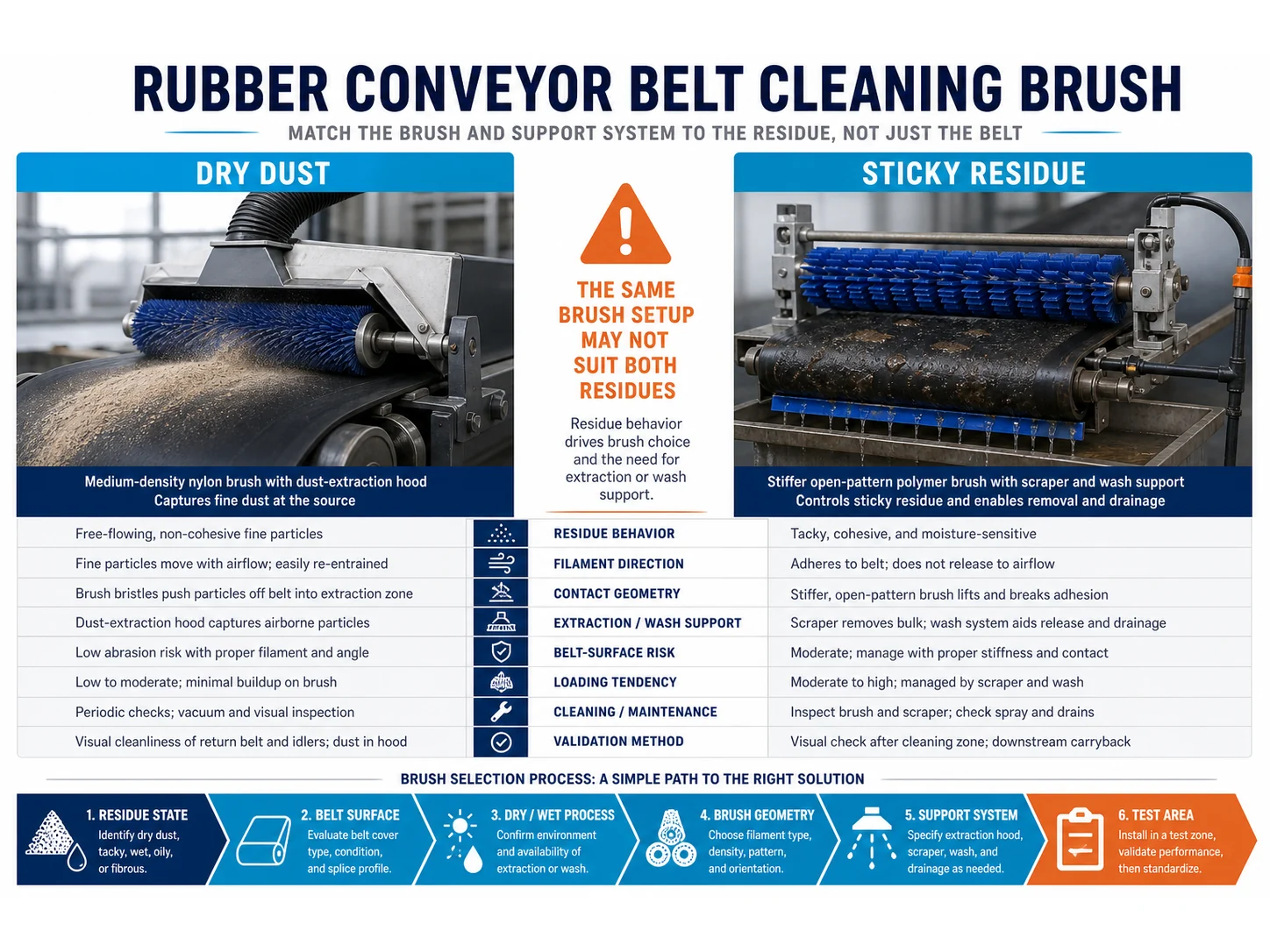
Dry dust (e.g., powders, sawdust, dry grains): A roller brush is usually the first choice. Its continuous rotation and bristle splay are effective at knocking airborne particles off the belt. For narrow belts or low volumes, a strip brush can work if maintenance keeps it in firm contact.
Sticky residue (e.g., rubber crumbs, adhesives, moist clay): Avoid plain strip brushes—they tend to push sticky materials around. A spiral brush provides better release because the helical path helps the residue roll off the brush. If the residue is extremely tacky, you may need a combination of a brush and a water spray or a scraper blade.
Measuring Cleaning Efficiency
To evaluate brush performance objectively, track these metrics:
- Carryback weight: Collect material falling under the return side of the belt per unit time. Lower carryback indicates better cleaning.
- Belt coverage rating: A visual inspection scale (e.g., 1–5) where 1 = clean and 5 = fully covered with residue.
- Dust concentration: Use a dust monitor near the discharge point to measure airborne particles before and after brush installation.
- Bristle wear rate: Measure bristle length regularly; a too-fast wear rate may signal excessive pressure or unsuitable material.
For most operations, a carryback reduction of 70–90% from an unbrushed condition is a good benchmark, but the target depends on your cleanliness requirements.
Maintenance of Conveyor Belt Cleaning Brushes
- Inspect bristles weekly for wear, flattening, or clogging. Replace when bristle length is reduced by 30–40%.
- Adjust brush-to-belt contact so that bristle tips barely touch or penetrate 1–2 mm into the belt surface. Too much pressure accelerates wear and heat buildup.
- Clean the brush itself: Remove wrapped material or buildup on the shaft and housing. A spiral brush needs less manual cleaning but still requires occasional inspection.
- Lubricate bearings and check drive mechanisms (if powered) according to the manufacturer’s schedule.
- Check belt alignment—a misaligned belt causes uneven brush contact and premature wear.
Common Mistakes When Choosing a Conveyor Brush
- Choosing based on cost alone: A low-cost strip brush may cost more in downtime and belt damage if it fails to clean adequately.
- Ignoring residue type: Using a roller brush for oily or sticky crumbs often leads to rapid clogging.
- Overlooking belt speed: At very high speeds (>400 ft/min), a stationary strip brush is almost useless; a powered roller brush is needed.
- Forgetting access for maintenance: A brush mounted in a tight space that cannot be reached easily will be neglected.
- Incorrect bristle material: Using stiff metal-filled bristles on a soft rubber belt can gouge the cover. Match bristle stiffness to belt hardness.
When a Scraper Blade Is Better Than a Brush
Brushes are not the universal solution. In these situations, a mechanical scraper (blade) often outperforms a brush:
- Heavy, sticky, or wet residue (e.g., clay, wet ash, thick pastes) that mats down bristles.
- High-temperature applications where plastic bristles melt or soften.
- Very large lumps that can damage brush bristles or get tangled.
- Space constraints that make brush rotation impractical.
- Cost-sensitive, low-precision cleaning where a simple polyurethane scraper is sufficient.
However, scrapers can wear the belt cover faster if not properly tensioned. For fine dust control on a rubber belt, a brush is still the gentler option.
The key is to evaluate the residue, environment, and maintenance capacity before deciding.
Final Takeaway
Select a rubber conveyor brush by first identifying the dominant residue type. Use a roller brush for high-volume dry dust, a spiral brush for sticky materials that need self-cleaning, and a strip brush only for light, non-tacky applications on slow belts. Always consider belt material and temperature resistance. Measure cleaning performance with carryback tests, and don’t hesitate to pair a scraper blade when the residue is beyond a brush’s capability. The right choice reduces maintenance and extends belt life.
When a Rubber Conveyor Belt Cleaning Brush Is the Wrong Choice
This brush is not enough when the main problem is blocked access, unsafe working conditions, damaged equipment, incompatible chemicals, or a process setting that keeps recreating the residue. In those cases, review screen opening, belt or surface material, carryback, uptime risk, and whether the brush can clean without process damage and confirm the surrounding cleaning method before increasing brush stiffness or contact pressure.
Frequently Asked Questions
Can I use the same brush for dust and sticky residue?
It is not recommended. A roller brush may work temporarily but will quickly load up with sticky material. A spiral brush handles mixed residue better, but for consistently sticky conditions, consider a scraper or a washable brush system.
How often should I replace the brush bristles?
Check weekly. When bristles are worn by one-third of their original length or show significant flattening, replace the brush strip or roller core. In dusty environments, this could be based on wear condition, operating load, and the equipment maintenance plan; in light-duty, it may last a year.
Do spiral brushes work on wet sticky residue?
They perform better than straight roller brushes because the spiral helps eject debris, but they are not a cure-all. Very wet or tacky residue may still require a scraper or a water wash.
What belt speed is best for roller brushes?
Roller brushes work well from 100 to 600 ft/min. Below 100 ft/min, a strip brush might suffice; above 600 ft/min, a powered brush drive is often needed to prevent slipping and ensure effective cleaning.
How do I measure conveyor belt cleaning efficiency?
A common method is the carryback test: place a tray under the return belt for a set period (e.g., 1 minute) and weigh the collected material. Compare with and without the brush. Aim for a reduction of at least 70% for typical operations.
When should I consider a scraper blade instead of a brush?
Choose a scraper when the residue is heavy, sticky, hot, or contains large lumps that would damage brushes. Also use a scraper if space does not allow a brush assembly or if the budget does not support brush maintenance.
Can conveyor brushes damage my rubber belt?
Yes, if bristles are too stiff, incorrectly mounted, or if the brush applies excessive pressure. Always match bristle stiffness to the belt’s hardness and adjust contact pressure carefully. Nylon or TPE bristles are generally safe for most rubber belts.
Are there brushes that work with FDA requirements?
Yes, brushes with FDA-approved bristles (e.g., white nylon, polyester, or TPE with specific color codes) and stainless steel shafts are available for food processing belts. Confirm material compliance with your supplier.
Technical References
- OSHA — Machine Guarding
- OSHA — Control of Hazardous Energy
- OSHA — Combustible Dust
- EPA — Particulate Matter Basics
Which bristle material fits this job — Rubber, Nylon PA or AISI 304 Stainless Steel Wire?
| Material | Continuous temperature (°C) | Peak temperature (°C) | Water absorption | Hardness |
|---|---|---|---|---|
| Rubber | 100 | 130 | very low | Specified by compound and Shore hardness; published TPE families can span roughly 50–80 Shore A, but that is a product-family example rather than a universal rubber range. |
| Nylon PA | 93 | 121 | 0.3–9% by PA grade and conditioning | Medium to firm; filament diameter and trim length control bending force. |
| AISI 304 Stainless Steel Wire | 400 | 500 | 0% | Rockwell B 70–95 depending on temper and cold work |
Figures as published by Brushtec / DuPont; Alleima. Confirm the exact grade against the supplier datasheet before ordering.
What should replace Rubber for conveyor belt?
- Rubber — Compare Rubber with Silicone elastomer, TPE, PVC profile, PVA sponge. Change material when wet stiffness, temperature, chemical resistance, conductivity, particle shedding, or surface marking becomes the limiting factor.
- Nylon PA — Compare Nylon PA with PP, PBT, PET. Change material when wet stiffness, temperature, chemical resistance, conductivity, particle shedding, or surface marking becomes the limiting factor.
- AISI 304 Stainless Steel Wire — Use AISI 316 stainless steel wire for chloride, marine, dairy, beverage, chemical washdown, or higher pitting-resistance requirements. Use carbon steel for dry aggressive cutting and brass or abrasive nylon for lower marking risk.