
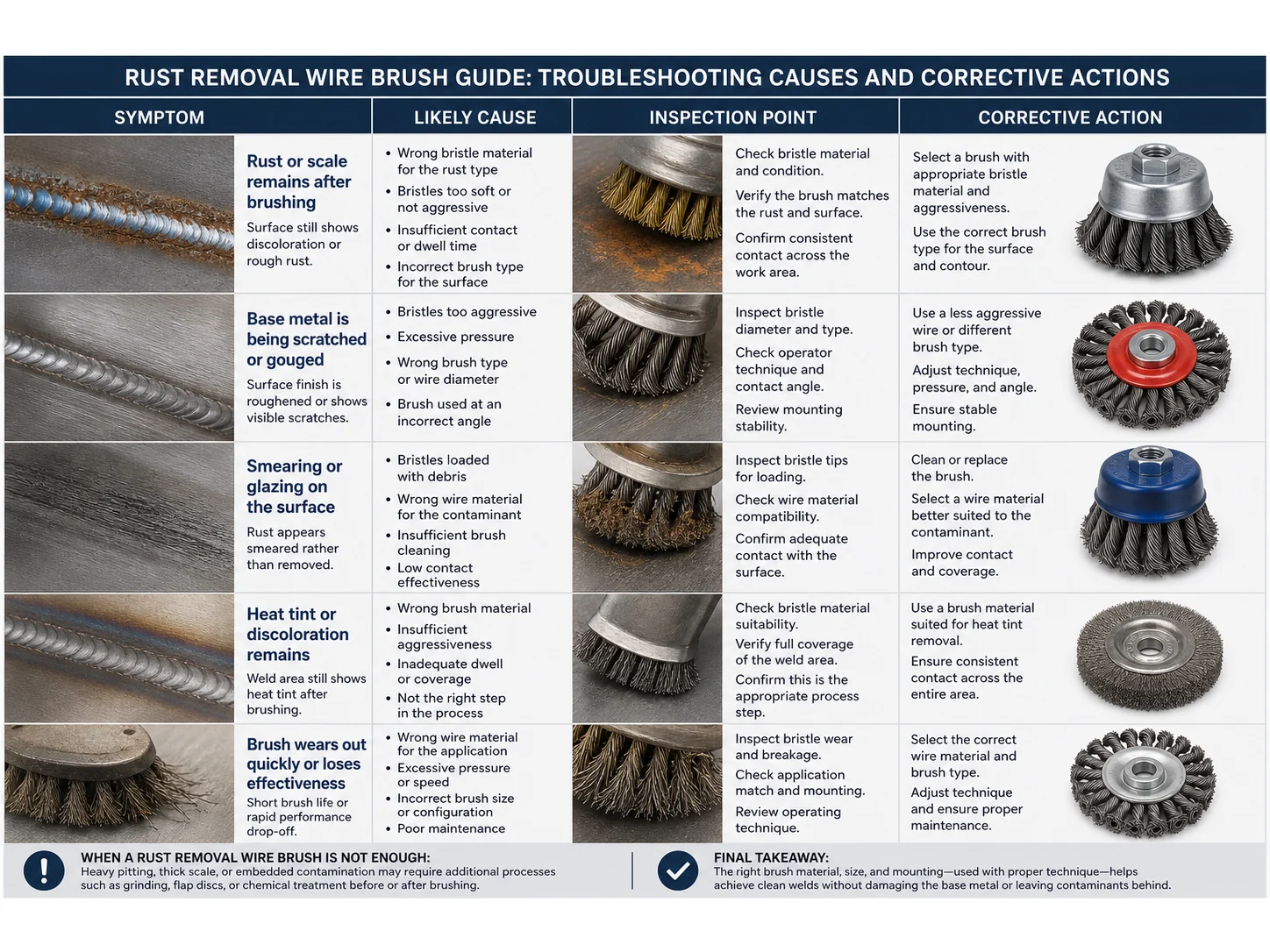
What Is a Rust Removal Wire Brush?
A rust removal wire brush is a cleaning tool with metal or abrasive-filled filaments designed to abrade corrosion, oxide layers, coatings, and welding residue from metal surfaces. The bristles are typically made of steel, stainless steel, brass, or nylon with embedded abrasives, and they are anchored in a handle, shaft, or hub for manual or power-tool use. Unlike grinding discs or chemical strippers, a wire brush removes surface contamination without changing the geometry or thickness of the workpiece—when chosen correctly. For weld cleanup, the right brush balances aggressive cutting action with minimal base-metal scoring.
Common Material and Bristle Options
Brush performance starts with the bristle material. Each option targets specific surface conditions and substrate metals:
- Carbon Steel Wire: Good general-purpose abrasive for carbon steel. Low cost, but sheds and rusts quickly. Do not use on stainless steel or aluminum—carbon residue will cause galvanic corrosion.
- Stainless Steel Wire: Essential for stainless steel, aluminum, and other non-ferrous metals. Prevents cross-contamination. Available in 304 or 316 grades for corrosive environments.
- Brass Wire: Softer, non-sparking, and gentler on sensitive surfaces. Ideal for light rust, cleaning threads, or where sparking is a hazard. Less durable than steel.
- Nylon Abrasive: Filaments impregnated with silicon carbide or aluminum oxide. Uniform finish, no metal shed, and suitable for wet environments. Often used for deburring and light cleaning on machined surfaces.
- Coated or Plated Wire: Zinc-coated or polymer-coated steel wire resists rust and extends brush life, but may not be suitable for weld prep if the coating contaminates the weld joint.
Comparing Key Brush Types for Weld Cleanup
The physical form of the brush determines how and where it can be used. The table below compares the most common types for weld preparation and interpass cleaning:
| Brush Type | Best For | Typical Mounting | Strengths | Limitations |
|---|---|---|---|---|
| Hand Wire Brush | Small areas, tight corners, touch-up | Handle or scraper-style grip | Low cost, portable, simple | Labor-intensive, slow for large areas |
| Cup Brush | Flat surfaces, weld seams, heavy rust | 4-1/2″ or 5″ angle grinder threads | Aggressive, good visibility, balanced | Can dig into soft metals; requires guard clearance |
| Wheel Brush | Narrow grooves, inside corners, edges | Bench grinder, drill, or straight grinder arbor | Cuts into tight profiles, various diameters | Less stable on large flats; can walk off surface |
| End Brush | Internal bores, deep holes, cavities | Die grinder or drill chuck | Reaches where others can’t; small tip control | Short bristle life at high RPM; limited coverage area |
| Strip / Scratch Brush | Fine detail, light rust, surface finishing | Drill or bench motor with shaft adapter | Controlled scratch pattern, narrow footprint | Not for heavy mill scale or thick rust |
How to Choose the Right Rust Removal Wire Brush
Selection is rarely about finding the “best” brush—it’s about matching the brush to the job. Start with these decision factors:
- Residue Type and Thickness: Light surface rust and finger print removal (brass or fine steel); heavy mill scale and deep pitting (coarse wire, cup or wheel brush at high speed).
- Base Metal Sensitivity: Carbon steel plates (carbon steel wire acceptable); stainless steel or aluminum (must use stainless steel or brass to avoid contamination).
- Equipment Interface: Threaded cup brush for angle grinders; 1/4″ shank for die grinders; arbor hole for bench grinders. Always check maximum RPM rating against tool speed.
- Wet or Chemical Exposure: Wash-down or humid conditions favor stainless steel bristles or nylon abrasives to prevent brush rust.
- Hygiene Expectations: Food-grade or pharmaceutical zones require 316 stainless steel or FDA-compliant nylon brushes, and the brush mounting must be fully sealed.
- Maintenance Frequency: High-volume production may justify longer-life coated wire or knot-type cups. Low-volume maintenance can use standard crimped wire.
- Custom Size Requirements: When off-the-shelf diameters or bristle lengths fall short, contact a manufacturer for a drawing review. Non-standard pipe IDs, deep shoulders, or robotic end effectors often need a tailored solution.
Common Mistakes When Specifying or Using Wire Brushes
Even experienced operators make these errors. Avoid them to save time and prevent rework:
- Using a carbon steel brush on stainless steel: Embedded iron particles will rust and cause pitting. Dedicate stainless-only brushes and label them clearly.
- Choosing wire diameter by instinct instead of surface finish requirement: Fine wire (0.005–0.008″) for light cleaning and blending; coarse wire (0.014–0.020″) for heavy removal. Using coarse wire on a polished surface will leave deep scratches.
- Ignoring maximum RPM rating: Exceeding the rated speed can throw bristles and cause injury. Always match the brush RPM limit to the tool’s no-load speed.
- Assuming all brass brushes are non-sparking: While brass is less likely to spark than steel, fine brass wires can still produce sparks in certain conditions. For certified non-sparking tools, verify compliance with a recognized standard.
- Overlooking handle or core compatibility: A threaded cup brush with an M10 arbor will not fit a 5/8″-11 grinder without an adapter. Check spindle thread size before ordering.
- Forgetting that knot-twisted brushes are more aggressive than crimped: Twisted wire removes material faster but leaves a rougher surface. Choose crimped for blending and finish work.
When a Rust Removal Wire Brush Is the Wrong Choice
A wire brush works well for light-to-medium surface corrosion and slag, but it has clear limits. If you overlook these, you risk poor weld quality or damaged parts:
- Deep, layered rust and heavy pitting: A wire brush may only polish the surface while leaving corrosion in pits. Consider needle scaling, sandblasting, or media blasting first.
- Heat-treated or hardened surfaces: Brushing a hardened bearing race or induction-hardened shaft can dull the bristles immediately and generate harmful heat. Use specialty abrasive pads or soft media.
- Profiled or irregular surfaces: Hand brushing a complex casting with deep recesses is often inefficient. Custom-shaped brushes or robotic brushing with programmable paths may be required.
- Strict surface profile requirements: When a coating specification demands a particular anchor profile (e.g., SSPC or ISO standards), a wire brush alone cannot Help confirm the required profile depth and uniformity. A sample test with a representative brush and profile gauge is recommended, or a supplier drawing review for a controlled-condition test.
Final Takeaway
Choosing a rust removal wire brush for weld cleanup isn’t about grabbing the first steel brush from the shelf. Start with the base metal: carbon steel or stainless/ aluminum? Define the residue severity, and pick a brush form factor that matches your tooling and access. Verify material compatibility, RPM limits, and mounting details before you order. When uncertainty remains, a sample test with a few candidate brushes on your actual material is the lowest-cost insurance against contamination, rework, or injury.
Frequently Asked Questions
What is the difference between a wire brush and a wire wheel?
A wire brush is the general term for any tool with bristles; a wire wheel specifically refers to a circular brush that mounts on a bench grinder or motor shaft. Wire wheels are excellent for edge cleaning and deep grooves, while cup brushes cover larger flat areas. Both are used for rust removal.
Can I use a wire brush on stainless steel without contaminating it?
Yes, but only if you use a stainless steel wire brush that has never touched carbon steel. Even trace iron from a previous job can embed in the stainless surface and cause rust spots. Dedicated brushes, color coding, and separate storage are common practices in fabrication shops.
Why does my wire brush leave scratches?
Scratches are typically a sign that the wire diameter is too coarse for the surface finish you need, or you are applying excessive pressure. Try a finer crimped wire brush, or switch to a non-woven abrasive product for a smoother result without deep scoring.
Is a brass brush better than steel for rust removal?
It depends on the base metal. On soft, non-ferrous metals or threaded components, a brass brush is gentler and prevents galling. For heavy rust on carbon steel, a steel wire brush cuts faster. Brass is not “better” overall—it is a different tool for a different sensitivity level.
What safety precautions should I take when using a power wire brush?
Always wear safety glasses and a full-face shield, because bristles can break free at high speed. Use gloves to protect from sharp wires, and ensure the workpiece is clamped. Never exceed the brush’s maximum RPM rating, and check that the guard on your grinder is correctly positioned.
How long does a wire brush last?
Brush life varies widely with bristle material, wire diameter, speed, and pressure. A coarse steel cup brush used daily on heavy weld slag may last a few hours, while a fine stainless brush used lightly can last months. Watch for bristle breakage or a rounded profile, which indicate it’s time for replacement.
Can I use a drill wire brush for heavy rust on structural steel?
A drill-mounted cup or wheel brush can handle moderate rust, but heavy mill scale on large beams or I-beams will quickly dull a small brush and overheat a standard drill. For heavy structural work, an angle grinder with a knot-twisted cup brush is more efficient and safer, as it handles the higher torque and RPM.
Technical References
- OSHA — Personal Protective Equipment
- ASME — Y14.5 Dimensioning and Tolerancing
- World Stainless — Corrosion Resistance of Stainless Steels
Which bristle material fits this job — AISI 304 Stainless Steel Wire, Nylon PA or Carbon Steel Wire?
| Material | Continuous temperature (°C) | Peak temperature (°C) | Water absorption | Hardness |
|---|---|---|---|---|
| AISI 304 Stainless Steel Wire | 400 | 500 | 0% | Rockwell B 70–95 depending on temper and cold work |
| Nylon PA | 93 | 121 | 0.3–9% by PA grade and conditioning | Medium to firm; filament diameter and trim length control bending force. |
| Carbon Steel Wire | 200–300 | 350–450 | 0% | Rockwell C 40–60 |
| Brass Wire | 150–200 | 250–300 | 0% | Rockwell B 40–90 |
Figures as published by Alleima; Brushtec / DuPont. Confirm the exact grade against the supplier datasheet before ordering.
What should replace AISI 304 Stainless Steel Wire for weld cleanup?
- AISI 304 Stainless Steel Wire — Use AISI 316 stainless steel wire for chloride, marine, dairy, beverage, chemical washdown, or higher pitting-resistance requirements. Use carbon steel for dry aggressive cutting and brass or abrasive nylon for lower marking risk.
- Nylon PA — Compare Nylon PA with PP, PBT, PET. Change material when wet stiffness, temperature, chemical resistance, conductivity, particle shedding, or surface marking becomes the limiting factor.
- Carbon Steel Wire — Compare Carbon Steel Wire with Carbon steel wire, brass wire, abrasive nylon. Change material when wet stiffness, temperature, chemical resistance, conductivity, particle shedding, or surface marking becomes the limiting factor.
- Brass Wire — Compare Brass Wire with Steel wire, stainless wire, nylon. Change material when wet stiffness, temperature, chemical resistance, conductivity, particle shedding, or surface marking becomes the limiting factor.