
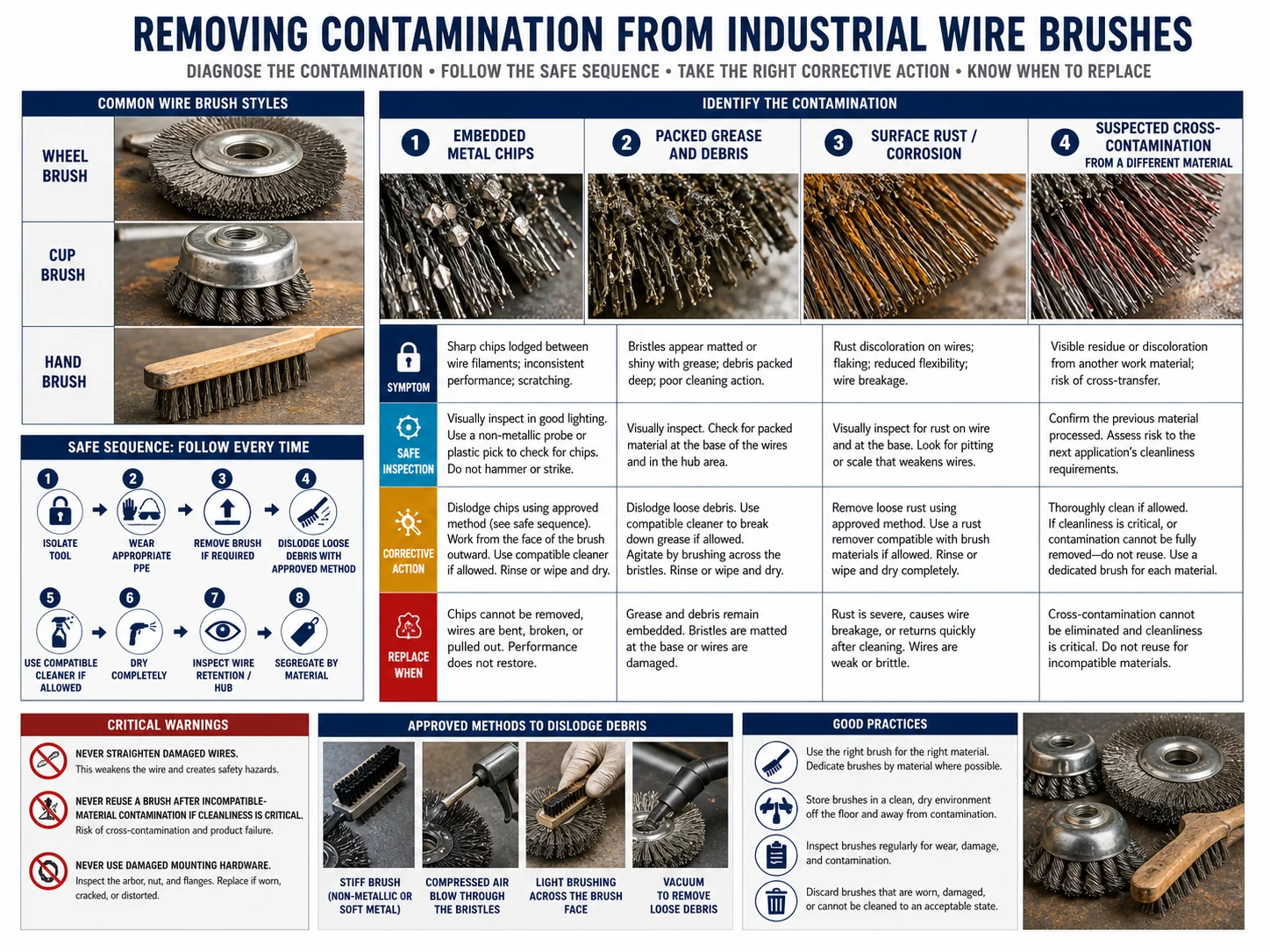
What Is Wire Brush Contamination?
Wire brush contamination is the buildup of foreign material on bristles that reduces cutting efficiency, causes uneven wear, and can embed debris into the workpiece. It happens when bristle tips, cup brushes, or wheel brushes load up with paint residue, adhesive films, gummy rubber, or metallic smearing. A contaminated brush skates over the surface instead of abrading it, generates excessive heat, and may mar the finish. Recognizing contamination early is the first step to effective cleaning.
Common Types of Contamination
Wire brushes encounter several contamination types that require different removal strategies. Understanding the nature of the contaminant helps select a cleaning method that protects the bristle material and geometry.
- Paint and powder coating – cured paint fills between bristles and hardens, locking them together. Solvent-based and waterborne paints are common in automotive, marine, and metal fabrication work.
- Adhesive and tape residue – pressure-sensitive adhesives, epoxy, and contact cement cling to bristles and attract further debris. These are frequent in woodworking and sign-making applications.
- Rubber and elastomer buildup – soft rubber smears onto bristles when cleaning molds or removing gaskets. The material rolls into balls and clogs the brush face.
- Metal transfer and galling – when a wire brush is used aggressively on stainless steel or aluminum, base metal can transfer onto the bristles. This contamination is harder than the brush wire and causes rapid wear if not removed.
- Grease, oil, and carbon – in industrial environments, brushes collect thick hydrocarbon residues that combine with dust to form a sticky, abrasive paste.
Mechanical vs. Chemical vs. Thermal Removal Methods
Three primary approaches exist for removing contamination from wire brushes: mechanical cleaning, chemical stripping, and thermal treatment. Each has distinct advantages and risks. The following table compares them across key operational factors.
| Factor | Mechanical | Chemical | Thermal |
|---|---|---|---|
| Best for | Paint, light rust, dried debris | Adhesive, heavy grease, powder coat | Heavy paint, rubber, thick buildup |
| Bristle wear risk | Moderate to high | Low if compatible | Moderate if controlled |
| Speed | Fast | Slow (soak time) | Fast |
| Cost | Low | Moderate (solvent cost) | Moderate (equipment/energy) |
| Safety hazards | Flying debris, dust | Chemical exposure, ventilation | Burn risk, toxic fumes |
| Typical tools | Wire brush comb, file card, compressed air, needlegun | Solvent soak, parts washer, alkaline cleaner | Propane torch, heat gun, oven (controlled ramp) |
How to Choose the Right Cleaning Method
Selecting the correct cleaning approach requires matching the contaminant to the method that preserves bristle temper and alignment. Follow this decision logic:
- Identify the contaminant type first. Organic coatings (paint, adhesive) respond well to chemical solvents; inorganic metallic transfer requires mechanical removal.
- Check bristle material. Carbon steel bristles can tolerate mild thermal treatment but are prone to rust if chemicals are not completely removed. Stainless steel bristles resist many chemicals but lose spring temper if overheated. Brass and nylon bristles are easily damaged by excessive heat or aggressive solvents.
- Consider brush construction. Cup brushes and wheel brushes with thick wire sections can handle more aggressive mechanical cleaning than fine detail brushes or scratch brushes. Knot-twist brushes are more robust than straight crimp styles.
- Evaluate health and safety requirements. Confined spaces or poor ventilation favor mechanical over chemical methods. When using a torch or oven, ensure no flammable residues remain on the brush.
- Test on a small section. Start with the least aggressive method (soaking, brushing with a file card) before escalating to power tools or heat.
Safety Precautions When Cleaning Contaminated Wire Brushes
Cleaning contaminated brushes introduces workplace hazards that can be more severe than the original brushing operation. Always observe these precautions:
- Wear proper PPE. Safety glasses, cut-resistant gloves, and respiratory protection are essential. Mechanical cleaning can eject bristle fragments and produce toxic dust from old paint (lead risk).
- Control ignition sources. Solvents and thermal methods create flammable vapors. Work away from sparks, open flames, and static discharge areas. Use suitable for the site safety requirements ventilation when possible.
- Ventilate chemical stripping zones. Many paint strippers contain methylene chloride or other volatile organic compounds. Use local exhaust and monitor air quality.
- Avoid overheating. Thermal cleaning can draw the temper from wire bristles, making them brittle or soft. Do not exceed 500°F (260°C) for carbon steel unless wire specifications allow. Never quench hot bristles in water; let them air cool to prevent micro-cracks.
- Contain chemical waste. Spent solvents and contaminated rinse water must be disposed of according to local regulations. Do not pour them down drains.
Common Mistakes That Damage Bristles
Even experienced operators make cleaning errors that shorten brush life. Avoid these practices:
- Using a wire brush on a contaminated brush. Brushing bristles against themselves (“combing”) can deform tips and create uneven wear. Use a purpose-made file card or brush comb with correctly spaced teeth.
- Soaking for too long in aggressive solvents. Long exposure to ketones or chlorinated solvents can attack the binder or the wire surface, causing hydrogen embrittlement in high-carbon steel.
- Excessive thermal cycles. Repeated heating to remove heavy contamination can alter the wire’s metallurgy, reducing fatigue life and leading to premature bristle breakage.
- Ignoring rinse and dry steps. Leaving chemical residue on the brush attracts new contamination and can cause corrosion during storage. Always rinse thoroughly and dry with compressed air or low heat.
- Using high-pressure water blasting. High-pressure water can embed moisture deep into the brush core and between bristles, leading to hidden rust or mold growth on natural fibers. Use only moderate pressure and ensure complete drying.
When Contamination Causes Permanent Damage
No cleaning method can restore a wire brush to new condition in every case. Recognizing permanent damage prevents wasted labor and ensures workpiece quality. A brush should be retired under these conditions:
- Bristle deformation or set. If bristles are bent, splayed, or permanently clumped and cannot be mechanically straightened, the brush will not cut evenly. This often happens after severe glue or paint buildup.
- Loss of temper. Overheated bristles that appear blue or straw-colored have lost their spring hardness. They will dull quickly and may break inside the workpiece.
- Embedded work-hardened metal. When a brush used on hard alloys is contaminated with microscopic fragments that bond to the wire, those fragments become cutting edges that gouge the next softer metal. No practical cleaning removes them.
- Core wear or crack propagation. Aggressive thermal cleaning of a brush with a cracked hub or weld can propagate fractures, leading to catastrophic failure at speed. Always inspect the hub before and after cleaning.
- Contamination that compromises safety. Brushes used on hazardous materials (asbestos, lead, radioactive dusts) should be disposed of in accordance with regulations rather than cleaned for reuse.
Final Takeaway
Removing contamination from wire brushes without damaging bristles is a matter of matching the method to the material. Identify what is on the brush, understand how heat, chemicals, and mechanical force will affect the wire, and always err on the side of gentleness. A clean brush cuts faster, runs cooler, and produces a better finish—but a damaged brush creates rework and safety risks. Train operators to recognize early contamination, provide the right cleaning supplies, and establish a regular maintenance schedule to maximize brush life and performance.
Frequently Asked Questions
Can I use a wire brush to clean another wire brush?
It is not recommended. Using one wire brush on another can deform bristles, reduce cutting efficiency, and create uneven wear. A dedicated file card or brush comb is safer and more effective.
How often should I clean a wire brush during use?
Clean the brush when you notice reduced cutting action, glazing of the surface, or visible loading between bristles. In heavy applications like paint removal, this may be as often as every 10–15 minutes of continuous use.
Is it safe to use a torch to burn off paint from a wire brush?
It can be done with caution, but only if the brush has no plastic components and the wire is not a heat-sensitive alloy. Keep the flame moving, avoid exceeding 500°F for carbon steel, and allow the brush to air cool slowly. Never use a torch near flammable liquids.
What chemical is safe for cleaning paint off a wire brush?
A mild solvent like mineral spirits or citrus-based paint remover is often sufficient for uncured paint. For cured coatings, use a non-corrosive formulated brush cleaner or alkaline degreaser. Always check compatibility with the bristle material; avoid chlorinated solvents on high-carbon steel.
Can I soak a wire brush overnight in a solvent?
Brief soaking (a condition-based interval) is usually safe, but overnight exposure can soften brush binders or trigger hydrogen embrittlement in some steels. If extended soaking is needed, monitor the brush and rinse thoroughly after removal.
How do I dry a wire brush after chemical cleaning to prevent rust?
Rinse with clean water (or a water-displacing solvent) and immediately blow off excess fluid with compressed air. Then place the brush in a warm, dry area or use a low-heat oven (under 150°F) for complete drying. Applying a light protective oil can prevent flash rust on carbon steel.
When should I simply replace a contaminated brush instead of trying to clean it?
Replace the brush if bristles are permanently bent, the hub shows cracks, or the brush has been used on hazardous materials. If cleaning takes longer than the cost of a new brush, replacement is the more economical choice.
Technical References
- OSHA — 1910.242 Hand and Portable Powered Tools
- OSHA — Personal Protective Equipment
- World Stainless — Corrosion Resistance of Stainless Steels
Which bristle material fits this job — Rubber, AISI 304 Stainless Steel Wire or Nylon PA?
| Material | Continuous temperature (°C) | Peak temperature (°C) | Water absorption | Hardness |
|---|---|---|---|---|
| Rubber | 100 | 130 | very low | Specified by compound and Shore hardness; published TPE families can span roughly 50–80 Shore A, but that is a product-family example rather than a universal rubber range. |
| AISI 304 Stainless Steel Wire | 400 | 500 | 0% | Rockwell B 70–95 depending on temper and cold work |
| Nylon PA | 93 | 121 | 0.3–9% by PA grade and conditioning | Medium to firm; filament diameter and trim length control bending force. |
Figures as published by Alleima; Brushtec / DuPont. Confirm the exact grade against the supplier datasheet before ordering.
When is Rubber the wrong choice?
- Rubber — Generic rubber cannot support a technical page claim without chemistry, hardness and compatibility data.
- AISI 304 Stainless Steel Wire — Avoid using AISI 304 as the default in marine, brine, hypochlorite, and persistent chloride environments; use AISI 316 when higher pitting and crevice-corrosion resistance is required.
- Nylon PA — The nylon family spans several grades, so heat, moisture and chemical limits should follow the selected PA resin rather than a generic nylon value.
What should replace Rubber when it stops working?
- Rubber — Compare Rubber with Silicone elastomer, TPE, PVC profile, PVA sponge. Change material when wet stiffness, temperature, chemical resistance, conductivity, particle shedding, or surface marking becomes the limiting factor.
- AISI 304 Stainless Steel Wire — Use AISI 316 stainless steel wire for chloride, marine, dairy, beverage, chemical washdown, or higher pitting-resistance requirements. Use carbon steel for dry aggressive cutting and brass or abrasive nylon for lower marking risk.
- Nylon PA — Compare Nylon PA with PP, PBT, PET. Change material when wet stiffness, temperature, chemical resistance, conductivity, particle shedding, or surface marking becomes the limiting factor.