
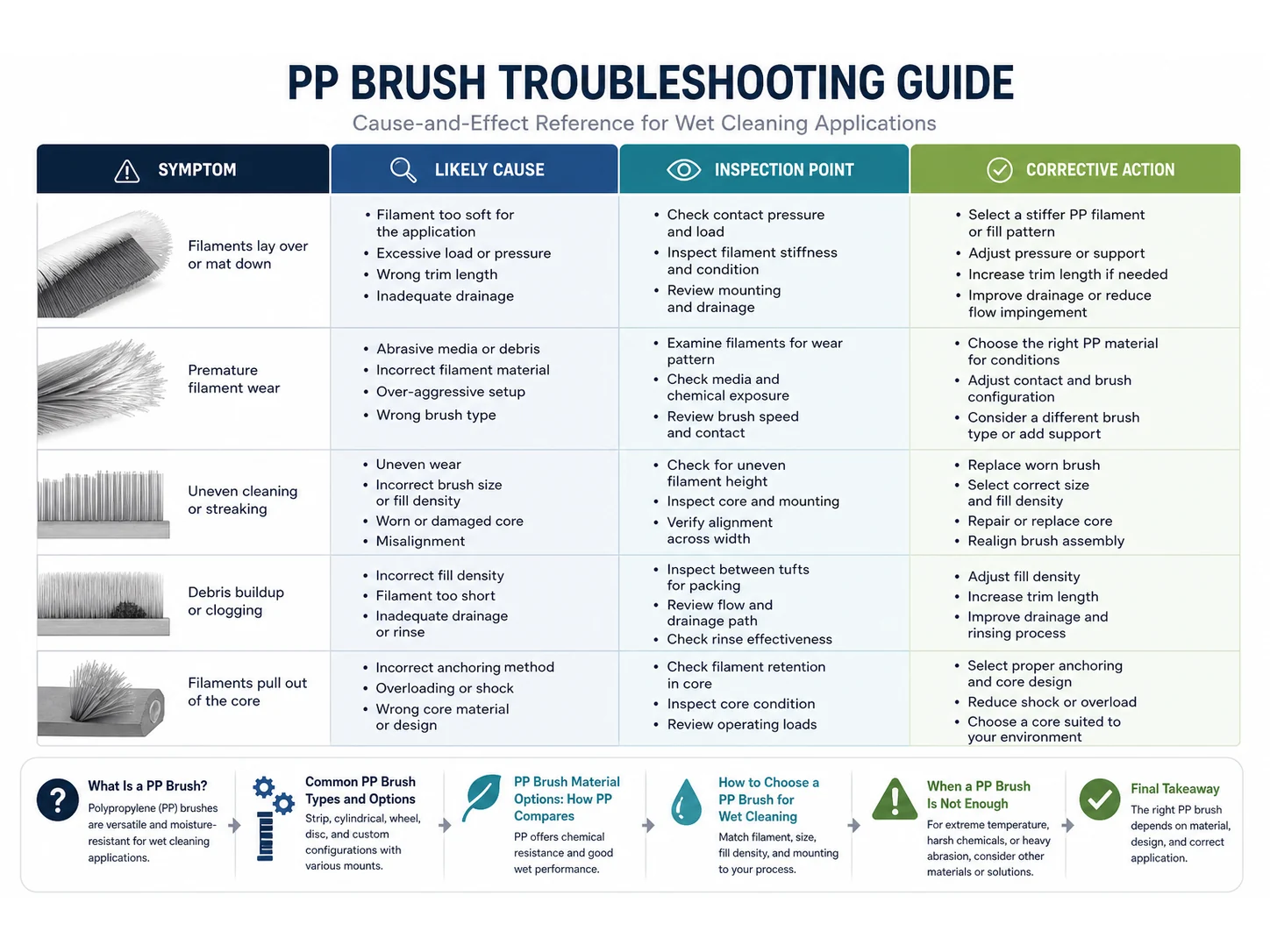
What Is a PP Brush?
A PP brush for wet cleaning should be judged by the actual job conditions, not by the product name alone. Start with access, residue type, surface sensitivity, brush stiffness, operating environment, and replacement routine. The right brush reaches the area, removes the target soil or finish defect, and avoids creating a second problem such as scratching, shedding, jamming, static risk, or contamination.
A PP brush features bristles made from polypropylene, a thermoplastic polymer valued for its toughness, chemical resistance, and near‑zero moisture absorption. In wet cleaning, these properties keep the filament from softening or swelling, helping the brush retain its scrubbing action even after prolonged exposure to water, mild acids, alkalis, and cleaning solvents. PP filaments typically withstand operating temperatures up to around 180°F (82°C) in continuous wet service, which makes them suitable for many industrial and sanitary tasks but not for high‑heat steam or autoclave cycles.
Common PP Brush Types and Options
PP brushes are not one‑size‑fits‑all. Understanding the basic variations helps you specify the right tool without over‑engineering or under‑specifying.
- Filament configuration – Straight PP provides maximum stiffness for heavy scrubbing. Crimped or wavy filaments offer more surface contact and hold liquids better for gentle wiping or coating.
- Core and handle materials – Cores may be plastic, wood, or stainless steel. Plastic handles are lightweight and rust‑proof; stainless cores offer durability and high‑temperature resistance, while wood is often found in low‑cost disposable brushes.
- Mounting attachment – Common styles include threaded studs, ferrule‑type sockets, looped wire ends, and clamp‑on holders. The interface must match the equipment shaft or manual handle.
- Diameter and trim length – Brush diameter and filament trim length determine access to tight spaces, scrub pressure, and flexibility. Longer trim provides more give; shorter trim increases aggressiveness.
PP Brush Material Options: How PP Compares
| Filament Material | Stiffness | Water Absorption | Chemical Resistance | Temperature Limit (Continuous Wet) | Surface Risk | Relative Cost |
|---|---|---|---|---|---|---|
| Polypropylene (PP) | Medium‑High | Very low | Good against acids, alkalis, solvents | ~180°F (82°C) | Low (non‑abrasive) | Low |
| Nylon (PA) | Medium | Moderate (can swell) | Good, but absorbs chemicals | ~250°F (121°C) | Low | Medium |
| Polyester (PBT/PET) | High | Very low | Excellent | ~300°F (149°C) | Low | Medium |
| Brass | High (metal) | None | Limited – reacts with acids/alkalis | High (metal limit) | Can scratch | Medium |
| Stainless Steel | Very high | None | Excellent (grade dependent) | Very high | Aggressive – will scratch | High |
| Tampico (natural fiber) | Low‑Medium | High (absorbs, rots) | Poor – degrades in chemicals | Low (degrades) | Very low | Medium |
PP occupies a middle ground: it resists moisture and chemicals without the high cost or scratching risk of metal, and it stays stiffer than many natural fibers.
How to Choose a PP Brush for Wet Cleaning
Use these five decision factors to narrow down the options.
- Residue type – Light films call for softer, crimped PP; heavy, caked‑on soil requires stiffer, straight filaments.
- Surface sensitivity – PP is generally safe for glass, plastic, and stainless steel, but always test on a hidden area if surface finish is critical.
- Equipment interface – Measure shaft diameter, mounting thread pitch, and clearance. A mismatch here is the single most common cause of returned brushes.
- Chemical exposure – Although PP resists many chemicals, verify compatibility against your specific cleaning agents, especially at elevated concentrations or temperatures.
- Hygiene and maintenance – In food zones, look for solid‑molded PP or FDA‑compliant materials. For frequent washdowns, choose a rust‑free core material.
Common Mistakes When Specifying PP Brushes
- Picking by cost drivers alone – Cheaper brushes often use lower‑density PP that mats down quickly or has inconsistent trim lengths.
- Ignoring filament stiffness – Assuming all PP bristles feel the same leads to either under‑scrubbing or surface damage.
- Mismatched core material – A wood core in a constant‑wet cycle swells and rots; stainless steel in an acidic environment without the proper grade can corrode.
- Overlooking chemical compatibility – Even PP can be attacked by strong oxidizing acids or certain hydrocarbons. Always confirm with the chemical manufacturer.
- Neglecting temperature limits – PP softens above 180°F (82°C) and deforms. If your process runs hotter, consider polyester or nylon.
- Wrong mounting type – A press‑fit ferrule may slip under torque; a threaded connection may require a locking nut. Double‑check your machine’s original brush attachment.
When a PP Brush Is the Wrong Choice
PP has clear boundaries. Choose an alternative when:
- Operating temperatures exceed 180°F (82°C) continuously. Nylon or polyester filaments handle higher heat without softening.
- You need abrasive cleaning. PP cannot remove heavy rust, scale, or weld spatter. Switch to brass or stainless steel wire.
- Sterilization by autoclave is required. PP will warp. Look for specialty high‑heat plastics or metal brushes.
- Extremely soft contact is needed. On polished optical surfaces or soft coatings, even straight PP may be too stiff. Consider natural hair or foam.
- The cleaning solution contains strong solvents. While PP resists many, some hydrocarbons and chlorinated solvents can cause swelling or cracking.
Final Takeaway
A PP brush works best when you match filament stiffness to the actual residue, verify core and mounting compatibility, and stay within its chemical and thermal limits. The lowest-cost option often costs more in rework, downtime, or surface damage. When in doubt, request sample brushes for a field test before committing to a large order – it is the only way to confirm fit, durability, and cleaning performance in your exact conditions.
Frequently Asked Questions
Can PP brushes be used on food‑contact surfaces?
Many PP filaments are FDA‑compliant for incidental food contact. However, you must verify that the specific brush model meets all applicable regulations for your process, including colorants and core materials. Always request a letter of compliance from the manufacturer.
What is the difference between crimped and straight PP filaments?
Straight PP filaments are stiffer and better for removing stubborn, dried‑on residues. Crimped filaments are wavy, which makes them more flexible and allows them to hold water or cleaning solutions, making them a better choice for wiping, spreading, or gentle scrubbing.
How do I determine the correct trim length for my PP brush?
Trim length depends on the gap between the brush core and the surface, the amount of flex you need, and the pressure required to break the soil loose. A shorter trim gives more aggression, while a longer trim allows the bristles to conform to uneven surfaces. Measure the existing brush or provide the original equipment manufacturer’s specification.
Will a PP brush scratch stainless steel?
Polypropylene is much softer than steel, so it will not scratch under normal cleaning pressure. However, if grit or metal particles become embedded in the bristles during use, they can cause scratches. Rinse brushes frequently and never use a contaminated brush on a polished surface.
What temperature can a PP brush handle?
PP brushes generally withstand continuous operating temperatures up to about 180°F (82°C) in wet environments. Above that, the filaments may soften and lose their scrubbing ability. For higher temperatures, switch to nylon or polyester.
Can I use a PP brush with acidic cleaners?
PP has good resistance to most inorganic acids at moderate concentrations and temperatures. However, it can be attacked by strong oxidizing acids such as nitric or chromic acid. Always consult the chemical compatibility chart for your specific cleaning solution.
Do PP brushes absorb water?
Polypropylene absorbs virtually no water, typically less than 0.03% after 24 hours of immersion. This is one reason PP outperforms nylon in wet cleaning: it stays stiff and does not swell, keeping the brush geometry consistent.
How can I avoid mounting mistakes when ordering a PP brush?
Take exact measurements of your existing brush’s shaft diameter, thread type (if any), ferrule length, and overall brush diameter. If you do not have a sample, request a dimensioned drawing from the supplier before production. A small dimensional error can make the entire brush unusable.
Technical References
Which bristle material fits this job — AISI 304 Stainless Steel Wire, Nylon PA or Polypropylene PP?
| Material | Continuous temperature (°C) | Peak temperature (°C) | Water absorption | Hardness |
|---|---|---|---|---|
| AISI 304 Stainless Steel Wire | 400 | 500 | 0% | Rockwell B 70–95 depending on temper and cold work |
| Nylon PA | 93 | 121 | 0.3–9% by PA grade and conditioning | Medium to firm; filament diameter and trim length control bending force. |
| Polypropylene PP | 80–100 | 120–140 | ≤0.03% | Shore D 65–75 |
| PBT | 120–140 | 160–180 | 0.05–0.20% | Shore D 80–90 |
Figures as published by Alleima; Brushtec / DuPont; Perlon. Confirm the exact grade against the supplier datasheet before ordering.
What should replace AISI 304 Stainless Steel Wire for wet cleaning?
- AISI 304 Stainless Steel Wire — Use AISI 316 stainless steel wire for chloride, marine, dairy, beverage, chemical washdown, or higher pitting-resistance requirements. Use carbon steel for dry aggressive cutting and brass or abrasive nylon for lower marking risk.
- Nylon PA — Compare Nylon PA with PP, PBT, PET. Change material when wet stiffness, temperature, chemical resistance, conductivity, particle shedding, or surface marking becomes the limiting factor.
- Polypropylene PP — Compare Polypropylene PP with Nylon, PBT, PET. Change material when wet stiffness, temperature, chemical resistance, conductivity, particle shedding, or surface marking becomes the limiting factor.
- PBT — Compare PBT with Nylon, PP, PET. Change material when wet stiffness, temperature, chemical resistance, conductivity, particle shedding, or surface marking becomes the limiting factor.