
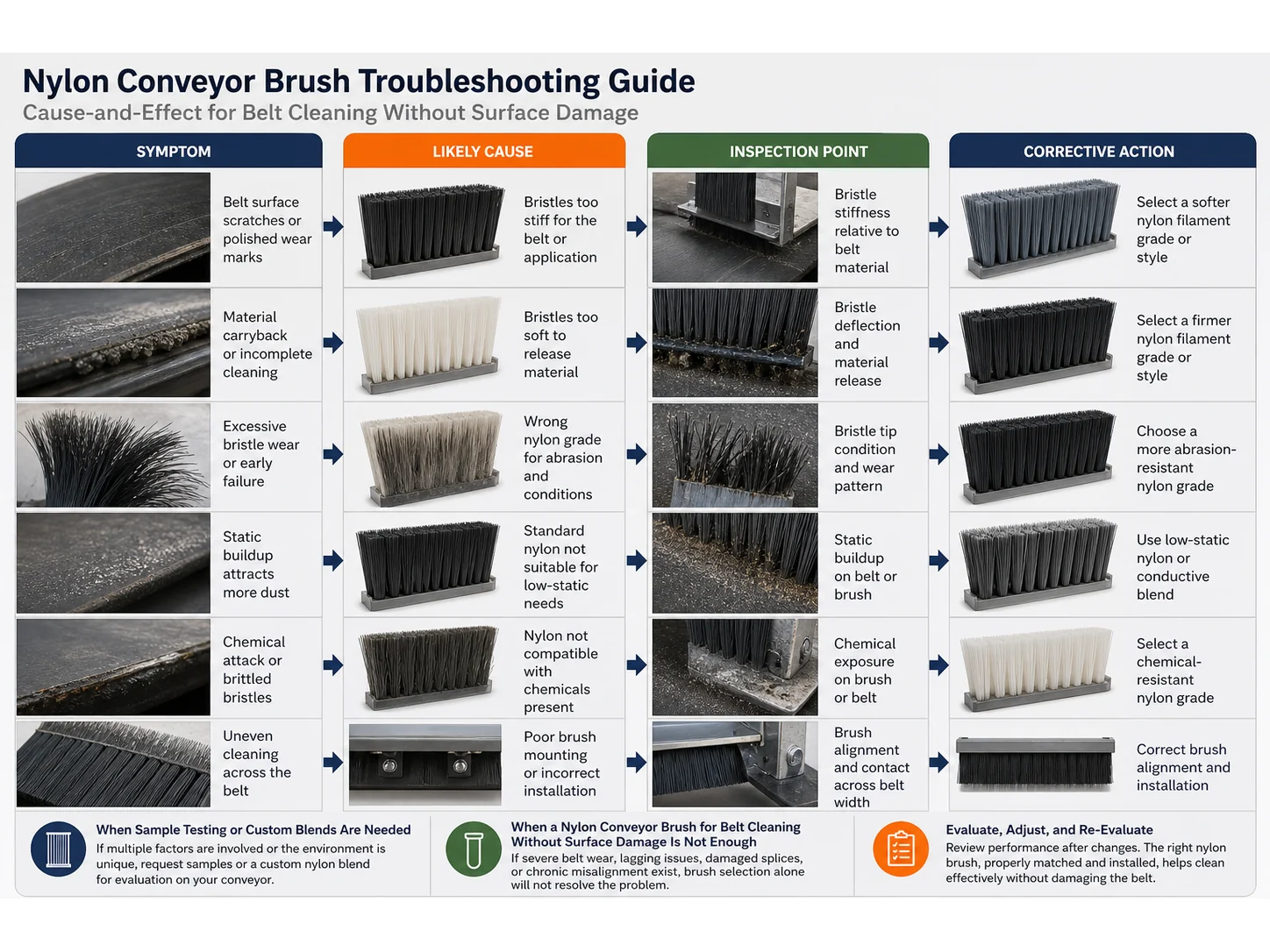
What Is a Nylon Conveyor Brush?
A nylon conveyor brush is a cleaning, sweeping, or positioning component that uses nylon filaments mounted on a core or backing. It removes debris, dust, or product residue from conveyor belts and transported goods. Nylon is chosen for its balance of stiffness, abrasion resistance, surface safety, and chemical tolerance. It works across light agro-industrial, packaging, food handling, and general material handling lines where metal wires would damage the belt or product.
Common Types of Nylon Brushes for Conveyors
The nylon brush family includes several mounting styles. Each suits a different installation location and cleaning job.
- Roller / cylinder brush: Full-length spiral or straight-fill brush for continuous belt cleaning across a width.
- Strip brush: Flexible holder with nylon bristles, often clamped into a bracket for wiping or edge sealing.
- Disc / wheel brush: Rotating brush for concentrated scrubbing of small zones or product surfaces.
- Cup brush: Shaped for end-of-arm or rotary tool cleaning of tight conveyor parts.
- Tube brush: Fits inside pipes, chutes, or transfer tubes to prevent buildup.
Nylon vs. Other Bristle Materials
Bristle material directly affects cleaning aggressiveness, service life, and surface safety. The table below compares nylon with commonly available alternatives.
| Material | Stiffness / Aggressiveness | Wear Resistance | Surface Safety | Moisture Tolerance | Static Control | Chemical Resistance |
|---|---|---|---|---|---|---|
| Nylon (standard) | Medium | Good | Excellent (non-scratch) | Absorbs water; softens if saturated | Needs additive to be static dissipative | Resists many oils, solvents; attacked by strong acids |
| Abrasive nylon | Medium-high with grit | High (impregnated abrasive) | Can lightly abrade; not for delicate surfaces | Similar to nylon | Similar | Similar |
| Polypropylene | Lower | Fair | Very good | No water absorption | No inherent static dissipation | Excellent acid/alkali resistance |
| Polyester | Higher | Very good | Good; slight scratch risk | Low absorption | No | Good chemical resistance |
| Horsehair / Tampico | Very low | Low | Excellent | Absorbs water, can rot | No | Poor with chemicals |
| Brass / Steel wire | Very high | High | Scratches; not for soft belts | Rust risk (steel) | Conductive if needed | May corrode |
How to Choose the Right Nylon Brush for Your Conveyor
Match the nylon brush specifications to your actual operating conditions. Consider these factors in order of relevance.
- Contact surface: Soft belts, food surfaces, or coated products need non-abrasive nylon. Metal surfaces or heavy buildup may tolerate abrasive nylon.
- Residue type: Dry dust and light powder can be swept with standard nylon. Sticky, oily, or wet residues often require wider spacing, flagged filaments, or higher stiffness to avoid matting.
- Machine speed: High-speed lines need lower bending fatigue; invest in quality nylon grades and correct trim length to avoid bristle breakage.
- Dry vs. wet operation: Nylon absorbs water, which can soften bristles. For wet environments, consider nylon with moisture-resistant treatment or a polypropylene/polyester alternative.
- Chemical exposure: Cleaning agents, sanitizers, oils—check compatibility with your specific nylon grade. Nylon 6/6 offers better heat and chemical tolerance than nylon 6 in some cases.
- Static control: If static discharge is a concern (e.g., electronics, dust explosion risk), specify static-dissipative nylon with conductive additives.
- Brush density and filament diameter: Denser fill gives finer cleaning; thicker filaments increase stiffness but may flag less. Ask for a sample to test on your actual residue.
Common Mistakes When Choosing Nylon Conveyor Brushes
Avoid these pitfalls to prevent early failure and poor cleaning performance.
- Selecting by cost alone: Low-cost nylon often lacks UV or moisture stabilizers, leading to premature brittleness.
- Ignoring chemical compatibility: Even mild detergents can degrade certain nylon grades over time.
- Overlooking moisture absorption: In wet washdown, standard nylon softens and loses stiffness, reducing cleaning effectiveness.
- Assuming all nylon is the same: Nylon 6, 6/6, 6/12, and abrasive nylon each behave differently; match the grade to the load and environment.
- Using too aggressive a brush: Abrasive nylon on soft belts or plastic products causes irreversible scuffing.
- Neglecting static buildup: Fast-moving dry nylon can generate static, attracting more dust or risking electronic damage.
When Sample Testing or Custom Blends Are Needed
Off-the-shelf nylon brushes solve most routine cleaning tasks, but push beyond general limits and you need validation.
- Extreme temperature: Continuous exposure above 180°F (82°C) may soften nylon. Request heat-stabilized material or test under load.
- Aggressive chemicals: Strong acids, chlorinated solvents, or frequent CIP cycles demand chemical-specific testing. Ask for immersion test data.
- High-speed wear: If a brush is a critical inline component, run a wear trial with your actual product to confirm replacement cycles.
- Static-sensitive environments: Custom static-dissipative nylon blends (carbon-filled) may be needed—verify surface resistivity with film samples.
- FDA or 3-A sanitary requirements: Brush design, not just bristle material, must be cleanable. Consult a brush manufacturer experienced in washdown design.
In these cases, ask your brush supplier for sample strips or test shanks. Run them on your line for at least 100 hours before committing to a full order.
Final Takeaway
Choosing a nylon conveyor brush starts with your contact surface and residue, then narrows by speed, moisture, and chemical exposure. Match nylon grade and brush geometry to those conditions, verify with samples when operating at any extreme, and avoid substituting cost for engineered material choices. A well-selected nylon brush will clean reliably without damaging your belt or product.
When a Nylon Conveyor Brush Is the Wrong Choice
This brush is not enough when the main problem is blocked access, unsafe working conditions, damaged equipment, incompatible chemicals, or a process setting that keeps recreating the residue. In those cases, review screen opening, belt or surface material, carryback, uptime risk, and whether the brush can clean without process damage and confirm the surrounding cleaning method before increasing brush stiffness or contact pressure.
Frequently Asked Questions
What is the difference between nylon 6 and nylon 6/6 for conveyor brushes?
Nylon 6/6 generally offers higher stiffness, better wear resistance, a higher melting point, and lower moisture absorption compared to nylon 6. For most conveyor cleaning, nylon 6/6 provides longer life if the cost premium is acceptable.
Can nylon brushes be used with food?
Nylon bristles can be suitable for food contact when the brush assembly is designed for sanitation. However, off-the-shelf grades may not meet FDA or 3-A standards. Always confirm food-grade compliance with the brush manufacturer, and consider filament color (e.g., blue detectable) for foreign body control.
Does nylon absorb water, and why does it matter?
Yes, nylon absorbs moisture from air and liquids. Water absorption softens the bristles and reduces stiffness, which can lower cleaning effectiveness. In wet environments, choose a low-moisture nylon grade, stabilized nylon, or a hydrophobic alternative like polypropylene.
Are nylon conveyor brushes anti-static?
Standard nylon is insulating and can build up static charge during dry operation. Anti-static or static-dissipative nylon is available with conductive additives (e.g., carbon) for applications where static discharge is a concern.
How often should nylon conveyor brushes be replaced?
No fixed schedule applies. Monitor cleaning performance and visual bristle wear. When the brush no longer removes residue adequately or bristle length has shortened beyond the recommended trim, it’s time to replace. Running a wear trial on your own line is the most accurate way to set replacement intervals.
What is abrasive nylon, and when should I use it?
Abrasive nylon contains silicon carbide or aluminum oxide grit embedded in the filaments. It is used when you need mild abrasive cleaning—such as deburring, surface finishing, or removing stubborn residues—without risking wire contamination. Do not use it on soft belts or delicate surfaces.
Can I get a sample before ordering?
Reputable brush manufacturers often provide sample brush sections or test shanks for trial on your conveyor. Test under actual speed, loading, and chemical conditions for at least a few days to confirm compatibility.
Technical References
- OSHA — Machine Guarding
- OSHA — Control of Hazardous Energy
- OSHA — Combustible Dust
- EPA — Particulate Matter Basics
- British Plastics Federation — Thermoplastics
Which bristle material fits this job — Nylon PA, Abrasive Nylon or Horsehair?
| Material | Continuous temperature (°C) | Peak temperature (°C) | Water absorption | Hardness |
|---|---|---|---|---|
| Nylon PA | 93 | 121 | 0.3–9% by PA grade and conditioning | Medium to firm; filament diameter and trim length control bending force. |
| Abrasive Nylon | 120 | 150 | 0.1–1.0% | Abrasive filament; stiffness and cutting level is controlled by PA base, grit type, grit size, filament diameter and trim height. |
| Horsehair | 60–80 | 100–120 | 8–15% | — |
Figures as published by Brushtec / DuPont; Perlon. Confirm the exact grade against the supplier datasheet before ordering.
What should replace Nylon PA when it stops working?
- Nylon PA — Compare Nylon PA with PP, PBT, PET. Change material when wet stiffness, temperature, chemical resistance, conductivity, particle shedding, or surface marking becomes the limiting factor.
- Abrasive Nylon — Compare Abrasive Nylon with PP, PBT, PET. Change material when wet stiffness, temperature, chemical resistance, conductivity, particle shedding, or surface marking becomes the limiting factor.
- Horsehair — Compare Horsehair with Boar bristle, goat hair, microfiber. Change material when wet stiffness, temperature, chemical resistance, conductivity, particle shedding, or surface marking becomes the limiting factor.