
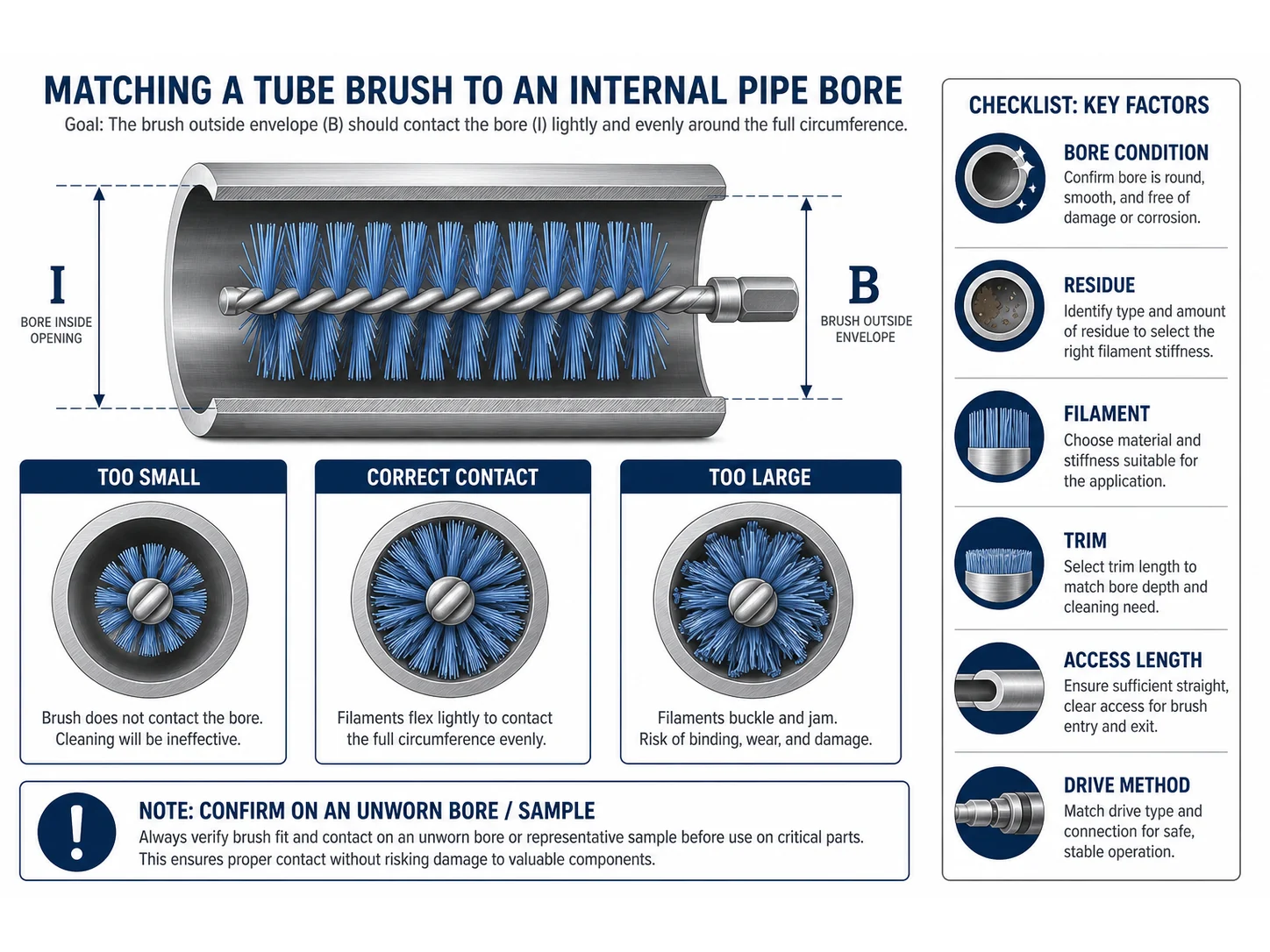
What Is Tube Brush Sizing?
A tube brush size is defined primarily by its outside diameter—the measurement across the widest point of the bristles. The key question is how much larger the brush should be than the pipe’s inner diameter. There is no single universal oversize percentage. The right choice depends on the cleaning task, pipe material, bend radius, residue type, filament stiffness, and drive method.
Why the Right Fit Matters More Than a Fixed Oversize Rule
Many industry sources suggest that a tube brush should be 10–25% larger than the pipe ID, but this range only works as a starting point. A stiff steel wire brush sized 20% over a thin-walled soft copper tube will gall the surface and bind in bends. A soft nylon brush sized 5% over a heavily fouled chemical process pipe may barely touch the walls. Understanding the interplay between oversize and the other factors is what turns a generic selection into a working solution.
Key Factors in Tube Brush Sizing
- Brush Diameter vs Pipe ID: The core dimension. Measured at the filament tips. Oversize is expressed as a percentage or a simple clearance measurement.
- Trim Length: The length of the bristles from stem to tip. Longer trim allows more flexibility and conformance to pipe irregularities, but may reduce cleaning aggressiveness in small diameters.
- Filament Stiffness and Material: Nylon, polypropylene, horsehair, steel wire, abrasive nylon, and brass all behave differently. Stiff filaments clean more aggressively but are less forgiving in bends and on delicate surfaces.
- Pipe Inner Diameter and Tolerance: Real pipes are not perfectly round. ID can vary along the length and at weld seams. Sizing must account for the minimum ID the brush will encounter.
- Bend Radius: The tightest curve in the tube run. A brush must navigate the bend without jamming. Oversize that works in a straight section can bind the brush in an elbow.
- Residue Type: Light dust, heavy carbon scale, wet sludge, dried paint, or soft biofilm each require different levels of mechanical action. Hard, bonded residues demand more oversize and stiffer filaments.
- Drive Method: Manual pull, air motor, or electric drill. Power-driven brushes can handle slightly more oversize because they maintain rotation through bends, but they also increase the risk of pipe damage if improperly sized.
- Coupling and Fitting Clearance: End connections often have smaller IDs than the tube body. A brush must pass through the smallest restriction without becoming permanently deformed.
Sizing Approaches by Cleaning Task
| Cleaning Task | Typical Oversize Range | Recommended Filament Type | Key Considerations |
|---|---|---|---|
| Light dust or powder removal | 10–20% | Soft nylon, horsehair | Prevent scratching; lower oversize for polished or coated tubes |
| Heavy residue or scale removal | 15–25% | Abrasive nylon, stiff nylon, steel wire | May require multiple passes; monitor pipe wear |
| Deburring after cutting or drilling | 15–25%+ | Steel wire, abrasive nylon | Designed for edge material removal; often power-driven |
| Delicate tube surfaces (e.g., soft metals, plastic, thin-wall) | 5–15% | Soft nylon, natural fiber | Test on sample first; avoid metal filaments |
| Bent or curved tubes | 5–15% (effective oversize may be lower) | Flexible nylon | Must clear bend radius; too much oversize causes friction-locking |
How to Choose the Right Tube Brush Size
- Measure the pipe ID accurately. Use calipers or a pin gauge. If possible, measure at multiple points, especially near bends and fittings.
- Identify the smallest restriction. Check coupling IDs, valve ports, and reducer dimensions. The brush must pass through this point.
- Determine the bend radius. If the tube has bends, select a brush with a filament length and flexibility that can navigate the curve without binding.
- Assess the residue. For light soils, start at the lower end of the oversize range. For heavy, bonded deposits, move toward the upper end but adjust filament type accordingly.
- Select filament type and stiffness. Match filament material to pipe material and desired aggression. When in doubt, start with a nylon brush and move to a more aggressive type only if needed.
- Test on a sample tube. Before ordering large quantities, run a trial to confirm the brush performs as expected and does not damage the pipe or get stuck.
Common Tube Brush Sizing Mistakes
- Applying a one-size-fits-all oversize rule. Assuming 20% oversize is correct for every application ignores pipe material, bends, and residue.
- Ignoring bend radius. A brush that fits straight pipe may lock solid in an elbow when oversize is too great or filament is too stiff.
- Overlooking coupling clearance. A brush that cleans the tube body perfectly may never pass through the end fitting.
- Choosing by diameter alone. Filament stiffness, trim length, and construction quality are equally important for a successful clean.
- Using too aggressive a brush on soft pipes. Steel wire in copper or aluminum tubes causes gouging and premature wear.
- Not considering drive method. A manual pull with a high-oversize brush can be exhausting or impossible; a power drive may be required but introduces new risks if the brush is too stiff.
When Sample Inspection or Manufacturer Review Is Necessary
In most straightforward applications, the measurement and selection logic above will produce a workable brush size. However, certain situations demand a more careful approach:
- Thin-walled tubes where even soft filaments could cause deformation.
- Critical applications such as medical devices, food-grade lines, or high-pressure hydraulic systems where surface finish tolerances are tight.
- Complex geometries with multiple bend radii, tees, or reducers where a single brush size may not serve the entire path.
- Custom or non-standard tube IDs where off-the-shelf brush sizes are not an exact match.
- When the residue composition is unknown or highly variable, and the risk of cross-contamination or chemical reaction exists.
In these cases, provide a sample tube section to a brush manufacturer or supplier, or send an engineering drawing with tolerances and bend radii. A technical review can prevent costly field failures.
Final Takeaway
Tube brush sizing is not about finding a magic oversize percentage; it is about balancing brush diameter, filament type, bend geometry, and residue load. Start by measuring the minimum ID through all restrictions, then match the oversize and filament to the cleaning task. Test if possible, and always keep bend radius and drive method in mind. When in doubt, err on the side of slightly less oversize with a proper filament, rather than forcing a too-large brush that risks jamming or damage.
When a Tube Brush Is the Wrong Choice
This brush is not enough when the main problem is blocked access, unsafe working conditions, damaged equipment, incompatible chemicals, or a process setting that keeps recreating the residue. In those cases, review inside diameter, route length, bend radius, residue hardness, and the risk of jamming and confirm the surrounding cleaning method before increasing brush stiffness or contact pressure.
Frequently Asked Questions
What is the correct oversize percentage for a tube brush?
There is no single correct oversize. A range of 10–25% larger than the pipe ID is common, but the right value depends on filament stiffness, bend radius, pipe material, and residue type. For delicate surfaces, start closer to 5–10%.
Can I use a larger brush for a better clean?
Not always. While more oversize can increase cleaning aggression, it also raises the risk of jamming in bends, damaging soft materials, and excessive operator effort. A well-sized brush with the correct filament is more effective and safer than a simply oversized one.
How does bend radius affect brush sizing?
In a bend, the effective path diameter becomes narrower because the brush must curve. A brush that is too large or too stiff may not flex enough and can bind. For tight bends, reduce the oversize or select a brush with longer, more flexible filaments.
What if my pipe ID is between standard brush sizes?
Choose the next larger standard brush, but verify that the oversize still falls within an acceptable range considering all factors. If possible, work with a supplier that offers custom diameters or modify the cleaning procedure (e.g., more passes) with a slightly smaller brush.
Should I use a steel wire brush for all metal pipes?
No. Even for metal pipes, steel wire can scratch, gall, or generate sparks. For soft metals like copper, brass, or aluminum, use nylon or natural fiber brushes. Steel wire is primarily for hard scale or deburring in steel pipes that are not surface-critical.
How do I size a brush for a pipe with internal coatings or linings?
Treat the coating as part of the pipe surface. Use a lower oversize and softer filament to avoid damaging the lining. A brush that is too aggressive can peel or score the coating, leading to corrosion or flow issues.
Can one brush clean both straight and bent sections?
Yes, if the brush is sized for the tightest bend in the system. Choose a filament type that is flexible enough to navigate the bend while still providing adequate cleaning in straight sections. A nylon brush with moderate oversize is often a good compromise.
When should I replace a tube brush?
Replace the brush when filament length is significantly worn, bristles become bent or permanently deformed, or the cleaning action degrades noticeably. A brush that no longer contacts the pipe wall must be replaced to maintain effectiveness.
Technical References
Which bristle material fits this job — Nylon PA, Abrasive Nylon or Horsehair?
| Material | Continuous temperature (°C) | Peak temperature (°C) | Water absorption | Hardness |
|---|---|---|---|---|
| Nylon PA | 93 | 121 | 0.3–9% by PA grade and conditioning | Medium to firm; filament diameter and trim length control bending force. |
| Abrasive Nylon | 120 | 150 | 0.1–1.0% | Abrasive filament; stiffness and cutting level is controlled by PA base, grit type, grit size, filament diameter and trim height. |
| Horsehair | 60–80 | 100–120 | 8–15% | — |
| Carbon Steel Wire | 200–300 | 350–450 | 0% | Rockwell C 40–60 |
| Brass Wire | 150–200 | 250–300 | 0% | Rockwell B 40–90 |
Figures as published by Brushtec / DuPont; Perlon. Confirm the exact grade against the supplier datasheet before ordering.
What should replace Tube & Pipe Bore Brushes for tube brush?
- Tube & Pipe Bore Brushes — Tube and bore brushes work by radial contact inside a confined diameter; wire wheels and cups work mainly on external edges, profiles, welds, and broad surfaces.
- Nylon PA — Compare Nylon PA with PP, PBT, PET. Change material when wet stiffness, temperature, chemical resistance, conductivity, particle shedding, or surface marking becomes the limiting factor.
- Abrasive Nylon — Compare Abrasive Nylon with PP, PBT, PET. Change material when wet stiffness, temperature, chemical resistance, conductivity, particle shedding, or surface marking becomes the limiting factor.
- Horsehair — Compare Horsehair with Boar bristle, goat hair, microfiber. Change material when wet stiffness, temperature, chemical resistance, conductivity, particle shedding, or surface marking becomes the limiting factor.