
What Is a Weld Cleaning Brush?
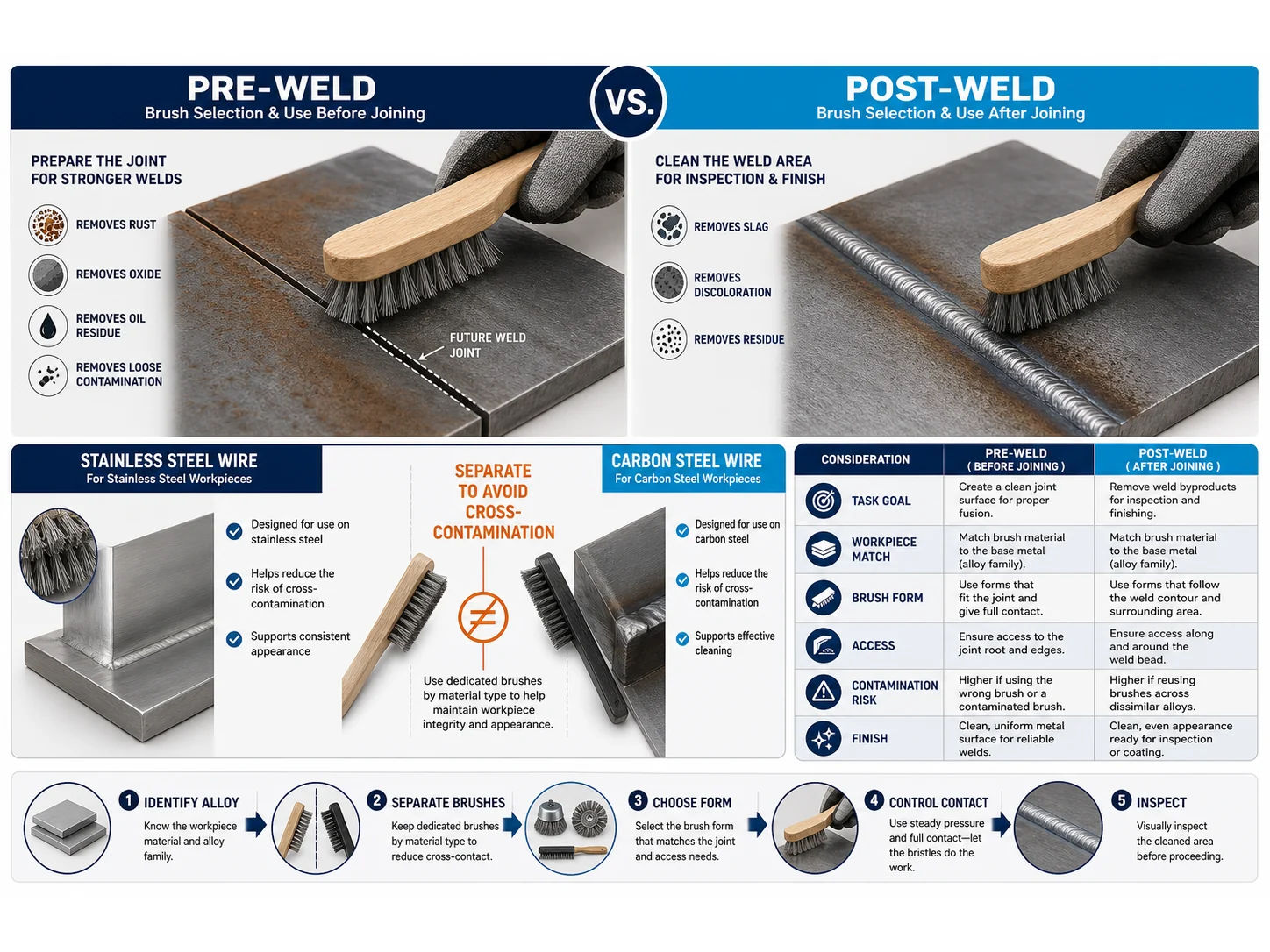
A weld cleaning brush is a hand or power tool accessory with wire bristles used to remove rust, scale, slag, spatter, or surface contamination before or after welding. It prepares joint surfaces for proper fusion and cleans completed welds for inspection, finishing, or coating. Unlike general-purpose wire brushes, weld cleaning brushes must be selected based on the base metal to prevent cross-contamination and meet code requirements.
Pre-Weld vs Post-Weld Cleaning Needs
Weld cleaning brushes serve two distinct roles:
- Pre-weld (surface preparation): Removes mill scale, rust, paint, oil, or previous coatings to expose clean, bare metal. This step ensures proper arc initiation, reduces porosity, and improves penetration. Brush selection must match the base metal hardness and surface condition.
- Post-weld (slag and spatter removal): Removes slag from flux-cored or stick electrodes, and light spatter from MIG or TIG passes. The brush should be aggressive enough to dislodge slag without gouging the weld or surrounding base metal. Stainless steel brushes are often preferred to avoid leaving carbon steel residue that can initiate corrosion.
Common Wire Brush Types for Welding
The most common materials used in weld cleaning brushes are:
- Stainless steel wire: Non-contaminating, ideal for stainless steel and aluminum welding. Resists corrosion and does not leave carbon deposits that can cause rust or intergranular attack. Often required by fabrication standards for stainless work.
- Carbon steel wire: More aggressive, used for heavy pre-weld preparation on carbon steel. Can embed carbon particles into softer metals, so it must never be used on stainless or aluminum.
- Brass wire: Softer, non-sparking, often used for cleaning non-ferrous metals or delicate surfaces. Brass can leave a thin deposit that may require removal before welding, making it less common for direct weld preparation but useful for light post-weld cleanup on brass or copper components.
- Brass‑coated steel wire: The brass coating reduces friction and resists corrosion during storage, but it wears off quickly and the underlying steel can still contaminate stainless or aluminum. Not a substitute for true stainless or brass brushes.
- Nylon‑abrasive or diamond‑coated brushes: Advanced options for demanding applications. Diamond‑coated stainless steel brushes offer extreme longevity and consistent finish without wire shedding, often used in high‑spec or automated settings.
Stainless Steel vs Carbon Steel Wire Brushes: Key Comparison
| Factor | Stainless Steel Wire Brush | Carbon Steel Wire Brush |
|---|---|---|
| Base metal compatibility | Stainless, aluminum, mild steel (if dedicated) | Carbon steel only |
| Contamination risk | None on stainless; low on carbon steel | High if used on stainless or aluminum – causes rust and pitting |
| Typical pre-weld use | Light cleaning of stainless, aluminum, or corrosion‑resistant alloys | Aggressive removal of mill scale, heavy rust on carbon steel |
| Typical post-weld use | Slag removal without contamination; weld finishing | Slag/chip removal on carbon steel; must be segregated |
| Aggressiveness | Moderate – less prone to gouging | High – faster material removal |
| Corrosion resistance | Excellent – brush stays cleaner longer | Poor – rusts if wet; can transfer rust to workpiece |
| Cost | Higher initial cost | Lower initial cost |
How to Choose the Right Weld Cleaning Brush
Use these decision factors to narrow down your brush selection:
- Base metal type: Stainless steel, aluminum, or titanium require stainless brushes. Carbon steel can use carbon steel brushes. Never mix metal families.
- Weld stage: Pre-weld often needs more aggressive cleaning; post-weld needs controlled aggression to avoid surface damage. For stainless post-weld, use a softer stainless brush (0.014″ wire) to avoid scratching.
- Weld process: Stick and flux‑cored welds produce heavy slag; use a coarse carbon steel or stainless brush (depending on metal) with a sturdy handle. TIG and MIG produce fine spatter; a fine stainless hand brush or a light cup brush works well.
- Brush form: Hand brushes for small areas and touch‑ups; cup or wheel brushes in angle grinders, drills, or die grinders for larger surfaces and faster cleaning.
- Wire diameter and knot style: Fine wire (0.014″) for finishing; standard wire (0.020″) for general cleaning; coarse or knotted wire for aggressive removal. Knotted cups resist bending and last longer under high pressure.
- Cleanliness requirements: Food, pharmaceutical, or aerospace applications demand stainless brushes dedicated to one alloy family and often require passivation after brushing.
- Tool speed and power: Match the brush to the tool’s RPM rating. Over‑speeding can bend wires, throw filaments, and damage the workpiece.
Setup and Usage Factors That Affect Brush Selection
Even the right brush can perform poorly if used incorrectly. Keep these real‑world factors in mind:
- Pressure and angle: Use the tool weight and let the brush tips do the work. Too much pressure flattens wires, generates excess heat, and shortens brush life. For cup brushes, hold the tool at 10–15° so only the outer edge contacts the work.
- Brush rotation direction: Many threaded brushes are one‑directional. For angle grinders, ensure the nut does not loosen during use. Follow manufacturer markings.
- Cross‑contamination prevention: Dedicate brushes by metal type. Use color‑coded handles or clearly label storage racks. Even airborne dust from a carbon steel brush can settle on stainless and cause rust spots.
- Cleaning and storage: Remove buildup from bristles regularly with a wire comb or pick. Store brushes dry, hanging or bristles‑up, especially carbon steel. Discard brushes with broken, flattened, or corroded wires.
- Workpiece support: Thin sheet metal may warp or burn through under aggressive brushing. Use a backing bar or lower speed and pressure.
Common Mistakes When Selecting and Using Weld Cleaning Brushes
Avoid these frequent errors that compromise weld quality and safety:
- Using a carbon steel brush on stainless or aluminum: Leaves behind free iron particles that rust or initiate pitting corrosion – one of the costliest mistakes in fabrication.
- Same brush for pre-weld and post-weld on different metals: Picks up contaminants from one job and transfers them to the next. Always segregate by metal family and application stage.
- Buying based on cost alone: Cheaper carbon steel brushes seem economical but can cause expensive rework if misapplied. Invest in purpose‑matched brushes.
- Ignoring brush wear: Worn bristles lose aggressiveness and can embed broken wires in the workpiece. Replace regularly.
- Over‑aggressive cleaning: Using a coarse knotted brush on a finished stainless weld can create deep scratches that trap moisture and initiate crevice corrosion.
- Assuming brass brushes are safe for all metals: Brass can leave smears or embedded particles on aluminum or stainless that may interfere with anodizing or passivation and must be removed chemically.
When a Standard Wire Brush Is the Wrong Choice
Wire brushes have limits. Recognize when a different tool or process is needed:
- Heavy mill scale or deep rust: Use abrasive blasting, grinding wheels, or needle scalers before switching to a wire brush for final cleaning.
- Tight corners or complex geometries: Small hand brushes or abrasive‑filled nylon brushes may be necessary; standard cup brushes cannot reach.
- Post‑weld passivation on stainless: Brushing alone does not restore the passive layer. After mechanical cleaning, use passivation paste or gel to rebuild corrosion resistance.
- Coated or painted surfaces: Solvent cleaning or media blasting is more effective than wire brushing for removing thick coatings.
- Automated or high‑volume production: Diamond‑coated or ceramic filament brushes offer longer life and consistent results, reducing downtime and consumable cost per part.
Final Takeaway
Matching your weld cleaning brush to the base metal and application stage is non‑negotiable for quality fabrications. Stainless steel brushes are the safe choice for stainless, aluminum, and high‑spec work. Carbon steel brushes handle tough pre‑weld prep on carbon steel but must stay segregated. Keep pre-weld and post-weld brushes separate, watch for contamination, and replace brushes before they wear out. A small investment in the right brushes prevents big problems in your finished welds.
Frequently Asked Questions
Can I use a wire brush on stainless steel?
Yes, but only a stainless steel wire brush that has never been used on carbon steel. Using a carbon steel brush on stainless will embed free iron and cause rust. Many codes require dedicated stainless brushes for stainless work.
Why is a stainless steel wire brush better for weld cleaning on stainless and aluminum?
Stainless steel bristles do not deposit carbon steel particles that can rust or cause galvanic corrosion. For aluminum, stainless brushes prevent metallic contamination that can lead to pitting and preserve surface quality for anodizing or painting.
What is the difference between brass and stainless steel wire brushes for welding?
Brass brushes are softer and non‑sparking, making them suitable for light cleaning of non‑ferrous metals like copper or brass without scratching. However, brass can leave a residue that may affect welding or finishing of aluminum or stainless. Stainless brushes are preferred for direct weld preparation on most structural metals.
Can I use one brush for both pre‑weld and post‑weld cleaning?
Not if you are working with different metals or require contaminant‑free welds. Even on the same metal, a pre‑weld brush can pick up dirt, oil, or scale that then gets ground into a finished weld. Use separate brushes for each stage and label them clearly.
How do I clean and maintain a wire brush for welding?
During use, tap the brush against a hard surface to dislodge debris or use a wire comb. After use, wash stainless brushes with a degreaser if they contacted oil, then dry thoroughly. Store carbon steel brushes in a dry place to prevent rust, and replace them if bristles are flattened, broken, or heavily corroded.
What size or type of wire brush is best for removing slag after stick welding?
A hand brush with stiff stainless or carbon steel bristles (depending on base metal) and a chipping hammer work well. For faster cleaning, a knotted cup brush on an angle grinder provides aggressive slag removal. Match the brush material to the base metal to avoid contamination.
Are there special brushes for cleaning stainless steel chimney liners or food‑grade surfaces?
Yes. Any brush used on stainless in food, pharmaceutical, or chimney applications must be stainless steel and dedicated to that alloy family to prevent rust contamination. Soft or fine‑wire brushes minimize scratching, and some facilities require color‑coded tools as part of their hygiene or quality programs.
When should I replace a weld cleaning brush?
Replace when bristles are flattened, twisted, broken, or reduced to less than 50% of their original length. A worn brush loses cleaning efficiency, generates more heat, and can shed wires that become embedded in the workpiece or create safety hazards. For critical work, inspect brushes before each use.
Technical References
Which bristle material fits this job — AISI 304 Stainless Steel Wire, Carbon Steel Wire or Nylon PA?
| Material | Continuous temperature (°C) | Peak temperature (°C) | Water absorption | Hardness |
|---|---|---|---|---|
| AISI 304 Stainless Steel Wire | 400 | 500 | 0% | Rockwell B 70–95 depending on temper and cold work |
| Carbon Steel Wire | 200–300 | 350–450 | 0% | Rockwell C 40–60 |
| Nylon PA | 93 | 121 | 0.3–9% by PA grade and conditioning | Medium to firm; filament diameter and trim length control bending force. |
| Brass Wire | 150–200 | 250–300 | 0% | Rockwell B 40–90 |
Figures as published by Alleima; Brushtec / DuPont. Confirm the exact grade against the supplier datasheet before ordering.
What should replace AISI 304 Stainless Steel Wire when it stops working?
- AISI 304 Stainless Steel Wire — Use AISI 316 stainless steel wire for chloride, marine, dairy, beverage, chemical washdown, or higher pitting-resistance requirements. Use carbon steel for dry aggressive cutting and brass or abrasive nylon for lower marking risk.
- Carbon Steel Wire — Compare Carbon Steel Wire with Carbon steel wire, brass wire, abrasive nylon. Change material when wet stiffness, temperature, chemical resistance, conductivity, particle shedding, or surface marking becomes the limiting factor.
- Nylon PA — Compare Nylon PA with PP, PBT, PET. Change material when wet stiffness, temperature, chemical resistance, conductivity, particle shedding, or surface marking becomes the limiting factor.
- Brass Wire — Compare Brass Wire with Steel wire, stainless wire, nylon. Change material when wet stiffness, temperature, chemical resistance, conductivity, particle shedding, or surface marking becomes the limiting factor.