
Material
EPDM Rubber Brush Blade
Elastomer wiper blade material
Choose EPDM Rubber Brush Blade based on its stiffness, recovery, wear, wet-service, chemical, and temperature behavior. For brush stiffness, do not give only the material name. Filament diameter, free trim, density, grade, and service conditions must be specified together.
Datasheet values
- Blade form
- Molded or cut EPDM wiping/squeegee profile
- Hardness
- Compound specific, commonly specified by Shore A
- Water / steam service
- Often suitable with the correct EPDM formulation; confirm compound TDS
- Temperature use
- Compound and load dependent; validate exact blade and assembly
EPDM Rubber Brush Blade is used as brush fill or contact media where its property profile fits the cleaning duty.
What is EPDM Rubber Brush Blade, and where is it used?
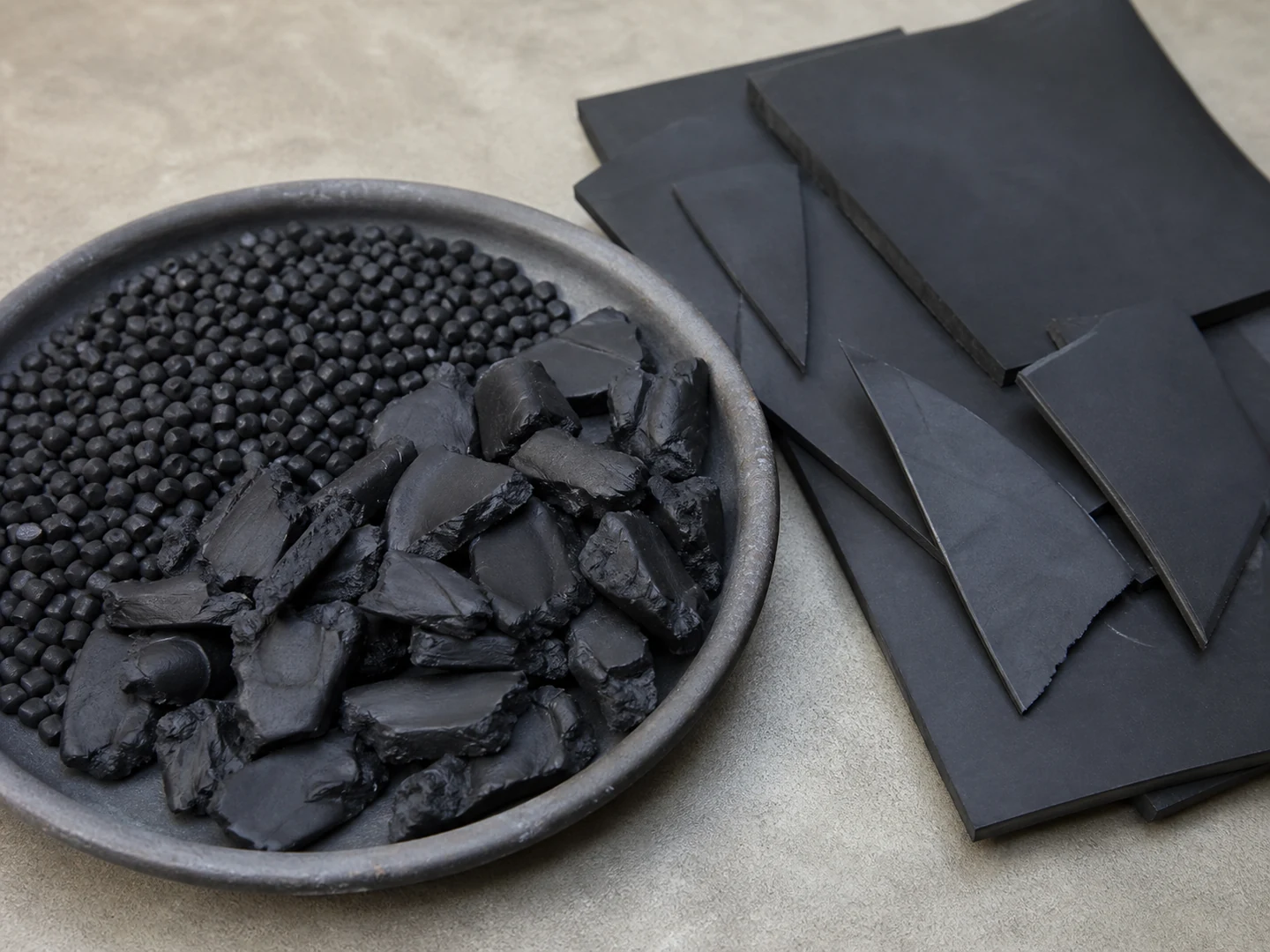
EPDM Rubber Brush Blade is an elastomer wiper, supplied as strip, roller fill, moulded blade or foam pad in rectangular, tapered, lip or serrated profiles. It is used where a blade edge has to sweep liquid or fines that bristles would leave behind.
EPDM Rubber Brush Blade is a custom brush contact material selected by filament or blade geometry, temperature, moisture, chemicals and surface risk.
Change material when temperature, chemicals, static, shedding or surface marking becomes limiting.
What stiffness and contact pressure can I expect from EPDM Rubber Brush Blade?
EPDM Rubber Brush Blade is specified in Shore A, not Shore D: 40–90 across grades, from a soft wiping lip to a firm squeegee edge. Contact pressure comes from the blade section, the free height and how far the edge is compressed against the surface. A soft lip at high interference and a firm lip at low interference can leave the same surface looking the same and wear at completely different rates.
The part people get wrong: stiffness is not a property of the material on its own. A thick low-density pad and a thin dense one in the same grade behave nothing alike. Fix thickness and density first, then confirm the material.
How does water affect EPDM Rubber Brush Blade performance?
EPDM Rubber Brush Blade takes up 0.5–2.0% (Grade/Formulation Dependent, ISO 62/ASTM D570).
EPDM is commonly used in wet service, but swelling and property retention are compound and chemical dependent.
What this means for your application: EPDM is stable in water, steam and dilute caustic, and swells in mineral oil and fuel. The failure to design against is chemical swelling, not water uptake.
A practical check: immerse a sample in the actual fluid at the actual temperature for 24 hours and measure the change in thickness. Anything over a few percent will change how the blade sits on the surface.
What temperature limits apply to EPDM Rubber Brush Blade?
EPDM is available in formulations for elevated-temperature wet service, but the usable range varies by compound, cure system and load. Confirm the exact blade compound rather than using one universal continuous/peak rating.
Where it stops working: An edge that stays deformed after the load comes off means the answer is a different compound, not a thicker section.
The usable limit also moves with section, free height and interference. A tall lip at light interference tolerates more than a short stiff one pressed hard into the surface.
What chemicals attack EPDM Rubber Brush Blade?
EPDM is often selected for water, steam and many polar chemicals, but formulation and chemical conditions matter; confirm the exact compound TDS.
The same cleaner can be harmless or destructive depending on how strong it is, how hot it runs and how long it sits. Quote the concentration and the dwell time, not just the product name.
Before you commit to a quantity: Use resin or alloy grade TDS, ISO/ASTM property method and lot traceability when specified.
What section and hardness should I specify for an EPDM blade?
An EPDM blade is a moulded strip, 0.50–6.00 mm in section — rectangular, tapered, lip or serrated — in free heights of 5–150 mm and Shore A 40–90 across grades.
Contact pressure comes from how far the edge is over-compressed against the surface, so the section, the free height, the hardness and the interference have to be given together. A blade specified without the interference is a blade that either skips or drags.
Finishing available on this material: slip coating, siliconization, flocking and anti-static formulation.
What applications typically use EPDM Rubber Brush Blade?
Custom cleaning brushes requiring EPDM Rubber Brush Blade for its mechanical, temperature, moisture or chemical behavior.
The applications that keep coming back to this grade:
- Conveyor Belt Cleaning
- Conveyor Bulk Material Cleaning
- Industrial Machine Cleaning
The constructions that usually carry it:
- Custom Disc Brushes
If the sample comes back rejected: Final performance depends on compound, hardness, blade geometry, compression, chemical exposure and operating temperature.
How do I specify EPDM Rubber Brush Blade for a custom brush?
A usable specification carries the construction, the blade section and free height, the Shore A figure, how far the edge is set into the surface, and the service conditions: wet or dry, temperature, and what the cleaner actually is.
The mistakes that most often send a sample back:
- Selecting only by material name without defining the section, how hard it is pressed, and the operating conditions
Reference standards behind the figures on this page: ISO 37; ASTM D412; ISO 48-4; ASTM D2240-15(2021); ISO 4892-3:2024; ASTM G154-23; UL 94.
Source: Material manufacturer TDS / ISO / ASTM / industry reference — EPDM material property compilation. Structured values from update package; water absorption references ISO 62/ASTM D570 where applicable; UV references ASTM G154; remaining brush-process values marked.
What else does the datasheet specify for EPDM Rubber Brush Blade?
| Filament cross-section | Rectangular / Tapered / Lip / Serrated |
|---|---|
| Electrical behaviour | Insulating; Conductive Carbon-Black Formulation Can Reach 10^2–10^6 Ω |
| Continuous service temperature (°C) | 120–150 |
| Peak temperature (°C) | 170–180 |
Questions this page is asked
How should an EPDM blade be qualified in the actual process fluid?
Expose finished blade specimens to the complete fluid formulation at the real concentration, temperature, time, pressure or compression and rinse cycle, including mixed contamination such as oils when credible. Compare mass, dimensions, volume, hardness, tensile behavior, compression recovery, surface condition and wiping force before and after exposure rather than copying a rating for a different compound.
Which functional checks should set replacement of an EPDM wiping blade?
Measure edge straightness, nicks, curl, permanent set, contact line or pressure, wipe residual, streaking, chatter and retained liquid after defined cycles in the installed holder. Replace the blade when the edge or recovery no longer maintains the accepted wipe, even if bulk hardness and remaining height still meet incoming values.
Where these figures come from
| Property | Published value | Source |
|---|---|---|
| Published specification |
|
ExxonMobil Chemical Retrieved 2026-07-22 |
Guides that go deeper on this
We have not written a guide specific to this one yet. The material that covers selection, filament, dimensions, maintenance and sourcing is collected in the technical resources library.
No catalogue item for this yet
Every brush here is made to order, and this one has no catalogue entry so far. Send the working surface, the residue, the access opening and the quantity, and it is quoted through the same specification route as the rest of the range.
Custom Manufacturing RFQ
Discuss This Material
Share the working surface, residue, dimensions, material direction, interface, quantity and drawing or sample photo.
Custom Brush RFQ
Request a Custom Cleaning Brush Quote
Upload a drawing, product photo, or sample photo and provide the core dimensions and cleaning conditions.
“We need a brush to remove wet residue from a stainless steel conveyor, about 800mm wide. The current brush wears quickly. We can send photos.”
“We sell drinkware and need a cleaning brush to include with the product. Quantity around 5,000 pieces.”