
Custom Cleaning Brush
Conductive Film Web Anti-Static Cleaning Brush
A conductive fill drains the charge that holds particles to a moving web, so dust and fines leave film and paper instead of being re-attracted.
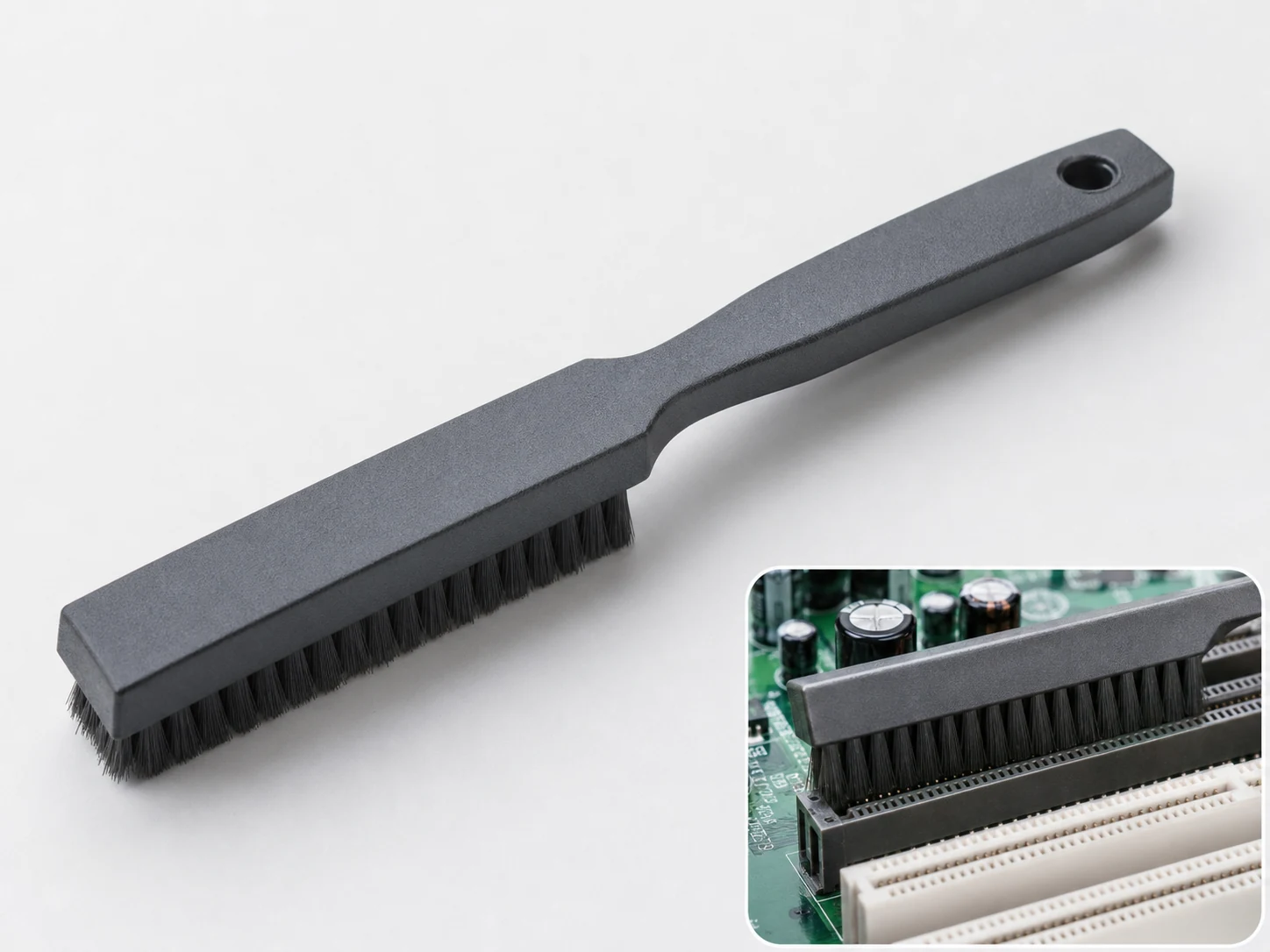
Medium brush
100 pcs
Minimum order
Worked with two hands or on a pole: chimney, gutter and pond-filter brushes, discs, cups and tank brushes.
Production lead time, once the specification is confirmed
- Up to 100 pcsWithin 7 days
- 101–5,000 pcsWithin 14 days
- 5,001–50,000 pcsWithin 21 days
- Over 50,000 pcsConfirmed with your quotation
Peak season can extend these times; the shipping date is confirmed in writing with your quotation. Sampling and shipping are quoted separately.
A grounded, full-width anti-static web cleaning brush for film, paper, sheet, and roll-to-roll production lines. Its conductive filament face drains static charge as it sweeps dust, fibers, and fines from moving webs, preventing re-attraction while protecting coated and optical surfaces.
What can this brush do for you?
Drains the charge that holds particles to the web
A floating web surface can hold dust and fibers electrostatically even after mechanical wiping. Conductive nylon filaments and the conductive mounting body give the charge a defined path to machine ground, so particles release from the film as the filament tips pass rather than staying pinned or re-depositing one roller downstream.
Gives full continuous contact across the sheet or film
The brush is built as a continuous filament face sized to the web path, not a hand-sized patch. This removes fibers, fines, and dust in one uniform pass across the entire coating or converting zone, eliminating lane-to-lane variation in manual wiping tools.
Cleans coated webs without scratching the surface
Conductive nylon filament tips combine anti-static performance with low surface marking risk on polarizers, optical films, hard-coated webs, and release liners. The tip contact is soft enough to preserve coatings yet resilient enough to flick loose particle debris from the surface.
Keeps removed particles from returning to the web
Because the brush is grounded, the particle no longer carries a mutual static attraction to the web. Combined with vacuum extraction or an existing web cleaning station, this produces a cleaner sheet than a non-discharging wiper, where dust is moved but not released.
Installs into the process instead of alongside it
The conductive backing rail, end brackets, and ground point are configured to the existing web path and holder, so the brush works as a stationary element above or below the moving web. It stays inside the machine geometry rather than adding a separate hand step to the line.
What is a Conductive Film Web Anti-Static Cleaning Brush?
A Conductive Film Web Anti-Static Cleaning Brush is a stationary grounding and mechanical removal element for sheet and roll-to-roll cleaning. It consists of conductive filaments set in a conductive backing rail or handle assembly that is bonded to machine ground. As the film or paper moves past the filament face, two things happen at the same time: the tips dislodge loose surface contamination, and the grounded filament path conducts static charge away from the contact zone so the particles do not jump back.
It is most often positioned ahead of coating, printing, laminating, slitting, or inspection stages where surface defects must be prevented before the web is fixed into a product. It can be mounted above the web, below the web, or in pairs for two-side cleaning, depending on the line arrangement and the holder already on the machine.
This is not a scrubbing brush for heavy deposits, adhesives, or wet films. The intended job is continuous removal of dry, loosely attached contamination — dust, fibers, fines, static-attracted particles — from flat or lightly tensioned moving surfaces. Anything bonded, saturated, or requiring aggressive abrasion is a different cleaning task.
Technical Specifications
Dimensions below are quoted for standard film and web cleaning installations. Active width, filament selection, trim, and mounting are adjusted to the web path and holder on your line.
| Parameter | Value / Options |
|---|---|
| Active cleaning width | 100–2,500 mm standard, segmented for longer web widths |
| Filament material | Conductive nylon (default), conductive acrylic, carbon fiber |
| Surface resistivity of fill | 10⁶–10⁹ Ω/sq for conductive nylon/acrylic; carbon fiber fill typically 10²–10⁵ Ω/sq |
| Filament diameter | 0.06–0.30 mm (conductive nylon/acrylic); carbon fiber tow selected for stiffness |
| Trim length / free tip height | 15–50 mm from backing face, matched to web tension and contact requirement |
| Filament density | 60–300 filament bundles per 100 mm depending on cleaning aggressiveness and surface sensitivity |
| Backing / mounting body | Conductive aluminum rail, conductive polymer bar, or stainless assembly |
| Ground connection | Stud, threaded terminal, braid, or cable lug on the backing; to be bonded to verified machine ground |
| Mounting interface | Bolt-on rail, clamping channel, end plate, or custom profile matched to existing holder |
| Operating orientation | Stationary above or below moving web; single or double face |
| Working environment | Dry process air; solvent/wet exposure requires compatible backing and hardware specification |
| Brush type | Custom Strip Seal Brushes |
| How it is driven | Hand-guided |
| Cleaning target | optical and display film line, coating and laminating equipment, and flat glass and sheet cleaning |
| Surface or part | webs, sheets, rails, drain, web paths, roller, substrates, and edges |
| Residue or debris | fiber, dust, fines, adhesive, particles, loose fibers, carbon, and loose surface contamination |
| Mounting / connection | Conductive aluminum rail, conductive polymer bar, or stainless assembly; Stud, threaded terminal, braid, or cable lug on the backing; to be bonded to verified machine ground; Bolt-on rail, clamping channel, end plate, or custom profile matched to existing holder |
Where does this brush work best?
- Optical and display film lines — polarizer, diffusion, protective and hard-coated films where dust and static-induced marks must be removed before lamination or inspection without scratching.
- Coating and laminating equipment — substrate cleaning immediately upstream of adhesive, coating, or primer application; loose fibers and fines are pulled off before they become coating defects.
- Converting, slitting, and sheeting lines — paper, film, foil, and coated web paths where edge trim dust and roll fibers carry static and settle onto the product.
- Flat glass and sheet handling — pre-cleaning of glass panels and sheet substrates before printing, coating, or lamination; the grounded brush removes static-attracted fines without marking.
- Packaging film and release liner processes — web surfaces that attract dust from adjacent rollers and machine enclosures, where a full-width grounded brush reduces re-contamination.
How do I choose the right one?
Start with the path dimensions and the machine interface, not with filament material. The brush must cover the full contaminated width and fit the existing holder, or it will create edge bands of uncleaned material.
1. Match the working width and mounting
Measure the maximum web or sheet width passing the cleaning station and the available mounting rail. The brush face should extend slightly beyond the coated or printed area so edge fibers are also removed, but not so far that it contacts guide rollers or tension bars. Confirm hole centers, rail profile, and vertical clearance before specifying trim length.
2. Select filament material by surface sensitivity and residue
- Conductive nylon: default for coated films, optical surfaces, and general dust/fiber removal. Good stiffness balance, surface resistivity in the 10⁶–10⁹ Ω/sq range, low marking risk.
- Conductive acrylic: slightly stiffer and more aggressive for paper, textured films, or higher web tension; similar surface resistivity to conductive nylon.
- Carbon fiber: lowest resistivity and highest stiffness, useful where stronger static drainage or more mechanical action is needed. More care is required on soft coatings, and carbon fiber can shed dark conductive fragments in worn or abused brushes, so it is usually not the first choice for optical white-room applications.
3. Set trim length and density from contact behavior
Longer free filament length follows web flutter and conforms to minor surface variation but applies softer tip pressure. Shorter trim applies more effective flick action to heavier fibers. Higher filament density gives more contact points; lower density reduces drag and surface marking. For very light webs, choose low drag configuration; for heavy dust, denser and stiffer.
4. Verify the ground path, or don’t install it
A conductive brush without a verified connection to machine ground is just a wiper. Check resistance from filament bundles to the mounting interface and from the interface to the equipment ground point. If the line cannot provide a bonded ground at the brush position, the brush will not drain charge and the cleaning effect will decline.
When to use a different tool
The brush is designed for dry, loosely attached particulate contamination. If the web carries grease, oil, adhesive residue, or wet coating, choose a contact cleaning roller, solvent wipe, or wash system instead. If the requirement is static neutralization without physical contact — such as on sensitive dielectric layers or where brushing forces cannot be tolerated — an ionizing bar is the better tool. If contamination is large embedded debris, use vacuum extraction or mechanical scraper upstream.
Can I customize this brush?
This brush is designed around the web path, not sold only in fixed lengths. We configure it from the line details you provide: web or sheet width, available mounting rail and hole pattern, vertical clearance, top or bottom position, coating type, and the particle problem you are trying to remove. A drawing, photo of the existing holder, and sample of the contaminated substrate help lock the configuration quickly.
We can adjust:
- Active width and segmentation — single continuous face or segmented modules for long web lines and easier service replacement
- Filament system — conductive nylon, conductive acrylic, or carbon fiber; diameter, density, trim length, straight or angled trim profile
- Contact geometry — flat face, single or double row, curved face for limited wrap, or custom tip pattern for zones with heavier debris
- Backing and body — aluminum rail, conductive polymer bar, stainless assembly, or existing rail adaptation
- Ground interface — stud, terminal, braid, cable lug, or conductive mount hardware placed to suit the machine
- Mounting — bolt pattern, end brackets, clamping channel, quick-release plate, or custom holder profile for retrofitting existing equipment
- Marking and packaging — part marking, color coding, ESD-safe protective packaging, or project-specific packing format
For projects that require surface resistivity verification, material declarations, inspection records, or third-party ESD testing support, provide the documentation requirements during specification and we will build that support into the project.
Which filament survives the cleaning and still lasts on a conductive film web anti-static cleaning brush?
Will the brush remove static completely, like an ionizer does?
No. The brush drains charge from the contact zone through the ground path, but it does not ionize ambient air or neutralize charge across the entire web. For high-charge dielectric films, the brush reduces local surface charge and releases particles; an ionizing bar may still be required upstream or downstream for full charge control.
How do I check that the brush is actually grounded on my line?
Use a continuity meter or resistance measurement from the filament tips to the mounting interface, then from the mounting interface to the machine ground point. The total path should be low enough for measurable conduction, and no insulating coating, anodized layer, or loose bracket should interrupt it. Recheck after any mounting change.
Do conductive nylon filaments scratch optical film?
Conductive nylon is generally safe for coated and optical films, but the final answer depends on coating hardness, web tension, trim length, and filament diameter. Run a short trial on scrap material at operating speed and inspect under the same QC lighting used for production. If any marking appears, move to a softer nylon configuration or reduce tip pressure before committing the line.
How often should the brush be cleaned or replaced?
Inspect the filament face each shift or scheduled maintenance window. Remove accumulated dust and fibers with dry compressed air or vacuum; do not use solvents unless the brush was specified for solvent exposure. Replace segments when filaments become matted, permanently bent, broken, or loaded with embedded debris that no longer releases.
Can the brush run in a wet or solvent web process?
Only if that environment was specified when the brush was built. Standard conductive nylon and a standard aluminum rail are intended for dry process air. Wet or solvent exposure requires compatible backing material, stainless hardware, and filament material verification. If the line is converting wet product, provide the chemistry and temperature up front rather than assuming the standard brush is suitable.
Does this brush replace an adhesive or contact cleaning roller?
Not generally. The brush removes loose, dry particulate and drains charge, but it does not remove adhesive-bound particles or oily films. Many lines use both: the grounded brush first for dry dust and static release, then a contact cleaning roller or adhesive roll for residual fine particles. Choose based on the actual contamination, not just the presence of static.
Guides that go deeper on this
Custom Manufacturing RFQ
Describe Your Application
For an accurate quotation, please provide the main dimensions, material preference, working surface, residue, quantity, and a drawing or photo.
Drawing or photo optional — it speeds things up, it does not gate the enquiry.
Custom Brush RFQ
Send Your Brush Project
Upload a drawing, product photo, or sample photo and provide the core dimensions and cleaning conditions.
“We need a brush to remove wet residue from a stainless steel conveyor, about 800mm wide. The current brush wears quickly. We can send photos.”
“We sell drinkware and need a cleaning brush to include with the product. Quantity around 5,000 pieces.”