
Custom Cleaning Brush
Faucet Aerator Cleaning Brush
Brush for faucet aerators, fine-mesh screens and valve passages. Nylon/PBT filaments remove lime scale and sediment without scratching chrome or brass.
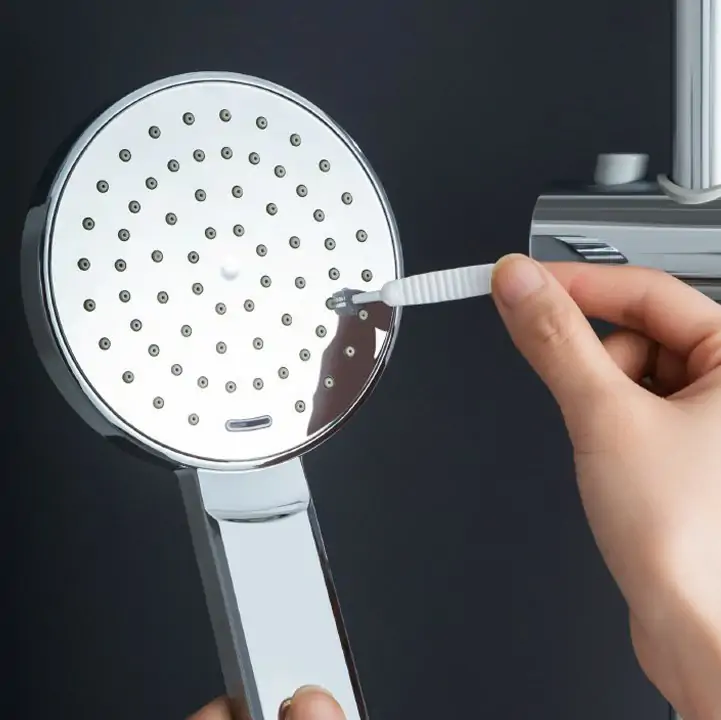
Small brush
500 pcs
Minimum order
Held in one hand: tube, bottle, detail and swab brushes — including long-handled ones with a small head.
Production lead time, once the specification is confirmed
- Up to 500 pcsWithin 7 days
- 501–50,000 pcsWithin 14 days
- Over 50,000 pcsWithin 21 days
Peak season can extend these times; the shipping date is confirmed in writing with your quotation. Sampling and shipping are quoted separately.
A compact, hand-guided cleaning brush built for faucet aerators, fine-mesh screens, nozzle outlets, and narrow valve passages. Nylon or PBT filaments remove mineral scale and sediment without scratching chrome, brass, or coated fixture finishes.
What can this brush do for you?
Reaches into Aerator Screens and Small Passages
Head widths from 1 mm let the filament tips enter fine mesh openings, narrow slots, and internal thread grooves instead of only wiping the outside face. A brush that works inside these small cavities removes the debris that actually restricts water flow.
Breaks Up Lime and Sediment Without Metal-on-Metal Contact
Nylon PA and PBT filaments are stiff enough to push out softened mineral scale, yet softer than chrome, PVD, anodized, and brushed metal finishes. You get the mechanical action of a brush without the scratch risk that comes with steel or brass wire.
Controlled Reach Inside Short Cavities
The short working head and slender stem put the cleaning force exactly on the screen, washer seat, or thread area. Operators can work around the aerator without overshooting into the faucet body or damaging the surrounding finish.
Recovers Its Shape Through Wet/Dry Cleaning Cycles
PBT filaments in particular hold their form after repeated contact with water and dilute descaling solutions, so the brush stays effective through multiple sinks, suites, or production runs instead of flattening after the first use.
Simple to Rinse and Inspect
The open filament structure releases loosened scale and sediment under a quick water rinse. The head can be checked between uses, which helps maintenance teams confirm the aerator is actually clear before reassembly.
What is a Faucet Aerator Cleaning Brush?
A Faucet Aerator Cleaning Brush is a small hand-held brush made to clean the components that restrict and distribute water at the faucet outlet: the aerator screen, internal diffuser, washer seat, housing threads, and adjacent nozzle openings. Its design is narrower and more controlled than a general bottle brush or toothbrush-sized scrub brush.
In a maintenance or production flow, the aerator is removed from the spout, descaling solution is applied when needed, and the brush works the mesh and threads with short push, twist, and pull strokes. The filament tips enter the openings where mineral deposit and sediment collect, while the stem keeps the operator’s hand clear of the fixture.
The brush is designed around small contact areas. It is not intended for long pipe bores, wide spout interiors, or heavy-scale removal on unprotected metal. When the job involves one of those conditions, a different brush configuration is normally required.
Technical Specifications
Stock and custom parameters are listed below. Head diameter, working length, filament type, and handle style are adjusted to the aerator model and the cleaning step where the brush will be used.
| Parameter | Value / Options |
|---|---|
| Head diameter or width | 1–10 mm, matched to the screen mesh, outlet slot, or thread passage being cleaned |
| Working head length | 10–40 mm, sized for the contact area inside the aerator body or nozzle recess |
| Overall reach | 70–180 mm from grip end to brush tip |
| Grip / body diameter | 5–18 mm |
| Filament material | Nylon PA (6/6 or 6/12) or PBT |
| Filament diameter | 0.08–0.20 mm, finer for micro-mesh screens, stiffer for clogged threads and slots |
| Head profile | Straight cylindrical, tapered, flat side-brush, or stepped multi-diameter form |
| Stem / core | Galvanized steel wire, 304 stainless steel, or rigid polymer |
| Handle | PP, TPE-overmolded, stainless steel, or turned aluminum |
| Chemical exposure | Suitable for short contact with diluted vinegar or citric acid descaling solutions; rinse after use |
| Operating temperature | Room temperature to about 80°C (176°F) for short rinse cycles, per filament material |
| Brush type | Custom Bottle & Container Brushes |
| How it is driven | Hand-guided |
| Cleaning target | faucet aerators removed, fine mesh flow screen and diffuser disc, and pull-down and pull-out spray head cleaning |
| Surface or part | screens, fixtures, valves, nozzles, thread, passages, metal, and aerator screens |
| Residue or debris | sediment, scale, mineral scale, and mineral deposits |
| Mounting / connection | Fixed / Twisted-Wire Stem |
If the brush will be used in a wet or descaling station, stainless steel stem options and PBT filaments are usually the more stable configuration.
Where does this brush work best?
- Faucet aerators removed from kitchen, bath, and utility sinks in hotels, restaurants, apartments, and commercial buildings.
- Fine mesh flow screens and diffuser discs inside standard and water-saving aerator assemblies.
- Pull-down and pull-out spray heads where the outlet face, recess, and narrow channels collect scale.
- Valve stems, cartridge seats, and small threaded fittings around sink and shower fixtures.
- New aerator components during production or quality inspection, where debris must be cleared before assembly or packaging.
How do I choose the right one?
Select the brush from the smallest opening it must enter, then match the filament material and handle to the cleaning environment.
Start with the smallest opening or slot
Measure the mesh opening, slot width, or thread groove. A 1–3 mm head is normally needed for micro-mesh aerator screens. A 4–10 mm head works for housing threads, wider slots, and outlet cavities. If the head cannot enter, it only wipes the visible surface and the restriction remains.
Match the filament material to water and chemical exposure
Nylon PA is flexible and common for low-cost consumer and janitorial programs. PBT absorbs less moisture, holds its shape better through repeated wet/dry use, and tolerates dilute descaling solutions with less visible softening. For daily damp sink use and maintenance programs, PBT is usually the more consistent choice.
Select filament stiffness from the residue and the surface
Fine filaments in the 0.08–0.12 mm range clear micro-mesh holes gently. Heavier 0.15–0.20 mm filaments work better on caked sediment in threads and slots, but they can distort very fine screens. Use the heavier stiffness on metal threads and larger slots, not on delicate mesh.
Set reach and grip for the operator
A short overall reach gives precise control inside a hand-held aerator. A longer stem is useful when cleaning a recessed spray-head outlet or when the brush is used on an assembly bench. Grip diameter around 5–8 mm supports fingertip work; 10–18 mm is easier to hold through gloves.
When a different tool fits better
Thick, hard calcium should be softened with a descaling soak before brushing; the brush clears loosened residue rather than replacing chemical descaling. For long faucet spouts or narrow water lines, use a flexible tube brush. For heavy deposits on unprotected metal where surface finish is not a concern, a brass or stainless wire brush may cut faster but carries a real scratch risk.
Can I customize this brush?
Yes. The most useful starting information is the aerator drawing or sample, the mesh opening size, the residue you are removing, the cleaning chemical, and the handle and packaging format your program requires. We use those inputs to set the head, stem, and filament configuration for your specific application.
- Head geometry — diameter, working length, taper, flat side-brush profile, stepped tip, or custom shape for your aerator model.
- Filament package — Nylon PA or PBT, diameter, trim length, stiffness, and density.
- Stem and core — straight wire, twisted wire, rigid polymer, galvanized or 304 stainless, in the reach you specify.
- Handle — molded PP, TPE-overmolded grip, stainless steel, aluminum, hanging loop, or branding area.
- Color and marking — custom color, pad print, laser marking, or item identification coding.
- Packaging — bulk pack, individual sleeve, retail card, kit with multiple head sizes, or project-specific packaging.
For projects that require material declarations, dimensional inspection reports, or third-party testing, we can support those requirements during the customization process.
How long does a faucet aerator cleaning brush last, and how is it cleaned between runs?
Should I remove the aerator before cleaning?
Yes, remove the aerator housing from the faucet spout when possible. This exposes the back side of the screen, internal washer seat, and threads. Cleaning while installed only reaches the exposed outer face and often pushes debris back into the housing.
How do I know whether the brush is cleaning the screen holes or just the surface?
Hold the screen up to a light after brushing and rinsing. Open holes should appear clear against the light. If holes remain dark or partially blocked, the filament tips are not entering the openings. Try a finer head, softer filament, or a pre-soak before the next pass.
Can I use this brush on anodized, PVD, or brushed-metal faucet finishes?
Yes when using light hand pressure. Nylon and PBT filaments are softer than chrome, PVD, anodized, and brushed finishes. Rinse any abrasive mineral grit from the bristles before contact so the grit does not become the scratching agent.
When should I replace the brush?
Replace when filaments flatten or lay over permanently, the tip no longer recovers, the stem shows corrosion or bends at the crimp, or bristle coverage is visibly reduced. A worn brush takes more strokes and gives less predictable cleaning, which is especially important in multi-unit maintenance programs.
Does this brush remove hard calcium deposits by itself?
It clears loose scale, sediment, and partially softened deposits. Hard mineral buildup should first be loosened with a suitable descaling soak, then brushed and rinsed. Using only the brush on thick scale slows the job and wears the filaments faster.
Is this brush suitable for cleaning inside the faucet spout or water line?
Not for extended internal passages. The head is designed for short cavities and small parts around the aerator. For long spout bodies, supply lines, or narrow pipe bores, use a flexible tube brush or pipe brush with a longer working head.
Guides that go deeper on this
We have not written a guide specific to this one yet. The material that covers selection, filament, dimensions, maintenance and sourcing is collected in the technical resources library.
Custom Manufacturing RFQ
Describe Your Application
Send the key measurements, cleaning requirement, residue, material direction, mounting method, quantity, and drawing or photo.
Drawing or photo optional — it speeds things up, it does not gate the enquiry.
Custom Brush RFQ
Send Your Brush Project
Upload a drawing, product photo, or sample photo and provide the core dimensions and cleaning conditions.
“We need a brush to remove wet residue from a stainless steel conveyor, about 800mm wide. The current brush wears quickly. We can send photos.”
“We sell drinkware and need a cleaning brush to include with the product. Quantity around 5,000 pieces.”