
Custom Cleaning Brush
Feeder Brush
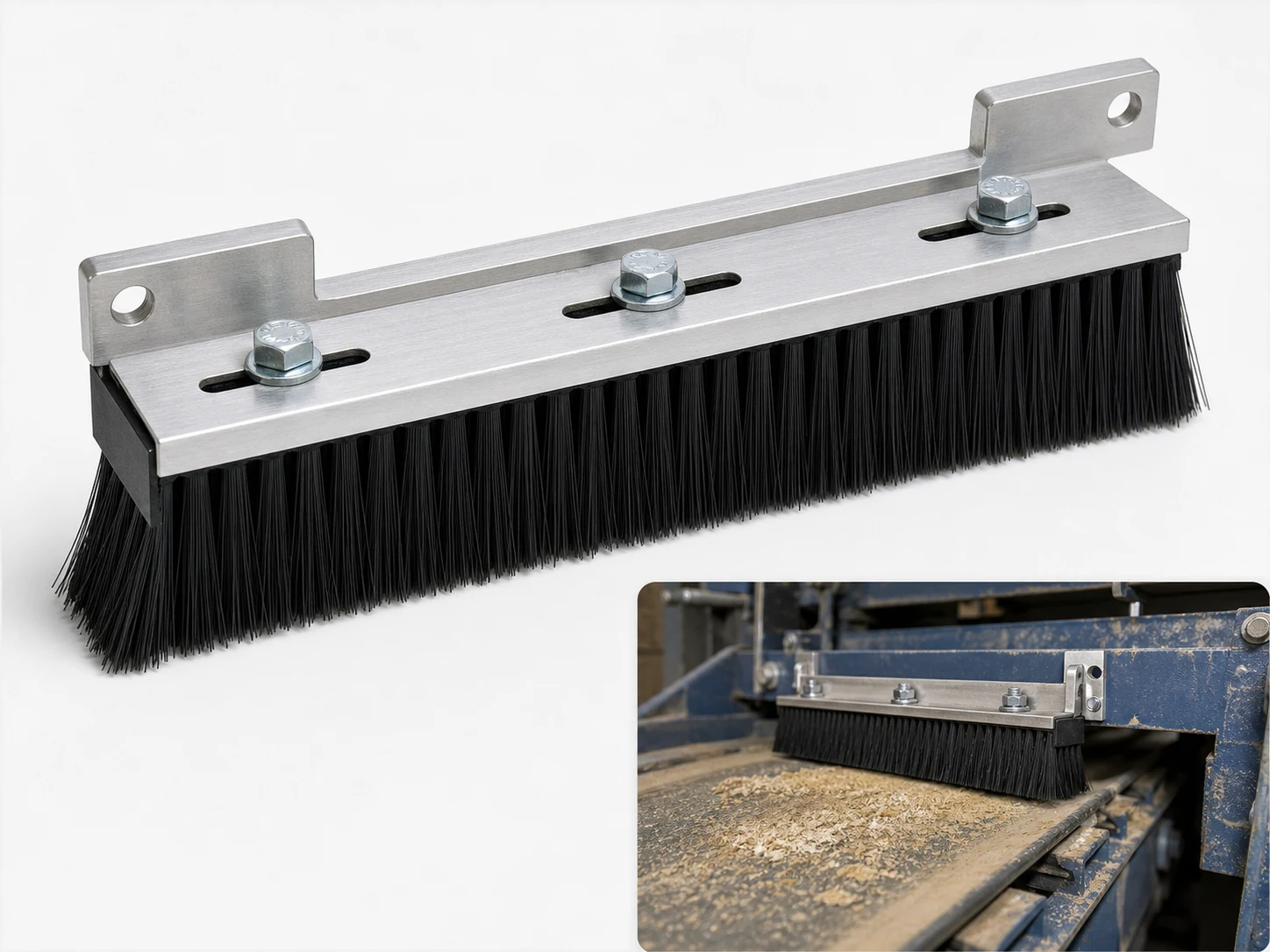
Custom feeder brush strips in PP or nylon for sheet feeders, packaging lines and part feeders. Adjust trim height, filament and channel to your feed gap.
Large-format brush
100 pcs
Minimum order
Built one at a time on a core or channel: full-width rollers, sweeper brooms and long strip.
Production lead time, once the specification is confirmed
- Up to 100 pcsWithin 20 days
- 101–1,000 pcsWithin 30 days
- Over 1,000 pcsConfirmed with your quotation
Peak season can extend these times; the shipping date is confirmed in writing with your quotation. Sampling and shipping are quoted separately.
A continuous strip brush for mounting along sheet, board, and component feeder paths. It applies a controlled, spring-loaded contact that separates, aligns, restrains, and wipes stock passing through the feed station, with PP or nylon fill selected for the material being handled.
What can this brush do for you?
Prevents double-fed sheets and stacked parts
Filament tips form a passive gate at the feed point. The intended piece deflects the tips just enough to pass, while the quickly recovering fill blocks the next sheet or part from following. Unlike a solid stop, the gate complies with normal stock and returns before the following piece reaches the contact line.
Holds contact across changing material thickness
The fill operates within a 5–25% working compression range of the trim height. As thickness varies across the web, through a stack, or between production runs, the filaments flex and maintain contact without manual gap adjustment at the station.
Guides printed, coated, and delicate stock without edge damage
Fine PP and nylon tips distribute the contact force across many filament points instead of pressing a rigid rail against the stock. This reduces the risk of denting, scratching, or breaking the edge of printed cartons, coated board, labels, and thin sheet material.
Sweeps loose dust and fiber at the feed point
At 5–15% trim compression, the brush functions as a wiping and dust-control element. Tips skim light debris from the moving surface ahead of print heads, sensors, and transfer stations, so loose paper dust and fibers are not carried into the next process.
Dampens sheet flutter at entry and exit transitions
As stock leaves a set of rollers or enters a gate, the free edge can flap or lift. A compliant fill strip supports that edge along the feed path, reducing flutter and keeping the lead edge controlled without adding a fixed obstruction.
Works as a seal or restraint when set at higher compression
The same extrusion geometry can be set at 10–25% trim compression to hold stock in place, close a light gap, or restrain material at a hopper opening. This allows one brush profile to serve wiping, separation, or retention duties by changing the mounting offset and fill density.
What is a Feeder Brush?
A feeder brush is a continuous brush strip in which one or more rows of synthetic filaments are locked into an aluminum, steel, stainless steel, or plastic channel. It is mounted parallel to, above, or along the edge of a feeder path so the filament tips contact moving stock. The strip itself is not driven. Stock moving under or past the fill deflects the tips, and the spring recovery of the filaments provides the control force.
In a typical installation, the strip is positioned ahead of feed wheels, at a hopper gate, along a registration rail, or across the outfeed side of a feed station. The brush may contact the top, edge, or underside of the stock depending on how the holding channel is mounted and whether a straight or angled holder is used.
The feeder brush is primarily a feed control component rather than a cleaning brush. It may remove loose surface dust during normal operation, but its main duty is mechanical separation, guidance, and restraint. Because the filaments flex with every cycle, the strip is treated as a consumable wear part, cut to station length, and replaced on a maintenance schedule.
Technical Specifications
Standard building components for the feeder brush are shown below. Each dimension can be adjusted to the station and stock being processed.
| Parameter | Standard range / options |
|---|---|
| Strip length | 100–3,000 mm cut to station length; longer runs built as segmented sections or joined extrusions |
| Trim height | 12.7–152.4 mm (0.5–6.0 in) |
| Base / channel width | 3.2–14.3 mm (1/8–9/16 in), matched to the mounting slot |
| Filament diameter | 0.10–1.27 mm (0.004–0.050 in) |
| Fill material | Polypropylene (PP) or Nylon PA (PA6 / PA6.6) |
| Filament density | Project-specified fill count per row; denser fill increases back pressure and sealing, open fill clears debris |
| Working compression | 5–25% of trim height; 5–15% for wiping and dust control, 10–25% for holding, sealing, or restraining |
| Holder / base profile | Straight aluminum channel, steel or stainless steel channel, plastic profile, angle holder, or custom extrusion |
| End treatment | Square cut, mitered ends, end caps, pre-punched mounting holes, or station-identified segmented lengths |
| Brush type | Custom Strip Seal Brushes |
| How it is driven | Fixed in place, no drive of its own |
| Cleaning target | sheet and paper feeder, carton and blank magazine, and mailing equipment cleaning |
| Surface or part | edges, boards, sheets, slots, channel, rails, aluminum, and panels |
| Residue or debris | dust, and labels |
| Mounting / connection | Fixed / Screw-Fastened / Adhesive-Bonded |
Trim height and filament diameter should be reviewed together. Fine filaments work well at low compression on thin or sensitive stock; heavy filaments and denser fill are required when the feed line must control thick board or heavier parts.
Where does this brush work best?
- Sheet and paper feeders on printing presses, die cutters, and folder-gluers: gate-mounted strips prevent double sheets and absorb curl at the feeder head.
- Carton and blank magazines on packaging lines: edge and top-mounted strips hold the stack, release one blank at a time, and guide warped blanks into the pick station.
- Inserting, collating, and mailing equipment: fine filament strips wipe paper dust from inserts while maintaining light tension on thin stock.
- Corrugated and board handling: wider trim and heavier nylon fill control board through slots, diverters, and transfer points without edge crush.
- Vibratory and rotary part feeder tracks: short cut sections separate stacked caps, closures, or small components and help keep them oriented in the track.
- Panel and board edge guides on material handling equipment: strips keep the stock edge controlled while allowing thickness variation through the line.
How do I choose the right one?
Start with the feeding function, then size the trim and select the fill to match the stock and environment.
| Feeding function | Recommended compression | Typical fill direction |
|---|---|---|
| Dust wiping and light guidance | 5–15% of trim height | Fine PP filament, open density, short trim where possible |
| Double-feed prevention / separation | 10–20% of trim height | Nylon PA or denser PP, fast spring recovery |
| Sealing, holding, or retaining | 10–25% of trim height | Dense fill, heavier filament, trim set to the gap |
| Edge guiding and vibration damping | 5–15% of trim height | Medium filament, low-marking tips |
Size the trim to the gap
Measure the available gap and the full thickness range of the stock. The trim height must be greater than the clearance so the tips deflect into the working compression range, but not so long that they fold over and stall thin material. If the thickness range is wide, specify both the minimum and maximum values so the trim, density, and mounting offset can be matched to the entire range.
Choose PP or nylon by contact and environment
Polypropylene is softer, resists moisture and many light process chemicals, and works well for light stock, labels, and wet or humid areas. Nylon PA carries more load per filament, recovers faster after deflection, and resists wear better at repeated cycles and higher process temperatures. However, nylon can absorb moisture and change tip force in humid conditions, so PP may be more stable where the feeder runs in a wet or high-humidity environment.
Match filament diameter and density to the load
Fine filaments in the 0.10–0.30 mm range provide gentle contact for thin sheets, films, and coated surfaces. Medium diameters around 0.30–0.80 mm suit general carton, paper, and blank feeding. Heavy filaments from 0.80–1.27 mm support corrugated board, panels, and larger parts. Denser fill raises the back pressure and sealing effect; open fill allows debris to clear and reduces drag on light stock.
Select the holder for the mounting point
A straight channel integrates into a flat rail or existing slot. An angle holder changes the attack angle so the brush sweeps with or against the stock direction. Wider aluminum carriers add rigidity for long spans and high compression. Custom extrusions are used where the brush must fit a dedicated feeder housing or an OEM machine frame.
When to use a different component
A feeder brush is a passive control element. If the process requires timed registration, positive transport, or controlled acceleration, use powered feed rollers, vacuum feeds, or servo gating instead. For a hard registration stop with zero deflection, use a solid or adjustable metal stop. If the workpiece is sharp, hot, or abrasive enough to cut or melt PP or PA fill, select a different contact material or a mechanical guide. For continuous dust extraction, pair the brush with vacuum collection because the strip sweeps debris but does not carry it away.
Can I customize this brush?
The feeder brush is built to the station, not to a shelf size. To configure a strip, provide the stock material and thickness range, feed speed, mounting slot or rail drawing, required function, and any process environment conditions such as heat, moisture, oil, or chemical exposure.
Standard customization points include:
- Length and profile: 100–3,000 mm single extrusion, segmented or joined runs, mitered ends, cutouts, and clearance for sensors or photoeyes.
- Trim height: 12.7–152.4 mm, with special lengths available for deep channels or extended reach.
- Fill material and stiffness: PP or nylon PA, adjusted through filament diameter, density, and row pattern.
- Filament diameter: 0.10–1.27 mm, selected for surface sensitivity and required back pressure.
- Base / channel: aluminum, steel, stainless steel, or plastic profile; pre-punched mounting holes, slots, notches, or end tabs.
- Holder geometry: straight channel, angled holder, adjustable bracket, quick-release carrier, or custom mounting hardware.
- End treatment and identification: end caps, station labels, color coding, or finished cut lengths packed by feeder position.
If the project requires material documentation, inspection, prototype samples, or third-party testing support, we can assist with those requirements during the customization process.
What speed and pressure suit a feeder brush, and how is that checked?
How can I verify the brush is set at the right compression?
Run the thinnest and thickest stock through the station. The brush should maintain contact without permanently folding the fill. For wiping duty, the tips should lightly touch or barely deflect from the surface. For double-feed prevention, the intended piece should pass without tearing or stalling, and the following sheet or part should be held back. If either condition fails, adjust the mounting gap, trim height, or filament stiffness.
Will a feeder brush remove static electricity?
No. Standard PP and nylon fills are not static dissipative. The brush can sweep loose dust and fibers and reduce sheet flutter, but static cling and static-related misfeeds require ionizing bars, grounding, or anti-static equipment. If static control is a requirement, it must be specified as a material or project requirement rather than expected from the standard fill.
Can the brush be used on wet or coated stock?
It can contact dry or surface-dry coated materials. Avoid using the strip against uncured inks, wet coatings, or exposed adhesive edges that can transfer into the fill and redeposit on later pieces. PP is generally preferred for wet or humid conditions, while nylon may absorb moisture and change tip force. Test on production samples when the surface condition is uncertain.
What should I inspect when feed quality drops?
Look for permanently folded or flattened tips, broken or missing filaments, packed debris inside the fill, and worn or damaged channel ends. Check whether the fill still springs back after each cycle. If not, repositioning cannot restore performance. Recording the installation date and batch helps identify high-wear stations before misfeeds occur.
Can I cut the strip in-house after delivery?
Straight aluminum or plastic channel can be cut in the field with an appropriate metal or plastics saw, followed by de-burring and end caps where the cut end is exposed. However, ordering pre-cut, punched, and station-identified lengths eliminates field trimming errors and keeps replacement intervals consistent across the line.
When is a feeder brush the wrong component?
It is not a powered transport device and cannot provide timed registration. Use feed rollers, vacuum feeds, or servo gating when timing is required, and use a rigid stop when zero deflection is required. If the fill material would be cut or damaged by the workpiece, choose a different contact material or a mechanical guide instead.
Guides that go deeper on this
Custom Manufacturing RFQ
Describe Your Application
To quote this brush accurately, send the size, material, cleaning target, residue, quantity, and any available drawing or sample photo.
Drawing or photo optional — it speeds things up, it does not gate the enquiry.
Custom Brush RFQ
Send Your Brush Project
Upload a drawing, product photo, or sample photo and provide the core dimensions and cleaning conditions.
“We need a brush to remove wet residue from a stainless steel conveyor, about 800mm wide. The current brush wears quickly. We can send photos.”
“We sell drinkware and need a cleaning brush to include with the product. Quantity around 5,000 pieces.”