
What Is a Brass Safety Brush?
A brass safety brush uses softer, non-sparking brass wire bristles instead of steel. It provides a gentle abrasive action that removes light rust, oxidation, carbon deposits, paint, or surface contaminants while drastically reducing the risk of scratching, embedding steel particles, or generating sparks. Because brass is non-magnetic and softer than most steels, it is often specified for use around flammable environments, precision mating surfaces, and base metals that cannot tolerate ferrous contamination.
Common Types of Wire Brushes
Both brass and steel wire brushes come in many shapes, sizes, and bristle configurations. Understanding the basic options helps narrow down the right tool before comparing materials.
- Hand brushes – standard rectangular block with a handle, used for manual scrubbing.
- Toothbrush-style / detail brushes – small, angled heads for tight spots like breech faces or threads.
- Tube and bore brushes – cylindrical bristles for cleaning inside pipes, barrels, or cylinders.
- Cup brushes & wheel brushes – designed for power tools (drills, grinders) for larger surface areas.
- Knot wire brushes – twisted wire tufts for aggressive cleaning with angle grinders.
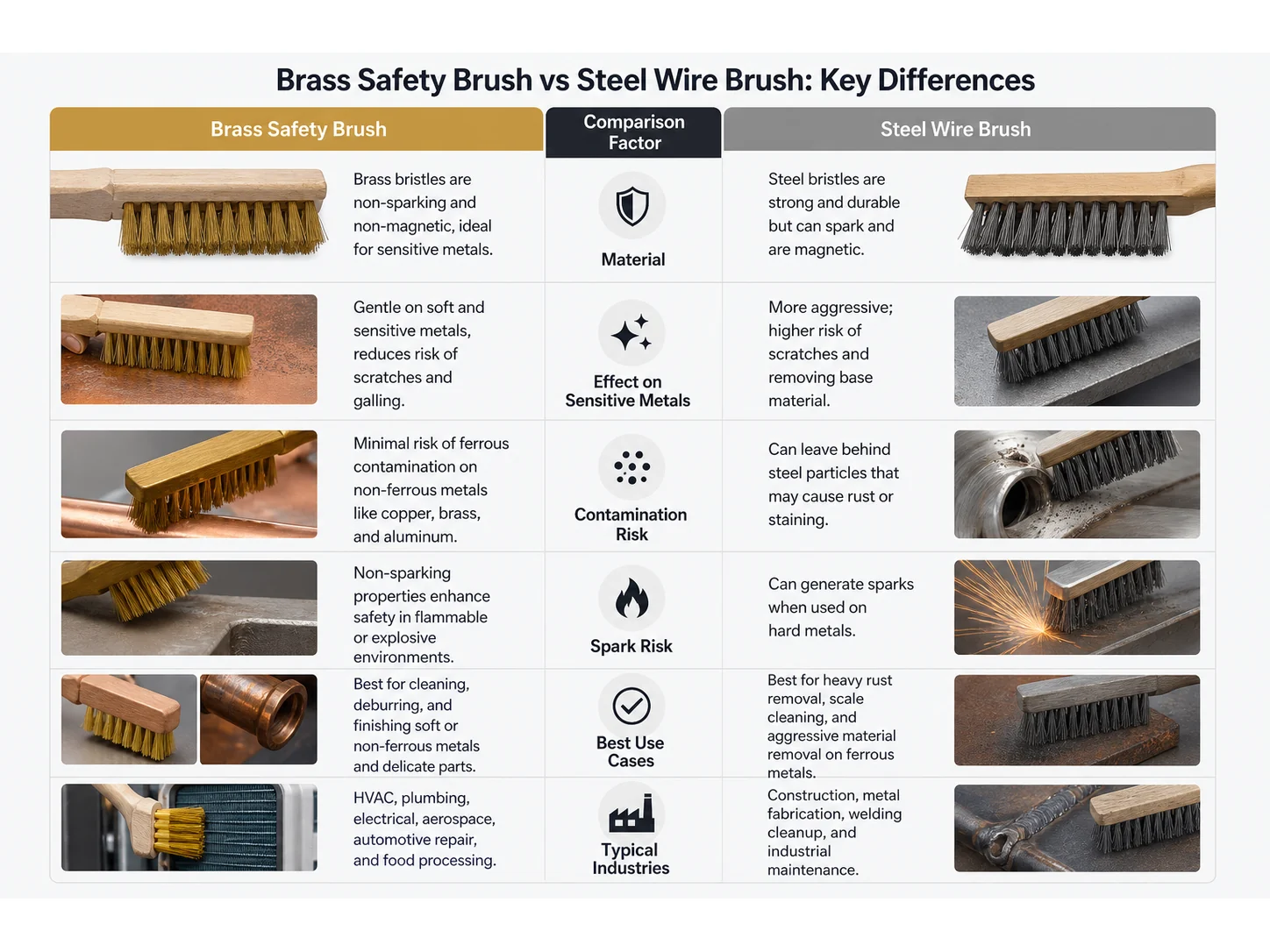
Brass Safety Brush vs Steel Wire Brush: Key Differences
| Factor | Brass Safety Brush | Steel Wire Brush |
|---|---|---|
| Bristle Hardness | Soft, conforms to surface contours | Hard, aggressive material removal |
| Spark Risk | Non-sparking | Can spark on ferrous metals |
| Ferrous Contamination | None, safe for stainless & aluminum | Can embed steel particles causing rust |
| Surface Scratches | Minimal on most metals | Prone to scratching softer metals |
| Material Removal Rate | Low – best for light cleaning | High – heavy rust, scale, weld spatter |
| Durability | Wears faster against hard residues | Longer life on tough jobs |
| Typical Applications | Stainless steel, aluminum, brass, bronze, gun parts, flammable areas | Carbon steel, cast iron, heavy equipment cleanup |
How to Choose Between a Brass Safety Brush and a Steel Wire Brush
Ask these five questions before selecting a brush:
- What is the base metal? If the workpiece is stainless steel, aluminum, brass, bronze, or a critical mating surface, brass is usually safer.
- How sensitive is the surface finish? Precision surfaces or polished areas require a non-marring brass brush to avoid scratches.
- Is ferrous contamination a risk? Embedded steel particles can rust and cause pitting, galvanic corrosion, or discoloration – choose brass to prevent this.
- How heavy is the residue? Brass can handle light rust, carbon, paint, or oxidation. For thick mill scale, heavy corrosion, or weld spatter, steel may be necessary.
- Are there spark or fire hazards? In explosive atmospheres or near flammable materials, a non-sparking brass safety brush is mandatory.
Bristle Stiffness, Diameter, and Handle Considerations
Bristle stiffness depends on wire diameter and how the tufts are crimped or twisted. Softer, finer brass wires (e.g., 0.003–0.006 inch) clean gently without removing base metal. Coarser wires or knot-type brass brushes provide more aggression but still remain softer than steel. Handle and core materials matter: a wooden or plastic handle brush prevents the tool itself from causing contamination or sparking. For bore cleaning, the brush diameter must match the tube or barrel ID closely to ensure effective contact.
Common Mistakes When Using a Brass Safety Brush
- Assuming brass is always safe. Brass is non-sparking but can still scratch soft metals if pressed too hard or if bristles embed dirt and metal debris that then scour the surface.
- Using one brush for multiple metal families. A brass brush that cleaned carbon steel will pick up ferrous particles and transfer them to stainless or aluminum, causing rust spots.
- Expecting brass to remove heavy rust or mill scale quickly. Brass wears quickly on tough residues; production pressure often leads operators to switch to steel and sacrifice surface quality.
- Ignoring brush mounting and speed limits. When using power brass brushes, exceeding the maximum RPM can cause bristle breakage and unsafe flying wire pieces.
- Skipping a test patch. On critical surfaces, a hidden scratch pattern can ruin a part. Always test on a scrap or inconspicuous area first.
When a Brass Safety Brush Is the Wrong Choice
Brass brushes are excellent for precision cleaning and anti-spark requirements, but they have clear limits:
- Heavy corrosion or baked-on deposits often require steel or even abrasive blasting. Brass is too soft and will wear out before the job is done.
- High-production deburring of steel parts where ferrous contamination is acceptable may favor steel brushes for longer life and faster material removal.
- Deep pitting or weld slag removal typically needs a knotted steel brush or mechanical grinding, not a brass brush.
- Materials harder than brass (notably hardened steel, titanium alloys, or ceramics) may rapidly degrade a brass brush without effective cleaning.
In these situations, review a supplier’s technical drawing for bristle material compatibility, request brush samples for a test, or consult an application engineer. For extreme environments, consider specialized brush materials like bronze, nylon, or stainless steel before defaulting to brass.
Final Takeaway
For sensitive metal surfaces where corrosion risk, spark generation, or surface finish matters, a brass safety brush is the clear winner. Choose steel wire brushes only when the base metal can tolerate it, when residue is too tough for brass, and when ferrous contamination is not a concern. Always match brush material to the workpiece, keep dedicated brush sets for different metal families, and validate with a small test before committing to full-scale cleaning.
Frequently Asked Questions
Can a brass safety brush scratch stainless steel?
Yes, light scratching is possible if high pressure is applied or if the brush is contaminated with steel particles. However, brass is much less likely to cause deep scratches compared to a steel brush. Always use a clean, dedicated brush for stainless steel.
Is a brass wire brush safe for aluminum?
Yes, brass is softer than many aluminum alloys and is generally safe. But to be certain, test on a scrap piece. Avoid using a brass brush previously used on steel to prevent embedded iron from transferring and causing galvanic corrosion.
Can I use a brass brush on a gun barrel?
Brass cleaning brushes are widely used for gun barrels because they effectively remove carbon and copper fouling without scratching the bore steel. Bronze brushes are even more common, but brass is acceptable for light cleaning. Always clean from the chamber end if possible.
Why do some brass wire bristles break off?
Bristle breakage usually results from excessive pressure, RPM, or using a brush that is too small for the job. Power brushes have maximum safe RPM ratings; exceeding them can cause fatigue and snap the wires.
How do I prevent rust after using a steel wire brush on metal?
Ideally, avoid steel brushes on stainless steel or aluminum. If you must use one on carbon steel, follow up with a rust inhibitor, primer, or coating. For sensitive metals, switch to a brass safety brush to eliminate the risk of embedded steel particles rusting later.
Is there a standard for non-sparking brushes?
Brass is inherently non-sparking, but no single universal standard governs all non-sparking tools. In hazardous environments, employers often refer to OSHA, ATEX, or FM-approved tool lists. Brass generally meets non-sparking requirements, but always verify with your safety officer.
Can I clean a BBQ grill with a brass brush instead of steel?
Yes, a brass brush is a popular choice for cleaning grill grates because it is less likely to scratch stainless steel or porcelain coatings. However, after cleaning, always wipe down the grates to remove any loose bristles, regardless of brush material.
What is the difference between a brass safety brush and a bronze brush?
Brass bristles are softer and wear faster but are easier on surfaces. Bronze bristles (typically phosphor bronze) are slightly harder, more wear-resistant, and also non-sparking. Bronze is often preferred for bore and gun cleaning where longevity matters.
Technical References
Which bristle material fits this job — AISI 304 Stainless Steel Wire, Brass Wire or Nylon PA?
| Material | Continuous temperature (°C) | Peak temperature (°C) | Water absorption | Hardness |
|---|---|---|---|---|
| AISI 304 Stainless Steel Wire | 400 | 500 | 0% | Rockwell B 70–95 depending on temper and cold work |
| Brass Wire | 150–200 | 250–300 | 0% | Rockwell B 40–90 |
| Nylon PA | 93 | 121 | 0.3–9% by PA grade and conditioning | Medium to firm; filament diameter and trim length control bending force. |
| Carbon Steel Wire | 200–300 | 350–450 | 0% | Rockwell C 40–60 |
Figures as published by Alleima; Brushtec / DuPont. Confirm the exact grade against the supplier datasheet before ordering.
What should replace Tube & Pipe Bore Brushes for brass safety brush?
- Tube & Pipe Bore Brushes — Tube and bore brushes work by radial contact inside a confined diameter; wire wheels and cups work mainly on external edges, profiles, welds, and broad surfaces.
- AISI 304 Stainless Steel Wire — Use AISI 316 stainless steel wire for chloride, marine, dairy, beverage, chemical washdown, or higher pitting-resistance requirements. Use carbon steel for dry aggressive cutting and brass or abrasive nylon for lower marking risk.
- Brass Wire — Compare Brass Wire with Steel wire, stainless wire, nylon. Change material when wet stiffness, temperature, chemical resistance, conductivity, particle shedding, or surface marking becomes the limiting factor.
- Nylon PA — Compare Nylon PA with PP, PBT, PET. Change material when wet stiffness, temperature, chemical resistance, conductivity, particle shedding, or surface marking becomes the limiting factor.