
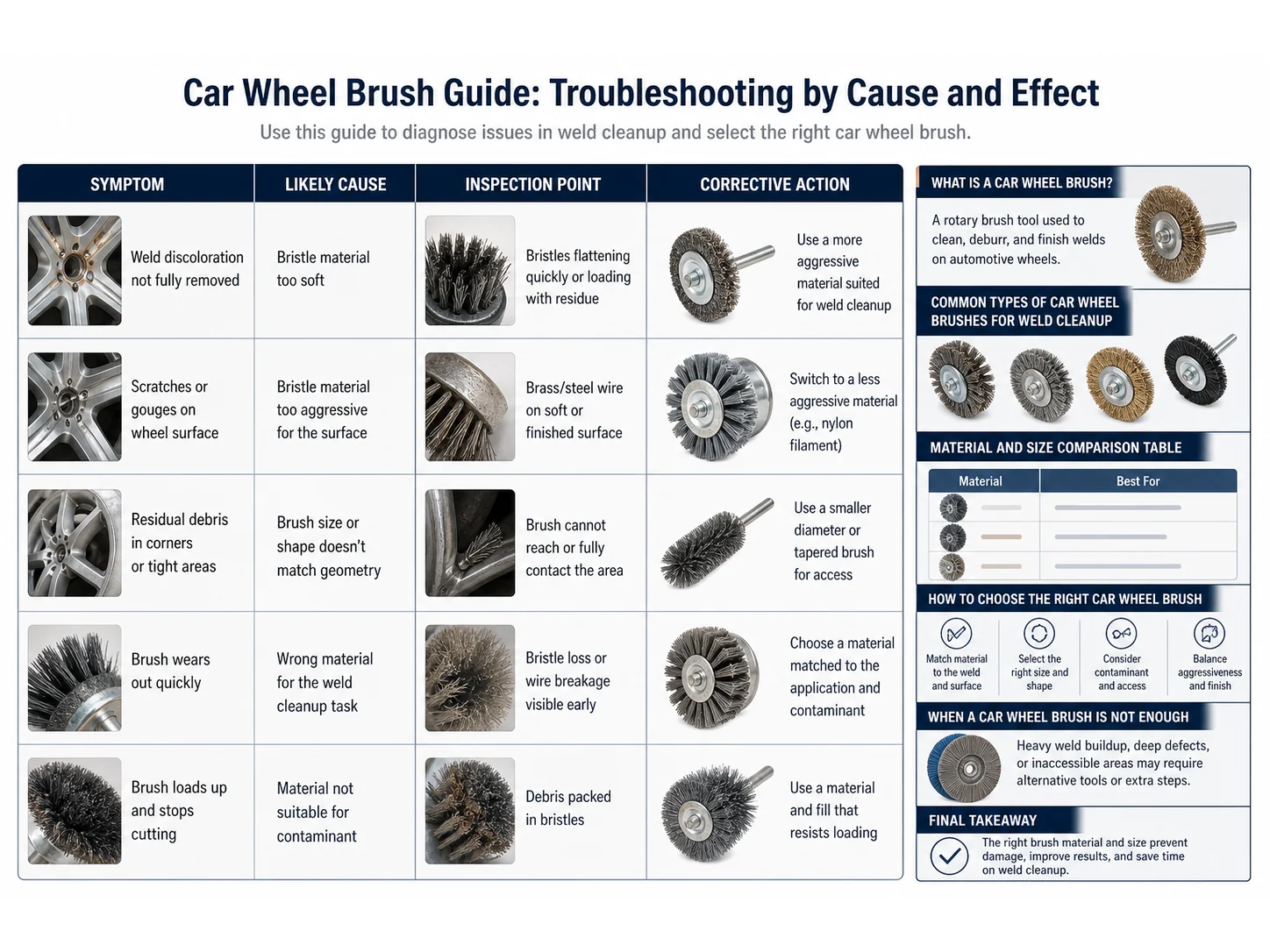
What Is a Car Wheel Brush?
A car wheel brush for weld cleanup is a bristled tool—usually mounted on a drill, die grinder, or bench motor—that strips away weld spatter, heat discoloration, and light oxidation from wheel rims, spokes, and welded joints. Unlike general cleaning brushes, these are selected for their ability to work on curved, hard-to-reach contours without gouging alloy, steel, or plated surfaces.
Common Types of Car Wheel Brushes for Weld Cleanup
Three main brush families cover most wheel weld cleanup tasks:
- Knotted wire wheel brushes – Heavy-gauge wire twisted into tight bundles. Very aggressive, ideal for breaking off stubborn spatter and heavy scale on steel wheels.
- Crimped wire wheel brushes – Wavy wire filaments that are more flexible. They leave a finer surface finish and are safer on softer metals and chromed surfaces.
- Nylon abrasive filament brushes – Nylon bristles embedded with silicon carbide or aluminum oxide grit. Non-marring, they can clean welded areas on clear-coated, painted, or polished wheels without scratching.
- Coated abrasive brushes – Scrim-backed abrasive flaps or discs that conform to shapes, used for blending and light deburring of weld seams.
Material and Size Comparison Table
| Brush Type / Material | Typical Diameter Range | Bristle Stiffness | Best for Residue Type | Surface Compatibility | Wet Use | Risk to Wheel Finish |
|---|---|---|---|---|---|---|
| Stainless steel knotted wire | 3 to 6 inches | Very high | Heavy spatter, thick scale | Steel wheels only | Not recommended | High – will scratch alloy, chrome, and paint |
| Brass crimped wire | 3 to 6 inches | Medium | Light spatter, oxidation, discoloration | Alloy, chrome, steel | Acceptable with care | Low – may leave micro-scratches on polished surfaces |
| Nylon abrasive (SiC grit) | 2 to 4 inches | Medium | Light discoloration, surface oxide | All wheel types, including clear coat | Fully compatible | Very low – non-marring when matched to grit |
| Coated abrasive disc / flap | 2 to 4 inches | Varies by grit | Blend weld seam, remove light burr | Steel, alloy | Dry preferred | Medium – can round edges if overused |
Note: Brushes come with 1/4-inch shanks for drills, threaded arbors for grinders, or as hand-held brushes with long handles for manual work. Always match the mounting system to your power tool’s RPM and collet size.
How to Choose the Right Car Wheel Brush
Select a brush by working through these factors, not by cost drivers or brand alone:
- Analyze the weld residue. Heavy spatter needs a knotted wire brush; fine oxide and discoloration call for a crimped wire or nylon abrasive brush.
- Match bristle to wheel material. Steel wheels tolerate stainless wire; aluminum, chrome, and painted wheels require brass, nylon, or coated abrasives to avoid scratches.
- Pick the right diameter. A 6-inch brush speeds up open face cleanup, but 2- to 3-inch cup or wheel brushes are needed to reach between spokes and lug nut pockets.
- Check the attachment interface. Verify arbor size (1/4-inch, 1/2-inch, M14) and ensure the brush’s maximum RPM rating is not exceeded by your tool. A die grinder at 20,000 RPM can destroy a brush rated for 4,500 RPM.
- Decide on wet or dry use. Nylon and brass can be run wet to reduce dust and keep the surface cool. Stainless steel wire rusts if used with water and is almost always used dry.
- Consider maintenance frequency. Single-use jobs may allow low-cost crimped brushes; professional shops often choose longer-life nylon abrasive or industrial-grade wire brushes that can be cleaned and reused.
- Evaluate custom sizes. If off-the-shelf diameters do not fit your wheel profile or arbor, contact suppliers for custom brush drawings before ordering. Custom brushes can match exact hub bore clearance or spoke curvature.
Common Mistakes When Selecting a Car Wheel Brush
- Using a stainless steel wire brush on painted or clear-coated wheels. Even one pass can leave permanent scratches, forcing additional repainting or polishing.
- Choosing a diameter too large for tight areas. A 5-inch wheel brush cannot clean between closely spaced spokes; uneven cleanup and missed residue result.
- Ignoring arbor size and RPM limits. A loose-fitting shank slips, causes vibration, or flies off. Over-speeding a brush sheds bristles at high velocity.
- Skipping a test on a hidden area. Aggressive bristles can leave a profile or texture mismatch. Always run a quick pass on the back of a spoke or an old scrap wheel first.
- Using the same brush for multiple metals. Steel particles embedded in a brush used previously on mild steel will embed into aluminum and rust later, causing corrosion stains.
- Assuming all wire brushes are the same. A low-cost carbon steel wire brush from a household store will rust quickly and may contaminate the weld zone with carbon, promoting future corrosion.
When a Car Wheel Brush Is the Wrong Choice
A car wheel brush excels at surface finishing and light removal, but it has limits:
- Large weld beads or deep cracks. Heavy stock removal requires a carbide burr, grinding disc, or even re-machining before a brush is useful.
- Deep pitting or warping. Brushes cannot fill material or straighten deformed rims. Those defects need professional wheel repair or welding backfill.
- Strict surface finish specs. If a roughness average (Ra) value must be verified, a brush alone may not achieve the required consistency—consider media blasting or honing.
- Sanitary or food-grade applications. For wheels used in hygienic environments, brushes must meet contamination-free standards and often require dedicated certification that standard automotive brushes do not carry.
- Complex internal passages. A standard wheel brush cannot clean inside hollow spokes or drilled weight reduction holes. A pencil brush or flexible hone may be needed.
- When in doubt, request a sample brush test or review a supplier drawing to confirm fit and material compatibility before committing to a large order.
Final Takeaway
The safest rule for weld cleanup on car wheels is to use the softest bristle that still removes the residue. Match the brush material to the wheel surface (stainless for steel, brass or nylon for alloy/chrome/paint), choose a diameter that reaches every corner of the design, and always test on a hidden spot. A car wheel brush is a finishing tool—let a grinder handle the heavy cutting and let the brush deliver the final, clean surface your work deserves.
Frequently Asked Questions
Can I use a wire wheel brush on painted car wheels?
No. Even soft brass wire can leave micro-scratches visible through clear coat. Use a nylon abrasive filament brush designed for delicate surfaces.
What diameter brush works best for tight areas like lug nut holes?
A 1- to 2-inch cup brush or a pencil-style brush with a narrow profile is ideal. Many detailers use a 1-inch nylon abrasive wheel brush for spoke crevices.
Is it safe to use a car wheel brush with a standard drill?
Yes, provided the brush’s shank fits tightly and the drill’s maximum no-load speed does not exceed the brush’s rated RPM. A corded or cordless drill with variable speed gives better control. For prolonged use, a die grinder often provides a more stable platform.
How do I clean a car wheel brush after removing weld spatter?
Wire brushes can be cleaned with a brush comb or by soaking in a mild solvent to dissolve metal debris. Nylon abrasive brushes should be rinsed and hung to dry. Never leave a brush loaded with acidic or salty residue; it will corrode the bristles and contaminate the next wheel.
What is the difference between knotted and crimped wire brushes?
Knotted wire is twisted into tight bundles, making it stiff and aggressive—best for breaking off heavy spatter. Crimped wire has a wavy pattern that provides more flexibility and a finer scratch pattern, making it safer for blending and light oxidation removal.
Can a car wheel brush completely remove heat tint after welding?
A brush can reduce surface oxidation, but deep heat discoloration often penetrates the metal. For a flawless appearance, follow brushing with a chemical cleaner, mild acid wash, or polishing step to restore the original finish.
When should I consider ordering a custom-sized car wheel brush?
Order a custom brush when no stock diameter, arbor, or bristle density meets your wheel geometry. This is common for wide lip rims, deep-dish designs, or production work where consistent tool fit reduces rework. Always request a supplier drawing for review before manufacturing.
Technical References
- ABMA — ANSI B165.1 Power Brush Safety Slips
- OSHA — 1910.242 Hand and Portable Powered Tools
- OSHA — 1910.215 Abrasive Wheel Machinery
- OSHA — Personal Protective Equipment
- OSHA — Hexavalent Chromium
Which bristle material fits this job — Nylon PA, AISI 304 Stainless Steel Wire or Carbon Steel Wire?
| Material | Continuous temperature (°C) | Peak temperature (°C) | Water absorption | Hardness |
|---|---|---|---|---|
| Nylon PA | 93 | 121 | 0.3–9% by PA grade and conditioning | Medium to firm; filament diameter and trim length control bending force. |
| AISI 304 Stainless Steel Wire | 400 | 500 | 0% | Rockwell B 70–95 depending on temper and cold work |
| Carbon Steel Wire | 200–300 | 350–450 | 0% | Rockwell C 40–60 |
| Brass Wire | 150–200 | 250–300 | 0% | Rockwell B 40–90 |
| AISI 316 Stainless Steel Wire | 400 | 500 | 0% | Rockwell B 70–95 depending on temper and cold work |
Figures as published by Brushtec / DuPont; Alleima. Confirm the exact grade against the supplier datasheet before ordering.
What should replace Wheel Brushes for nylon abrasive filament brush?
- Wheel Brushes — Wheel brushes give narrow edge contact; cup brushes cover a broader open face, while end brushes concentrate contact at the end of a small stem for recesses.
- Cup Brushes — Cup brushes cover a broader face than wheel brushes; end brushes are better for small recesses or pockets where the cup body blocks access.
- Nylon PA — Compare Nylon PA with PP, PBT, PET. Change material when wet stiffness, temperature, chemical resistance, conductivity, particle shedding, or surface marking becomes the limiting factor.
- AISI 304 Stainless Steel Wire — Use AISI 316 stainless steel wire for chloride, marine, dairy, beverage, chemical washdown, or higher pitting-resistance requirements. Use carbon steel for dry aggressive cutting and brass or abrasive nylon for lower marking risk.