
What Is a Car Wheel Brush?
A car wheel brush is a circular brush that mounts directly onto a power tool—typically a cordless drill or an angle grinder—via a standard shank or threaded arbor. Its bristles are arranged in a cup, wheel, or twisted knot pattern to reach wheel faces, spokes, barrels, and lug nut recesses faster than a manual hand brush. The bristle material is usually chosen to clean effectively without marring clear coatings or painted finishes, making it distinct from generic rotary brushes that are often built for heavy material removal on bare metal.
Common Types of Car Wheel Brushes for Drill and Grinder Attachments
There is no single “car wheel brush.” In practice, the term covers several bristle and mounting styles, each tuned for a different cleaning task:
- Soft nylon bristle wheel brushes – The most common choice for painted, clear-coated, and polished alloy wheels. Nylon resists shop chemicals and rinses clean easily.
- Brass-coated wire cup brushes – Safer than steel on softer metals; often used for light corrosion removal on chrome or raw aluminum surfaces.
- Stainless steel wire brushes – Reserved for bare steel wheels or heavy rust scaling; too aggressive for most cosmetic wheel finishes.
- Mild steel wire wheel brushes – Used in industrial or restoration work where fast material removal is needed and finish damage is acceptable.
- Foam or wool pad adapters – Attach to a backing plate on a polisher/sander; not a true brush but often compared in wheel cleaning kits.
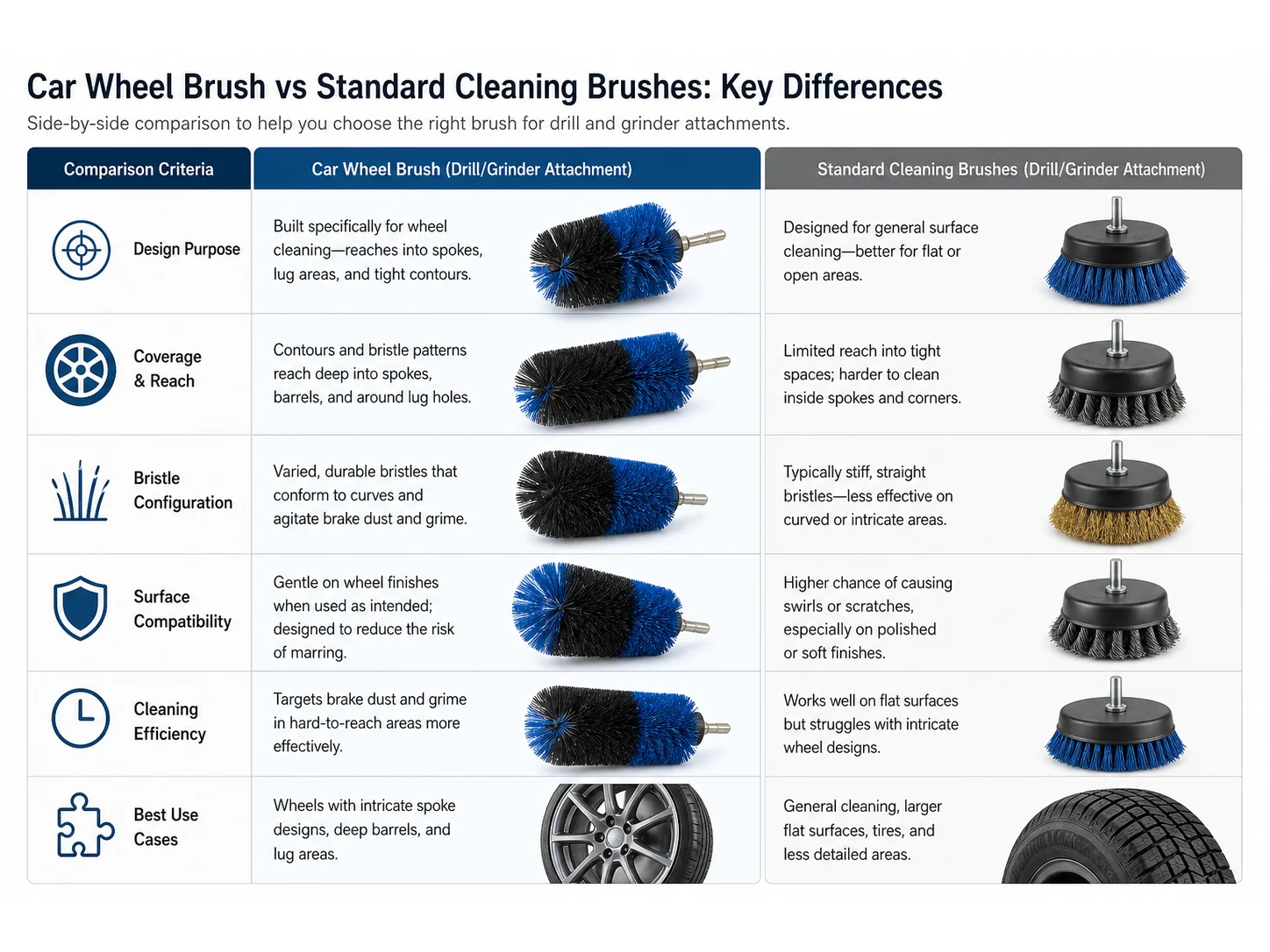
Car Wheel Brush vs Standard Cleaning Brushes: Key Differences
A standard cleaning brush—whether a hand brush, an extension-pole brush, or a general-purpose rotary brush—is rarely optimized for wheel contours or sensitive automotive coatings. The table below highlights where the two categories part ways.
| Attribute | Car Wheel Brush (Drill/Grinder) | Standard Cleaning Brushes |
|---|---|---|
| Mounting interface | ¼” hex shank, threaded arbor, or twist‑knot hub for chuck or spindle | Manual handle, extension pole, or generic adapters (often without speed rating) |
| Typical diameter range | 2 to 5 inches for wheels; some cup brushes up to 4 inches | Hand brushes: under 2 inches; large deck/utility brushes: over 6 inches |
| Bristle material focus | Nylon, brass, soft stainless steel selected for coating‑safe cleaning | Polypropylene, Tampico, harder steels, or mixed fibers for all‑purpose scrubbing |
| Stiffness | Medium to soft – bends under moderate pressure to avoid clear‑coat burn | Varies widely; many off‑the‑shelf rotary brushes are as stiff as industrial wire wheels |
| Surface risk | Low when matched to wheel material; nylon and brass are forgiving | Medium to high if run at uncontrolled speed on painted surfaces; can leave micro‑scratches |
| Chemical resistance | High for nylon and brass; withstands acidic wheel cleaners and degreasers | Inconsistent; natural bristles may swell or degrade in harsh wheel cleaners |
| Common shapes | Cup, wheel, knot, or angled head for spoke and barrel access | Flat, round, angled, or specialty shapes often not optimized for wheel cavities |
| Power source match | Rated for typical cordless drills (800–2000 RPM) or small angle grinders | Many unrated for power tools; some fit bench grinders but with limited wheel‑specific control |
How to Choose the Right Brush for Your Wheel Cleaning Task
Instead of picking a brush by the title alone, walk through these five decision points:
- Residue type – Light brake dust and road film need only soft nylon; baked‑on tar or light surface rust might call for a brass‑coated wire brush.
- Surface sensitivity – For clear‑coated or painted wheels, stick with a non‑steel car wheel brush. Test on the barrel first if the finish is unknown.
- Equipment interface – Check your drill’s chuck capacity (a ¼‑inch hex shank is common) or your angle grinder’s spindle thread if using a threaded hub.
- Wet or chemical exposure – If you plan to spray wheel cleaner while scrubbing, choose a brush material that won’t rust or degrade—nylon and brass are safer bets.
- Coverage and size – Smaller cup brushes (2–3 inches) work into lug nut pockets; wider wheel brushes (4–5 inches) cover face and spokes faster but may skip tight crevices.
Setup and Usage Considerations for Drill/Grinder Mounted Brushes
Even the right brush can cause damage if it runs too fast or at the wrong angle.
- RPM rating – Always check the brush’s maximum RPM against your drill or grinder speed. Exceeding the limit can throw bristles or warp the hub.
- Wet vs. dry – Many detailers prefer to apply wheel cleaner first, let it dwell, then scrub with a damp nylon brush to reduce dust and heat buildup.
- Safety gear – Wire bristles can shed, especially when new. Wear eye protection and stay clear of the brush plane of rotation.
- Attachment security – Tighten the chuck or arbor nut fully; a loose brush at 1500 RPM becomes a flying hazard.
- Pressure control – Let the bristle tips do the work; excessive force increases coating burn risk and shortens brush life.
Common Mistakes When Using and Selecting Wheel Brushes
- Grabbing the stiffest wire wheel “just in case.” A hard‑tempered steel wheel will strip paint and leave deep scratches on alloy wheels almost instantly.
- Ignoring the RPM rating. Running a brush above its rated speed can fling bristles and void any responsible usage guidance.
- Assuming one brush fits both drill and grinder. A twist‑knot brush designed for a 5/8‑inch grinder spindle will not mount on a drill unless a separate adapter is available and safe to use.
- Using the same brush for wheels and body panels. Cross‑contaminating brake dust and grit into a brush used on paint can cause swirl marks.
- Storing the brush without cleaning it. Dried brake dust and chemical residue harden bristles and reduce cleaning effectiveness on the next use.
When a Car Wheel Brush Is the Wrong Choice
A car wheel brush handles routine maintenance well, but there are clear boundaries where another tool or a more thorough evaluation is needed:
- Heavy rust or scale on steel wheels – A soft nylon or brass brush will barely touch thick corrosion. In that case, a dedicated twisted‑knot wire cup on an angle grinder may be needed, with acceptance of surface metal removal.
- Ultra‑delicate finishes – High‑polish forged wheels or chrome finishes can sometimes still micro‑mar with even soft nylon. A microfiber hand pad or a foam‑based wheel wand is safer.
- Production‑level volume – If you detail dozens of wheels per day, a sample test with the chosen brush and coating mock‑up should be done before standardizing on one model, because batch variations in bristle fill or diameter can change performance.
- Tight crevices – Some wheel designs have narrow slots or behind‑spoke areas that a 2‑inch cup still cannot reach. A detail brush with a long, slim profile is then necessary as a complement, not a replacement.
- When custom size or density is critical – If off‑the‑shelf diameters or bristle densities don’t match a specific wheel manufacturer instructions specification, a supplier drawing review or custom brush order may be the only reliable path.
Final Takeaway
A car wheel brush becomes the better choice when you need to clean coated or painted wheels at speed without sacrificing surface safety. Standard cleaning brushes can handle all‑purpose scrubbing, but they often lack the tight mounting tolerance, surface‑safe stiffness, and diameter options that make a wheel‑specific brush worth adding to your kit. Match the bristle material to the residue and the wheel finish, confirm the mounting fits your tool, respect the RPM rating, and the right car wheel brush will outperform a generic alternative every time heavy wheel soil is involved.
Frequently Asked Questions
Can I use any circular brush with my drill to clean wheels?
Not safely on finished wheels. Many general‑purpose circular brushes are made of hard steel wire and will scratch paint, clear coats, and even aluminum. Look for brushes explicitly labeled surface‑safe or designed for automotive wheel use.
What is the difference between a twisted knot wire wheel and a nylon brush for wheels?
Twisted knot wire wheels are aggressive, tightly wound steel bundles used for heavy rust removal on bare metal. Nylon wheel brushes are much softer and non‑metallic, designed to clean without damaging painted or coated surfaces. For typical wheel detailing, nylon is the safer starting point.
How do I know if a brush is safe for painted wheels?
Check the bristle material and stiffness rating. Soft nylon, flagged nylon, or brass filaments under about 0.012‑inch diameter are generally safe. Avoid any brush without a finish‑safe label and test on an inconspicuous spot first.
Can I use a car wheel brush for other cleaning tasks?
Yes, but with care. A soft nylon wheel brush can clean engine bay plastics, floor mats, or textured trim, but once used on greasy parts or heavy grit, it should be dedicated to non‑paint surfaces to prevent cross‑contamination.
Do I need different brushes for the wheel face and the wheel barrel?
Many detailers prefer a wider brush (3–5 inches) for the face and a narrower cup brush (2–3 inches) for the barrel and behind the spokes. This reduces missed areas and keeps abrasive particles from the barrel from spreading back onto the more visible face.
How often should I replace a car wheel brush?
Replace when bristles lose their memory and stay flattened, when you see uneven wear that reduces contact, or when embedded particles won’t rinse out. For a nylon brush used weekly, replacement every 3–6 months is typical in a professional setting.
Is a cordless drill powerful enough for wheel cleaning?
Yes, for light to moderate brake dust removal. A 12–20 volt drill delivering 1500‑2000 RPM works well with nylon cup and wheel brushes. For heavier scrubbing or rust, an angle grinder may be needed, but it also increases the risk of surface damage if speed is not controlled.
Technical References
- ABMA — ANSI B165.1 Power Brush Safety Slips
- OSHA — 1910.242 Hand and Portable Powered Tools
- OSHA — 1910.215 Abrasive Wheel Machinery
- OSHA — Personal Protective Equipment
- NHTSA — Tire Safety Ratings and Awareness
Which bristle material fits this job — Nylon PA, AISI 304 Stainless Steel Wire or Brass Coated Wire?
| Material | Continuous temperature (°C) | Peak temperature (°C) | Water absorption | Hardness |
|---|---|---|---|---|
| Nylon PA | 93 | 121 | 0.3–9% by PA grade and conditioning | Medium to firm; filament diameter and trim length control bending force. |
| AISI 304 Stainless Steel Wire | 400 | 500 | 0% | Rockwell B 70–95 depending on temper and cold work |
| Brass Coated Wire | 200 industry reference range | 250 industry reference range | — | Firm non-ferrous metallic wire; softer than carbon/stainless steel wire and less aggressive on softer metal parts. |
| Microfiber | 80–120 | 140–170 | 0.2–1.0%Material Itself ; Structure Can Absorb 3–7 Times Its Own Weight | — |
| Abrasive Nylon | 120 | 150 | 0.1–1.0% | Abrasive filament; stiffness and cutting level is controlled by PA base, grit type, grit size, filament diameter and trim height. |
Figures as published by Brushtec / DuPont; Alleima; Perlon. Confirm the exact grade against the supplier datasheet before ordering.
What should replace Wheel Brushes for wire cup brush?
- Wheel Brushes — Wheel brushes give narrow edge contact; cup brushes cover a broader open face, while end brushes concentrate contact at the end of a small stem for recesses.
- Cup Brushes — Cup brushes cover a broader face than wheel brushes; end brushes are better for small recesses or pockets where the cup body blocks access.
- Handheld Detail Brushes — Handheld detail brushes cover general precision cleaning; auto-detailing brushes impose tighter controls for painted, polished, leather, display, and trim surfaces.
- Nylon PA — Compare Nylon PA with PP, PBT, PET. Change material when wet stiffness, temperature, chemical resistance, conductivity, particle shedding, or surface marking becomes the limiting factor.