
What Is a Carbon Fiber Anti Static Brush?
A carbon fiber anti static brush uses filaments made from conductive carbon fibers. These fibers are typically blended with a polymer base to create bristles that are stiff enough for light scrubbing yet soft enough to avoid scratching delicate coatings or components. The brush handle or ferrule often includes a grounding path—either through a conductive handle material or a separate grounding cord—that channels static charges away from the work piece toward a grounded surface or wrist strap. This makes the brush safe for cleaning populated circuit boards, sensors, optical devices, and other static-sensitive assemblies.
Standard cleaning brushes (e.g., nylon, horsehair, Tampico, or polypropylene) do not inherently dissipate static. Some can even become highly charged through friction, creating a risk of ESD damage or particle attraction. Anti static brushes bridge the gap between effective mechanical cleaning and electrostatic safety, but they are not a replacement for full ESD control programs; they are one component of a broader static-safe workflow.
Common Brush Types for Static-Sensitive Parts
Several brush types are used around static-sensitive equipment, each with different trade-offs:
- Carbon Fiber Anti Static Brushes – Conductive bristles, low tribocharging, ideal for light dust removal from populated PCBs, optical surfaces, and precision assemblies.
- Conductive Nylon Brushes – Nylon fibers loaded with carbon or metal particles to provide static dissipation; often stiffer than pure carbon fiber, suitable for heavier scrubbing.
- Natural Fiber Brushes (Horsehair, Goat Hair) – Soft and gentle, but can generate static electricity and shed particles; best for non-ESD-sensitive applications or when used with anti static treatments.
- Synthetic Brushes (Standard Nylon, Polypropylene) – Durable and chemical-resistant but generate high static levels unless treated with topical anti static agents, which can wear off.
- Conductive Foam or Sponge Brushes – Used for applying cleaning solvents; foam can be made static-dissipative, but bristle brushes are better for loose particle removal.
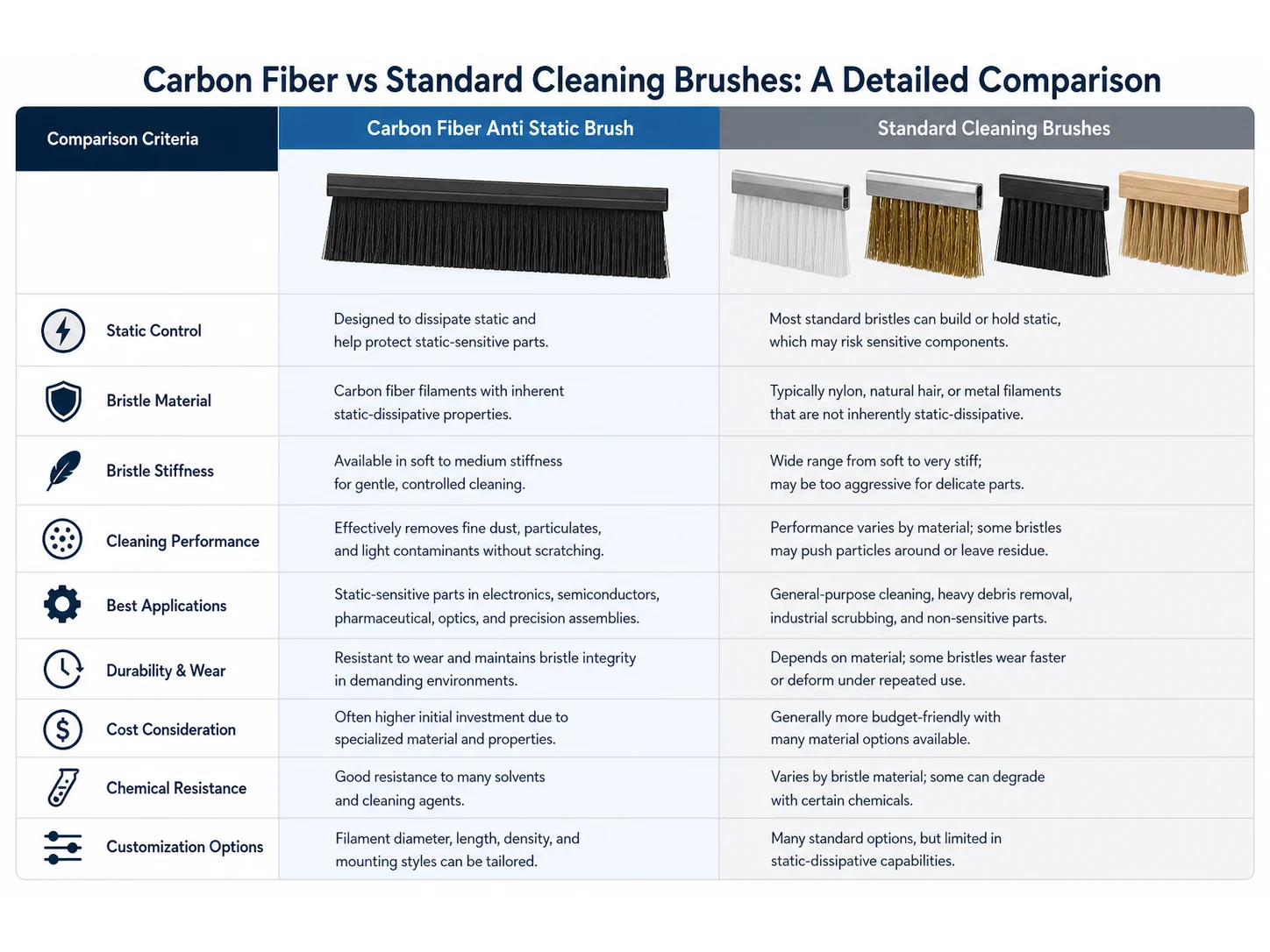
Carbon Fiber vs Standard Cleaning Brushes: A Detailed Comparison
The table below highlights key differences that influence brush selection for static-sensitive tasks.
| Factor | Carbon Fiber Anti Static Brush | Standard Nylon Brush | Natural Horsehair Brush |
|---|---|---|---|
| Static Dissipation | Excellent – conductive fibers, can be grounded | Poor – high static generation unless treated | Poor – tends to build up charge |
| Bristle Stiffness | Soft to medium – good for light dust, gentle scrubbing | Medium to stiff – suitable for heavier debris | Very soft – ideal for polishing, gentle dusting |
| Chemical Resistance | Good – carbon fiber resists most common solvents | Good – nylon resists many chemicals | Limited – can absorb water, degrade with solvents |
| Particle Shedding | Low – fibers are bound well, minimal breakage | Low – but may fray with heavy use | Moderate – natural hairs can break or shed |
| Cost | Higher – specialized material and grounding | Low – widely available, mass-produced | Low to moderate – natural material but less durable |
| Typical Uses | PCB cleaning, optical lenses, ESD-safe assembly lines, film/negatives, vinyl records | General cleaning, machinery, non-ESD electronics (disconnected) | Polishing, dusting non-ESD parts, woodworking |
How to Choose the Right Brush for Your Application
Use the following checklist to match a brush to your task:
- Residue type: Loose dust and light lint call for a soft carbon fiber brush. Dry, caked flux or solder balls may require a stiffer conductive nylon brush or a combination brush.
- Surface sensitivity: If the surface scratches easily (e.g., optical coatings, flexible circuits), choose the softest carbon fiber grade. For conformal-coated boards, a medium stiffness may be acceptable.
- Equipment interface: Brushes integrated into automated cleaning systems, pick-and-place machines, or in-line ionizers may need specific mounting dimensions and grounding connections. Specify ferrule style, overall length, and bristle face shape early.
- Wet or chemical exposure: Carbon fiber handles isopropyl alcohol, hydrocarbon solvents, and mild acids well. For aggressive acids, bases, or high temperatures, verify compatibility with the handle and binder material.
- Hygiene expectations: Cleanroom environments may require pre-cleaned, low-linting brushes with heat-resistant properties. Some carbon fiber brushes can be autoclaved for sterile applications.
- Maintenance frequency: Brushes used continuously should have durable fibers and be easy to clean (rinse with solvent, dry). Replace when bristles become matted or lose conductivity.
- Custom size requirements: Standard off-the-shelf brushes may not fit tight spaces. Many manufacturers offer custom trimming, angled heads, or mini-sized carbon fiber brushes for specialized assemblies.
Common Mistakes When Selecting Static-Dissipative Brushes
- Using a standard brush on ESD-sensitive components – Even brief contact can generate a damaging discharge. Always verify that the brush is labeled “anti static” or “conductive” and has a path to ground.
- Ignoring bristle stiffness – Too stiff can scratch; too soft may not remove the debris. Match the stiffness to the residue and surface.
- Assuming all black brushes are carbon fiber – Many standard nylon brushes are dyed black. Check specifications or measure resistance with a megohmmeter to confirm conductivity.
- Neglecting handle conductivity – The brush is only effective if the charge can travel from the bristles to a grounded person, mat, or equipment. A plastic handle insulates the bristles and defeats the purpose.
- Overlooking particle generation – Worn brushes shed carbon dust, which can be conductive and cause shorts on dense circuits. Replace brushes regularly and inspect before use.
- Skipping a sample test – Process compatibility (solvent attack, shedding, abrasion) is best confirmed with a small sample lot before bulk order.
When a Carbon Fiber Anti Static Brush Is the Wrong Choice
Carbon fiber brushes excel at removing dry, loose particles from static-sensitive surfaces, but they have limits. In high-humidity environments where particles cling tightly, or when cleaning heavy grease, flux residues, or thick conformal coating overspray, a carbon fiber brush alone may be insufficient. In such cases, combine the brush with a compatible solvent, ultrasonic cleaning, or a stiffer conductive nylon bristle brush for mechanical action.
Extreme static control requirements (e.g., Class 0 ESD areas, semiconductor fabrication) may necessitate ionized air blowers and full grounding plans beyond what a brush can provide. Also, if the brush must contact live voltage or wipe across moving parts, consult an ESD engineer to ensure the grounding path does not create a new hazard. For custom, non-standard applications, always ask the supplier for a detailed drawing and, if possible, a pilot run to verify brush performance and longevity.
Final Takeaway
Choose a carbon fiber anti static brush when your primary goal is to remove light dust from static-sensitive parts without introducing ESD risk. Standard brushes are adequate for robust assemblies where static damage is not a concern or when cleaning can be performed in a controlled, grounded environment with proper personal grounding gear. For high-force scrubbing or extremely soft surfaces, consider other brush types but validate their static generation behavior first. Always match the brush to the residue, sensitivity, and your ESD control plan, and remember that a sample test can save costly rework later.
Frequently Asked Questions
Can a carbon fiber brush be used on live circuits?
No. Never use any brush on powered circuits. Even if the brush is conductive, contact with live components can cause shorts, shocks, or equipment damage. Always disconnect power and discharge capacitors before cleaning.
How do I clean and maintain a carbon fiber anti static brush?
Rinse the bristles with isopropyl alcohol or a compatible solvent, gently blot on a lint-free cloth, and allow it to air dry. Do not soak the handle if it contains conductive elements that could corrode. Replace the brush when bristles become bent, matted, or no longer show a low resistance reading.
Do I need to ground the brush to use it effectively?
Yes. For reliable static dissipation, the brush handle should be connected to a common ground point—typically through a coiled cord plugged into a grounded mat or wrist strap adapter. Some brushes have conductive handles that can be held by a grounded operator, but a dedicated ground connection is more consistent.
Will a carbon fiber brush scratch optical lenses?
High-quality carbon fiber filaments are soft enough for most optical surfaces (e.g., camera lenses, laser optics) when used gently. However, for coated lenses or extremely sensitive surfaces, test on a scrap element first, or consider a dedicated optical anti static brush with even finer, softer bristles.
Can I use a carbon fiber brush with acetone or strong solvents?
Pure carbon fiber resists most solvents, but the binder that holds the tufts together and the handle material may degrade with aggressive chemicals. Check with the brush manufacturer for chemical compatibility. For acetone exposure, a brush with a stainless steel ferrule and solvent-resistant epoxy is preferred.
How do I know if a brush really dissipates static?
Measure the resistance from the bristle tips to the handle connection point using a megohmmeter or multimeter. A typical static-dissipative range is 10⁴ to 10¹¹ ohms. If the reading is infinite or very high, the brush is not conductive and may not provide ESD protection.
What is the typical lifespan of a carbon fiber anti static brush?
Under normal use in electronics assembly or vinyl record cleaning, a well-made carbon fiber brush can last many months. Regular inspection for bristle shedding, matting, and loss of conductivity is key. In industrial automated cleaning lines, replacement may be needed every few weeks depending on duty cycle.
Technical References
- EOS/ESD Association — ESD Fundamentals
- EOS/ESD Association — Principles of ESD Control
- British Plastics Federation — Thermoplastics
Which bristle material fits this job — Carbon Fiber, Nylon PA or Conductive Nylon?
| Material | Continuous temperature (°C) | Peak temperature (°C) | Water absorption | Hardness |
|---|---|---|---|---|
| Carbon Fiber | 200–350 | 400–500 | ≤0.10% | — |
| Nylon PA | 93 | 121 | 0.3–9% by PA grade and conditioning | Medium to firm; filament diameter and trim length control bending force. |
| Conductive Nylon | 80–110 | 130–160 | 0.5–2.5% | Shore D 75–88 |
Figures as published by Brushtec / DuPont. Confirm the exact grade against the supplier datasheet before ordering.
What should replace Carbon Fiber when it stops working?
- Carbon Fiber — Compare Carbon Fiber with Conductive nylon, anti-static filament, stainless micro-wire, standard nylon. Change material when wet stiffness, temperature, chemical resistance, conductivity, particle shedding, or surface marking becomes the limiting factor.
- Nylon PA — Compare Nylon PA with PP, PBT, PET. Change material when wet stiffness, temperature, chemical resistance, conductivity, particle shedding, or surface marking becomes the limiting factor.
- Conductive Nylon — Compare Conductive Nylon with Anti-static filament, carbon fiber, stainless conductive filament, standard PA6. Change material when wet stiffness, temperature, chemical resistance, conductivity, particle shedding, or surface marking becomes the limiting factor.