
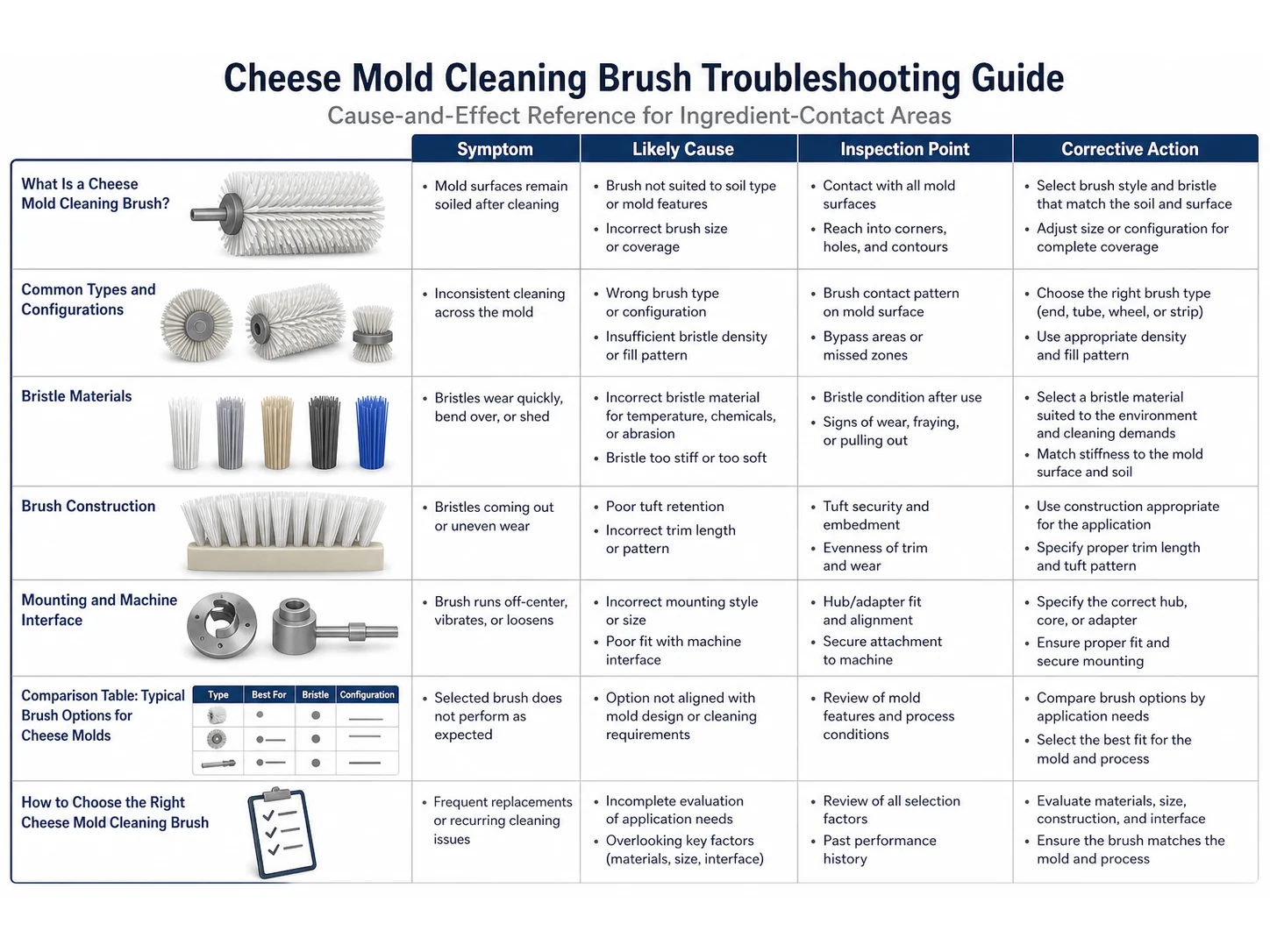
What Is a Cheese Mold Cleaning Brush?
A cheese mold cleaning brush is a brush with bristles arranged around a central core or handle, used to scrub the interior of cheese molds. Unlike generic utility brushes, these brushes are selected to match the mold’s shape, surface sensitivity, and cleaning chemistry while meeting strict hygiene standards for food-contact tools.
For industrial parts-cleaning process selection, contaminant classes, mechanical cleaning systems, and residue removal, this article cites ASM International — Choosing a Cleaning Process, ASM International, 1996; contaminant classes and mechanical cleaning process selection.
Common Types and Configurations
Cheese mold cleaning brushes vary by several attributes. Understanding the options helps narrow the choice before asking for a custom quote.
Bristle Materials
- Nylon (soft to medium): Good general performance, resistant to mild acids and fats, safe for most plastic and metal molds. Wall thickness 0.15–0.30 mm is common.
- Polypropylene (medium to firm): Higher stiffness and chemical resistance; used for baked‑on residues or stiffer mold materials. Often 0.30–0.50 mm.
- Polyester/PBT: Excellent durability and chemical resistance, low moisture absorption; suitable for frequent CIP and high‑temperature washdowns.
- Stainless steel wire: Very aggressive; only for hard metal molds where scratching is not a concern and where allowed by food safety protocols. Requires careful inspection for loose bristles.
- Natural fibers (tampico, horsehair): Soft and absorbent; sometimes used where gentle action is needed, but harder to sanitize and dry.
Brush Construction
- Twisted‑in‑wire: Bristles are twisted between wire stems. Common for smaller diameters (6–25 mm); suitable for cylindrical or tapered holes.
- Staple‑set or resin‑set: Bristles are inserted into a solid core or backing. Holds shape well for flat or oval brushes; used in strip and disc brushes.
- Handle types: Straight, loop, or T‑handle for manual use; threaded or quick‑connect ends for automated systems.
Mounting and Machine Interface
- Manual: Hand brushes with ergonomic grip, often with color‑coded handles for zone separation.
- Machine‑mounted: Brushes designed to be held in rotary tools, CIP booms, or brush‑carts. Need to match shaft diameter and speed.
- Custom mandrel: Where standard shafts fail, custom machined cores can adapt to unique mold turners or wash stations.
Comparison Table: Typical Brush Options for Cheese Molds
| Attribute | Soft Nylon | Medium Polyester | Firm Polypropylene | Stainless Steel Wire |
|---|---|---|---|---|
| Surface sensitivity | Very low; good for plastic molds | Low–medium | Medium; test patch needed | High; scratches hard metals |
| Residue type | Light curd, fat film | Moderate curd, light scale | Baked‑on or dried deposits | Heavy scale, carbonized |
| Chemical resistance | Good to acids, fair to strong alkalis | Excellent across wide pH | Very good | Excellent but may corrode |
| Hygiene maintenance | Easy to sanitize, dries quickly | Excellent; low absorb | Good | Difficult; bristle retention risk |
| Typical diameter (mm) | 8–40 | 6–50 | 10–60 | 8–30 |
| Cost factor | Low | Medium | Low–medium | Higher, plus inspection cost |
How to Choose the Right Cheese Mold Cleaning Brush
Match the brush to the real cleaning challenge, not just the mold’s inner diameter.
- Residue type: Identify the main foulant – soft curd, aged cheese deposits, fat, or mineral scale. Stiffer bristles or chemical‑assisted cleaning may be needed for tough deposits.
- Mold surface: Check material and coating. Plastic molds scratch easily; avoid steel wire or very stiff synthetic. Stainless steel can handle more aggressive bristles but still needs surface finish preservation.
- Brush size vs. mold cavity: The brush diameter should allow enough contact without jamming. For cylindrical holes, choose a brush 1–2 mm larger than the hole to ensure firm contact while still being insertable. For tapered or shaped molds, consider custom-made brush profiles.
- Stiffness and pressure: Too soft = incomplete cleaning. Too stiff = surface damage. When in doubt, test on a sample mold first.
- Chemical exposure: If using acidic or chlorinated cleaners, verify bristle material compatibility. Nylon can degrade with strong acids; polyester and polypropylene are better choices.
- Temperature: In hot‑water washdowns (over 70°C), choose heat‑resistant fibers like PBT or polyester.
- Handle and mounting: For manual operation, ergonomics matter – a long handle reduces reaching into tanks. For automated systems, shaft diameter and connection type must match the tool holder.
- Regulatory expectations: In the US, tools for food‑contact surfaces should meet FDA 21 CFR for indirect additives. In EU, look for brushes compliant with (EC) 1935/2004. However, do not assume all “food‑grade” claims cover your specific process conditions.
Common Mistakes When Specifying Cheese Mold Cleaning Brushes
- Choosing by cost drivers alone: A low-cost brush may shed bristles faster, absorb moisture, or degrade in chemicals, raising contamination risk.
- Ignoring bristle diameter and trim length: Too short a trim reduces reach into crevices; too long can bend and miss contact. Check bristle length against mold depth.
- Not testing on actual molds: Laboratory data doesn’t replicate real residue. Always run a trial with a few prototype brushes.
- Using wire brushes on plastic molds: Even “soft” stainless steel wire can create micro‑scratches that harbor bacteria.
- Overlooking brush hygiene: Brushes can become contamination sources. Select materials that withstand frequent sanitation and allow visual inspection for trapped debris.
- Assuming a standard size will fit: Off‑the‑shelf diameters may not clean ends or shoulders. Custom diameter, taper, or trimmed back length may be required.
- Mixing handle colors: In allergen‑sensitive environments, a color‑coding system helps prevent cross‑contact. Not all suppliers offer this; ask early.
When a Cheese Mold Cleaning Brush Is the Wrong Choice
A brush alone cannot solve every cleaning problem. Recognize its limits:
- Extreme baked‑on or caramelized residues: Pre‑soaking, enzymatic cleaners, or high‑pressure spray may be needed before brushing.
- Complex internal geometries: Undercuts, small holes, or bidirectional paths may require high‑pressure jets, ultrasonic cleaning, or spray balls instead of a mechanical brush.
- Validation requirements: If your HACCP plan requires a verifiable clean (ATP or protein swab testing after cleaning), a brush may need to be part of a validated CIP routine, not a standalone solution.
- High‑speed automated lines: Brushes can wear quickly; consider brush replacement frequency and the cost of downtime versus contact‑time‑optimized spray systems.
- Brush shedding risk: If even a single bristle cannot be tolerated in the final product, ask the supplier for lost‑bristle testing data or consider non‑bristle cleaning tools such as squeegees or wipers for final passes.
- Sample testing: When standard brushes fail, request a drawing review and a few test samples from a technical brush manufacturer. A good supplier will ask for mold prints, residue details, and operating conditions before recommending a design.
Final Takeaway
Selecting a cheese mold cleaning brush is a balance of material science, hygiene requirements, and practical fit. Start with the residue and mold surface, then match bristle type, diameter, and stiffness. Avoid the trap of buying on cost drivers or size alone. Test a sample under real conditions, and don’t hesitate to request a custom brush design when standard tooling falls short.
Frequently Asked Questions
Can I use a standard utility brush for cleaning cheese molds?
Standard utility brushes are often made from unknown plastics, may absorb water, and can shed bristles quickly. They are rarely designed to meet the hygiene, chemical resistance, and fit requirements of food‑contact mold cleaning. Use a brush designed or approved for food‑zone cleaning.
What bristle stiffness is safe for plastic cheese molds?
Soft to medium nylon or polyester with bristle diameters around 0.15–0.25 mm is generally safe for most PE or PP cheese molds. Always test on a scrap or representative mold first, because some coatings or aged plastic may be more sensitive.
How often should cheese mold cleaning brushes be replaced?
There is no single answer. Replace brushes when bristles show permanent deformation, breakage, fouling that cannot be cleaned, or when inspection reveals wear that might affect cleaning performance. A practical rule is to inspect after each production cycle and schedule a maximum usage life based on trials.
Are stainless steel wire brushes allowed in dairy cleaning?
Stainless steel wire brushes are permitted in some applications but are strongly discouraged on plastic molds and on stainless steel surfaces where finish integrity is critical. If used, they must be inspected thoroughly for loose bristles and often require a validated metal detection step in production.
What diameter brush should I choose for my mold size?
For a cylindrical hole, the brush body diameter should be 1–2 mm larger than the mold’s inner diameter to ensure adequate contact. For non‑cylindrical shapes, provide the manufacturer with a drawing so they can suggest a matching profile, taper, or custom trim.
How do I clean and sanitize the cleaning brush itself?
Wash the brush after use with a compatible detergent, rinse, and then apply an approved sanitizer (e.g., peracetic acid or quaternary ammonium). Hang to dry in a clean, designated location. Avoid storing brushes in wet buckets or in contact with floor surfaces. If the brush material cannot handle thermal sanitization, use chemical methods.
Can a cheese mold cleaning brush be used with automatic CIP systems?
Some brush designs can be mounted on rotating shafts or inserted into automated brush carts. Check that the brush core and connection can handle the torque, speed, and water exposure of your system. Not all manual brushes are suited for machine mounting; specifying the interface early avoids mismatch.
Where can I get a custom‑sized cheese mold cleaning brush?
Many industrial brush manufacturers offer custom design services. Prepare a clear description of your mold dimensions, residue, cleaning process, and any regulatory requirements. Request a technical drawing and a small sample batch for testing before placing a large order.
Technical References
- eCFR — 21 CFR Part 117 Human Food CGMP and Preventive Controls
- FDA — Food Code
- eCFR — 21 CFR 177.1500 Nylon Resins
- eCFR — 21 CFR 177.1630 Polyethylene Phthalate Polymers
- eCFR — 21 CFR 178.1010 Sanitizing Solutions
Which bristle material fits this job — AISI 304 Stainless Steel Wire, Nylon PA or PBT?
| Material | Continuous temperature (°C) | Peak temperature (°C) | Water absorption | Hardness |
|---|---|---|---|---|
| AISI 304 Stainless Steel Wire | 400 | 500 | 0% | Rockwell B 70–95 depending on temper and cold work |
| Nylon PA | 93 | 121 | 0.3–9% by PA grade and conditioning | Medium to firm; filament diameter and trim length control bending force. |
| PBT | 120–140 | 160–180 | 0.05–0.20% | Shore D 80–90 |
| Horsehair | 60–80 | 100–120 | 8–15% | — |
| Polypropylene PP | 80–100 | 120–140 | ≤0.03% | Shore D 65–75 |
Figures as published by Alleima; Brushtec / DuPont; Perlon. Confirm the exact grade against the supplier datasheet before ordering.
What should replace Handheld Detail Brushes for cheese mold cleaning brush?
- Handheld Detail Brushes — Handheld detail brushes cover general precision cleaning; auto-detailing brushes impose tighter controls for painted, polished, leather, display, and trim surfaces.
- AISI 304 Stainless Steel Wire — Use AISI 316 stainless steel wire for chloride, marine, dairy, beverage, chemical washdown, or higher pitting-resistance requirements. Use carbon steel for dry aggressive cutting and brass or abrasive nylon for lower marking risk.
- Nylon PA — Compare Nylon PA with PP, PBT, PET. Change material when wet stiffness, temperature, chemical resistance, conductivity, particle shedding, or surface marking becomes the limiting factor.
- PBT — Compare PBT with Nylon, PP, PET. Change material when wet stiffness, temperature, chemical resistance, conductivity, particle shedding, or surface marking becomes the limiting factor.