
What Is a Cheese Mold Cleaning Brush?
A cheese mold cleaning brush is a food-grade, medium-stiffness brush engineered to clean cheese molds, conveyor belts, and other food-contact surfaces. Its bristles are typically made from nylon, PBT, or polyester—materials that resist moisture, chemicals, and temperatures common in dairy sanitation. The brush often comes in custom diameters, lengths, and mounting styles to fit specific equipment gaps, rollers, or fixed holders. Unlike generic brushes, it is designed to remove sticky, acidic residues without scratching stainless steel or abrading plastic conveyor belts.
Common Types of Conveyor Cleaning Brushes
Not all conveyor cleaning brushes are the same. The category includes several industrial designs, each suitable for different residues, surfaces, and mechanical setups:
- Standard strip brushes – Frequent in general industrial conveyor cleaning. Often have polypropylene or nylon bristles and a metal or plastic channel back.
- Coil / spiral brushes – Used inside tubes or small-diameter openings. Can be customized for cheese mold cavities.
- Roller brushes – Mounted across the conveyor width for continuous cleaning. Common in belt scrape applications.
- Disc / cup brushes – Applied where a rotating face cleans flat surfaces or mold bottoms.
- Custom cheese mold cleaning brushes – Shapes and bristle layouts tailored to specific mold profiles, with materials and stiffness tuned for cheese residues.
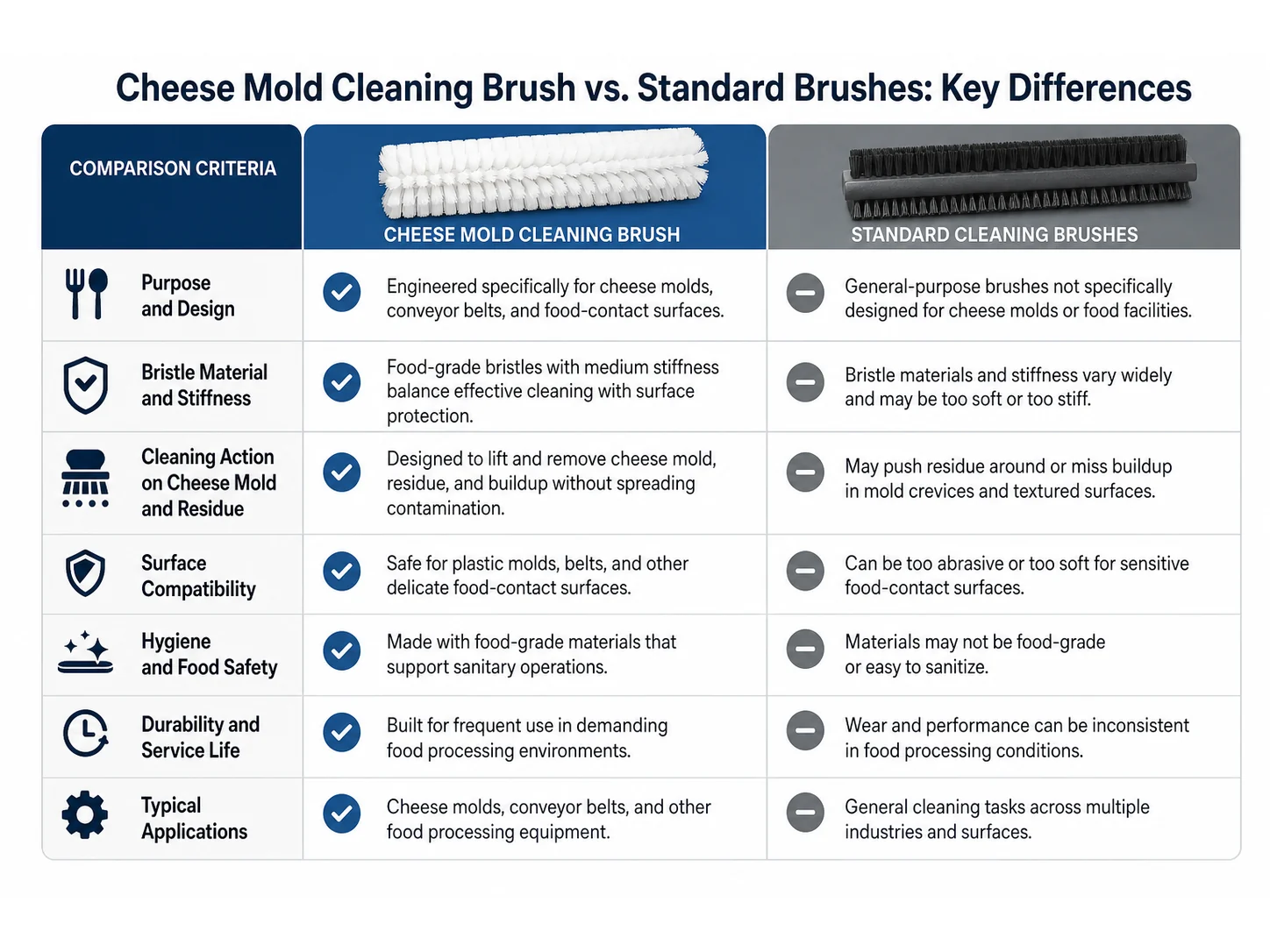
Cheese Mold Cleaning Brush vs. Standard Brushes: Key Differences
The table below compares a cheese mold cleaning brush against a typical standard conveyor cleaning brush to highlight where each excels.
| Feature | Cheese Mold Cleaning Brush | Standard Conveyor Brush |
|---|---|---|
| Bristle material | Food-grade nylon, PBT, polyester | Often polypropylene, nylon, or wire |
| Stiffness | Medium to firm – removes sticky biofilm without surface damage | Can range from soft to very aggressive (wire) |
| Design flexibility | Custom diameters, lengths, and mounting to match specific molds and gaps | Typically stock sizes; limited custom options for complex contours |
| Residue removal | Optimized for wet, sticky cheese residues, protein films | May tackle dry, coarse particulates but can smear wet residues |
| Surface sensitivity | Safe on stainless steel, plastic belts, and coated surfaces | Wire brushes can scratch; overly stiff synthetics may wear belts |
| Chemical resistance | Stands up to common CIP detergents, acid rinses, and sanitizers | Varies; polypropylene good; some materials degrade with strong chemicals |
| Hygiene compliance | Meets FDA/3-A sanitary design expectations; often autoclavable | May not be food-grade; risk of harboring bacteria in crevices |
| Typical mounting | Shaft-mount, keyed hub, or screw-in handle for stationary or rotary use | Channel back, clamp-on, or holder-based |
How to Choose the Right Brush for Conveyor Sanitation
Use the following decision factors to match a brush to your production line conditions:
- Residue type – Wet, sticky cheese residues call for a non-absorbent, medium-stiff brush with good scraping action. Dry particulates may allow softer or standard bristles.
- Surface material – Stainless steel and FDA-approved plastic belts require non-abrasive bristles. Wire or heavy abrasive brushes can cause micro-scratches that trap bacteria.
- Equipment interface – Consider brush dimension, core diameter, and mounting. A cheese mold cleaning brush often needs a specific shaft/mount to fit between conveyor gaps or inside mold cavities.
- Cleaning method – Manual cleaning, semi-automated stations, or full CIP systems dictate handle style, brush length, and chemical compatibility. For automated systems, the brush must withstand repeated mechanical flex and chemical exposure.
- Hygiene expectations – In a dairy plant, sanitation brushes should meet food-contact material standards. Check for FDA-listed materials, stainless steel cores, and easy-to-clean designs.
- Maintenance frequency – Brushes used in high-frequency lines wear faster. Choose a design that can be easily inspected and replaced without extensive downtime.
- Custom sizing – If you need a brush to fit a unique mold profile, a standard off-the-shelf brush will likely leave gaps or damage surfaces. A customized cheese mold cleaning brush, built from a drawing or sample, ensures complete contact and thorough cleaning.
Installation and Usage Factors
Even the best brush performs poorly if installed incorrectly. When integrating a cheese mold cleaning brush into a conveyor sanitation program:
- Mounting rigidity – The brush core must be secured without wobble to maintain consistent pressure. Shaft-mount designs allow quick changeover.
- Brush alignment – Align bristle contact with the residue path. For mold cavities, the brush must reach all internal corners.
- Wet or chemical exposure – In CIP environments, verify the brush materials resist caustic, acid, and hot-water solutions. Polyester and PBT often provide better chemical resistance than standard nylon.
- Cleaning schedule – Pair brush selection with a validated cleaning protocol (time, temperature, chemical concentration) for best results.
Common Mistakes When Selecting a Conveyor Cleaning Brush
- Using a wire brush on food-contact surfaces – Wire bristles shed, scratch, and are nearly impossible to sanitize, leading to contamination risks.
- Ignoring bristle stiffness – Too soft and residue remains; too stiff and sensitive conveyor belts wear prematurely. Stiffness must match the residue without excessive force.
- Skipping chemical compatibility checks – A brush that degrades in CIP chemicals will leave plastic particles in the product zone. Always confirm resistance to the sanitation chemicals used.
- Selecting by cost drivers alone – Low-cost standard brushes often require frequent replacement, increasing downtime and risk of contamination. A well-engineered cheese mold cleaning brush may cost more upfront but provides consistent cleaning and longer life.
- Neglecting custom sizing – Assuming a “close enough” stock brush will clean a specialized cheese mold usually leads to missed residue in crevices, creating a bacteria harbor point.
When a Cheese Mold Cleaning Brush Is the Wrong Choice
A cheese mold cleaning brush excels at removing sticky organics from conveyors and molds, but it has limits. If the conveyor carries heavy, baked-on crusts or abrasive materials, a brush alone may be insufficient. In those cases, combine the brush with a pre-soak stage, steam cleaning, or a high-pressure rinse. For very large, high-speed lines, a simple manual brush may not keep pace—consider automated roller brush systems or integrated brush cleaning stations that continuously scrub the belt. Also, when designing a new line, involve a brush manufacturer early to review equipment drawings and suggest the right brush geometry. A sample test with actual production residues will validate performance before full-scale ordering.
Final Takeaway
For conveyor sanitation in cheese and dairy processing, a purpose-designed cheese mold cleaning brush outperforms standard brushes on residue removal, surface safety, and hygiene compliance. Standard brushes still have a place for general dry-particle cleaning or non-food-contact areas, but where sticky, wet residues and food safety are paramount, the specialized brush is the clear choice. Start by defining the residue, surface, and mounting constraints, then select a brush material and stiffness that matches your cleaning protocol. A custom brush engineered for your exact mold or conveyor gap will save cleaning time, extend equipment life, and help maintain microbiological control.
Frequently Asked Questions
What materials are best for a cheese mold cleaning brush?
Food-grade nylon, PBT, and polyester are common choices. PBT offers excellent chemical resistance and stiffness retention in wet environments, while nylon is durable and cost-effective for less aggressive cleaning cycles.
Can I use the same brush for multiple mold sizes?
Possibly, if the brush diameter and bristle length can accommodate the variation, but a one-size-fits-all approach often leads to incomplete cleaning. It’s better to have a brush sized for each mold or a slightly oversized brush that can be inserted into different cavities if the contour allows full contact.
How often should cheese mold cleaning brushes be replaced?
Inspect bristles daily for deformation, matting, or embedded residue. Replace when bristles no longer spring back to shape, when cleaning effectiveness drops, or after any visible breakage. A preventive replacement schedule based on line hours is common.
Are cheese mold cleaning brushes safe for clean-in-place (CIP) systems?
Yes, if the brush materials and core (typically stainless steel) are specified to withstand the temperature and chemicals used in the CIP cycle. Always confirm with the brush supplier that the entire assembly, including any adhesive or molded core, is CIP-compatible.
Can a standard conveyor belt cleaning brush meet FDA requirements?
Many standard brushes are not manufactured with food-contact compliance in mind. Even if the bristle material is FDA-listed, the overall design (e.g., crevices, coatings, core material) may not meet sanitary standards. For direct food-contact hygiene, it’s safer to use a brush designed and supplied as food-grade.
How do I specify a custom cheese mold cleaning brush?
Provide the brush manufacturer with the mold or conveyor dimensions (drawings or samples), residue type, cleaning method (manual or automated), chemical exposure, and target contact pressure. A detailed request for quotation (RFQ) with these parameters helps the supplier design a brush that fits your application.
What is the difference between a roller brush and a cheese mold cleaning brush for conveyor sanitation?
A roller brush is typically a long, cylindrical brush mounted across the conveyor for continuous belt cleaning. A cheese mold cleaning brush is usually a smaller, specialized brush inserted into individual molds or targeted crevices. Both serve conveyor sanitation but at different scales.
Technical References
- FDA — Food Code
- eCFR — 21 CFR 177.1500 Nylon Resins
- eCFR — 21 CFR 177.1520 Olefin Polymers
- eCFR — 21 CFR 177.1630 Polyethylene Phthalate Polymers
- OSHA — Machine Guarding
- eCFR — 21 CFR Part 117 Human Food CGMP and Preventive Controls
Which bristle material fits this job — Nylon PA, AISI 304 Stainless Steel Wire or PBT?
| Material | Continuous temperature (°C) | Peak temperature (°C) | Water absorption | Hardness |
|---|---|---|---|---|
| Nylon PA | 93 | 121 | 0.3–9% by PA grade and conditioning | Medium to firm; filament diameter and trim length control bending force. |
| AISI 304 Stainless Steel Wire | 400 | 500 | 0% | Rockwell B 70–95 depending on temper and cold work |
| PBT | 120–140 | 160–180 | 0.05–0.20% | Shore D 80–90 |
| Polypropylene PP | 80–100 | 120–140 | ≤0.03% | Shore D 65–75 |
Figures as published by Brushtec / DuPont; Alleima; Perlon. Confirm the exact grade against the supplier datasheet before ordering.
What should replace Handheld Detail Brushes for cheese mold cleaning brush?
- Handheld Detail Brushes — Handheld detail brushes cover general precision cleaning; auto-detailing brushes impose tighter controls for painted, polished, leather, display, and trim surfaces.
- Nylon PA — Compare Nylon PA with PP, PBT, PET. Change material when wet stiffness, temperature, chemical resistance, conductivity, particle shedding, or surface marking becomes the limiting factor.
- AISI 304 Stainless Steel Wire — Use AISI 316 stainless steel wire for chloride, marine, dairy, beverage, chemical washdown, or higher pitting-resistance requirements. Use carbon steel for dry aggressive cutting and brass or abrasive nylon for lower marking risk.
- PBT — Compare PBT with Nylon, PP, PET. Change material when wet stiffness, temperature, chemical resistance, conductivity, particle shedding, or surface marking becomes the limiting factor.