
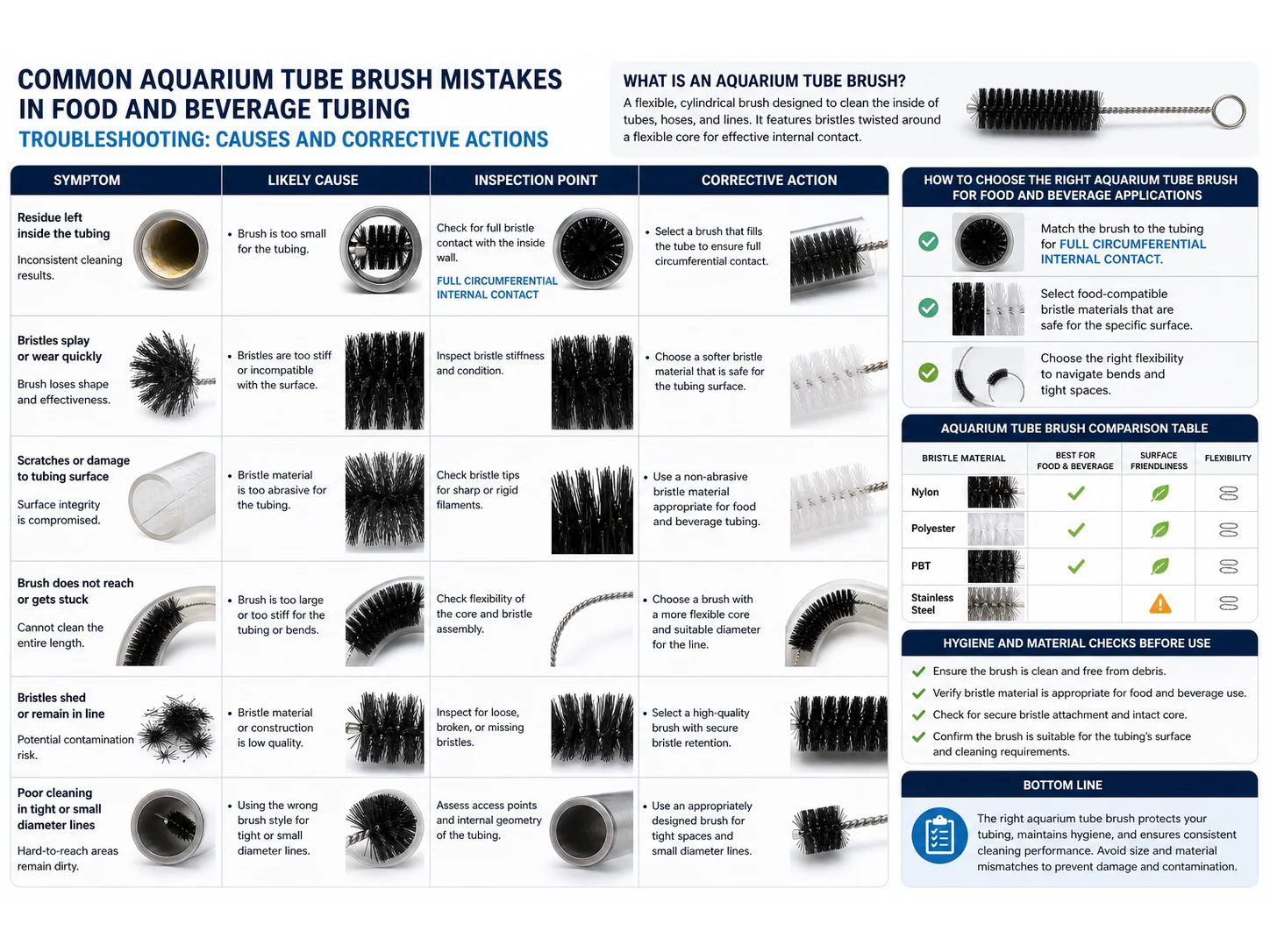
What Is an Aquarium Tube Brush?
An aquarium tube brush is a hand-operated cleaning tool consisting of a wire stem, typically twisted from stainless steel or galvanized wire, with bristles crimped into the twist. The bristles, usually nylon or animal fiber, extend outward to contact the inner wall of a tube. In its original use, it scrubs away algae and biofilm inside aquarium piping. When this same design is applied to food processing, the brush becomes a low-cost manual cleaning device for parts that are too small or complex for mechanical cleaning systems.
For industrial parts-cleaning process selection, contaminant classes, mechanical cleaning systems, and residue removal, this article cites ASM International — Choosing a Cleaning Process, ASM International, 1996; contaminant classes and mechanical cleaning process selection.
Why Size and Material Fit Mistakes Happen in Food and Beverage Tubing
Food and beverage tubing is often made from materials like silicone, Teflon (PTFE), PVC, or stainless steel. Unlike rigid aquarium tubing, these materials can scratch easily, swell with certain chemicals, or require specific surface finishes to prevent biofilm buildup. A common mistake is inserting a brush with a diameter that is too large, which can score the inner surface of soft tubing, creating harborage points for bacteria. Alternatively, using a brush that is too small leaves residue behind. Stiffness mismatches also cause problems: a rigid brush can kink flexible tubing, while an overly limp brush cannot scrub effectively around bends.
Common Mistakes When Selecting an Aquarium Tube Brush
- Mistake 1: Choosing by generic name alone. The term “aquarium tube brush” often implies nylon bristles on a twisted wire stem of unknown stainless steel grade. In food zones, you need to verify actual material specifications.
- Mistake 2: Ignoring chemical compatibility. Nylon bristles can degrade when exposed to strong alkaline or acidic cleaning agents used in CIP or manual cleaning. This leads to bristle shedding into product contact areas.
- Mistake 3: Overlooking core wire material and finish. A brush with a carbon steel wire core will rust quickly in wet, sanitized environments. Stainless steel (304 or 316) is preferred but may not be standard in off-the-shelf aquarium brushes.
- Mistake 4: Assuming one brush works for all tube IDs. A brush must be selected with a slight interference fit—usually 1–2 mm larger than the tube ID—to clean effectively without excessive force. Using the wrong diameter wastes labor or damages the tube.
- Mistake 5: Neglecting bristle stiffness and end design. Soft tubing may require a brush with a flexible loop tip instead of a sharp cut wire end, which can puncture the tube wall during insertion.
- Mistake 6: Skipping hygiene validation. In food processing, brushes must be easy to clean and inspect. Twisted wire stems can trap soil if not properly flushed. Some facilities require a smooth, encapsulated design.
- Mistake 7: Ordering without a clear replacement schedule. Bristle wear is difficult to see. A worn brush may lose stiffness and shed bristles, leading to foreign material contamination.
How to Choose the Right Aquarium Tube Brush for Food and Beverage Applications
To avoid these mistakes, evaluate the following six factors before ordering or specifying a brush:
- Residue type: Is it sticky sugar syrup, protein-based film, mineral scale, or dried powder? Abrasive bristles may be needed for scale, while softer nylon is better for delicate surfaces.
- Surface sensitivity: What is your tubing’s roughness (Ra) requirement? Scratches in sanitary tubing can be inspected with a borescope. For electropolished stainless, choose a non-abrasive brush and test on a sample tube first.
- Equipment interface: How will the brush reach the tube? If the tube has a quick-connect fitting, the brush length and handle must allow complete insertion. For long runs, consider a flexible brush with a leader or a brush that can be attached to a snake.
- Wet or chemical exposure: If the brush will be soaked in sanitizer or used with caustic foam, all components—bristles, stem, and handle—must withstand the chemical and temperature.
- Hygiene expectations: Is the area a direct food-contact zone? Brushes may need to comply with FDA 21 CFR for indirect additives, and the design should minimize particle shedding. Smooth, crimped-in or fused bristle retention methods are easier to clean than simple twisted wire.
- Maintenance frequency and lifespan. A high-use cleaning station requires brushes that withstand frequent autoclaving or sanitization without losing bristle tension. Consider the cost of bristle loss versus investing in a more robust design.
- Custom size requirements: Standard aquarium brushes come in fixed diameters and lengths. If your tube has a non-standard ID, a tight bend radius, or a reduced end section, you may need a custom brush built to a drawing. In that case, provide the tube ID, bend radius, and the distance from entry to the area to be cleaned.
Aquarium Tube Brush Comparison Table
The table below compares typical options and their suitability for food and beverage tubing cleaning. Note that these are generic categories; actual performance depends on manufacturer specifications and quality.
| Feature | Standard Aquarium-Style | Food-Grade Nylon Twisted Wire | Encapsulated Hygienic Design | Abrasive (Carborundum or Wire Bristle) |
|---|---|---|---|---|
| Bristle Material | General-purpose nylon or animal fiber | Nylon formulated for food contact (21 CFR indirect additive) | Thermoplastic elastomer (TPE) or silicone | Silicon carbide grit, brass, or stainless wire |
| Stem Material | Galvanized or 304 stainless steel wire | 304 or 316 stainless steel twisted wire | Solid core with molded-on bristles (often polypropylene) | Stainless steel twisted wire |
| Stiffness | Low to moderate | Low to moderate; can be made stiffer with heavier wire | Moderate; smooth core flexes without kinking | High; can be difficult to push through tight bends |
| Chemical Resistance | Good with mild detergents; nylon degrades in strong acids/bases | Better nylon grades resist repeated sanitizing; verify chemical chart | Excellent with most CIP chemicals; TPE is often CA/CIP compatible | Wire bristles may corrode; grit-impregnated nylon may shed particles; check compatibility with cleaning agents |
Choosing the right brush design avoids cross-contamination, reduces scrap, and extends equipment life. For high-purity applications, consider brushes that can be fully disassembled or sterilized. Always validate cleaning efficacy with a test on actual residues after implementing a new brush specification.
Bottom Line
The best result comes from matching aquarium tube brush mistakes in food and beverage tubing and how to avoid them to the real cleaning task rather than forcing one brush to solve every condition. Confirm access, residue, surface limits, and replacement routine first; then use a small trial or inspection step before scaling the method into daily work.
What should be checked before using this brush?
Check access, residue type, surface sensitivity, bristle condition, and whether loosened debris can be removed safely after brushing.
Frequently Asked Questions
Does the brush have to reach the whole run of tubing?
It has to, or the run has to be treated a different way. A brush that stops short leaves a ring of residue exactly where flow already slows, which is where biofilm establishes first. Measure the full length and the tightest bend before choosing, and anything the brush cannot physically reach belongs on a clean-in-place cycle or on a replacement schedule instead.
Can I use a standard aquarium tube brush for cleaning food processing lines?
While the design is similar, standard aquarium brushes may use materials not rated for food contact, such as carbon steel wire or bristles that shed. Always verify that the brush meets your facility’s material and hygiene standards, especially for direct food-contact surfaces.
How do I know if my tube brush is the right diameter?
A good rule is to select a brush that is 1–2 mm larger than the tube’s internal diameter. This ensures enough contact for cleaning without excessive force that could scratch or distort soft tubing. Test on a scrap piece first to confirm fit and effectiveness.
What is the risk of using a worn-out brush?
Worn bristles lose stiffness and can break off into product lines, creating a foreign material hazard. Additionally, a flattened brush no longer cleans effectively, leaving residue that can harbor bacteria. Implement a regular replacement schedule based on visual inspection or number of uses.
Are there brushes designed specifically for sensitive tubing like PTFE or silicone?
Yes. Brushes with soft, non-abrasive bristles—such as horsehair or fine-grade nylon—and looped or encapsulated ends are ideal for delicate surfaces. Some manufacturers offer FDA-compliant, non-scratch options that minimize the risk of surface damage.
Technical References
- FDA — Food Code
- eCFR — 21 CFR Part 117 Human Food CGMP and Preventive Controls
- eCFR — 21 CFR 178.1010 Sanitizing Solutions
- ASME — Y14.5 Dimensioning and Tolerancing
Which bristle material fits this job — Nylon PA, AISI 304 Stainless Steel Wire or Silicone?
| Material | Continuous temperature (°C) | Peak temperature (°C) | Water absorption | Hardness |
|---|---|---|---|---|
| Nylon PA | 93 | 121 | 0.3–9% by PA grade and conditioning | Medium to firm; filament diameter and trim length control bending force. |
| AISI 304 Stainless Steel Wire | 400 | 500 | 0% | Rockwell B 70–95 depending on temper and cold work |
| Silicone | 200–250 | 280–300 | 0.1–1.0% | Shore A 20–80 |
| Carbon Steel Wire | 200–300 | 350–450 | 0% | Rockwell C 40–60 |
| Abrasive Nylon | 120 | 150 | 0.1–1.0% | Abrasive filament; stiffness and cutting level is controlled by PA base, grit type, grit size, filament diameter and trim height. |
Figures as published by Brushtec / DuPont; Alleima; Perlon. Confirm the exact grade against the supplier datasheet before ordering.
When are Tube & Pipe Bore Brushes the wrong choice for tube brush?
- Tube & Pipe Bore Brushes — Use pigs, flushing, ultrasonic, chemical descaling, blasting, or a flexible cable system for long, sharply curved, or heavily scaled passages.
- Nylon PA — The nylon family spans several grades, so heat, moisture and chemical limits should follow the selected PA resin rather than a generic nylon value.
- AISI 304 Stainless Steel Wire — Avoid using AISI 304 as the default in marine, brine, hypochlorite, and persistent chloride environments; use AISI 316 when higher pitting and crevice-corrosion resistance is required.
- Silicone — Not for aggressive scraping, rust removal or metal deburring.
What should replace Tube & Pipe Bore Brushes for tube brush?
- Tube & Pipe Bore Brushes — Tube and bore brushes work by radial contact inside a confined diameter; wire wheels and cups work mainly on external edges, profiles, welds, and broad surfaces.
- Nylon PA — Compare Nylon PA with PP, PBT, PET. Change material when wet stiffness, temperature, chemical resistance, conductivity, particle shedding, or surface marking becomes the limiting factor.
- AISI 304 Stainless Steel Wire — Use AISI 316 stainless steel wire for chloride, marine, dairy, beverage, chemical washdown, or higher pitting-resistance requirements. Use carbon steel for dry aggressive cutting and brass or abrasive nylon for lower marking risk.
- Silicone — Compare Silicone with PP, TPE, Nylon. Change material when wet stiffness, temperature, chemical resistance, conductivity, particle shedding, or surface marking becomes the limiting factor.