
What Is a Brass Wire Brush and Why Are Attachments Different?
A brass wire brush is a cleaning and surface finishing tool with bristles made from brass wire—an alloy of copper and zinc—instead of steel. Its main advantage is that it resists sparking and is less aggressive than steel, which reduces the risk of deeply scratching or embedding abrasive particles into the workpiece.
When mounted on a drill or angle grinder, these brushes rotate at high speed and multiply contact pressure. The same brush that performs safely by hand can generate excessive heat, wire breakage, and surface smearing when spun at several thousand RPM. Recognizing this difference is the first step to avoiding costly mistakes.
Common Types of Brass Wire Brush Attachments
Brass wire brushes come in several forms for power tools. The most common types are wheel brushes (for edges and flat surfaces), cup brushes (for larger flat areas and rust removal), end brushes (for recessed or contoured areas), and stem-mounted brush bits (for drills, often used in tight spots like bores or internal threads). Each style has a different balance of speed, coverage, and control.
Brass Wire Brush Attachment Options at a Glance
| Attachment Type | Typical Mount | Wire Stiffness | Best For | Keep in Mind |
|---|---|---|---|---|
| Wheel brush | Arbor hole or threaded nut | Medium to stiff | Edge cleaning, pipe exteriors, flat stock | Narrow width can cause striping if handled unevenly |
| Cup brush | 5/8″-11 threaded or nut | Medium to very stiff | Large flat surfaces, heavy rust, weld cleaning | High torque; match grinder RPM to brush rating |
| End brush | 1/4″ or 1/8″ shank | Soft to medium | Recessed areas, corners, small parts | Small diameter; easy to over-speed in a die grinder |
| Stem-mounted brush | 1/4″ or 1/8″ shank | Soft to medium | Drill work, bores, internal threads | Often used wet; choose brass wire that resists gauling |
How to Choose the Right Brass Wire Brush Attachment
The right brush depends more on the job than on the tool. Start by identifying the residue you need to remove—light oxidation, heavy rust, paint, carbon deposits, or gasket material—and the base metal. Then work through these factors:
- Residue type: Fine residue calls for finer wire; thick scale needs coarser wire or higher knot density, but be careful not to bite into soft base metals.
- Surface sensitivity: Aluminum, brass, and soft alloys scratch easily. Always test in an inconspicuous area first, even with brass.
- Equipment interface: Match the brush arbor, shank, or thread to the tool spindle. A sloppy fit causes vibration and uneven wear.
- Wet or chemical exposure: Some jobs use solvents or water. Ensure the brush hub material and plating are compatible to avoid corrosion or glue failure.
- Hygiene expectations: In food or medical tool cleaning, even tiny brass particles are unacceptable. Consider stainless or dedicated non-metallic brushes.
- Maintenance frequency: High-volume shops often need professional-grade knot-wire wheels; occasional users may do fine with crimped wire.
Why Brass Wire Brush Mistakes Happen on Drills and Grinders
Most errors come from treating a power brush like a hand brush. A drill can spin a stem-mounted brush at three times the safe surface speed if the operator doesn’t check the RPM limit. A grinder cup brush run at the wrong angle can gouge the workpiece. Even the wrong wire gauge—too thick for thin metal—can warp a panel. Understanding these risk points turns a destructive tool into a controlled cleaning instrument.
7 Common Brass Wire Brush Mistakes and How to Avoid Them
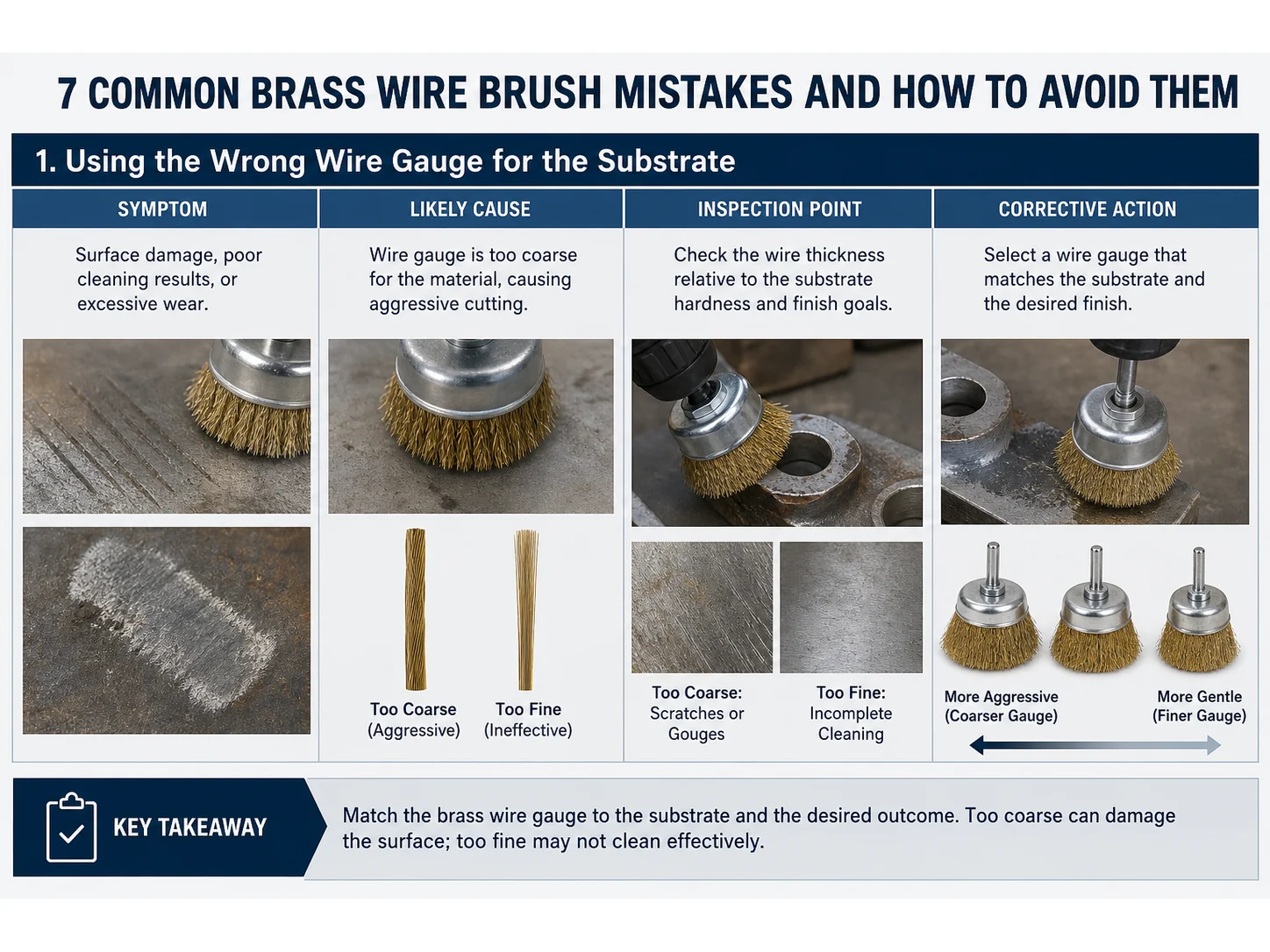
1. Using the Wrong Wire Gauge for the Substrate
Coarse wires (≥0.3 mm) on soft metals like aluminum can dig deep scratches or embed brass particles. Use fine wire (≤0.1 mm) for soft metals and sensitive surfaces. Switch to stainless steel wire brushes only when the base metal is harder and rust removal requires more aggression.
2. Assuming Brass Won’t Scratch Aluminum
Brass is softer than steel, but it will still leave marks on aluminum if run at high speed with heavy hand pressure. Always test on a scrap piece, and use the lowest effective RPM. A common sign of trouble is a golden smear on the surface—that’s brass transfer, not just dirt.
3. Exceeding the Maximum Safe RPM
Every brush has a rated maximum RPM. Run a cup brush rated for 6,500 RPM on a 11,000 RPM grinder and wires can fly off at projectile speed. Check the rating, check the tool’s no-load speed, and never exceed it.
4. Ignoring Shank and Arbor Compatibility
A stem-mounted brush with a 1/8″ shank chucked loosely into a 1/4″ drill collet or adapter will wobble, break wires, and scar the workpiece. Use the correct collet or adapter, and tighten securely.
5. Using a Contaminated Brush on a Clean Surface
Brass brushes pick up old rust, paint, and grime. Using the same brush to clean a machined surface transfers that debris. Dedicate brushes to specific materials or jobs, and clean them regularly by running them against a piece of scrap cardboard or a brush cleaning tool.
6. Skipping Personal Protective Equipment (PPE)
Spinning brass wires break. They fly radially at high speed. Always wear safety glasses or a face shield. Gloves and long sleeves protect against wire tips that can penetrate skin. This is a non-negotiable mistake.
7. Mismatching Brush Width to the Work Area
A narrow wheel brush on a wide plate leaves streaks and uneven finish. A cup brush too large for a small bracket can catch edges and kick back. Match the brush width or diameter to the size of the area you need to clean.
When a Brass Wire Brush Is the Wrong Choice
A brass brush can handle light rust, paint prep, and carbon removal, but it has clear limits. Do not rely on a brass brush for heavy mill scale on steel, severe pitting corrosion, or hardened residues such as baked-on carbon inside exhaust ports. In these cases, abrasive blasting, chemical stripping, or a stainless steel brush of the correct hardness may be required. Brass is also unsuitable for food-contact surfaces that demand zero metallic residue, and for high-purity applications where copper contamination is a concern. If you are unsure, request a sample brush from a reputable manufacturer and run a test piece against your cleaning specification before placing a full order.
Final Takeaway: Stop Guessing, Start Matching
The most expensive brass wire brush mistake is not the wrong type—it’s the lack of a simple matching process. For every cleaning job, write down the base metal, the residue, the tool RPM, and the required surface finish. Then select a brush whose wire gauge, attachment type, stiffness, and speed rating align with those four parameters. That one habit prevents nearly every mistake on this list.
Frequently Asked Questions
Can I use a brass wire brush on stainless steel?
Yes, but be aware of the risk of “brass transfer,” where small amounts of brass can smear onto the stainless surface. This may not matter for appearance, but if the part later requires passivation or must be free of copper contamination, choose a stainless steel brush instead or test first.
How do I know if my drill RPM is too high for a brush?
Check the maximum RPM printed on the brush or its packaging. Compare that to your drill’s no-load RPM (typically in the manual or on the tool body). The tool speed should never exceed the brush rating. If your drill is variable speed, keep it in the lower range for small-diameter brushes.
Does a brass wire brush leave residue on aluminum?
It can. Brass is an alloy of copper and zinc, and under high friction both metals can transfer onto aluminum. This shows up as a faint gold or copper-colored smear. For cosmetic or corrosion-critical parts, switch to a brush with fiber or nylon bristles impregnated with abrasive instead.
What’s the difference between crimped and knotted brass wire wheels?
Crimped wires are wavy and flexible, making them ideal for light cleaning and irregular surfaces. Knotted wires are twisted together into tight bundles for higher stiffness and cutting power, used mainly for heavy rust and weld scale removal. For sensitive surfaces, a crimped brass wheel is a safer first choice.
How often should I replace a brass wire brush attachment?
Replace when you see excessive wire breakage, uneven bristle length, a visibly unbalanced cup or wheel, or reduced cleaning performance. A worn brush may also throw wires more aggressively. In a production environment, track hours of use and set a conservative replacement schedule based on visual inspection.
Can I use a brass wire brush wet with solvents?
Yes, but confirm that the brush’s hub and adhesive (if used) are solvent-resistant. Some hubs swell or degrade when exposed to acetone or aggressive degreasers. Stainless steel hubs or those rated for wet service are a safer bet. Always follow the brush manufacturer’s chemical compatibility guidance.
Are brass wire brushes safe for gun cleaning?
They are widely used for bore and chamber cleaning because brass is softer than steel and less likely to damage rifling. However, be careful not to embed brass particles in the bore. Use a tight-fitting patch to remove loose debris after brushing, and avoid leaving the brush spinning in one spot.
How do I select a brass wire brush supplier for industrial orders?
Look for a supplier that provides clear technical data: wire diameter, bristle type, hub material, max RPM, and chemical resistance. For custom requirements, a supplier who offers sample brushes or can provide test reports is preferable. Always check whether the brush meets any relevant industry standards your workplace follows, and request a drawing or spec sheet before committing to a large order.
Technical References
- OSHA — 1910.242 Hand and Portable Powered Tools
- OSHA — Personal Protective Equipment
- World Stainless — Corrosion Resistance of Stainless Steels
- ASME — Y14.5 Dimensioning and Tolerancing
Which bristle material fits this job — Brass Wire, AISI 304 Stainless Steel Wire or Nylon PA?
| Material | Continuous temperature (°C) | Peak temperature (°C) | Water absorption | Hardness |
|---|---|---|---|---|
| Brass Wire | 150–200 | 250–300 | 0% | Rockwell B 40–90 |
| AISI 304 Stainless Steel Wire | 400 | 500 | 0% | Rockwell B 70–95 depending on temper and cold work |
| Nylon PA | 93 | 121 | 0.3–9% by PA grade and conditioning | Medium to firm; filament diameter and trim length control bending force. |
Figures as published by Alleima; Brushtec / DuPont. Confirm the exact grade against the supplier datasheet before ordering.
What should replace Brass Wire when it stops working?
- Brass Wire — Compare Brass Wire with Steel wire, stainless wire, nylon. Change material when wet stiffness, temperature, chemical resistance, conductivity, particle shedding, or surface marking becomes the limiting factor.
- AISI 304 Stainless Steel Wire — Use AISI 316 stainless steel wire for chloride, marine, dairy, beverage, chemical washdown, or higher pitting-resistance requirements. Use carbon steel for dry aggressive cutting and brass or abrasive nylon for lower marking risk.
- Nylon PA — Compare Nylon PA with PP, PBT, PET. Change material when wet stiffness, temperature, chemical resistance, conductivity, particle shedding, or surface marking becomes the limiting factor.