
What Is a Double-Ended Cleaning Brush?
A double-ended cleaning brush features two working ends, typically with different bristle configurations or sizes, sharing a common handle or core. In thread cleaning, one end may break up heavy debris while the other polishes or removes fine residue. The design allows quick transition between two cleaning steps without changing tools, making it efficient for repetitive maintenance tasks on threaded components.
Common Types and Material Options
Double-ended brushes are available in several material and configuration options. The most common types include:
- Stainless steel wire: High stiffness, ideal for removing rust and carbon buildup on hard metals.
- Brass wire: Medium stiffness, safer for delicate threads where marring must be avoided.
- Abrasive nylon: Impregnated with silicon carbide or other grit, balances cutting power with less risk of scratching.
- Natural fiber (Tampico, horsehair): Soft, used for dusting or light residue on sensitive surfaces.
- Combination ends: One end wire, the other nylon or fiber, for two-stage cleaning without switching brushes.
Comparison Table: Material and Configuration Options
| Material | Bristle Stiffness | Typical Diameters | Best For | Risks / Limitations |
|---|---|---|---|---|
| Stainless steel wire | High | 0.25″–2″+ | Heavy rust, carbon, scale on ferrous metals | Can scratch soft threads; may embed in aluminum |
| Brass wire | Medium | 0.25″–1.5″ | General thread cleaning on brass, bronze, steel | Not effective on hard deposits; wears faster |
| Abrasive nylon | Medium-High | 0.5″–3″ | Paint, light rust, anti-seize residue | Can remove base metal if overused; limited chemical resistance |
| Natural fiber | Low | 0.75″–2″ | Dust, dry debris on delicate threads | No cutting action; degrades with oil or moisture |
| Combination wire + fiber | Mixed | Varies | Sequential cleaning without tool change | Cost premium; requires proper sequence to avoid cross-contamination |
Key Selection Mistakes (And How to Choose Correctly)
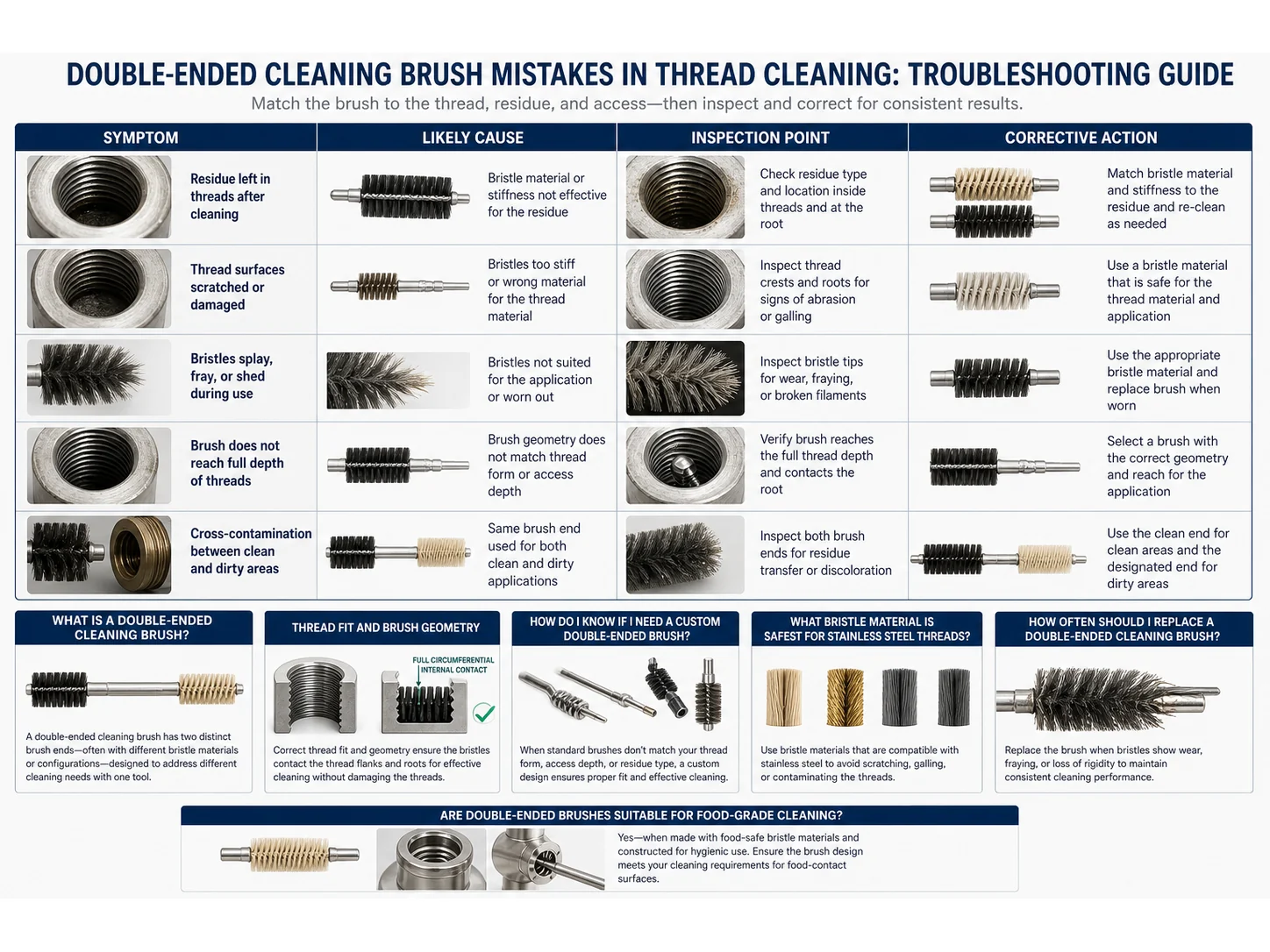
Choosing the wrong double-ended brush is the single biggest source of thread cleaning failures. The most common mistakes and how to avoid them include:
- Selecting by diameter alone: Bristle material and stiffness must match the residue and thread hardness. A 0.5″ brush in stainless wire acts completely different from one in nylon.
- Ignoring chemical compatibility: Some bristle materials (e.g., nylon) can soften or swell in aggressive solvents. Always verify the brush material’s resistance to your cleaning chemicals.
- Assuming one brush fits all threads: Thread pitch, depth, and profile vary. A brush that fits a coarse metric thread may not work on a fine UNF thread of similar diameter.
- Overlooking hygiene requirements: For food, pharmaceutical, or cleanroom applications, bristle material and construction must meet regulatory standards (e.g., FDA, EU 10/2011) and be autoclavable.
- Neglecting the handle and ergonomics: A short, thin handle can make cleaning deep or blind holes difficult and increase operator fatigue. Handle length, grip diameter, and whether a loop or straight configuration is needed should be considered.
- Using the same brush for different residues: Cross-contamination can spread abrasive particles or chemically reactive residues. Use dedicated brushes or clean thoroughly between incompatible applications.
- Skipping custom sizing when needed: Standard off-the-shelf brushes may not reach the full thread depth or may be too loose/tight. When tolerances are tight, custom diameter, length, or bristle fill can improve cleaning while preventing thread damage.
Setup and Usage Factors That Change the Right Choice
Real-world conditions often make a standard recommendation inappropriate. Consider these factors:
- Wet vs. dry cleaning: If solvents or water are used, the handle material must be corrosion-resistant (stainless steel core vs. plated steel). Bristles that swell in liquid will lose effectiveness.
- Manual vs. powered use: Many double-ended brushes can be chucked into a drill or rotary tool. Verify the maximum safe RPM for the bristle material; wire brushes can shed bristles at high speed.
- Hygiene and cleanroom protocols: Autoclavable handles (e.g., with silicone grips) and bristles that withstand repeated sterilization cycles are essential. Single-use disposable brushes may be required in some processes.
- Maintenance frequency: Brushes used every shift wear out faster than those used monthly. Choose a material that offers adequate durability without being overly aggressive.
Common Ordering and Specification Mistakes
Even when the brush type is correctly identified, ordering and specification errors lead to delays and rejects:
- Not providing a clear drawing or CAD: When ordering custom sizes, a dimensioned sketch with overall length, brush diameters, working length, and thread interface details prevents misinterpretation.
- Confusing overall length with working brush length: Specify the length of the bristle section, not the total tool length, to ensure the brush reaches the full threaded depth.
- Assuming standard threads without verification: A thread cleaning brush must match the thread specification (e.g., M12×1.75). Providing only the nominal diameter often results in a poor fit.
- Ordering single-piece samples without testing: A sample tested in one condition may not represent production variability. Order enough samples to validate under worst-case contamination.
- Neglecting handle ergonomics: For repetitive manual cleaning, a comfortable, non-slip handle reduces fatigue and improves consistency.
When a Double-Ended Cleaning Brush May Not Be Enough
Double-ended brushes are excellent for routine thread maintenance, but they have limitations. In the following situations, consider alternative solutions or additional steps:
- Deeply embedded contamination: If rust or carbon is chemically bonded, mechanical brushing may only smear the surface. Ultrasonic cleaning or chemical stripping should precede brushing.
- Damaged threads: If threads are cross-threaded or galled, a cleaning brush cannot repair them. Re-tapping or thread chasing is required first.
- Extreme hygiene or single-use requirements: In sterile pharmaceutical or certain food lines, even reusable brushes carry risk. Single-use disposable brushes or no-contact cleaning methods may be mandated.
- Complex internal geometries: If threads are interrupted, stepped, or have intersecting cross-holes, a standard double-ended brush may not reach all surfaces. Custom-shaped brushes or flexible shaft designs are needed.
- High-volume automated cleaning: For in-line production, a hand brush is too slow and inconsistent. Machine-mounted brush rolls or automated rotary brushes with controlled feed are better suited.
How to Prevent Mistakes: A Practical Checklist
Use this checklist before making a purchase or issuing a work order:
- Define the residue type (rust, carbon, grease, anti-seize, paint, etc.).
- Measure thread specifications: nominal diameter, pitch, depth, and form.
- Assess surface sensitivity: thread material hardness and acceptable scratch potential.
- List any chemical exposure (solvents, acids, alkalis).
- Determine hygiene requirements (food, pharma, cleanroom).
- Decide if cleaning is manual or powered (RPM, safety).
- Select bristle material and stiffness based on steps 1–6.
- Choose handle design (straight, loop, length, grip) for the working environment.
- If standard sizes are inadequate, prepare a drawing with critical dimensions and tolerances.
- Test with a sample under real conditions before committing to a large order.
Final Takeaway
The right double-ended cleaning brush is not a generic choice. By matching bristle material, stiffness, and dimensions to the exact residue, thread specifications, and operating environment, you can avoid the most common mistakes. Always test with a sample when conditions differ from standard recommendations, and keep a clear specification record for re-orders.
Frequently Asked Questions
What is the difference between a double-ended cleaning brush and a standard tube brush?
A double-ended brush has two working ends, often with different bristle types or diameters, allowing two-stage cleaning without swapping tools. A standard tube brush typically has one brush end and a handle, suited for single-step cleaning or larger diameters.
Can I use a double-ended cleaning brush with power tools?
Many can be used with drills or rotary tools if the shank is compatible (usually a round shank). Always check the maximum RPM rating for the bristle material. Wire brushes can throw bristles at high speed, so always wear eye protection.
How do I know if I need a custom double-ended brush?
If standard sizes do not match your thread pitch and depth, or if you need a unique combination of bristle types on each end, a custom design is advisable. Also, if you see excessive wear or poor cleaning with off-the-shelf brushes, custom fill density and trim length can solve the problem.
What bristle material is safest for stainless steel threads?
Brass wire is generally safe for stainless steel because it is softer and less likely to score the thread surface. Abrasive nylon can also be used if you need more cutting power, but it should be tested on a sample first to ensure it does not remove metal or embed abrasive particles.
How often should I replace a double-ended cleaning brush?
There is no fixed rule. Replace when bristles become bent, broken, or worn down so the brush no longer fills the thread profile. In high-production settings, track usage cycles and inspect brushes regularly. A worn brush is ineffective and can damage threads.
Are double-ended brushes suitable for food-grade cleaning?
They can be, provided the bristle and handle materials comply with food safety regulations (such as FDA 21 CFR or EU 10/2011). The brush must be detectable (metal-detectable or X-ray visible) and designed to resist bacterial harborage. Stainless steel wire and certain nylon grades are common.
Can a double-ended brush clean both internal and external threads?
Yes, by design, one end can be rotated inside a female thread while the other works on a male thread or external surface. However, the brush size must match the thread diameter to be effective; a brush too small on the external thread will not clean the roots.
What should I include in an RFQ for custom double-ended brushes?
Provide a dimensioned drawing showing overall length, brush diameters, bristle lengths, shank diameter, material specifications for bristle and handle, desired stiffness (e.g., wire diameter for wire brushes), any chemical compatibility requirements, and the intended cleaning environment (wet/dry, powered/manual). Include the target thread specifications and residue type to help the supplier recommend the best configuration.
Technical References
Which bristle material fits this job — AISI 304 Stainless Steel Wire, Nylon PA or Abrasive Nylon?
| Material | Continuous temperature (°C) | Peak temperature (°C) | Water absorption | Hardness |
|---|---|---|---|---|
| AISI 304 Stainless Steel Wire | 400 | 500 | 0% | Rockwell B 70–95 depending on temper and cold work |
| Nylon PA | 93 | 121 | 0.3–9% by PA grade and conditioning | Medium to firm; filament diameter and trim length control bending force. |
| Abrasive Nylon | 120 | 150 | 0.1–1.0% | Abrasive filament; stiffness and cutting level is controlled by PA base, grit type, grit size, filament diameter and trim height. |
| Brass Wire | 150–200 | 250–300 | 0% | Rockwell B 40–90 |
Figures as published by Alleima; Brushtec / DuPont; Perlon. Confirm the exact grade against the supplier datasheet before ordering.
When is AISI 304 Stainless Steel Wire the wrong choice for thread cleaning?
- AISI 304 Stainless Steel Wire — Avoid using AISI 304 as the default in marine, brine, hypochlorite, and persistent chloride environments; use AISI 316 when higher pitting and crevice-corrosion resistance is required.
- Nylon PA — The nylon family spans several grades, so heat, moisture and chemical limits should follow the selected PA resin rather than a generic nylon value.
- Abrasive Nylon — Exposed grit can change a surface finish, and high heat or aggressive chemicals can weaken the polymer carrier.
- Brass Wire — Avoid on stainless surfaces where copper contamination is restricted and on delicate coatings that mark under metal contact.
What should replace AISI 304 Stainless Steel Wire for thread cleaning?
- AISI 304 Stainless Steel Wire — Use AISI 316 stainless steel wire for chloride, marine, dairy, beverage, chemical washdown, or higher pitting-resistance requirements. Use carbon steel for dry aggressive cutting and brass or abrasive nylon for lower marking risk.
- Nylon PA — Compare Nylon PA with PP, PBT, PET. Change material when wet stiffness, temperature, chemical resistance, conductivity, particle shedding, or surface marking becomes the limiting factor.
- Abrasive Nylon — Compare Abrasive Nylon with PP, PBT, PET. Change material when wet stiffness, temperature, chemical resistance, conductivity, particle shedding, or surface marking becomes the limiting factor.
- Brass Wire — Compare Brass Wire with Steel wire, stainless wire, nylon. Change material when wet stiffness, temperature, chemical resistance, conductivity, particle shedding, or surface marking becomes the limiting factor.