
What Is a Fruit and Vegetable Brush Roller?
A fruit and vegetable brush roller is a cylindrical brush assembly designed to remove field soil, pesticide residues, waxes, and microbial film from the surface of fresh produce such as apples, potatoes, carrots, citrus, and tomatoes. The roller typically mounts onto a driven shaft and rotates at a controlled speed to gently but effectively scrub the passing product. In ingredient-contact areas—where the brush directly touches edible material without a barrier—every component must meet strict hygiene and food safety requirements.
Common Types and Options
Brush rollers for produce are not one-size-fits-all. They vary primarily by bristle material, filament stiffness, brush outer diameter, core construction, and mounting interface. Understanding these variations is the first step to avoiding costly ordering errors.
- Filament Material: Nylon (6, 6.6, 6.12), polyester, polypropylene, or natural fibers like tampico. Food-grade nylon is the most common for wet applications due to its stiffness retention and chemical resistance.
- Stiffness/Density: Measured in filament diameter and trim length. Softer brushes are used for delicate fruits (berries, stone fruit), while stiffer brushes handle tough root vegetables.
- Outer Diameter (OD): Typically ranges from 3 to 12 inches. The OD must match the conveyor gap and product size to maintain proper contact pressure.
- Core and Mounting: Cores can be solid polymer, stainless steel, or reinforced thermoplastic, with shaft ends bored for keyways, square drives, or quick-release pins. The wrong shaft interface leads to slippage or alignment issues.
- Special Features: Some rollers are designed for sanitary use with crevice-free construction, washdown-ready bearings, and FDA-compliant materials.
Key Features Compared
| Feature | Soft Brush (Delicate) | Medium Brush (General) | Stiff Brush (Tough Soil) |
|---|---|---|---|
| Typical Filament Material | Fine nylon, tampico | Nylon 6, polyester | Thick nylon, polypropylene |
| Outer Diameter (in.) | 3–8 | 4–10 | 6–12 |
| Filament Diameter (mm) | 0.10–0.30 | 0.30–0.60 | 0.60–1.20 |
| Best For | Berries, tomatoes, soft-skinned fruit | Apples, potatoes, carrots | Root vegetables, citrus with heavy soil |
| Water/Chemical Resistance | Good; check material | Excellent | Very good; may stiffen |
| Hygiene Design | Often crevice-free | Standard food-grade | Requires design review |
| Maintenance Consideration | Check for matting | Check for wear and chemical attack | Check for broken bristles |
Common Mistakes in Ingredient-Contact Areas
Even experienced engineers can make these missteps. Here are the most frequent errors and why they matter for food safety and product quality.
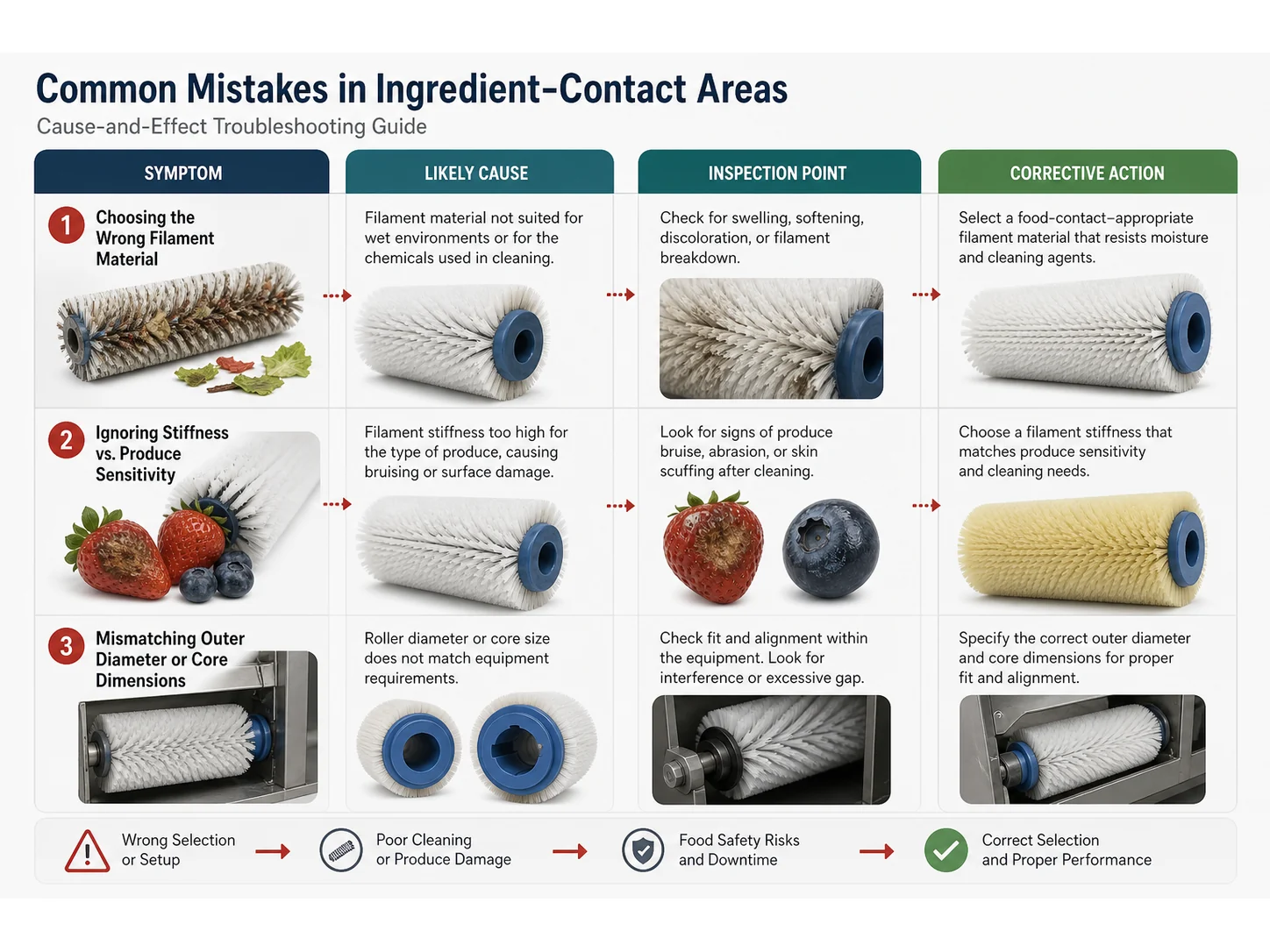
1. Choosing the Wrong Filament Material
Not all nylon is equal. Using a general-purpose nylon instead of food-grade, moisture-stabilized nylon can lead to filament swelling, bacterial harborage, and premature failure in wet environments. Always specify materials that comply with FDA 21 CFR or EU 10/2011 for food contact.
2. Ignoring Stiffness vs. Produce Sensitivity
A brush that is too stiff for soft fruit causes bruising and waste; one too soft for heavy soil leaves residues behind. Match bristle firmness to the target produce and soil type. Use supplier sample testing to verify.
3. Mismatching Outer Diameter or Core Dimensions
Ordering a brush with a slightly wrong OD or shaft bore can lead to poor contact pressure, motor overload, or brush slip. Double-check the equipment blueprint and confirm the drive interface before placing an order.
4. Overlooking Clean-in-Place (CIP) Compatibility
If the brush will be exposed to hot water, chlorine, or acidic cleaning solutions, the core and filaments must withstand those conditions without degrading. Standard polypropylene can fail under high temperatures. Request chemical resistance data.
5. Skimping on Sanitary Design
Brushes with crevices, pockets, or metal components that can rust introduce contamination risks. In ingredient-contact zones, opt for smooth, sealed cores and non-metallic retainers whenever possible.
6. Neglecting Maintenance and Replacement Schedules
Brush rollers wear down, harbor biofilm, and lose effectiveness over time. Without a preventive maintenance plan, brushes become a food safety liability. Set inspection intervals and replace brushes when filament deflection exceeds 30% or when visual damage appears.
7. Not Considering Whole-Line Compatibility
A brush roller may be perfect for one washing stage but inadequate for the next. Review the entire line from pre-wash to final rinse, ensuring each brush is suited to its specific residue type and hygiene demand.
How to Avoid These Mistakes
Prevention starts with a disciplined selection and ordering process. Use the following checklist before finalizing any fruit and vegetable brush roller purchase:
- Define the produce type, soil level, and line speed.
- Specify food-grade filament and core materials, citing applicable regulatory standards.
- Request a detailed drawing showing OD, length, bore, and mounting geometry—review it against your equipment.
- Ask for chemical resistance charts and CIP compatibility data.
- Require sample brushes or references for similar applications.
- Plan a maintenance schedule: daily rinse, weekly inspection, monthly integrity check.
- Document acceptable wear limits and replacement triggers.
When a Fruit and Vegetable Brush Roller Is the Wrong Choice
Brush rollers effectively remove loose soil and light residues, but they have limits. A brush alone may not:
- Eliminate heavy, baked-on mud or embedded stones—consider pre-soak tanks or high-pressure sprays first.
- Sanitize or sterilize the produce; brushes are a physical cleaning step, not a kill step. Pair with a suitable antimicrobial treatment.
- Handle misshapen or overly delicate items without a custom-engineered solution. In those cases, a test run with a full-size sample is essential.
- Substitute for rigorous environmental monitoring. Even the best brush requires a validated sanitation program around it.
If the produce surface has deep cracks or the line runs at extremely high throughputs, consulting with a brush design engineer for a tailored solution is the safest path. Request a supplier drawing review and on-site test if possible.
Final Takeaway
Selecting a fruit and vegetable brush roller for ingredient-contact areas is as much about food safety as it is about cleaning efficiency. The right brush matches the produce, the soil, the chemical environment, and the hygienic demands of the line. By avoiding the common mistakes of material mismatch, dimensional error, and maintenance oversight, processors can protect product quality and uphold audit-ready sanitation. Always verify the brush design against your specific equipment and run a trial before scaling up.
Frequently Asked Questions
What does “ingredient-contact area” mean for a brush roller?
An ingredient-contact area is any surface that directly touches raw, unprocessed produce intended for human consumption. In these zones, the brush roller must be made of food-safe, non-toxic materials and designed to prevent bacterial harborage.
Can I use the same brush roller for apples and potatoes?
It depends on the soil load and surface toughness. A medium-stiff nylon brush may work for both if properly adjusted, but delicate apples may require a softer filament to prevent bruising. Always test both products before committing.
How do I know if a brush roller is food-grade?
Look for documentation that the filament and core comply with FDA 21 CFR for indirect food contact, or EU regulations. Reputable suppliers provide material declarations and certificates of compliance. Never accept a brush without a clear regulatory status for food use.
What is the typical lifespan of a fruit and vegetable brush roller?
There is no single answer; it varies with usage, chemical exposure, and produce type. In heavy-duty root vegetable lines, brushes may last 3–6 months; in lighter applications, over a year. Regular inspection is more important than a fixed calendar date.
Can I clean and reuse a brush roller after it wears unevenly?
Uneven wear often indicates alignment or product flow issues. While you can sometimes redress the brush surface, once filaments are permanently deformed or the core is exposed, replacement is safer to avoid product damage or contamination.
Are natural fiber brushes acceptable in ingredient-contact areas?
Natural fibers like tampico can be acceptable if they meet food-contact standards and are used in dry or low-moisture applications. However, they tend to absorb water and harbor bacteria more readily than synthetic fibers, so they are less common in wet processing lines.
Should I request a custom brush roller drawing before ordering?
Yes. A detailed engineering drawing confirms all critical dimensions and materials before production. This step catches mismatches early and prevents costly downtime from an ill-fitting brush.
Technical References
- FDA — Food Code
- eCFR — 21 CFR 177.1500 Nylon Resins
- eCFR — 21 CFR 177.1520 Olefin Polymers
- eCFR — 21 CFR 177.1630 Polyethylene Phthalate Polymers
- eCFR — 21 CFR Part 117 Human Food CGMP and Preventive Controls
Which nylon grade fits this job — Nylon PA, PA6 Nylon or PA66 Nylon?
| Grade | Continuous temperature (°C) | Peak temperature (°C) | Water absorption | Hardness |
|---|---|---|---|---|
| Nylon PA | 93 | 121 | 0.3–9% by PA grade and conditioning | Medium to firm; filament diameter and trim length control bending force. |
| PA6 Nylon | 80–100 | 130–160 | 1.5–3.0% | Shore D 75–85 |
| PA66 Nylon | 100–120 | 150–180 | 1.0–1.8% | Shore D 80–88 |
| PA610 Nylon | 90–110 | 130–150 | 0.5–1.0% | Shore D 72–82 |
| PA612 Nylon | 90–110 | 130–150 | 0.3–0.7% | Shore D 70–80 |
Figures as published by Brushtec / DuPont. Confirm the exact grade against the supplier datasheet before ordering.
What should replace Nylon PA when it stops working?
- Nylon PA — Compare Nylon PA with PP, PBT, PET. Change material when wet stiffness, temperature, chemical resistance, conductivity, particle shedding, or surface marking becomes the limiting factor.
- AISI 304 Stainless Steel Wire — Use AISI 316 stainless steel wire for chloride, marine, dairy, beverage, chemical washdown, or higher pitting-resistance requirements. Use carbon steel for dry aggressive cutting and brass or abrasive nylon for lower marking risk.