
What Is a Side Seal Conveyor Brush?
A side seal conveyor brush is a linear brush assembly installed along the conveyor frame to create a tight seal between the moving belt edge and stationary chute sides. Its bristles flex to accommodate belt wander while preventing fugitive material from escaping at the belt line. Unlike traditional rubber skirting, brushes maintain contact without excessive friction, reducing belt wear and energy consumption. They are commonly used in industries handling powders, grains, aggregates, and other bulk materials where edge containment is critical.
Common Types and Key Features
Choosing the right side seal brush starts with understanding the main options. Below is a practical comparison of typical bristle materials and their characteristics.
| Feature | Nylon (Standard) | Polypropylene | Natural Fiber (Tampico/Horsehair) | Abrasive Nylon |
|---|---|---|---|---|
| Bristle Stiffness | Medium | Firm | Soft to medium | Very firm |
| Chemical Resistance | Good | Excellent | Poor (absorbs moisture) | Good |
| Temperature Range | Up to approx. 180°F | Up to approx. 200°F | Up to approx. 160°F | Up to approx. 250°F |
| Ideal Residue | Dry powders, granular | Wet, oily, acidic | Light dust, dry | Hard crust, scale |
| Typical Mounting | Aluminum channel | Stainless steel channel | Wood or plastic core | Aluminum/stainless channel |
| Cost Factor | Moderate | Lower | Lower | Higher |
In addition to bristle material, consider the brush holder or core. Extruded aluminum is common for dry environments; stainless steel is required for washdown or corrosive conditions. Mounting styles include clamp-on, bolt-on, and magnetic attachments, each suited for different frame access and ease of replacement.
How to Choose the Right Side Seal Conveyor Brush
Selection goes beyond picking a material. Evaluate these factors:
- Residue type and behavior: Abrasive, sticky, wet, or dusty materials demand different bristle properties.
- Belt speed and edge condition: High-speed belts generate more heat and require wear-resistant bristles; sharp or frayed edges may snag soft fibers.
- Operating environment: Consider washdown procedures, chemical exposure, and temperature extremes.
- Hygiene requirements: Food-processing applications often need FDA-compliant materials and easy-clean holder designs.
- Mounting space and frame compatibility: Measure available linear space and bracket positions; some designs need a channel height that fits under existing chutes.
- Maintenance frequency: Brushes that are hard to access may justify a more durable, higher-cost material to extend replacement intervals.
- Custom lengths and splice requirements: If your conveyor is longer than standard brush sections, plan for seamless joins to avoid leakage gaps.
Common Mistakes When Selecting and Using Side Seal Conveyor Brushes
Many issues stem from preventable errors. Here are the most frequent ones:
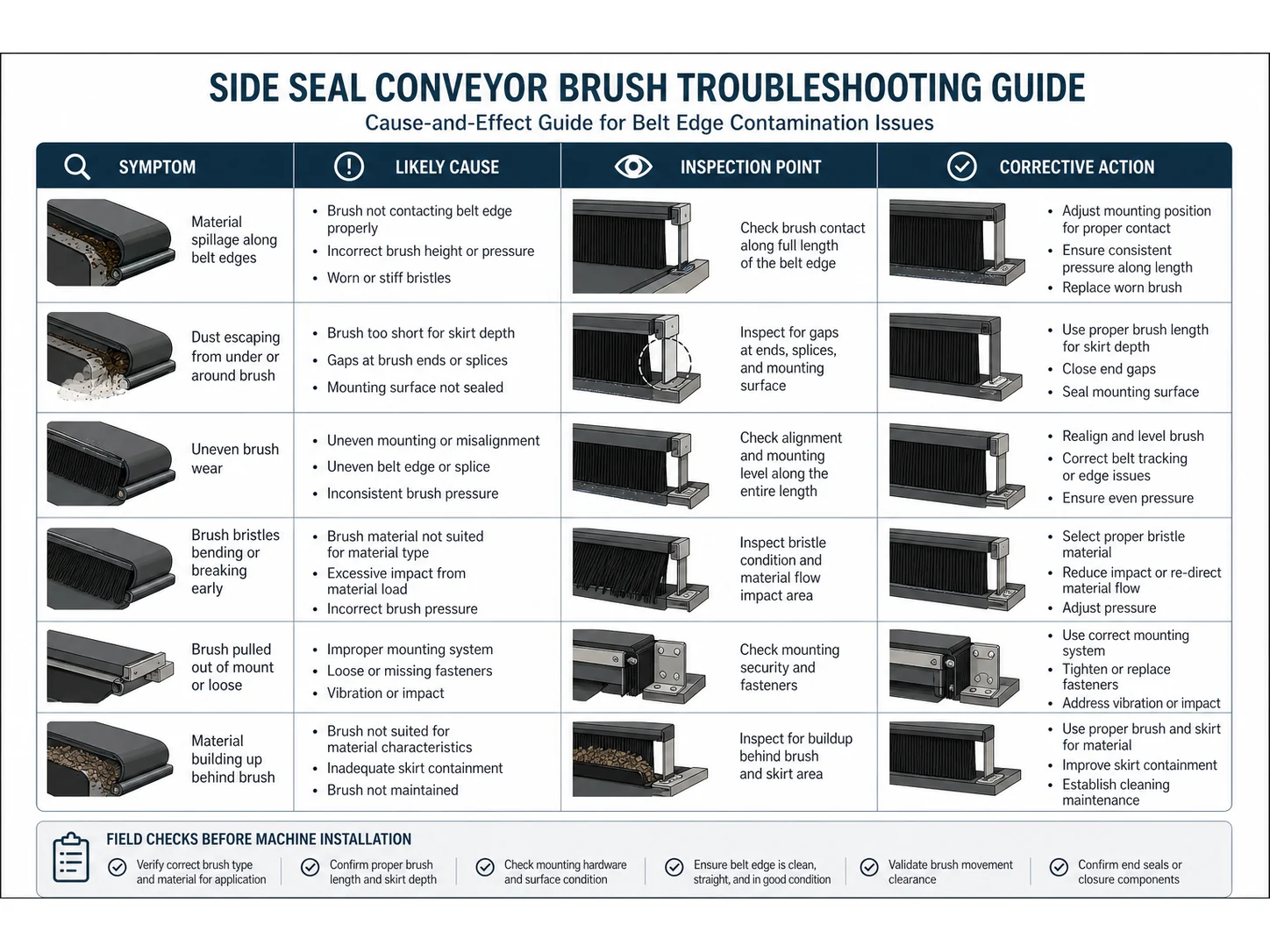
- Choosing bristle stiffness by cost drivers, not by residue: A brush that is too stiff can wear down the belt edge; one that is too soft may not maintain contact, letting material escape.
- Ignoring chemical compatibility: Using polypropylene in a high-solvent environment or nylon in strong acids can cause bristles to break down rapidly.
- Improper mounting alignment: If the brush does not track the belt edge uniformly, gaps form and spillage continues. Always align the holder parallel to the belt line.
- Using standard brushes in high-temperature zones: Nylon softens around 180°F; exceeding its limit leads to deformation and seal failure. Heat-resistant materials are a must near dryers or ovens.
- Neglecting holder material in washdown areas: Plain steel holders rust and contaminate product. Stainless steel or polymer holders prevent this.
- Underestimating belt wander: Belts rarely run perfectly true. Select a brush width that accounts for expected lateral movement, or use a flexible mount.
- Skipping a replacement schedule: Even durable brushes wear. A worn brush exposes the belt edge and increases cleanup labor. Plan proactive changeouts.
- Treating the side seal brush as a primary conveyor belt cleaner: A seal brush contains material; it does not remove carryback from the belt surface. Pair it with a proper belt cleaner if needed.
When a Side Seal Conveyor Brush Is the Wrong Choice
Side seal brushes work well for edge containment, but they have limits. Consider additional or alternative solutions when:
- Material is highly abrasive and quickly wears bristles – a combination of brush plus a hard-faced skirting may be more cost-effective.
- Dust or fumes require full containment – a side seal brush alone cannot provide airtight sealing; enclosures with vacuum extraction are necessary.
- Heavy liquid or slurry is present – brushes may wick moisture; a dual-stage system with a squeegee or drain pan is often needed.
- Food-grade certification with full documentation is mandatory – verify that the complete brush assembly (bristles, holder, and any adhesives) meets regulatory standards. Simple material claims are not enough.
- The belt edge is seriously damaged – a brush cannot fix a worn or crooked edge; schedule belt repair or replacement first.
If operating conditions are outside typical ranges, request supplier drawings and, if possible, arrange a sample test before committing to a full installation.
Final Takeaway
A side seal conveyor brush is a proven tool for reducing belt-edge contamination, but only when selected and installed correctly. Avoid the common shortcut of basing the decision on cost drivers or a generic spec. Match bristle material, stiffness, and holder to your specific residue, environment, and maintenance realities. Regularly inspect alignment and wear, and don’t hesitate to combine it with other solutions when the application demands more than a seal. A well-chosen brush reduces cleanup, protects downstream equipment, and extends belt life.
Frequently Asked Questions
What is the difference between a side seal brush and a conveyor belt cleaner?
A side seal brush is designed for belt edge containment, preventing material from falling off the sides. A conveyor belt cleaner (often a scraper or rotating brush) removes carryback from the belt surface. They serve different purposes and are often used together.
Can side seal brushes handle wet or sticky materials?
Yes, but careful material selection is required. Polypropylene bristles resist moisture and many chemicals, making them suitable for wet applications. Natural fibers like Tampico should be avoided in wet environments because they absorb water and can harbor bacteria.
How do I determine the correct bristle stiffness?
Start with the residue. Light, dry dust needs only a soft to medium bristle to create a seal without excessive pressure. Heavier or abrasive granules may need a firmer bristle to maintain contact. Always test on a small section first if possible; a brush that is too stiff can damage the belt.
What mounting options work best for retrofit applications?
Clamp-on or magnetic mounting systems are popular for retrofits because they require minimal frame modification. Bolt-on holders are more secure but need drilling. Make sure the mounting mechanism provides easy adjustment for alignment and wear compensation.
How often should side seal brushes be replaced?
Replacement intervals depend on material abrasiveness, belt speed, and operating hours. As a general guideline, inspect brushes monthly. Replace when bristle length has worn down by about 30% or when you notice increased spillage. Keeping a log helps predict the right interval for your specific process.
Are there food-grade side seal conveyor brushes?
Yes, brushes with FDA-compliant nylon or polyester bristles and stainless steel holders are available for food-processing lines. Always ask for full material certifications and ensure the design supports easy cleaning and sanitation.
Can I cut a stock brush to length myself?
Most industrial brush channels can be cut with a saw, but you must handle the ends properly. Exposed metal edges should be deburred and sealed to prevent corrosion and belt damage. For food applications, consult the supplier to avoid creating crevices that trap debris.
What signs indicate the brush is damaging the belt?
Look for accelerated belt-edge wear, grooves, or fraying on the belt cover. A squealing noise during operation can also signal excessive friction. If these occur, check bristle stiffness, alignment, and the presence of embedded abrasive material in the brush.
Technical References
- OSHA — Machine Guarding
- OSHA — Control of Hazardous Energy
- OSHA — Combustible Dust
- EPA — Particulate Matter Basics
Which bristle material fits this job — AISI 304 Stainless Steel Wire, Nylon PA or Abrasive Nylon?
| Material | Continuous temperature (°C) | Peak temperature (°C) | Water absorption | Hardness |
|---|---|---|---|---|
| AISI 304 Stainless Steel Wire | 400 | 500 | 0% | Rockwell B 70–95 depending on temper and cold work |
| Nylon PA | 93 | 121 | 0.3–9% by PA grade and conditioning | Medium to firm; filament diameter and trim length control bending force. |
| Abrasive Nylon | 120 | 150 | 0.1–1.0% | Abrasive filament; stiffness and cutting level is controlled by PA base, grit type, grit size, filament diameter and trim height. |
| Horsehair | 60–80 | 100–120 | 8–15% | — |
Figures as published by Alleima; Brushtec / DuPont; Perlon. Confirm the exact grade against the supplier datasheet before ordering.
What should replace AISI 304 Stainless Steel Wire for conveyor belt?
- AISI 304 Stainless Steel Wire — Use AISI 316 stainless steel wire for chloride, marine, dairy, beverage, chemical washdown, or higher pitting-resistance requirements. Use carbon steel for dry aggressive cutting and brass or abrasive nylon for lower marking risk.
- Nylon PA — Compare Nylon PA with PP, PBT, PET. Change material when wet stiffness, temperature, chemical resistance, conductivity, particle shedding, or surface marking becomes the limiting factor.
- Abrasive Nylon — Compare Abrasive Nylon with PP, PBT, PET. Change material when wet stiffness, temperature, chemical resistance, conductivity, particle shedding, or surface marking becomes the limiting factor.
- Horsehair — Compare Horsehair with Boar bristle, goat hair, microfiber. Change material when wet stiffness, temperature, chemical resistance, conductivity, particle shedding, or surface marking becomes the limiting factor.