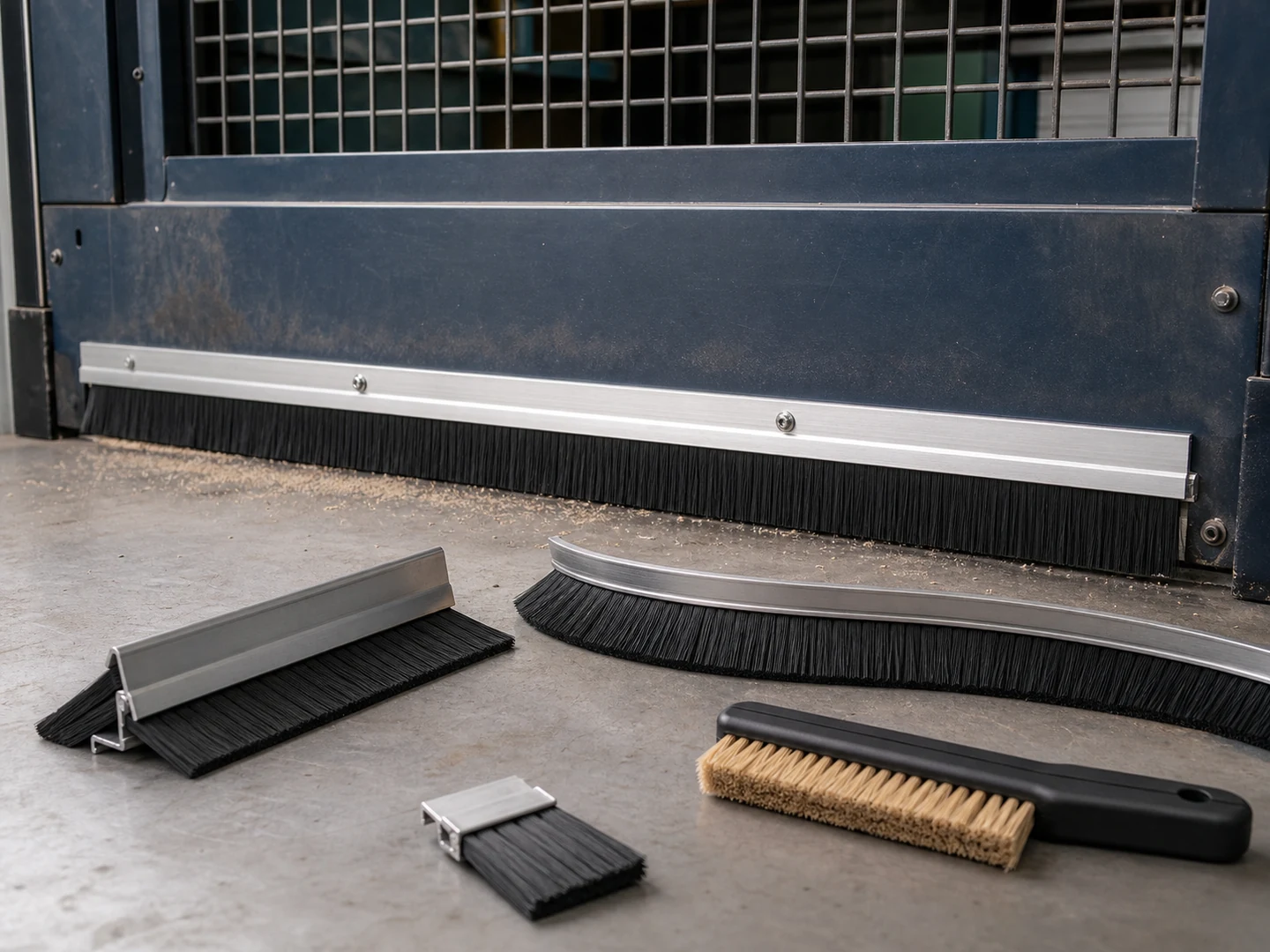
What does a seal brush actually do?
It holds a barrier. Every other brush on this site removes something; a seal brush fills a gap that must stay closed against dust, draft, light, chips or insects while a door, a belt or a cable moves through it. That makes it a wear part with a service life, and its specification is driven by the gap, the movement, and any rating the surrounding assembly has to carry.
What does the gap have to do?
- Keep contact while something moves: a door leaf, a sliding guard, a conveyor edge. The free trim has to be longer than the gap by enough to stay in contact over the whole travel, wear included.
- Let something pass without damage: cables through an entry, product across a guard opening. The fill must part and recover, not wear away what goes through.
- Contain, not seal completely: a brush seal is a barrier, not a gasket. Where a true seal is needed, a brush is the wrong part, and no fill choice changes that.
- Meet the assembly’s rating: fire, smoke, static or hygiene requirements belong to the assembly the strip sits in, and they decide the fill before the dust does.
Which fill for which duty?
| What the seal faces | Where to start | Why |
|---|---|---|
| Ordinary dust and drafts, indoors | Nylon PA or PBT | Recovers after millions of cycles, at low cost |
| A fire or smoke rating on the assembly | Flame Retardant Nylon | The rating belongs to the tested door or opening assembly, seal included; a flame-retardant fill helps but does not carry the rating on its own |
| Static-held dust, or an ESD-controlled room | Conductive Nylon or Anti-Static Filament | Carries charge away, rather than only resisting it, where there is a path to ground |
| Combustible dust in a protected area | Conductive Nylon with a measured bond | In these areas the measured bond to ground is the specification, not the name of the fill |
| Outdoors, sun and weather | Polypropylene PP, UV-stabilized | Keeps its strength through the seasons, where untreated fill chalks |
| Wet or washdown service | Polypropylene PP or PBT | Takes up very little water, so the trim length hardly changes with humidity |
How are seal brushes mounted?
The holder decides most of the installed cost: an aluminum or galvanized channel screwed to the frame, a clip-in profile, or a strip wound into a spiral for a rotating opening. Density is the second lever. The same fill set denser seals better and wears faster, and on a moving leaf it adds drag. Where the brush has to survive cleaning, choose the holder material together with the fill, not after it.
What usually goes wrong?
- Ordering to the gap instead of the travel. A strip sized to the closed gap loses contact as soon as the leaf moves or the frame settles.
- Buying a brush seal to do a gasket’s job. It contains; it does not seal.
- Choosing an antistatic fill where the area needs a path to ground. Antistatic and conductive are different claims, and only conductive can be measured at the bond.
- Forgetting the assembly’s rating. The right fill in a strip that does not meet the rating still fails the inspection.
What should you send for a quote?
The gap and its tolerance, the travel and how often it cycles, what passes through, the holder profile or the frame it fixes to, the environment, and any fire, smoke, hygiene or static requirement on the assembly. Say whether the strip is cut to length on site or supplied finished.