
What Is a Machine Guard Strip Brush?
A machine guard strip brush consists of bristles fastened into a rigid holder, usually made of metal, plastic, or an aluminum channel. The bristles extend outward, creating a flexible barrier that allows parts to move through or press against it while blocking the passage of airborne dust and larger particles. In dust sealing, the brush is often installed along the periphery of access doors, conveyor openings, robotic cell guards, or enclosure panels. Its effectiveness depends on filament density, stiffness, and proper contact with the mating surface.
Common Types of Machine Guard Strip Brushes
While strip brushes can look similar, their performance in dust sealing varies widely based on material and construction. The most frequently used variations include:
- Standard nylon filament strip brushes for dry, non-chemical environments.
- Antistatic strip brushes with conductive fibers for electronic assembly or flammable dust areas.
- High-temperature strip brushes using heat-resistant filaments like Nomex for oven doors or hot material handling.
- Stainless steel or brass wire strip brushes for heavy abrasion or rough surfaces.
- Food-grade strip brushes with FDA-compliant materials for processing lines.
Despite their simplicity, machine guard strip brushes are frequently misapplied. Understanding the most common pitfalls can save significant downtime and contamination risk.
Top Mistakes When Using Machine Guard Strip Brushes for Dust Sealing
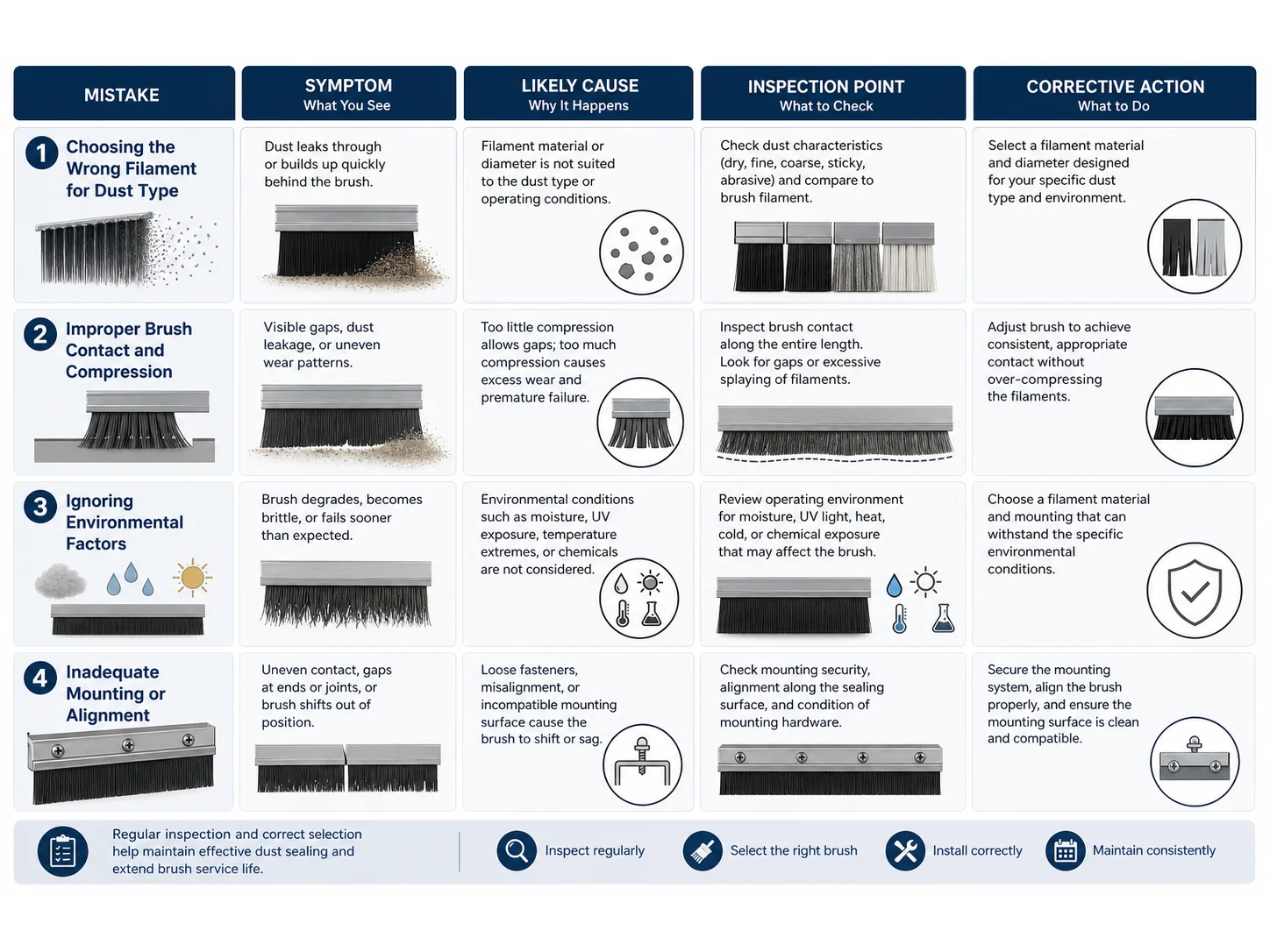
Mistake 1: Choosing the Wrong Filament for Dust Type
Not all dust is the same. Fine, powdery dust (such as toner or flour) requires a dense brush with soft, flagged filaments to create a tortuous path that traps particles. Stiff, monofilament brushes leave gaps that allow fine dust to pass. Conversely, abrasive dust like sand or metal filings will quickly wear soft bristles. For applications with fine and potentially conductive dust, neglect of antistatic properties can lead to static buildup and discharge hazards. Selecting the right filament material and configuration is critical.
Mistake 2: Improper Brush Contact and Compression
For effective sealing, the strip brush must maintain consistent contact with the opposing surface. Too little compression (or a gap) creates an open path for dust. Excessive compression, however, causes rapid bristle fatigue, permanent deformation, and increased friction that may overload motors or generate heat. The ideal compression is typically 10–30% of the bristle length, depending on filament stiffness. Inconsistent mounting can lead to uneven contact, creating localized dust leaks.
Mistake 3: Ignoring Environmental Factors
Temperature extremes, moisture, chemicals, and UV exposure can degrade filaments. Standard nylon absorbs moisture and loses stiffness in humid environments. Polypropylene is better for moisture but has lower heat resistance. Chemical exposure can embrittle many plastics; stainless steel wire may be required. Outdoor applications subject brushes to UV, which will cause nylon to become brittle over time unless UV-stabilized grades are used. Overlooking these factors leads to premature failure.
Mistake 4: Inadequate Mounting or Alignment
Even the best brush will leak if the holder is bent, twisted, or not aligned parallel to the mating surface. The channel must be securely fastened and straight. Common errors include using insufficient fasteners, not reinforcing long spans, or placing holders where they can be impacted by moving equipment. Additionally, the mounting surface must be clean and flat to prevent waviness that creates gaps.
Mistake 5: Neglecting Regular Inspection and Maintenance
Machine guard strip brushes are wear items. Over time, bristles can become clogged with dust, permanently bent, or worn down. A brush that looks intact may have lost its sealing effectiveness. Maintenance teams often overlook strip brushes until a dust leak becomes obvious. Establishing a periodic inspection schedule to check bristle condition, clean out accumulated debris, and measure compression helps prevent unexpected failures.
How to Avoid These Mistakes
To ensure your machine guard strip brush performs reliably in dust sealing:
- Consult the brush manufacturer early in the design phase to evaluate your specific dust, environmental conditions, and mechanical requirements.
- Request samples and test under actual operating conditions, particularly for critical or high-contamination applications.
- Use adjustable mounting brackets or shims to fine-tune the brush-to-surface gap and achieve uniform compression.
- Train maintenance staff on proper brush inspection and replacement criteria; set threshold measurements for bristle wear.
- Consider integrated sealing approaches, such as dual brush rows or combining strip brushes with rubber seals for extreme dust conditions.
Brush Selection Checkpoints
| Check point | What to confirm | Why it matters |
|---|---|---|
| Access | Confirm the brush can physically reach the target area | A brush that cannot reach the soil cannot solve the problem |
| Residue | Match bristle stiffness and material to the actual soil | Improves cleaning without unnecessary abrasion |
| Surface limit | Check scratch, shedding, staining, or compatibility risk | Prevents damage while cleaning |
| Use routine | Plan cleaning, drying, storage, and replacement | Keeps performance consistent over time |
How to Check the Result
After brushing, inspect both the cleaned area and the brush. A good result removes the target soil while leaving the surface, bristles, mounting, and nearby components in acceptable condition. If cleaning improves only when pressure is increased sharply, the brush specification or the surrounding process should be reviewed.
Bottom Line
The best result comes from matching machine guard strip brush mistakes in dust sealing and how to avoid them to the real cleaning task rather than forcing one brush to solve every condition. Confirm access, residue, surface limits, and replacement routine first; then use a small trial or inspection step before scaling the method into daily work.
Frequently Asked Questions
What is the best filament for machine guard strip brushes in dusty environments?
The ideal filament depends on the dust and environment. For fine, dry dust, nylon with flagged bristles offers excellent sealing. For abrasive dust, choose a harder filament like polypropylene or wire. In electronic manufacturing, antistatic conductive fibers are essential. Always match the material to the dust’s particle size, abrasiveness, and electrostatic properties.
How much compression should a machine guard strip brush have for effective sealing?
A general guideline is 10–30% compression of the free bristle length. For example, a brush with 50 mm long bristles should have 5–15 mm of interference with the mating surface. Excessive compression accelerates wear; too little fails to seal. The optimal value also depends on bristle stiffness and the required sealing level.
Can machine guard strip brushes be used with abrasive dust?
Yes, but filament material and density must be chosen to withstand abrasion. Wire filaments (stainless steel, brass) or heavy-duty nylon with thicker diameters are common. Regular inspection is crucial, as abrasive dust will gradually erode bristles. In high-abrasion areas, consider easily replaceable brush strips to minimize downtime.
How often should machine guard strip brushes in dust sealing be replaced?
Replacement intervals vary based on operating hours, dust type, and movement. Proactive replacement based on wear indicators or time-periodic inspections (e.g., quarterly) is recommended. If bristles are visibly shortened, deformed, or the seal shows visible gaps, immediate replacement is necessary to maintain dust containment.
Can a long seal be made up from shorter strip sections?
It can, but butt joints leak, and a dust seal is only as good as its worst gap. Where a run has to be assembled from sections, the joint should be overlapped rather than butted, or the fill densified across the seam. A seal that tests well along its length and fails at two joints is usually reported as a filament problem when it is a jointing one.
Technical References
- OSHA — Machine Guarding
- OSHA — Control of Hazardous Energy
- OSHA — Combustible Dust
- EPA — Particulate Matter Basics
Which bristle material fits this job — Nylon PA, AISI 304 Stainless Steel Wire or Brass Wire?
| Material | Continuous temperature (°C) | Peak temperature (°C) | Water absorption | Hardness |
|---|---|---|---|---|
| Nylon PA | 93 | 121 | 0.3–9% by PA grade and conditioning | Medium to firm; filament diameter and trim length control bending force. |
| AISI 304 Stainless Steel Wire | 400 | 500 | 0% | Rockwell B 70–95 depending on temper and cold work |
| Brass Wire | 150–200 | 250–300 | 0% | Rockwell B 40–90 |
| Rubber | 100 | 130 | very low | Specified by compound and Shore hardness; published TPE families can span roughly 50–80 Shore A, but that is a product-family example rather than a universal rubber range. |
| AISI 316 Stainless Steel Wire | 400 | 500 | 0% | Rockwell B 70–95 depending on temper and cold work |
Figures as published by Brushtec / DuPont; Alleima. Confirm the exact grade against the supplier datasheet before ordering.
When are Strip Seal Brushes the wrong choice for strip brush?
- Strip Seal Brushes — Use rubber lips, foam, labyrinth seals, air curtains, or rigid scrapers when pressure sealing or liquid containment is required.
- Nylon PA — The nylon family spans several grades, so heat, moisture and chemical limits should follow the selected PA resin rather than a generic nylon value.
- AISI 304 Stainless Steel Wire — Avoid using AISI 304 as the default in marine, brine, hypochlorite, and persistent chloride environments; use AISI 316 when higher pitting and crevice-corrosion resistance is required.
- Brass Wire — Avoid on stainless surfaces where copper contamination is restricted and on delicate coatings that mark under metal contact.
What should replace Strip Seal Brushes for strip brush?
- Strip Seal Brushes — Strip brushes create a linear barrier or guide; machine-table brush plates distribute load and support products over a broad area. Closest alternative: Machine Table Brush Plates.
- Nylon PA — Compare Nylon PA with PP, PBT, PET. Change material when wet stiffness, temperature, chemical resistance, conductivity, particle shedding, or surface marking becomes the limiting factor.
- AISI 304 Stainless Steel Wire — Use AISI 316 stainless steel wire for chloride, marine, dairy, beverage, chemical washdown, or higher pitting-resistance requirements. Use carbon steel for dry aggressive cutting and brass or abrasive nylon for lower marking risk.
- Brass Wire — Compare Brass Wire with Steel wire, stainless wire, nylon. Change material when wet stiffness, temperature, chemical resistance, conductivity, particle shedding, or surface marking becomes the limiting factor.