
Custom Cleaning Brush
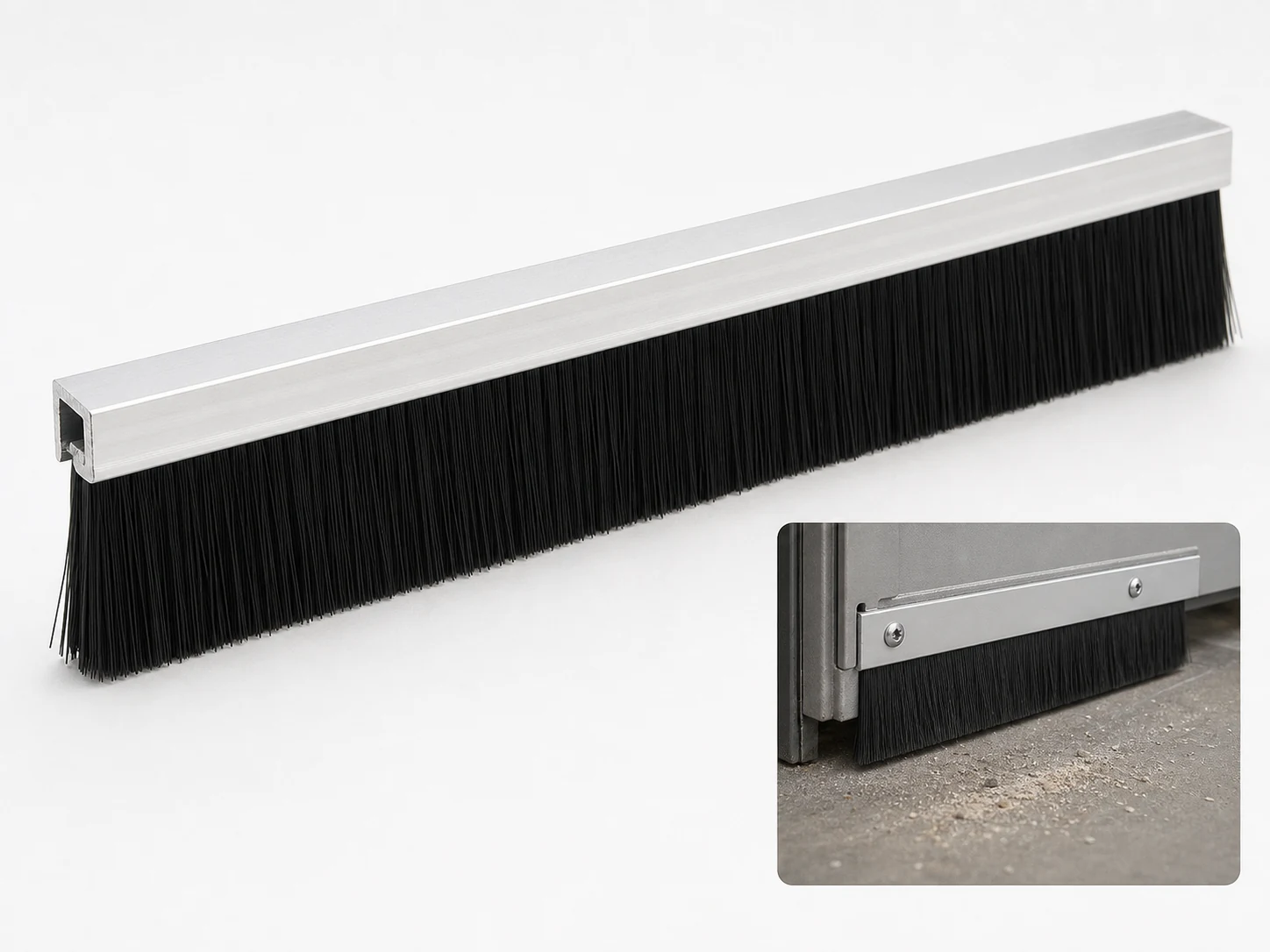
Strip Brush
Order custom strip brushes for door gap sealing, conveyor openings, cable routing, and edge wiping.
Large-format brush
100 pcs
Minimum order
Built one at a time on a core or channel: full-width rollers, sweeper brooms and long strip.
Production lead time, once the specification is confirmed
- Up to 100 pcsWithin 20 days
- 101–1,000 pcsWithin 30 days
- Over 1,000 pcsConfirmed with your quotation
Peak season can extend these times; the shipping date is confirmed in writing with your quotation. Sampling and shipping are quoted separately.
A configurable linear brush for sealing, wiping, guiding, and gap control along door edges, machine enclosures, conveyor openings, cable passages, and rails. The dense filament fill bends around moving parts and uneven panel gaps while still blocking air, dust, chips, light, noise, and loose debris.
What can this brush do for you?
Compensates for uneven and moving gaps
Fabricated doors and enclosure panels rarely have perfectly uniform edges. Strip brush filaments bend independently and spring back after contact, so one continuous length follows a gap that varies across the edge or moves with the panel. The brush keeps covering the opening without requiring every panel edge to be machined to a tight tolerance.
Seals openings while parts and cables pass through
The filament row separates under load and returns to position after the item passes. That allows conveyor openings, pass-through slots, cable entry points, and parts-transfer windows to stay covered during idle periods and open only where the product or cable is present. Air, dust, chips, spray mist, and light stay more contained than with a rigid barrier or an open slot.
One profile covers wiping, sealing, and guiding
Depending on compression and filament, the same strip brush can lightly strip granules from a moving belt edge, wipe oil film or dust from a rail, or seal a machine enclosure gap. Changing the installed compression changes the working mode without changing the brush profile.
Filament material sets the operating limit
Nylon PA provides general-purpose wear resistance and recovery; PBT resists moisture and many chemicals better; horsehair offers a soft natural contact for low-abrasion wiping and scratch-sensitive surfaces; 316 stainless steel wire extends the strip brush into high-temperature, wet, corrosive, and heavily abrasive duties. Specifying the material from the start prevents premature flattening or a filament that cannot tolerate the environment.
Mounts in standard hardware and replaces without rework
Straight channel, aluminum carrier, and angled holder constructions slide into common retaining slots or bolt directly to flat surfaces. When the fill wears, the whole brush section can be removed and replaced without rebuilding the door, panel, or machine frame.
What is a Strip Brush?
A strip brush is a long, narrow brush made from a continuous channel that holds parallel rows of filament along its full length. The brush is mounted along a door edge, enclosure frame, conveyor side, rail, or opening; the free filament tips contact the adjacent surface or the material moving past.
In sealing service, the mounted gap is smaller than the filament projection, so the fill bends under a controlled preload. The compressed filaments fill the remaining space and restrict airborne dust, chips, mist, light, noise, and insects. In wiping or guiding service, the brush contacts a moving surface lightly and removes loose debris, oil film, or product residue, or keeps the material aligned over the length of contact.
A strip brush is a passive linear contact tool, not a powered brush or an absolute seal. It reduces, redirects, and controls passage through a gap; it does not create a watertight or gas-tight closure. That distinction matters when the brush is compared with a gasket, rubber seal, or solid barrier.
Technical Specifications
Values below represent the standard range. Exact dimensions, fill density, and holder profile are matched to each installation.
| Parameter | Value / Options |
|---|---|
| Custom strip length | 100–3,000 mm per section; longer openings can be covered with aligned sections or project-specific continuous lengths |
| Trim height | 12.7–152.4 mm; measured from the channel face to the filament tips |
| Channel width | 3.2–14.3 mm; matched to the retaining slot or mounting face |
| Filament diameter | 0.10–1.27 mm; selected with fill material for required stiffness and density |
| Working compression | 5–25% of trim height |
| Wiping / dust control setting | 5–15% trim compression |
| Sealing setting | 10–25% trim compression; avoid loading the fill until it folds flat |
| Holder / backing | Straight steel channel, aluminum carrier, angle holder, or custom profile |
| Fill materials | Nylon PA, PBT, horsehair, 316 stainless steel wire |
| Mounting | Standard retaining slot, bolted channel, or carrier-type support |
| Brush type | Custom Strip Seal Brushes |
| How it is driven | Fixed in place, no drive of its own |
| Cleaning target | door and panel gap sealing, spray booth opening, and edge wiping and material guiding cleaning |
| Surface or part | edges, gaps, conveyors, panels, rails, door edges, cable, and machine enclosures |
| Residue or debris | dust, chips, loose debris, mist, noise, insects, oil film, and product residue |
| Mounting / connection | Standard retaining slot, bolted channel, or carrier-type support |
Compression is calculated from the free trim height, not the overall brush height. A brush with 50 mm trim tightened to 45 mm is at 10% compression.
Where does this brush work best?
- Door and panel gap sealing — access doors, sliding guards, machine enclosures, electrical cabinets, and inspection panels; closes gaps while the door remains operable.
- Conveyor, oven, and spray booth openings — pass-through slots where product or trays travel; filaments open locally and reseal, reducing heat loss, draft, spray mist, and dust transfer.
- Cable and wire routing openings — floor slots, control cabinets, server racks, and machine bases; cables pass continuously and the surrounding opening stays blocked.
- Edge wiping and material guiding — conveyor side rails, belt edges, printing and laminating lines, and transfer stations where light contact removes loose residue or aligns product.
- Exterior door and threshold edges — garage, loading dock, and exterior access door edges where insect, dust, light, and draft reduction are needed.
How do I choose the right one?
Start with the gap, not the brush
Measure the smallest and largest installed gap along the full length, plus the retaining slot dimensions or mounting surface. The trim height must exceed the largest gap at the planned compression setting. A gap that varies along the edge needs a longer trim and a lower preload, or a continuous flexible holder that follows the profile.
Set the compression for the intended job
Dust wiping and light product contact run better at 5–15% trim compression. Sealing and air or dust restriction need 10–25% compression. If the filament folds over flat and does not recover after the product passes, the preload is too high or the filament is too soft for the contact.
Choose the filament for the operating environment
| Operating condition | Usually suitable fill |
|---|---|
| General dry dust, chips, light wear | Nylon PA |
| Coolant, moisture, chemical washdown | PBT or 316 stainless steel wire |
| Low-abrasion, scratch-sensitive surfaces | Horsehair |
| High temperature, corrosive, or heavily abrasive contact | 316 stainless steel wire |
Adjust filament diameter and fill density after the material choice. Fine filaments with high density block fine dust and light; thicker filaments tolerate rougher edges and heavier mechanical contact.
Match the channel to the mounting system
Existing equipment may already have a standard retaining slot; in that case channel width and profile must match. New installations can use a straight channel, an aluminum carrier with bolt holes, or an angled holder to position the contact face correctly. Confirm the holder allows the brush to be slid out and replaced from one end or an accessible point.
Know when a strip brush is not the right closure
If the opening must be watertight or gas-tight, use a rubber gasket, foam, compression seal, or solid barrier instead. If the brush will be dragged across highly abrasive edges at heavy pressure, evaluate the wear rate and consider a heavier stainless steel wire fill or a separate metal wear strip. If the environment requires absolute contamination control and zero particle passage, a brush alone may need to be paired with another barrier.
Can I customize this brush?
Industrial strip brushes are usually built to the opening rather than selected from fixed stock. For a project request, provide the gap dimensions, panel edge profile, mounting slot or hole pattern, ambient and process temperatures, chemicals or washdown fluids, required compression, and anything that passes through the opening. A drawing or photo helps us match the profile quickly.
- Length — cut sections from about 100 mm to 3,000 mm; longer openings can use aligned sections or continuous custom lengths.
- Trim height and profile — any projection within or beyond the standard 12.7–152.4 mm range, straight or angled trim, and multi-height fill for irregular edges.
- Fill — nylon PA, PBT, horsehair, 316 stainless steel wire; filament diameter from fine to coarse; fill density and stiffness adjusted.
- Channel or holder — straight steel channel, stainless channel, aluminum carrier, angle holder, custom extrusion, drilled or slotted mounting.
- End details — cut ends, formed corners, closed ends, connectors, or overlapped joints.
- Color, marking, packaging — filament and channel color, printed or laser identification, bulk coil, cut-to-length, bagged per length, or project-specific packing.
If the project requires material declarations, inspection, or third-party testing, we can assist with the specific documentation during customization.
How do you tell when a strip brush is worn out?
What is the difference between trim height and overall brush height?
Trim height is the visible filament length from the channel face to the filament tips. Overall height includes the channel. Compression recommendations are based on trim height, so measure the free filament projection before setting the installed gap.
How can I check whether the installed brush is at the recommended compression?
Measure the free trim height at the mounted position, then compare it with the actual gap after the mating surface or product is in place. For wiping and dust control, install to approximately 5–15% less than the free trim; for sealing, target 10–25% compression. If the filament stays bent or folds flat after the load passes, the compression is too high or the filament is wrong for the application.
Can one strip brush be joined to cover a very long opening?
Yes. Sections can be mounted end to end in a continuous retaining channel or joined with aligned butt ends. A visible seam may create a small open line at the junction. For stricter sealing, request a single continuous length or a factory-fitted connection detail.
Does the direction of product travel affect brush life?
It can. In wiping and guiding duty, it is usually better for the product or belt to travel with the natural lean of the filament, not against it. Running against the lay increases flex fatigue and can fold the fill over. For static door sealing, travel direction is less important. We will ask about travel direction and set the fill accordingly.
Is the strip brush a watertight seal?
No. A brush controls airborne dust, chips, mist, insects, noise, and light. It reduces splash and air movement but is not a liquid- or gas-tight barrier. For water- or pressure-tight service, add a rubber gasket, compression seal, or splash guard in parallel.
When should I schedule brush replacement?
Replace the brush when the filament no longer springs back to its original trim height after parts or panels pass, when a visible gap opens between the filament tips and the mating surface, when the fill is heavily matted, or when the channel is bent or corroded enough to affect retention. If the same setting no longer provides the original seal or wipe, the brush has reached the end of its useful contact life.
Guides that go deeper on this
Extending Strip Brush Life in Abrasive Environments
Read this guideGuideFood Processing Strip Brush: Belt Edges, Dust and Washdown
Read this guideGuideGarage Door Brush Seal vs Standard Brushes: Dust Sealing
Read this guideGuideHow to Choose a Strip Brush for Cleaning Door Gaps
Read this guideGuideHow to Choose Door Seal Strip Brush
Read this guideGuideHow to Choose Horsehair Strip Brush
Read this guideGuideHow to Choose Nylon Strip Brush
Read this guideGuideHow to Choose PVC Dust Sealing Strip Brush
Read this guideGuideHow to Choose Rubber Strip Brush
Read this guideGuideHow to Choose Stainless Steel Strip Brush
Read this guideGuideHow to Specify Aluminum Holder Strip Brush in RFQs
Read this guideGuideHow to Specify Stainless Steel Strip Brush Holders in RFQs
Read this guide27 guides are indexed against this one. The rest are in the technical resources library.
Custom Manufacturing RFQ
Describe Your Application
Please share the brush dimensions, working area, residue type, material direction, quantity, and a drawing or photo for quotation.
Drawing or photo optional — it speeds things up, it does not gate the enquiry.
Custom Brush RFQ
Send Your Brush Project
Upload a drawing, product photo, or sample photo and provide the core dimensions and cleaning conditions.
“We need a brush to remove wet residue from a stainless steel conveyor, about 800mm wide. The current brush wears quickly. We can send photos.”
“We sell drinkware and need a cleaning brush to include with the product. Quantity around 5,000 pieces.”