
What Is a Roller Brush vs Strip Brush?
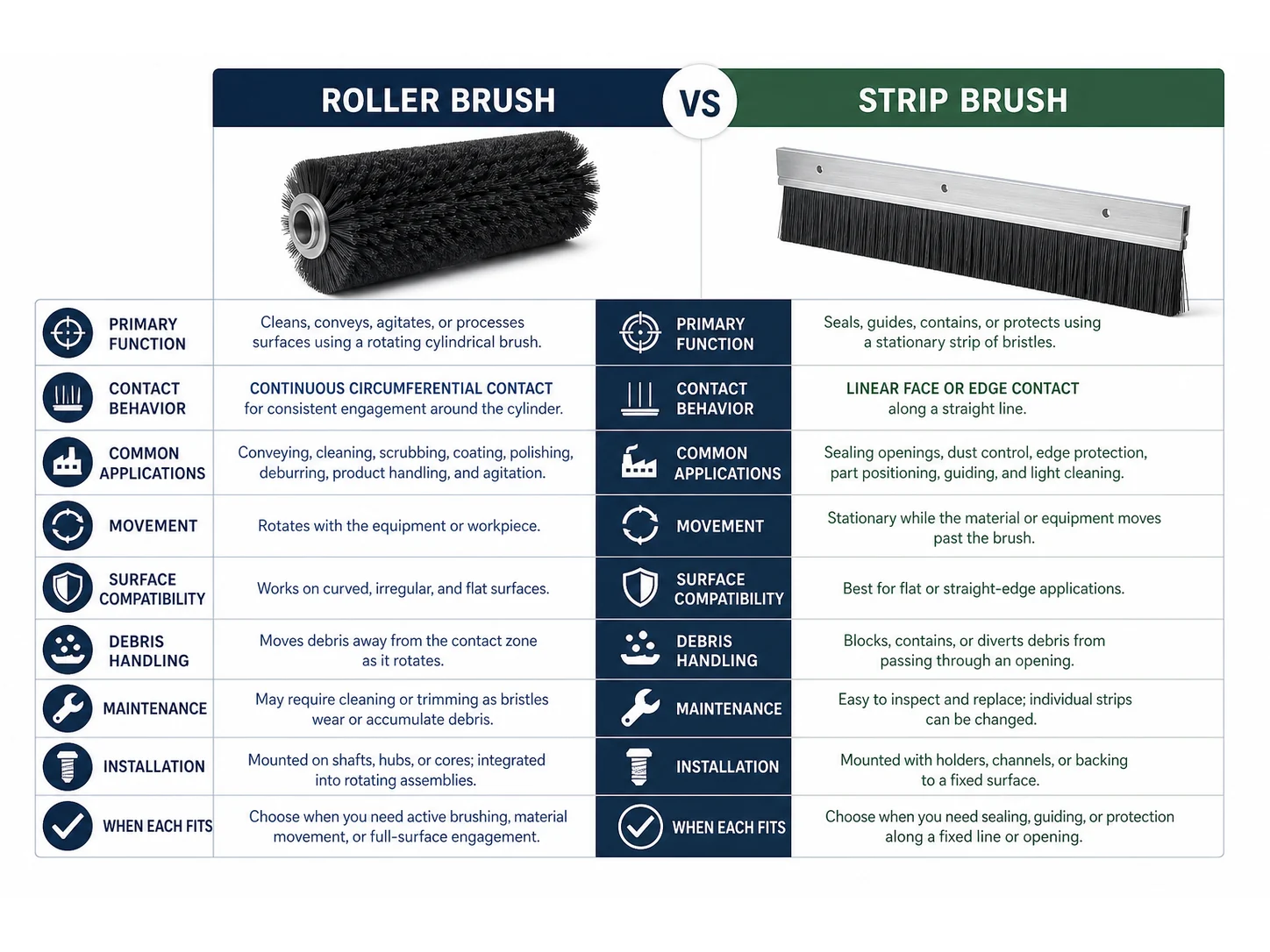
A roller brush is a cylindrical brush that rotates around a central shaft. It is designed for continuous contact over a moving surface, such as a conveyor belt, web, or product. The rotation allows the bristle tips to sweep, scrub, or transport material across the full working width.
A strip brush is a linear brush, usually mounted in a metal or plastic holder, that provides stationary or reciprocating contact. Strip brushes excel in edge sealing, wiping, static dissipation, or guiding material along a fixed path. They can be cut to length and bent to fit irregular profiles.
Common Types and Configurations
Both roller and strip brushes come in many variations, but three broad categories are:
- Roller Brush Construction: Spiral‑wound bristles on a solid or tube core, strip‑refill rollers with replaceable bristle segments, or molded cylinder brushes. Cores are typically steel, aluminum, or plastic.
- Strip Brush Construction: Metal‑backed strip with channel‑mounted bristles, flexible plastic‑backed strip, or clamp‑on designs. Mounting can be via screws, spring clips, or magnetic holders.
- Specialty Designs: Multiple rows, angled bristles, anti‑static filaments, or cut‑to‑shape strips for irregular contours.
How Roller Brushes and Strip Brushes Compare
| Feature | Roller Brush | Strip Brush |
|---|---|---|
| Typical Motion | Rotary | Stationary or reciprocating |
| Primary Use Cases | Conveyor cleaning, part scrubbing, surface finishing, material transfer | Edge sealing, draft stopping, static elimination, product guiding, wiping |
| Surface Contact Pattern | Continuous sweeping arc; can wrap around a rotating part | Linear line contact; constant pressure across the width |
| Installation Space | Requires clearance for rotation and shaft support bearings | Low‑profile; fits tight gaps, corners, and curved paths |
| Bristle Material Options | Nylon, polypropylene, abrasive‑filled nylon, natural fibers, brass, stainless steel | Similar material range; often softer for sealing, or conductive for static dissipation |
| Maintenance Access | May need removal of guards and end bearings; strip‑refill designs allow bristle replacement on‑core | Often accessible without dismantling adjacent machinery; refill strips can be slid into holders |
| Relative Cost | Higher initial cost, especially for long or high‑speed balanced rollers | Economical for long lengths, easy to cut and install in‑house |
| Sensitivity to Wear | Wear concentrated on the active arc; imbalance risk at high speed | Wear distributed evenly across the strip; no dynamic balance issues |
Key Factors for Choosing Between Roller and Strip Brushes
Before selecting a brush type, evaluate these process variables. The right choice is usually clear once the motion and contact requirements are fully defined.
- Motion requirement: Does the brush need to rotate to clean or convey? If yes, a roller brush is the starting point. If the brush must remain fixed while the product moves past it, a strip brush is typically correct.
- Contact surface sensitivity: Soft or easily scratched materials (polished metals, coated surfaces, thin films) often need a strip brush with fine, soft bristles to avoid rotational marring.
- Dry vs. wet operation: Both types can handle wet or dry environments, but roller brushes in wet tanks need corrosion‑resistant cores and bearings. Strip brushes often require stainless steel or polymer holders for wet or washdown areas.
- Temperature and chemical exposure: Match bristle material and core/holder material to the operating temperature range and any chemical contact. For example, nylon 6/6 tolerates moderate heat; PEEK or PTFE handles higher temperatures and aggressive chemicals.
- Line speed and duty cycle: Fast‑moving lines with continuous cleaning need a roller brush that can withstand centrifugal forces without bristle flare. High‑cycle reciprocating strip brush applications require robust holders to prevent fatigue.
- Cleaning target or residue type: Coarse, heavy debris may need an aggressive roller brush with crimped wire bristles. Light dust or static‑charged particles may only need a fine‑bristled strip brush with conductive filaments.
- Installation and maintenance windows: If access is limited to short shift breaks, a strip brush with quick‑release holders might beat a roller that requires bearing removal. Conversely, a strip‑refill roller can sometimes be serviced without dismounting the core.
- Budget and lifecycle cost: A roller brush often costs more upfront but may deliver better performance for high‑volume cleaning. Strip brushes are economical for long stretches of edging or sealing where precise rotational motion is not needed.
What to Confirm Before Ordering
When you submit an inquiry or RFQ, providing complete specifications avoids delays and ensures the supplied brush will perform as intended. Check these details:
- Dimensions: Overall length, face width (bristled working area), outside diameter (for roller brushes), and shaft/bore diameter.
- Bristle specification: Material, filament diameter, trim length (free bristle length), and density (rows per inch or fill percentage).
- Mounting details: For roller brushes: keyed shaft, set screw, clamp‑on, or flange mounting. For strip brushes: channel size, mounting hole spacing, or holder profile.
- Sample or drawing reference: If replacing an existing brush, provide a sample or dimensional drawing. Even a photograph with a scale can help suppliers match an unknown brush.
- Process parameters: Surface speed (fpm or m/s), expected load or pressure, ambient temperature, and any chemical exposure.
- Cleaning or sealing goal: Describe the residue, contamination, or gap being addressed. Specify the acceptable result—for example, “remove all particles larger than 0.5 mm” or “maintain a dust‑tight seal at 0.5 Pa pressure difference.”
These details help a supplier recommend the correct core material, bristle type, and design features without guesswork.
Common Mistakes When Selecting Industrial Brushes
Avoid these frequent errors that lead to poor performance or premature failure:
- Choosing by cost alone: An inexpensive brush that wears out quickly often costs more in downtime and replacement labor than a well‑specified brush.
- Ignoring core or holder material: A steel core in a wet, corrosive environment will rust and contaminate the product. Use stainless steel or polymer cores/holders when needed.
- Mismatching bristle stiffness: Overly stiff bristles can scratch delicate surfaces. Too‑soft bristles may not remove stubborn debris. Test on a non‑critical area if possible.
- Neglecting dynamic balance for roller brushes: Above a few hundred RPM, imbalance causes vibration, bearing failure, and uneven wear. Specify dynamically balanced rollers for moderate to high speeds.
- Overlooking thermal expansion: In high‑temperature applications, metal cores expand and can seize bearings or distort. Allow for thermal growth in the design.
- Forgetting about mounting access: A strip brush installed in a tight corner must be reachable for replacement. Design the machine or choose a holder style that allows quick change.
- Specifying without knowing the residue properties: Sticky, oily, or abrasive residues demand specific bristle materials and densities. Sending a residue sample to the manufacturer can prevent mis‑specification.
When a Roller Brush vs Strip Brush Is the Wrong Choice
Industrial brushes are excellent for mechanical cleaning, sealing, or low‑force conveying, but they have limits. A standalone brush cannot handle every contamination or sealing challenge. Consider supplementing or replacing a brush with another method when:
- Sticky or viscous residues: Heavy oils, adhesives, or food pastes may cling to bristles. Combine a brush with a spray bar, or switch to a scraper blade upstream, followed by a brush for final cleaning.
- Fine dust or airborne fibers: A dry brush can aerosolize fine particles, creating a respiratory hazard or re‑contamination. Add a vacuum extraction system directly at the brush housing to capture dust.
- Thin liquid films: A brush alone may spread a film rather than remove it. An air knife or combination air‑knife/brush system can blow off liquid while the brush agitates the surface.
- Thick, baked‑on deposits: Hard deposits may require a scraper, high‑pressure spray, or even ultrasonic cleaning before a brush can effectively polish or finish the surface.
- Clean‑in‑place (CIP) requirements: In sanitary processes, a brush that cannot be easily removed and cleaned may harbor bacteria. Switch to a CIP‑compatible design, or replace the brush station with spray balls or automated wash systems.
- Absolute sealing: When a brush cannot support zero leakage (e.g., vacuum chambers or high‑pressure differentials), a mechanical seal, inflatable seal, or labyrinth system must work alongside or instead of the brush.
Always analyze the entire system, not just the brush position. A well‑designed auxiliary process can extend brush life and improve overall performance.
Final Takeaway
The choice between a roller brush and a strip brush starts with the question: Does the application need rotating contact or fixed contact? Once you answer that, narrow options by surface sensitivity, environment, and maintenance reality. Provide complete specifications when ordering, and don’t overlook the value of combining a brush with vacuum, air, or scraping systems for demanding tasks. A correctly specified brush is one of the simplest and most reliable tools on any production line.
Frequently Asked Questions
Can a roller brush be used for static elimination?
Yes, but it is uncommon. Conductive roller brushes exist, but a stationary strip brush with conductive filaments is usually simpler and more cost‑effective for static discharge across a moving web.
What bristle material works best for high‑temperature applications?
Common choices include nylon 6/6 for up to 220°F (104°C), PTFE for up to 500°F (260°C), or stainless steel for even higher temperatures. Always confirm the filament’s continuous service temperature and any softening point.
How do I decide between a spiral‑wound roller brush and a strip‑refill roller brush?
Spiral‑wound rollers provide continuous bristle coverage and are economical for long production runs. Strip‑refill rollers allow quick bristle replacement without removing the core, reducing downtime. Choose based on your maintenance strategy and stock‑keeping preference.
Can strip brushes handle heavy debris like rocks or metal chips?
Heavy, sharp debris is generally not suitable for strip brushes, as the impact can bend or break the holder. For such applications, a robust roller brush with crimped steel wire bristles or a scraper may be a better choice.
What causes a roller brush to vibrate excessively?
Common causes include bristle wear creating an imbalance, a bent shaft, loose mounting, or operating above the designed speed without dynamic balancing. Inspect and re‑balance if vibration appears suddenly.
How often should I replace industrial brushes?
Replacement intervals depend on the application. Monitor bristle length—when it reaches about 25–30% of the original trim length, cleaning effectiveness typically drops significantly. Also watch for core or holder damage.
Are there food‑grade industrial brushes?
Yes, brushes for food contact must meet FDA or EU compliance. Bristles are often made of approved polypropylene, polyester, or nylon, and cores/holders use stainless steel. Always request the necessary documentation.
Can I cut a strip brush to length in‑house?
Most metal‑backed strip brushes can be cut with a hacksaw or cut‑off wheel. Plastic‑backed strips can be cut with shears. Deburr any sharp edges before installation.
Which bristle material fits this job — AISI 304 Stainless Steel Wire, Nylon PA or AISI 316 Stainless Steel Wire?
| Material | Continuous temperature (°C) | Peak temperature (°C) | Water absorption | Hardness |
|---|---|---|---|---|
| AISI 304 Stainless Steel Wire | 400 | 500 | 0% | Rockwell B 70–95 depending on temper and cold work |
| Nylon PA | 93 | 121 | 0.3–9% by PA grade and conditioning | Medium to firm; filament diameter and trim length control bending force. |
| AISI 316 Stainless Steel Wire | 400 | 500 | 0% | Rockwell B 70–95 depending on temper and cold work |
| Horsehair | 60–80 | 100–120 | 8–15% | — |
| PBT | 120–140 | 160–180 | 0.05–0.20% | Shore D 80–90 |
Figures as published by Alleima; Brushtec / DuPont; Perlon. Confirm the exact grade against the supplier datasheet before ordering.
What should replace Strip Seal Brushes for strip brush?
- Strip Seal Brushes — Strip brushes create a linear barrier or guide; machine-table brush plates distribute load and support products over a broad area. Closest alternative: Machine Table Brush Plates.
- AISI 304 Stainless Steel Wire — Use AISI 316 stainless steel wire for chloride, marine, dairy, beverage, chemical washdown, or higher pitting-resistance requirements. Use carbon steel for dry aggressive cutting and brass or abrasive nylon for lower marking risk.
- Nylon PA — Compare Nylon PA with PP, PBT, PET. Change material when wet stiffness, temperature, chemical resistance, conductivity, particle shedding, or surface marking becomes the limiting factor.
- AISI 316 Stainless Steel Wire — Use AISI 304 for general wet service without persistent chlorides. Use duplex, 904L, or higher-alloy wire when AISI 316 is insufficient for chloride stress-corrosion, severe crevice conditions, or aggressive acids.