
What Is a Copper Strip Cleaning Brush?
A copper strip cleaning brush is a linear brush where copper wire bristles are fixed into a channel that can be mounted onto strip brush holders, plates, or custom machinery. Unlike handheld brushes or rotary wheel brushes, the strip form factor suits inline, conveyorized, or coil-to-coil cleaning systems. Copper’s natural softness—relative to steel—makes it self-sacrificing, meaning it wears down the bristle rather than damaging the workpiece. This gentle aggression is ideal for removing:
- Light surface rust and flash corrosion
- Tarnish and oxidation on copper, aluminum, brass
- Debris and light deposits in narrow channels
The bristle diameter, trim length, and channel material (steel, stainless, aluminum, or plastic) can be customized for specific widths, angles, and chemical exposures.
Understanding Standard Cleaning Brushes for Rust Removal
When maintenance professionals speak of “standard” cleaning brushes for rust removal, they often mean handheld, cup, wheel, or strip brushes with bristles of steel (carbon or stainless), brass-coated steel, nylon with abrasive grit, or non-woven abrasives. Each has distinct characteristics:
- Steel wire brushes (crimped or knotted): Aggressive, fast, durable on hard steel; risk scratching soft metals.
- Brass-coated steel brushes: Softer than pure steel but the coating wears off, exposing steel and risking scratches.
- Nylon abrasive brushes: Polymer filaments with embedded abrasive (SiC, AlO); cut slower, surfaces remain smoother.
- Abrasive pad brushes: Non-woven fibers with abrasive grains; conform to shapes but wear rapidly.
None of these combine copper’s ductility, low scratch risk, and galvanic safety the way a pure copper strip brush does.
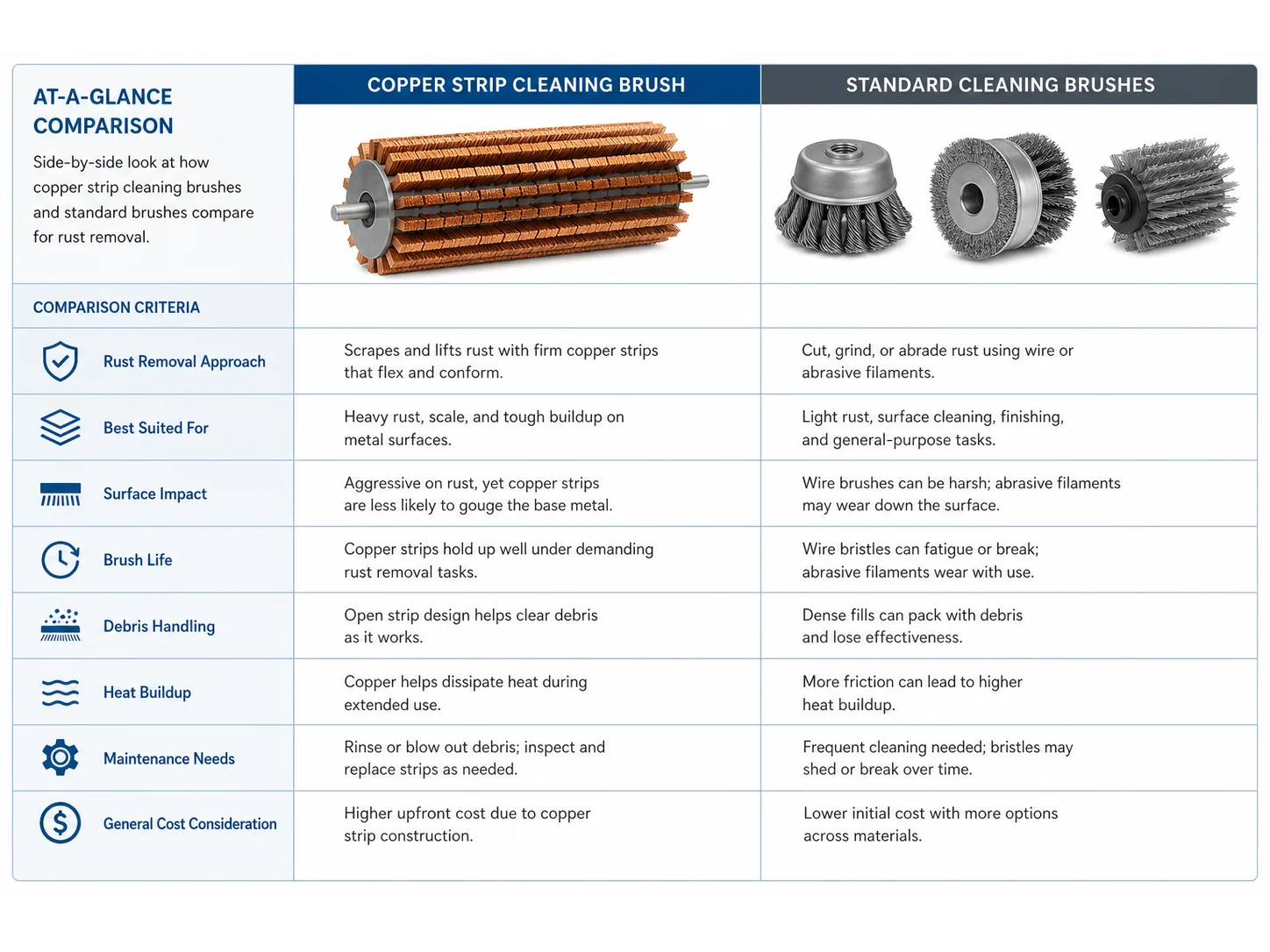
Copper Strip Cleaning Brush vs Standard Brushes: At-a-Glance Comparison
| Feature | Copper Strip Brush | Steel Wire Brush (Crimped) | Nylon/Abrasive Brush | Non-Woven Abrasive Pad |
|---|---|---|---|---|
| Bristle Material | Pure copper wire | Carbon steel (or stainless) | Nylon with grit | Non-woven fiber + abrasive |
| Rust Removal Capability | Light to moderate surface rust, oxidation | Moderate to heavy rust, mill scale | Light rust, surface prep | Light rust, blending, finishing |
| Surface Impact | Very low; safe on soft metals, aluminum, copper, thin steel | High; can scratch or gouge soft materials | Low to medium; grit wears surfaces gently | Medium; can profile surface if aggressive |
| Wet/Chemical Compatibility | Good; copper resists corrosion but avoid strong acids | Steel rusts unless stainless; chemicals may etch | Excellent; resistant to water and many chemicals | Good; can be used wet or dry |
| Hygiene & Cleanability | Copper antimicrobial; bristles shed naturally; not for direct food-contact unless certified | Can trap rust; steel particles contaminate | Non-absorbent; easy to clean | Fibers trap debris; harder to sanitize |
| Wear & Maintenance | Predictable wear; bristles deform but can be trimmed; strip replaceable in sections | Bristle fatigue and breakage; replace entire brush | Grit wears uniformly; long life | Rapid pad wear; consumable cost high |
| Customization | Adjustable width, bristle length, channel material, mounting | Standard diameters, limited strip styles | Limited custom extrusions | Standard rolls or hand pads |
| Best For | Coil lines, delicate part cleaning, electronics, food equipment (non-contact) | Heavy rust on steel, weld slag, cast iron | Sensitive surfaces, wet processes, thin coatings | Surface blending, light oxide removal, finishing |
How to Choose the Right Brush for Your Rust Removal Job
Selecting between a copper strip cleaning brush and a standard alternative comes down to five factors:
- Residue type and thickness: Light powder rust or tarnish responds to copper; thick, flaking scale needs steel wire or abrasive blasting.
- Surface material and sensitivity: Aluminum, brass, copper, thin-gauge steel, or polished surfaces demand copper to avoid scratches. Hardened steel parts can handle steel wire.
- Equipment interface: Inline strip systems (coil-to-coil, conveyorized washers) require a strip brush format. Handheld grinders favor wheel/cup brushes.
- Wet or chemical exposure: Copper and stainless steel withstand moisture better than carbon steel. Nylon is unmatched for chemical baths. Copper is safe with mild alkalis but not strong acids.
- Hygiene and maintenance frequency: In food, pharmaceutical, or electronics cleaning, copper sheds cleanly without leaving ferrous residue. For frequent cleaning, a strip brush’s sectional replacement reduces downtime.
- Custom size needs: Copper strip brushes can be cut to exact lengths, with adjustable channel widths and mounting brackets—ideal for retrofit projects where off-the-shelf wheels won’t fit.
Common Mistakes When Selecting a Rust Removal Brush
- Assuming harder is faster: Aggressive steel brushes often gouge soft metals, creating entries for future corrosion.
- Using steel wire on aluminum: Causes galvanic corrosion and leaves embedded steel particles that rust later.
- Ignoring bristle diameter and stiffness: Too fine a wire may not engage rust; too coarse can bend or mar surfaces.
- Choosing by cost drivers alone: A lower upfront brush cost may lead to frequent replacements or rework if incompatible.
- Skipping sample testing: Even within copper strip brushes, wire hardness (annealed vs half-hard) and trim length affect performance. Test on scrap or sample pieces first.
- Neglecting chemical compatibility: Some rust removers or cleaners degrade nylon or brass, while copper stands up well.
- Underestimating brush replacement intervals: In high-speed lines, worn bristles reduce contact pressure and effectiveness—schedule proactive strip swaps.
When a Copper Strip Cleaning Brush Is the Wrong Choice
A copper strip cleaning brush excels at light rust and oxidation removal without surface damage, but it reaches its limits when:
- Heavy scaling or thick mill scale: Requires steel wire, needle scalers, or abrasive blasting.
- Deep pitting and profiling: Copper wire cannot cut deep pits or create the anchor profile needed for paint adhesion. Use abrasive brushes or sandblasting.
- High-volume, rapid stripping: In shipyards or structural steel maintenance, the speed of steel cup brushes is unmatched.
- Extreme temperatures: Copper softens above 200–300 °C, losing effectiveness. Steel brush options handle higher heat.
- Clean-room or ultra-pure environments: Copper shedding may contaminate; choose static-dissipative nylon or rigorous containment.
In these cases, consider moving to a stainless steel strip brush for corrosion resistance with more aggression, a tungsten carbide abrasive brush for heavy descaling, or even chemical dipping/blasting for complete rust conversion.
Final Takeaway
Copper strip cleaning brushes fill a unique niche: they remove rust safely where steel would scar the surface. For soft metals, hybrid material assemblies, or continuous in-line cleaning of sensitive components, they outperform standard steel, nylon, or abrasive brushes. But when the rust is thick, the material hard, or the pace demands aggressive cutting, a steel wire brush or abrasive alternative remains the workhorse. The smart choice always begins with a sample test on your actual substrate and rust condition. Match the brush to the material, not the cost drivers tag, and your cleaning process will be both effective and economical.
Frequently Asked Questions
Can a copper strip cleaning brush remove heavy rust from steel beams?
No. Heavy, flaking rust and mill scale require aggressive steel wire brushes or abrasive blasting. Copper’s soft bristles are designed for light surface rust and oxidation, not heavy material removal.
Are copper strip brushes suitable for food-processing equipment cleaning?
Yes, with caution. Copper’s antimicrobial properties make it attractive, but direct food-contact applications must comply with FDA or local food-safety regulations. Typically, copper strip brushes are used on non-contact surfaces, conveyors, or between production runs where bristle shedding can be controlled.
What’s the difference between a copper strip brush and a brass wire brush?
Copper strip brushes use pure copper wire, which is softer than brass (an alloy of copper and zinc). Brass brushes are harder and slightly more aggressive, but they can still scratch soft metals when the brass coating wears off underlying steel. Pure copper is safer on delicate surfaces.
Can I use a copper strip brush in automated coil-cleaning lines?
Absolutely. Strip brushes are designed for in-line mounting. Copper versions are ideal for cleaning light oxide from aluminum or copper coils prior to plating or coating. Just ensure the channel material withstands line chemicals and speeds.
How do I know if I need a custom-sized strip brush?
If your machine has a non-standard brush holder width, requires specific bristle trim for reach into a channel, or must align with irregular part geometries, a custom strip brush can be economical. Many suppliers can cut to length and set bristle density to match your process.
Are copper brushes safe for cleaning stainless steel without cross-contamination?
Yes, in most cases. Copper does not leave ferrous particles that would later rust on stainless steel, unlike carbon steel brushes. However, for critical applications (nuclear, pharmaceutical), check with engineering standards to rule out any galvanic concerns.
Do copper brushes wear out faster than steel brushes?
On abrasive rust removal, yes. Copper wears faster because it is softer, but this is intentional to protect the workpiece. In light-duty applications, a copper strip brush can last through many cycles, and its wear rate is predictable, allowing scheduled changes without surprise downtime.
Can I use a copper brush with chemical rust removers?
Generally yes. Copper resists many mild acids and alkalis used in rust converters and cleaners. However, avoid strong oxidizing acids (nitric, hot sulfuric) and check compatibility with your specific chemical supplier. Always test a submerged bristle sample first.
Technical References
- World Stainless — Corrosion Resistance of Stainless Steels
- Copper Development Association — Electrical Conductivity of Copper
Which bristle material fits this job — Nylon PA, AISI 304 Stainless Steel Wire or Copper Wire?
| Material | Continuous temperature (°C) | Peak temperature (°C) | Water absorption | Hardness |
|---|---|---|---|---|
| Nylon PA | 93 | 121 | 0.3–9% by PA grade and conditioning | Medium to firm; filament diameter and trim length control bending force. |
| AISI 304 Stainless Steel Wire | 400 | 500 | 0% | Rockwell B 70–95 depending on temper and cold work |
| Copper Wire | 150–200 | 250–300 | 0% | Rockwell B 20–80 |
| Brass Wire | 150–200 | 250–300 | 0% | Rockwell B 40–90 |
Figures as published by Brushtec / DuPont; Alleima. Confirm the exact grade against the supplier datasheet before ordering.
What should replace Nylon PA when it stops working?
- Nylon PA — Compare Nylon PA with PP, PBT, PET. Change material when wet stiffness, temperature, chemical resistance, conductivity, particle shedding, or surface marking becomes the limiting factor.
- AISI 304 Stainless Steel Wire — Use AISI 316 stainless steel wire for chloride, marine, dairy, beverage, chemical washdown, or higher pitting-resistance requirements. Use carbon steel for dry aggressive cutting and brass or abrasive nylon for lower marking risk.
- Copper Wire — Compare Copper Wire with Compare with brass for greater spring and wear, phosphor bronze for resilience and stainless steel for aggressive corrosion-resistant cutting. Change material when wet stiffness, temperature, chemical resistance, conductivity, particle shedding, or surface marking becomes the limiting factor.
- Brass Wire — Compare Brass Wire with Steel wire, stainless wire, nylon. Change material when wet stiffness, temperature, chemical resistance, conductivity, particle shedding, or surface marking becomes the limiting factor.