
What Is a Steel Wire Brush?
A steel wire brush is a cleaning tool whose bristles are made from carbon steel or stainless steel wire, formed into a brush body with a handle, shank, or wheel shape. It works by mechanically abrading rust, scale, and old coatings from metal surfaces. Steel wire is harder and more aggressive than brass or nylon, making it the go-to choice for heavy rust removal on steel and iron. However, that same hardness can scratch or embed carbon in softer metals, so correct matching to the workpiece is essential.
Common Types of Steel Wire Brushes
Steel wire brushes come in many configurations. Understanding the basic categories helps you match the brush to the job:
- Hand brushes: Include short-handle, long-handle, and wooden-handle designs. Sizes like 6-inch or mini brushes fit tight spaces.
- Wheel and cup brushes: Power-tool mounted for angle grinders, drills, or bench grinders. Can be crimped (softer action) or knotted (more aggressive).
- Rotary and circular brushes: For use in drills or dedicated rotary tools. Available in carbon steel and stainless steel.
- Mini and specialty brushes: Small-diameter options for detailed work, often sold in multi-packs.
- Wire material: Carbon steel is common and affordable but leaves carbon residue; stainless steel prevents rust contamination on stainless workpieces.
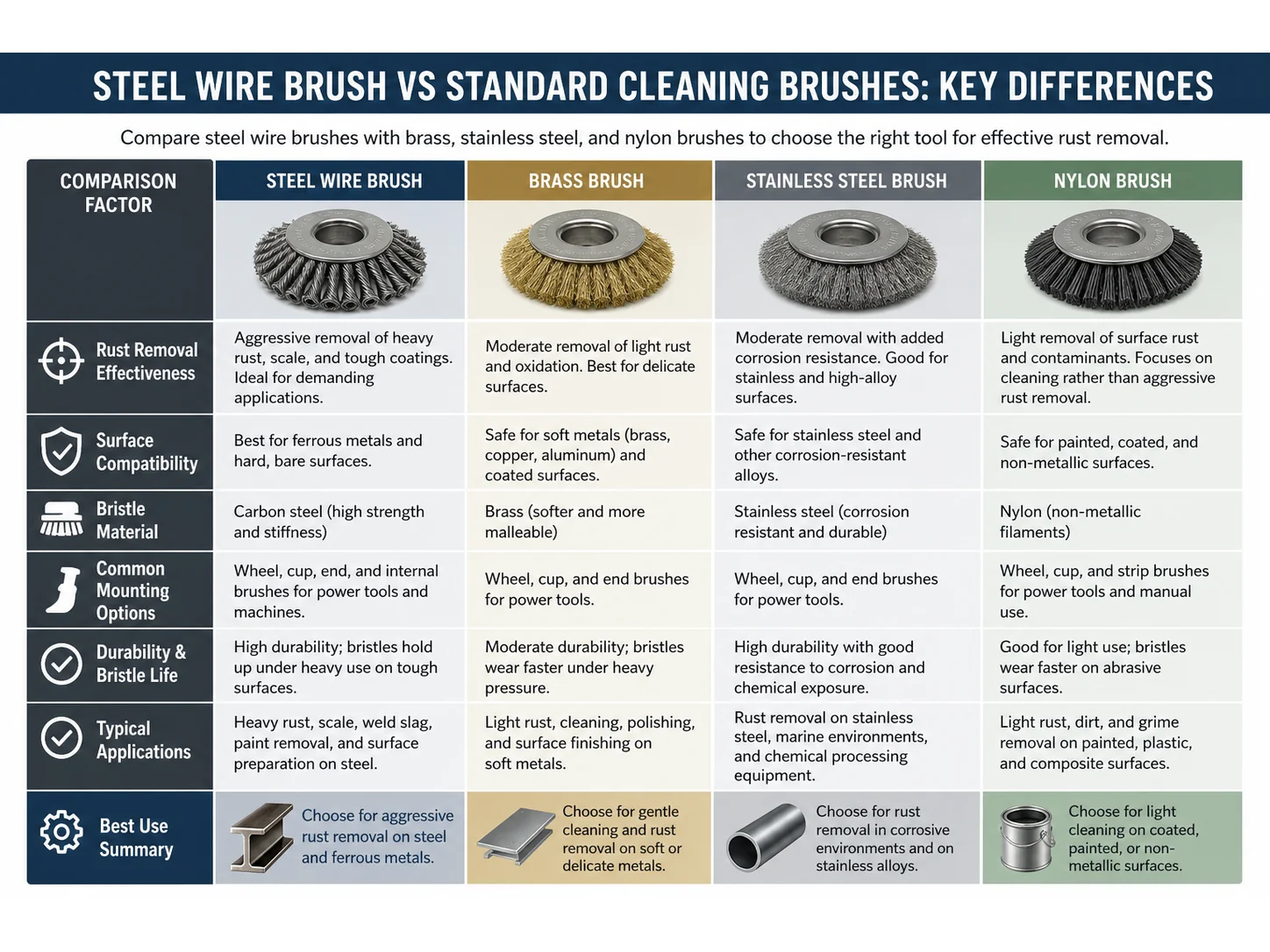
Steel Wire Brush vs Standard Cleaning Brushes: Key Differences
“Standard” cleaning brushes can refer to brass wire, stainless steel wire, nylon, or natural fiber brushes. The table below focuses on the most relevant alternatives for rust removal.
| Feature | Carbon Steel Wire Brush | Stainless Steel Wire Brush | Brass Wire Brush | Nylon/Abrasive Brush |
|---|---|---|---|---|
| Rust removal aggression | High – removes heavy rust quickly | Medium-high – less aggressive than carbon steel | Low – best for light oxidation or surface cleaning | Low – needs abrasive grit for rust removal |
| Risk of surface scratching | High – can scratch softer metals | Moderate – less scratching on stainless, but still abrasive | Low – safe on most metals including soft ones | Very low – non-marring when grit-free |
| Carbon contamination risk | Yes – can embed carbon causing future rust | No – safe for stainless and aluminum | No – but may transfer brass color | No – plastic or synthetic bristles |
| Typical use case | Heavy rust on steel, iron, weld cleanup | Stainless steel, food-grade, or marine environments | Delicate metals, threaded parts, electrical contacts | De-burring, light cleaning, or when metal bristles are forbidden |
| Durability / Longevity | High – bristles wear down gradually | Very high – corrosion-resistant | Medium – bristles are softer, wear faster | Varies – abrasive-impregnated types wear fast |
| Cost range | Low – most economical | Medium | Medium | Low to medium |
How to Choose the Right Brush for Rust Removal
Selecting the best brush is more about the workpiece and job conditions than the brush alone. Ask these questions:
- Base metal type: Carbon steel on carbon steel is fine; stainless steel requires a stainless brush to avoid cross-contamination.
- Rust severity: Heavy, pitted rust needs aggressive carbon steel; light surface rust may only need brass or a fine wire wheel.
- Surface finish requirements: If the surface will be painted or welded, check for embedded carbon. For cosmetic finishes, a stainless brush may be safer.
- Equipment interface: Confirm shank diameter, thread size, and RPM rating for power brushes. Hand brushes work anywhere but require more labor.
- Wet or chemical exposure: In wet environments or where acids/alkalines are used, stainless steel or nylon with chemical-resistant fill is preferred.
- Shape and access: Mini, long-handle, or circular brushes help reach corners, bores, and irregular shapes.
Setup and Usage Considerations
Even the best brush will underperform if used incorrectly. Keep these factors in mind:
- Workpiece fixturing: Secure the part so you can apply steady pressure without slipping.
- RPM and pressure: Use the manufacturer’s recommended speed. Too fast overheats bristles; too much pressure wears the brush prematurely.
- Direction of movement: Move the brush across the surface, not resting in one spot, to avoid gouging.
- Personal protection: Wear safety glasses and gloves. Wire bristles can break off at high speed.
- Post-brush cleaning: Always clean the surface after wire brushing to remove loose rust and bristle fragments.
Common Mistakes When Using Steel Wire Brushes
Avoid these errors to get the best results and longer brush life:
- Using a carbon steel brush on stainless steel: This can cause “free iron” contamination, leading to rust spots on the stainless later.
- Pressing too hard on a power brush: Let the bristle tips do the work; excessive pressure bends bristles and doesn’t improve cleaning speed.
- Skipping a test patch: Always test on a hidden area to check for scratching, especially on softer metals.
- Ignoring brush rotation speed limits: Exceeding the rated RPM can throw bristles dangerously.
- Storing brushes in damp areas: Carbon steel bristles will rust if left wet, rendering the brush less effective.
When a Steel Wire Brush Is the Wrong Choice
Steel wire brushes excel at loose rust and scale, but they have limits:
- Tight, complex geometries: Deep blind holes or intricate castings may require chemical rust removers or sandblasting.
- Thick mill scale: Heavy scale on hot-rolled steel often needs grinding or flap discs before wire brushing.
- Clean room or food-contact surfaces: Wire brushes can leave microscopic metal particles; single-use or non-metallic tools may be required.
- When surface hardness is critical: If the workpiece cannot be scratched, opt for nylon abrasive brushes or chemical methods.
When in doubt, ask a supplier for a sample drawing, material certification, or a test brush before committing to a large order.
Final Takeaway
For rapid, economical rust removal on ordinary steel, a carbon steel wire brush is tough to beat. But when you work with stainless steel, softer metals, or need a polished finish, step up to a stainless steel or brass brush. Match the brush material to the base metal, the bristle stiffness to the rust severity, and the mounting style to your tool setup. A few minutes spent choosing the right brush saves hours of rework and damaged parts.
Frequently Asked Questions
What is the difference between a crimped and a knotted wire brush?
Crimped wire brushes have straight bristles that are slightly wavy, offering a gentler action and finer finish. Knotted wire brushes use twisted wire tufts that are more aggressive, ideal for heavy rust and scale removal on large surfaces.
Can I use a steel wire brush on aluminum?
Carbon steel wire brushes can gall aluminum and embed carbon, leading to corrosion. If you must use a wire brush on aluminum, choose a stainless steel brush used only for aluminum to avoid cross-contamination.
How do I prevent flash rust after wire brushing?
Clean the surface with a solvent (like acetone) and immediately apply a rust-preventive primer, oil, or coating. In humid conditions, plan to coat within an hour of cleaning.
Is a brass or stainless steel wire brush better for delicate parts?
Brass is softer than stainless steel and less likely to scratch. Use brass for sensitive threads, electrical contacts, or soft metals. Stainless steel is still abrasive but won’t contaminate the workpiece with carbon.
What RPM should I use for a wire wheel on an angle grinder?
Always follow the brush manufacturer’s RPM rating. Typical cup brushes are rated for 6,000–12,000 RPM. Exceeding this can cause bristle loss and safety hazards.
Can a steel wire brush remove paint as well as rust?
Yes, carbon steel wire brushes are effective at stripping paint, especially on metal. For softer surfaces like wood, a brass or nylon brush is safer to avoid gouging.
Why do some steel wire brushes have long handles?
Long-handle brushes provide extended reach into deep tanks, pipe interiors, or behind equipment where standard handles won’t fit. They are common in industrial and boiler cleaning.
How do I choose the right size for a hand wire brush?
Consider the width of the area to clean and access constraints. A 6-inch brush is good for flat surfaces; mini brushes work in tight corners. Brush length should match the required reach without causing fatigue.
Technical References
Which bristle material fits this job — AISI 304 Stainless Steel Wire, Nylon PA or Carbon Steel Wire?
| Material | Continuous temperature (°C) | Peak temperature (°C) | Water absorption | Hardness |
|---|---|---|---|---|
| AISI 304 Stainless Steel Wire | 400 | 500 | 0% | Rockwell B 70–95 depending on temper and cold work |
| Nylon PA | 93 | 121 | 0.3–9% by PA grade and conditioning | Medium to firm; filament diameter and trim length control bending force. |
| Carbon Steel Wire | 200–300 | 350–450 | 0% | Rockwell C 40–60 |
| Brass Wire | 150–200 | 250–300 | 0% | Rockwell B 40–90 |
Figures as published by Alleima; Brushtec / DuPont. Confirm the exact grade against the supplier datasheet before ordering.
What should replace AISI 304 Stainless Steel Wire when it stops working?
- AISI 304 Stainless Steel Wire — Use AISI 316 stainless steel wire for chloride, marine, dairy, beverage, chemical washdown, or higher pitting-resistance requirements. Use carbon steel for dry aggressive cutting and brass or abrasive nylon for lower marking risk.
- Nylon PA — Compare Nylon PA with PP, PBT, PET. Change material when wet stiffness, temperature, chemical resistance, conductivity, particle shedding, or surface marking becomes the limiting factor.
- Carbon Steel Wire — Compare Carbon Steel Wire with Carbon steel wire, brass wire, abrasive nylon. Change material when wet stiffness, temperature, chemical resistance, conductivity, particle shedding, or surface marking becomes the limiting factor.
- Brass Wire — Compare Brass Wire with Steel wire, stainless wire, nylon. Change material when wet stiffness, temperature, chemical resistance, conductivity, particle shedding, or surface marking becomes the limiting factor.