
What Is a Rust Removal Wire Brush?
A rust removal wire brush is a hand or power-tool brush with stiff metallic bristles—usually steel, stainless steel, or brass—intended to abrade and remove rust, paint, and other firmly bonded surface contaminants. Unlike soft-bristled standard cleaning brushes, the wire filaments are engineered for aggressive mechanical cleaning without rapid wear.
Common Types of Rust Removal Wire Brushes
Rust removal wire brushes come in several forms, each suited to different tasks:
- Handheld wire brushes: Simple handle brushes for manual scrubbing of small areas, pipes, and irregular surfaces.
- Drill-attached wire brushes: Cup, wheel, or end brushes that mount onto power drills for faster rust removal on larger flat or shaped areas.
- Angle grinder wire wheels: Heavy-duty knotted or crimped wire wheels for high-speed rust and scale removal on big metal pieces.
- Tube and pipe brushes: Twisted-in-wire brushes for cleaning inside pipes, cylinders, or hard-to-reach bores.
- Bench grinder wire wheels: Stationary brush wheels for repetitive part cleaning and deburring.
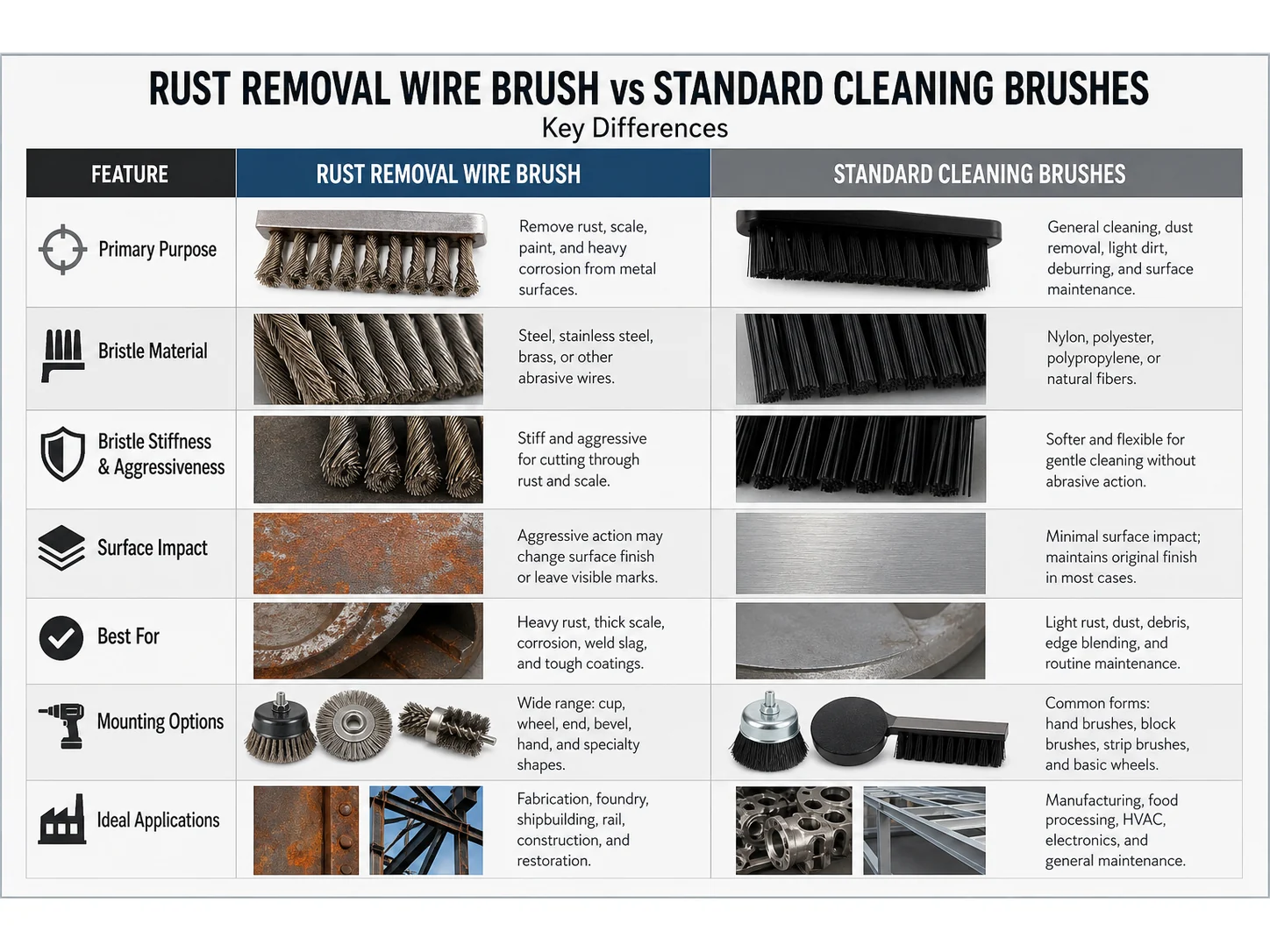
Rust Removal Wire Brush vs Standard Cleaning Brushes: Key Differences
| Feature | Rust Removal Wire Brush | Standard Cleaning Brush |
|---|---|---|
| Bristle material | Hardened steel, stainless steel, brass | Nylon, polypropylene, natural fiber, soft wire |
| Rust removal capability | High – cuts through heavy rust and scale | Low to none – typically ineffective on rust |
| Surface impact | Can scratch or texture soft metals | Gentle – safe for most surfaces |
| Typical applications | Auto body work, machinery restoration, weld cleaning | Dusting, wiping, light scrubbing, non-critical cleaning |
| Durability in harsh use | Long life on tough contamination | Bristles wear quickly or deform |
| Power tool compatibility | Common – drill, angle grinder, die grinder | Rarely designed for high-speed rotation |
The fundamental difference is bristle strength: a rust removal wire brush uses metal filaments that cut and scrape, whereas standard brushes rely on friction and flexibility.
How to Choose the Right Rust Removal Wire Brush
Selecting the best rust removal wire brush depends on several practical factors:
- Residue type and thickness: Heavy, flaky rust demands a stiff carbon steel or knotted wire brush; light surface rust can be tackled with a finer crimped brush or brass wire.
- Surface sensitivity: On soft metals (aluminum, copper), use stainless steel or brass to avoid deep scratching or embedment. For hard steel, a hardened steel brush is fine.
- Equipment interface: If using a power tool, choose the right shank, arbor, or thread size. Handles should be comfortable for manual work.
- Wet or chemical exposure: In environments where rust removers or chemicals are used, stainless steel brushes resist corrosion better than plain steel.
- Hygiene expectations: For food-contact surfaces or sanitary applications, a stainless steel brush with encapsulated bristles is often required.
- Maintenance frequency: In continuous use (e.g., production lines), prioritize durable materials and replaceable brush heads to reduce downtime.
- Custom size requirements: For cleaning tubes, bores, or irregular profiles, a twisted-in-wire brush may need a specific diameter or length that matches the workpiece.
Common Mistakes When Using Rust Removal Wire Brushes
- Mismatching brush material to the workpiece: Using a carbon steel brush on stainless steel can cause after-rust or contamination.
- Applying too much pressure: Excessive force can break wires prematurely or gouge the metal surface.
- Ignoring safety gear: Always wear eye protection—wires can break off and fly at high speed, especially with power tools.
- Using the wrong speed: Exceeding the recommended RPM for a wire brush can cause bristle loss or imbalance.
- Forgetting to consider the environment: In wet or marine environments, a stainless steel brush prevents further rust.
- Assuming one brush fits all tasks: A heavy knotted wheel is overkill for light surface rust and can damage thin sheet metal.
When a Rust Removal Wire Brush Is the Wrong Choice
Wire brushes are excellent for surface rust, but they have limits. If the metal is deeply pitted, structurally weakened, or has rust penetrating through the thickness, a brush alone cannot restore integrity. In such cases, you may need:
- Chemical rust converters or removers to neutralize deep corrosion.
- Abrasive blasting (sandblasting, soda blasting) to reach complex geometries or heavy mill scale.
- Mechanical grinding or sanding for heavy metal removal before finishing.
- Expert evaluation for structural components where safety is a concern.
Additionally, if dimensional tolerances are critical, wire brushing can alter surface roughness; a sample test or supplier drawing review is advisable before committing to a process.
Final Takeaway
A rust removal wire brush is the go-to tool for stripping surface rust efficiently, but it is not a one-size-fits-all solution. Standard cleaning brushes simply lack the abrasiveness to tackle corrosion. By matching brush material, stiffness, and mounting style to the specific rust condition, metal type, and your work environment, you can achieve clean results without damaging the underlying surface. When in doubt, start with a less aggressive option (like a brass-encapsulated brush) and test on a hidden area before moving to more aggressive steel types.
Frequently Asked Questions
Can I use a standard cleaning brush for rust removal?
No. Standard cleaning brushes with nylon or soft bristles cannot abrade rust effectively. You need the stiff metal wires of a rust removal brush to cut through the corrosion layer.
Which wire material is best for car rust removal?
For most car body panels, a stainless steel or brass wire brush is recommended. Brass is less aggressive and less likely to scratch the steel, while stainless steel offers a good balance of cutting power and rust resistance.
Are drill-attached wire brushes safe?
Yes, when used properly. Always wear ANSI-approved safety glasses or a face shield, ensure the brush has the correct shank size for the drill, and do not exceed the maximum RPM stated on the brush. Inspect for loose wires before each use.
How do I avoid damaging the metal surface?
Test on a small inconspicuous area first. Use a finer crimped wire or brass brush for sensitive surfaces, and apply light, even pressure. Avoid staying in one spot too long with a high-speed power tool.
What is the difference between knotted and crimped wire brushes?
Knotted wire brushes are twisted into tight bundles for aggressive heavy-duty rust and scale removal. Crimped wire brushes have wavy filaments that are more flexible and produce a finer finish with less surface impact.
When should I use a stainless steel wire brush versus carbon steel?
Stainless steel is ideal for surfaces that will be exposed to moisture or for cleaning stainless steel alloys to prevent cross-contamination. Carbon steel brushes are harder and more aggressive but can introduce after-rust if used on stainless steel or in damp conditions.
Can I use a wire brush on painted surfaces?
A wire brush will typically remove paint as well as rust. If you only want to clean surface dirt without stripping paint, use a soft brush or sponge. For paint removal alongside rust, a wire brush can be very effective.
How often should I replace my rust removal wire brush?
Replace it when bristles become flattened, broken, or lose their stiffness, or when the brush no longer cuts effectively. Power brushes that shed wires excessively are a safety hazard and should be retired immediately.
Technical References
- OSHA — 1910.242 Hand and Portable Powered Tools
- OSHA — Personal Protective Equipment
- ASME — Y14.5 Dimensioning and Tolerancing
Which bristle material fits this job — AISI 304 Stainless Steel Wire, Brass Wire or Nylon PA?
| Material | Continuous temperature (°C) | Peak temperature (°C) | Water absorption | Hardness |
|---|---|---|---|---|
| AISI 304 Stainless Steel Wire | 400 | 500 | 0% | Rockwell B 70–95 depending on temper and cold work |
| Brass Wire | 150–200 | 250–300 | 0% | Rockwell B 40–90 |
| Nylon PA | 93 | 121 | 0.3–9% by PA grade and conditioning | Medium to firm; filament diameter and trim length control bending force. |
Figures as published by Alleima; Brushtec / DuPont. Confirm the exact grade against the supplier datasheet before ordering.
What should replace AISI 304 Stainless Steel Wire when it stops working?
- AISI 304 Stainless Steel Wire — Use AISI 316 stainless steel wire for chloride, marine, dairy, beverage, chemical washdown, or higher pitting-resistance requirements. Use carbon steel for dry aggressive cutting and brass or abrasive nylon for lower marking risk.
- Brass Wire — Compare Brass Wire with Steel wire, stainless wire, nylon. Change material when wet stiffness, temperature, chemical resistance, conductivity, particle shedding, or surface marking becomes the limiting factor.
- Nylon PA — Compare Nylon PA with PP, PBT, PET. Change material when wet stiffness, temperature, chemical resistance, conductivity, particle shedding, or surface marking becomes the limiting factor.