
Custom Cleaning Brush
Stainless Steel Strip Brush
Cut-to-length stainless steel strip brushes with 316 wire fill for door gap sealing, rail wiping, and debris control.
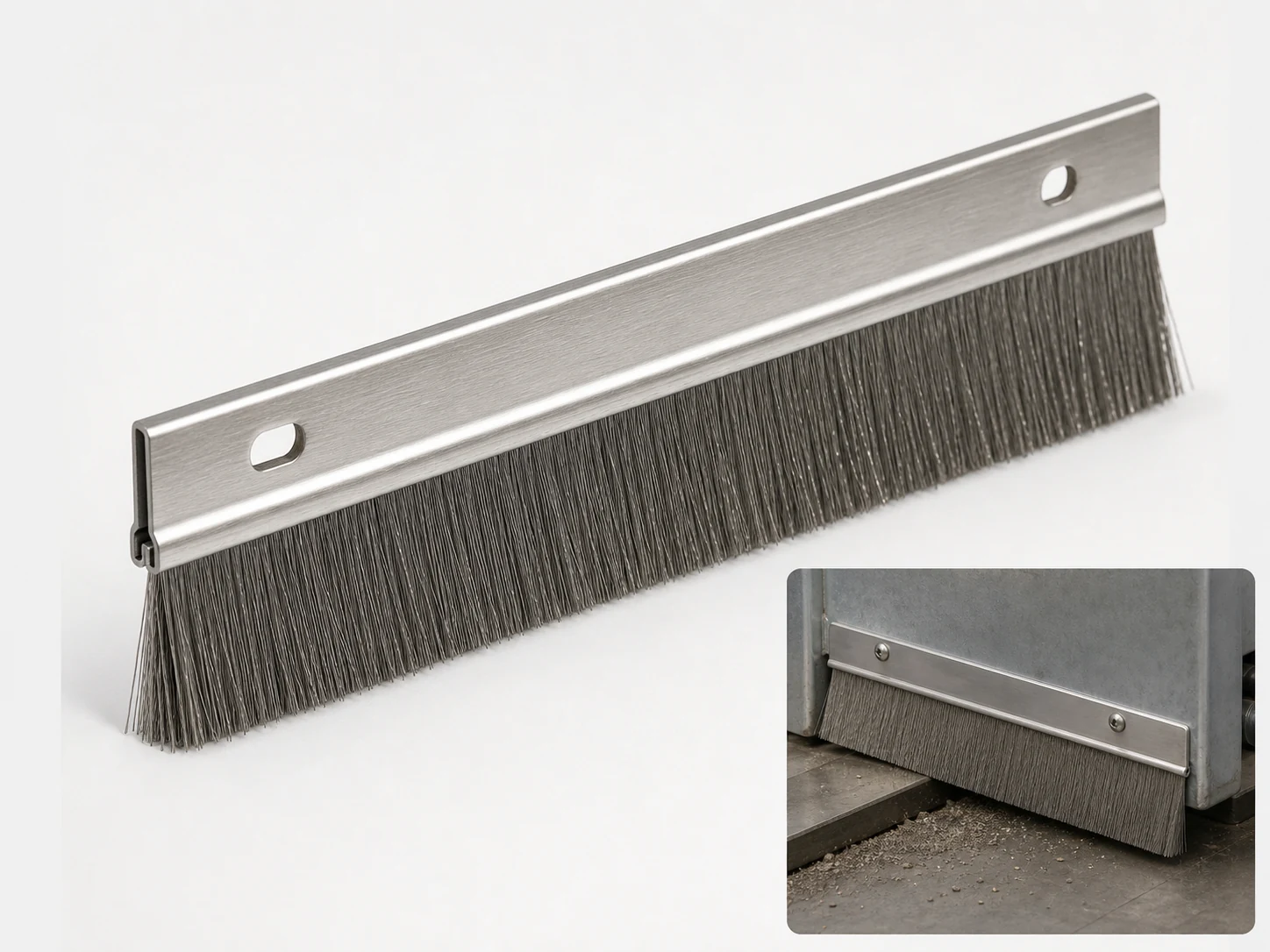
Large-format brush
100 pcs
Minimum order
Built one at a time on a core or channel: full-width rollers, sweeper brooms and long strip.
Production lead time, once the specification is confirmed
- Up to 100 pcsWithin 20 days
- 101–1,000 pcsWithin 30 days
- Over 1,000 pcsConfirmed with your quotation
Peak season can extend these times; the shipping date is confirmed in writing with your quotation. Sampling and shipping are quoted separately.
A channel-mounted strip brush filled with stainless steel wire for sealing door gaps, wiping rail and conveyor surfaces, and controlling dust, mist, light, and loose debris along linear openings in corrosive or high-wear environments. The wire fill compresses through repeated door strokes and returns to shape, maintaining a continuous contact line without blocking the sliding motion.
What can this brush do for you?
Keeps a Contact Line on Warped or Uneven Edges
Sheet-metal doors and guard panels are rarely perfectly straight. Individual stainless steel wire filaments deflect independently, so the brush keeps contact across small bows, step offsets, and hinge-side gaps that a solid lip seal would bridge over or catch on. The result is a seal that tracks the actual edge, not the drawing.
Survives Wet, Oily, and Chemically Exposed Gaps
The 316 stainless steel wire fill resists corrosion in washdown areas, marine splash zones, and coolant-heavy machine environments where carbon steel wire or synthetic filament degrades. Pair the fill with a stainless or anodized holder and the brush remains serviceable through repeated cleaning cycles.
Wipes Moving Surfaces Without Hard Impact
Machine guards, linear rails, and conveyor edges need light contact that removes coolant, chips, and loose residue as the surface moves past. The wire tips cut through film and loose debris instead of pushing it ahead, and the selected compression controls how much drag the system sees.
Blocks Debris at Openings That Must Stay Passable
Cable slots, material openings, and floor gaps often need to let something through while keeping insects, dust, mist, or granules out. The wire bristles bend around the passing object and spring back to re-close the opening, something a rigid baffle cannot do.
Covers Long Runs Without Mid-Span Supports
Each section is produced from 100 to 3,000 mm long, and longer sealing lines use sections butt-jointed end to end. That allows one continuous sealing spec to run the full height of a large door or the full length of a machine base without separate brush blocks.
What is a Stainless Steel Strip Brush?
A stainless steel strip brush is a linear brush assembly built from continuous crimped stainless wire fill held in a channel or angle holder. The holder mounts along the edge of a gap or parallel to a moving surface, and the free wire portion outside the holder, the trim height, is the working contact zone.
On a sliding door, the brush holds a flexible contact line against the floor, jamb, or mating panel and slows the passage of dust, mist, drafts, light, and insects while the door moves through the fill. In a wiping or guiding role, the wire tips ride against a passing rail, sheet edge, or conveyor surface to remove loose material and keep the travel path clean.
The wire is not a gasket. It reduces leakage and splash but does not create a hermetic or pressure-tight seal, and it can score softer finishes if set too hard. The critical design relationships are the free trim height, the wire diameter, and the actual gap at the mounting line. Vertical, horizontal, and inverted mounting are all possible, but inverted or high-vibration installations should use end caps or retention details so the fill cannot walk out of the channel.
Technical Specifications
The standard production range for stainless steel strip brushes is shown below. Each row can be adjusted to the sealing or wiping requirement, and the final dimensions are selected together with the holder and mounting method.
| Parameter | Value / Options |
|---|---|
| Fill material | 316 stainless steel wire; 304 or other stainless grades on request |
| Strip length | 100 to 3,000 mm per section; longer runs joined end-to-end at butt joints |
| Trim height (wire free length) | 12.7 to 152.4 mm |
| Channel / holder width | 3.2 to 14.3 mm |
| Filament diameter | 0.10 to 1.27 mm |
| Working compression | 5 to 25% of trim height; 5 to 15% for wiping and dust control, 10 to 25% for sealing without crushing the fill |
| Holder profile | Straight channel, aluminum carrier, angle holder, or custom profile |
| Mounting | Pre-punched holes, slots, backing adhesive, or clamping bracket by holder type |
| End treatment | Cut flush, sealed ends, end caps, or notched for cable and material pass-through |
| Environment | 316 wire for washdown, marine, and chemical exposure; holder material selected to match |
| Brush type | Custom Strip Seal Brushes |
| How it is driven | Fixed in place, no drive of its own |
| Cleaning target | sliding door, linear rail and machine tool way cover, and cable entry slot and floor opening cleaning |
| Surface or part | gaps, conveyors, rails, panels, edges, cable, floors, and channel |
| Residue or debris | dust, mist, insects, chips, coolant, granules, and loose debris |
| Mounting / connection | Pre-punched holes, slots, backing adhesive, or clamping bracket by holder type |
Where does this brush work best?
- Sliding doors on machine enclosures, cleanrooms, ovens, and industrial buildings — the brush blocks dust, mist, light, and insects along the bottom or side gap while the panel slides through the fill.
- Linear rails and machine tool way covers — the wire wipes coolant, chips, and fine swarf off guide surfaces and keeps contamination out of bearing paths.
- Cable entry slots and floor openings for moving hoses, cables, or product carriers — the opening stays passable, but dust and loose granules do not pour through.
- Conveyor transfer points and edge gaps — the fill contains small parts, removes loose residue from belt edges, and reduces drift between adjacent conveyors.
- Vent, draft, and light-blocking gaps — some airflow continues, but direct line-of-sight and airborne debris are interrupted.
How do I choose the right one?
Pin the gap before the brush. Measure the actual gap at the mounting line, including any door sag, panel bow, or hinge drop. If the gap varies, the brush must be sized to hold contact at the widest point without binding at the narrowest point, or the mounting face must be corrected. Trim height that is too short loses contact; trim height that is too long adds drag and can permanently bend the outer wire tips.
Work from the compression range, not just trim height. Use 5 to 15% of trim height for light wiping, dust control, and low-drag passes across coated or machined surfaces. Use 10 to 25% for sealing against dust, mist, light, and insects where a stronger contact line is acceptable. Compression beyond about 25% flattens the fill and shortens service life.
Set wire diameter to the job. Fine wire from about 0.10 to 0.30 mm bends easily, follows irregular surfaces, and is the first choice for door gap sealing and dust barriers. Heavy wire from about 0.50 to 1.27 mm applies more mechanical action and is better for wiping coolant or chips, holding back larger granules, or guiding heavy sliding panels.
Choose the holder for how it mounts and what it sees. Straight aluminum channel works for dry indoor enclosures and simple screw mounting. Stainless or coated steel angle holders go into washdown, marine, or high-corrosion positions. A custom profile is used when the brush must clamp into an existing extrusion, form a radius, or match a specific fastener pattern.
When to choose a different brush. If the mating surface is painted, anodized, polished, or otherwise scratch-sensitive, a nylon, PBT, or horsehair strip brush may be the better contact. If the opening must be airtight, watertight, or pressure-tight, the strip brush needs to work in series with an elastomer gasket or mechanical seal, not instead of one. If the deposit is cured, baked-on, or firmly bonded, brushing alone may not remove it.
Can I customize this brush?
Stainless steel strip brushes are configured to the mounting face and the gap, not picked from a fixed catalog. For a new design, the most useful inputs are the actual installed gap, door or panel travel, opposing surface material and finish, residue type, cleaning or washdown chemicals, mounting face drawing, and any curves or end transitions.
- Fill configuration — stainless wire grade (304, 316, or other grades on request), filament diameter from 0.10 to 1.27 mm, trim height, fill density, and single or double fill rows.
- Holder profile — channel width from 3.2 to 14.3 mm, straight channel, angle, aluminum carrier, stainless or coated steel channel, formed radii, or notched and bent corners.
- Mounting — pre-punched holes on a customer pitch, slotted holes for adjustment, adhesive or pressure-sensitive backing, clips or brackets, or welded and studded mounting.
- End treatment — flush cut, sealed or closed ends, plastic or metal end caps, mitered corners, or notches for cable and material pass-throughs.
- Length and joining — any section length from 100 to 3,000 mm, with longer runs built as end-to-end butt joints and alignment details.
- Identification and packaging — part identification tags, lot marking, individual poly bagging, bulk pack, or custom carton labels for distribution programs.
If the application requires material certificates, dimensional inspection, or third-party testing of the brush assembly, we can coordinate those requirements as part of the custom specification. Provide the required documents and acceptance criteria with the RFQ.
Which filament lasts longest on a stainless steel strip brush?
How do I know whether the stainless wire will mark or scratch the opposing surface?
Run a short test section against the actual door, rail, or panel material at the planned compression. If the contact line leaves visible scoring, reduce filament diameter or compression, or switch to a synthetic filament in that location. Satin or matte stainless steel and plain steel tolerate normal brush contact far better than anodized, painted, or polished surfaces.
Can this brush form around a door threshold radius or inside corner?
Yes, within limits. Holders can be bent, notched, or mitered around corners, but the minimum inside radius must be large enough for the channel and the trimmed wire to follow without kinking. Sharper corners are usually built as separate pieces butted together so the fill does not bind. Provide the actual radius and corner drawing for evaluation.
How do I set and verify the initial compression after mounting?
Install the holder so the wire tips overlap the mating surface by the chosen percentage of trim height. Measure the free trim height before mounting, then measure the visible free length at the contact point with the door or panel in its closed position. The difference divided by the original trim height is the actual compression. A chalk or witness mark along the contact path will also show whether the brush is touching uniformly across the full run.
Does the stainless steel fill require any lubrication or maintenance?
The wire itself does not need lubrication. Keep the channel clear of impacted debris that prevents the wire from flexing, and rinse or blow out the fill if it collects sticky residue. Check the mounting screws or brackets on the same schedule as the door or machine; loose mounting changes the compression and causes uneven wear.
When should I replace a stainless steel strip brush section?
Replace when the outer wire tips are permanently bent away from the contact line, when trim height has worn short enough that compression falls below 5%, when the holder is corroded or deformed, or when the fill shows broken or missing wire along the working edge. A brush that has lost its straight contact line no longer performs as a seal.
Can this brush be used on a hot oven or furnace door gap?
The stainless wire fill can survive intermittent contact with elevated-temperature edges that would melt nylon or PBT fill, but the complete assembly must be specified for the actual temperature. The holder material, any end caps, fasteners, and mounting substrate all need to be compatible with the door surface temperature and expansion movement. Provide the measured temperature at the mounting face when ordering.
Guides that go deeper on this
How to Choose Stainless Steel Strip Brush
Read this guideGuideHow to Specify Stainless Steel Strip Brush Holders in RFQs
Read this guideGuideStainless Steel Strip Brush Holder: Specs for Rust Removal
Read this guideGuideWhen to Use a Steel Strip Cleaning Brush on Power Tools
Read this guideGuideSteel Strip Brush Selection for Pipeline Pigs
Read this guideGuideWhen to Use a Steel Strip Cleaning Brush on Weld Cleanup
Read this guideCustom Manufacturing RFQ
Describe Your Application
For an accurate quotation, please provide the main dimensions, material preference, working surface, residue, quantity, and a drawing or photo.
Drawing or photo optional — it speeds things up, it does not gate the enquiry.
Custom Brush RFQ
Send Your Brush Project
Upload a drawing, product photo, or sample photo and provide the core dimensions and cleaning conditions.
“We need a brush to remove wet residue from a stainless steel conveyor, about 800mm wide. The current brush wears quickly. We can send photos.”
“We sell drinkware and need a cleaning brush to include with the product. Quantity around 5,000 pieces.”