
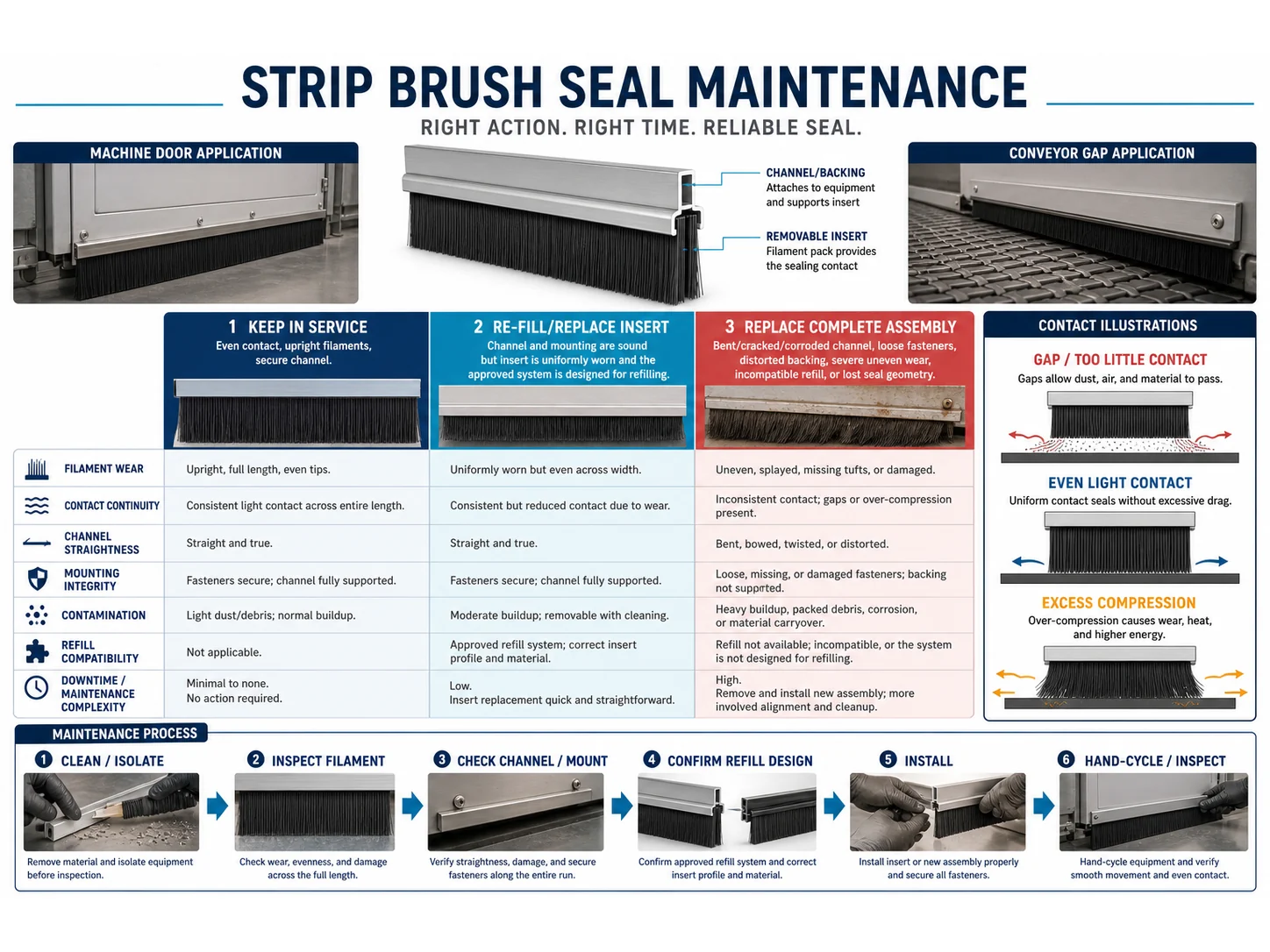
What Is a Strip Brush Seal?
A strip brush seal is a flexible sealing component made of densely packed bristles held in a rigid metal or plastic channel. It is commonly used to block dust, light, drafts, moisture, and noise while allowing moving parts to pass. In equipment enclosures, bottom door seals, cable pass-through panels, and conveyor transfer points, the bristles maintain contact with an opposing surface — even when that surface is uneven or vibrating.
Signs Your Strip Brush Seal Needs Attention
Most strip brush seals wear gradually. Spotting the warning signs early prevents damage to the surrounding equipment and avoids unexpected downtime.
- Bristle flattening or permanent bending: Bristles that no longer spring back to their original orientation have lost resilience. The seal gap becomes inconsistent.
- Visible gaps between bristles and the mating surface: Hold a light behind the door or panel; if you see streaks of light, the seal is no longer making full contact.
- Declining sealing performance: Increased dust ingress, temperature fluctuations, or higher energy bills often trace back to a degraded brush strip.
- Clumped or matted bristles: Contaminants like oil, paint, or sticky debris can cause bristles to clump, reducing the effective brush density.
- Corrosion or deformation of the channel: While the bristles are replaceable, a bent or rusted channel may require full replacement.
Re-fill vs. Full Replacement: Choosing the Right Path
The decision hinges on the condition of the channel and the type of brush strip originally installed. The table below compares the two approaches.
| Factor | Re-fill (Brush Strip Only) | Full Replacement (Channel + Brush) |
|---|---|---|
| Typical cost | Lower — only the brush insert is purchased | Higher — channel and mounting hardware are replaced |
| Labor time | 30–60 minutes for most standard door seals | a condition-based interval depending on mounting type |
| Performance after repair | Like-new if channel is clean and undamaged | Restores factory fit; solves channel-related issues |
| When to choose | Channel is straight, intact, and securely mounted; bristle wear is the only problem | Channel is bent, cracked, corroded, or the brush is permanently bonded to the channel |
| Common applications | Aluminium door brush strips, bottom door seal brush strips, cable pass-through brush panels | Welded or riveted channels, integrated weather strip brush seals on roll-up doors |
How to Decide Between Re-filling and Replacing
Ask these questions before ordering parts:
- Is the channel still straight? Apply a straightedge. Bends larger than 1–2 mm over a 300 mm span will prevent a tight brush fit.
- Does the channel use a standard brush strip size? Some aluminum door brush strips accept common refills (e.g., 15 mm or 20 mm base); custom extrusions may be proprietary.
- How critical is the seal’s performance? In cleanrooms, electrical enclosures, or extreme weather applications, even minor channel wear can cause seal failure. Full replacement may be safer.
- What is the production downtime allowance? Re-filling is faster; full replacement may require removing fasteners, drilling, or applying new adhesive.
- Is the mating surface in good condition? If the floor or panel is now damaged, a new brush strip of the same length might not be enough — consider a brush with a taller bristle or a different material instead.
Installation and Removal Tips for Strip Brush Seals
Following a repeatable process reduces the risk of damaging the channel or the new brush strip.
- Remove the old brush safely. For a brush strip door seal, grasp one end with pliers and pull steadily along the channel’s length. Avoid prying with screwdrivers that can distort the channel lips.
- Inspect and clean the channel. Use a small wire brush and compressed air to remove dirt, old adhesive residue, and corrosion. Even small particles can prevent the new brush strip from sliding in. A light spray of silicone lubricant can ease insertion of a dry-fit brush.
- Measure and cut the new brush strip. Order a strip slightly longer than the channel length. Cut with fine tin snips or a sharp utility knife, keeping the cut square.
- Insert the refill brush. Feed one edge of the brush base into the channel and push it home with a plastic wedge or a piece of hardwood. A small rubber mallet can tap it into place without damaging the bristles. Do not use a hammer directly.
- Check alignment. The bristle tips should contact the mating surface evenly across the entire width. Adjust or reseat if gaps remain.
Important boundary: If the channel is cracked, severely corroded, or its mounting is loose, even a perfectly installed brush refill will fail prematurely. In these cases — especially with weather strip brush seals on exterior doors — full replacement is the only reliable solution.
Common Mistakes to Avoid
- Ignoring channel deformation. A bent channel will cause the new brush to sit unevenly, leaving gaps.
- Using a different brush material without checking compatibility. Nylon, polypropylene, and abrasive-infused filaments have different wear rates, temperature ranges, and stiffness. A mismatched material can increase friction or reduce seal life.
- Skipping channel cleaning. Adhesive residues or rust particles act like sandpaper, accelerating wear of the new brush base.
- Ordering the wrong length or base width. Measure the channel’s internal groove, not the visible bristle height. A 15 mm brush strip may fit one 15 mm channel but not another.
- Assuming every strip brush seal can be re-filled. Some brush seals are co-extruded or permanently bonded, leaving no replaceable insert. Forcing a refill can destroy the seal.
When Strip Brush Seal Maintenance Is the Wrong Choice
Re-filling or replacing a worn strip brush seal restores normal sealing function — but it will not fix underlying problems such as:
- A door frame that has shifted, making the seal gap non-parallel.
- Excessive vibration that causes rapid bristle fatigue.
- High-temperature or chemical exposure beyond the brush material’s tolerance.
- A design flaw that caused the original seal to fail prematurely.
If these conditions exist, a maintenance-only approach will lead to frequent replacements. Consult an application engineer to evaluate whether a different type of seal (e.g., a rubber-and-brush combination or a pneumatic seal) is a better long-term fit.
Final Takeaway
For most everyday applications — door bottom seals, enclosure brush strips, and conveyor brushes — a re-fill is the faster, lower-cost fix when the channel is intact. Start by inspecting the channel, choose the correct brush material and size, and follow clean installation practices. Reserve full replacement for cases where the channel itself is damaged or the seal design is integral. This simple flow will keep your strip brush seals working reliably without unnecessary expense.
Frequently Asked Questions
Can I re-fill only a section of the brush seal?
Yes, if the channel is continuous and the damaged area is localized. Cut a matching replacement piece and butt it against the existing brush. However, butt joints can be weak spots; a single continuous strip performs better for demanding weather sealing and dust control applications.
How often should I inspect strip brush seals?
For high-cycle doors (50+ cycles per day), inspect frequent. For standard interior enclosures or occasional-use cable pass-through panels, every three to six months is usually sufficient. Always inspect after any incident that could strike or deform the channel.
Can I use any brush strip refill in my existing channel?
No. Channels have specific groove widths and depths. Check the original manufacturer’s specification or measure the channel’s internal width. Common sizes include 15 mm, 20 mm, and 24 mm base widths. Also match the bristle height and material to your application — a taller bristle might look better but can over-flex and create a larger gap under pressure.
Does a self-adhesive brush strip door seal require special removal?
Adhesive-backed brush strips usually need heat to soften the adhesive. Use a heat gun on a low setting and peel slowly. Residual adhesive can be removed with a citrus-based cleaner, but avoid harsh solvents that might damage the channel or door finish.
What’s the difference between a brush strip seal and a weather strip brush seal?
A brush strip seal is a generic term for any seal using a bristle filler. Weather strip brush seals are specifically designed to block drafts, dust, and light rain on exterior doors and windows. They often have a reinforced backing and tighter bristle density to handle wind-driven moisture.
Can I bend a brush strip seal to fit a curved door track?
You can hand-form a standard aluminum channel to gentle curves, but tight radius curves may kink the channel and pinch the bristles. Pre-curved or flexible brush strips with a slotted back are available for such applications. If a 90-degree corner is needed, mitering and joining two straight pieces is a cleaner solution.
Does refilling a brush seal affect fire rating or protection standards?
If the seal is part of a fire-rated door or controlled environment, refilling with a non-approved material may compromise compliance. Always verify that the replacement brush strip meets the same standard as the original assembly.
What is the most common cause of premature brush seal failure?
Dragging or abrasion against a rough or misaligned mating surface. Even a small high spot on a floor can wear a groove into the bristles within weeks. Level the surface and, if needed, adjust the door sweep or channel height before installing the new brush.
Which bristle material fits this job — Rubber, Silicone or Nylon PA?
| Material | Continuous temperature (°C) | Peak temperature (°C) | Water absorption | Hardness |
|---|---|---|---|---|
| Rubber | 100 | 130 | very low | Specified by compound and Shore hardness; published TPE families can span roughly 50–80 Shore A, but that is a product-family example rather than a universal rubber range. |
| Silicone | 200–250 | 280–300 | 0.1–1.0% | Shore A 20–80 |
| Nylon PA | 93 | 121 | 0.3–9% by PA grade and conditioning | Medium to firm; filament diameter and trim length control bending force. |
| AISI 316 Stainless Steel Wire | 400 | 500 | 0% | Rockwell B 70–95 depending on temper and cold work |
| AISI 304 Stainless Steel Wire | 400 | 500 | 0% | Rockwell B 70–95 depending on temper and cold work |
Figures as published by Brushtec / DuPont; Alleima. Confirm the exact grade against the supplier datasheet before ordering.
What should replace Strip Seal Brushes for strip brush?
- Strip Seal Brushes — Strip brushes create a linear barrier or guide; machine-table brush plates distribute load and support products over a broad area. Closest alternative: Machine Table Brush Plates.
- Rubber — Compare Rubber with Silicone elastomer, TPE, PVC profile, PVA sponge. Change material when wet stiffness, temperature, chemical resistance, conductivity, particle shedding, or surface marking becomes the limiting factor.
- Silicone — Compare Silicone with PP, TPE, Nylon. Change material when wet stiffness, temperature, chemical resistance, conductivity, particle shedding, or surface marking becomes the limiting factor.
- Nylon PA — Compare Nylon PA with PP, PBT, PET. Change material when wet stiffness, temperature, chemical resistance, conductivity, particle shedding, or surface marking becomes the limiting factor.