
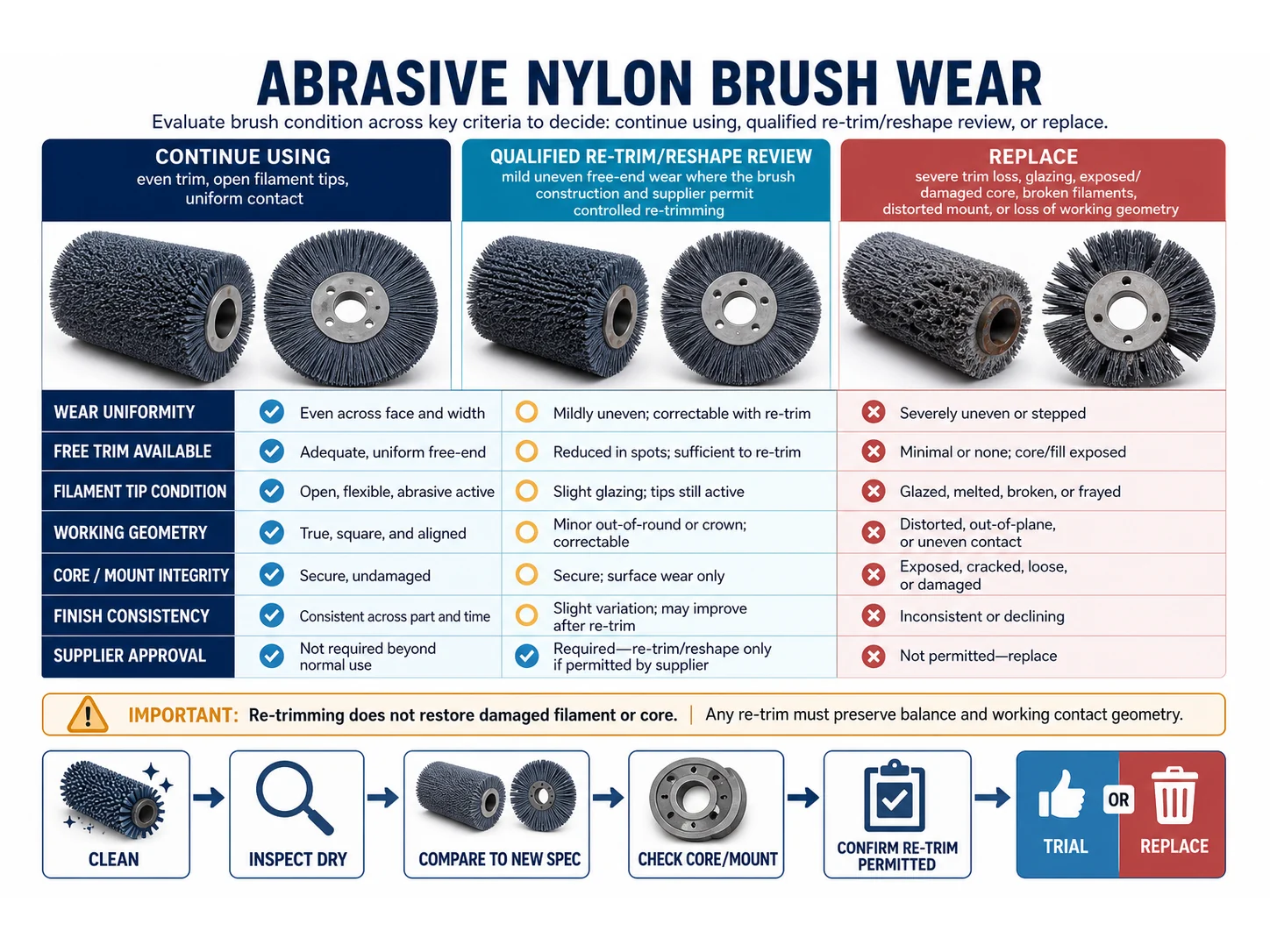
What Is Abrasive Nylon Brush Wear?
Abrasive nylon brush wear is the progressive loss of cutting effectiveness caused by changes in the brush filaments and abrasive particles. Nylon bristles are impregnated with abrasive grains such as silicon carbide or aluminum oxide. During use, three main changes occur: grit fracture or dislodgement, bristle tip rounding, and overall bristle length shortening. These changes increase cycle time, produce inconsistent finishes, and eventually lead to unusable brushes.
For deburring, edge finishing, brush/scraper choice, burr control, and replace-vs-recondition decisions, this article cites LaRoux K. Gillespie — Deburring and Edge Finishing Handbook, Society of Manufacturing Engineers, 1999; deburring process selection and edge-finishing sections.
For mechanical surface finishing, buffing, polishing, abrasive finishing, surface preparation, and wear context, this article cites ASM Handbook, Volume 5: Surface Engineering, ASM International, 1994; mechanical finishing, buffing, polishing, and surface preparation sections.
Common Types of Abrasive Nylon Brushes
Understanding the brush format helps identify wear patterns. Common types include:
- Wheel brushes: Used on bench grinders or automated machines for deburring edges and surfaces.
- Cup brushes: Ideal for flat surfaces and contoured parts, often mounted on angle grinders.
- Disc brushes: Thin cross-section wheels for narrow slots, grooves, or fine deburring.
- Tube brushes: Cylindrical brushes for internal bore cleaning and cross‑hole deburring.
Each type experiences wear differently, but the decision to re‑trim or replace follows similar principles.
Key Wear Indicators: When to Take Action
Spot these signs early to avoid quality problems or machine overload:
- Grit loss: The brush surface feels smoother and produces a finer, slower cut. Parts take longer to process.
- Bristle rounding: Tips become mushroom‑shaped instead of sharp, reducing aggression.
- Cutting performance decline: Higher pressure is needed to achieve the same result, or the brush deflects without cutting.
- Uneven wear: Some areas wear faster, causing streaks or uneven finishes.
- Excessive vibration or noise: May indicate bristle breakage or imbalance.
Once one or more indicators appear, it’s time to evaluate re‑trimming or replacement.
Re‑trimming vs Replacement: A Comparison
| Factor | Re‑trimming | Replacement |
|---|---|---|
| When applicable | Sufficient abrasive grit remains below the worn tip; bristles are long enough to dress | Grit is fully depleted, bristles are too short, or core/backing is damaged |
| Effect on performance | Restores fresh grit and sharp tips; may slightly reduce brush diameter | Full performance restored with factory‑spec dimensions and grit distribution |
| Cost | Low – requires labor and dressing tool | Higher – full purchase cost plus disposal of old brush |
| Downtime | Minutes per brush, onsite | Requires inventory availability; may cause longer downtime if not stocked |
| Life extension | Can extend life 10–40% if done correctly | N/A – new brush life begins |
| Risks | Uneven dressing, excessive diameter loss, or damage to bristle integrity | None if correct brush is selected |
How to Decide: A Practical Checklist
Use this checklist before spending money:
- Inspect for grit depletion: Can you see unfractured grit below the worn surface? If yes, re‑trimming is possible.
- Check minimum bristle length: Many brushes can be retrimmed until bristles are about 60–70% of original length. Shorter than that risks flex loss and overheating.
- Examine the core or hub: Cracks, warping, or balance issues mean replace immediately.
- Assess production requirements: If you need consistent, aggressive cut, a new brush may be safer even if re‑trimming is possible.
- Calculate cost per part: Compare labor + lost production time for frequent re‑trimming against the cost of a new brush.
Cost‑Benefit Analysis: Re‑trimming vs Buying New
A simple way to think about it: If re‑trimming can be done in‑house in less than 10 minutes and restores usable life for at least one more production run, it often pays off. However, if re‑trimming must be repeated every few hours or causes frequent machine adjustments, the labor and downtime may exceed the cost of a new brush.
For example, a typical 6‑inch abrasive nylon wheel brush costing $30–$80 may be retrimmed two or three times, extending its effective life by about 25–35%. That keeps the cost per part low. But if the abrasive grit is fully consumed after the first use, re‑trimming cannot help, and replacement is the only path.
When Re‑trimming Is the Wrong Choice
Re‑trimming cannot rescue a brush in these situations:
- Abrasive grit fully depleted: No amount of dressing can create new grit. The brush will just glaze and burnish without cutting.
- Bristle length below manufacturer’s minimum: Too‑short bristles overheat, lose flexibility, and may break off, risking part damage.
- Core damage or imbalance: A bent shaft, cracked flange, or missing filaments create safety hazards.
- Edge or corner wear tasks: When only the corners of cup or wheel brushes do the work, local wear can make re‑trimming ineffective because the dressed brush still lacks reach.
In these cases, continued use leads to poor quality, longer cycle times, and potential scrap. Replace the brush.
Common Mistakes to Avoid
- Waiting for total failure: Running a brush until it’s completely smooth increases workload on the machine and ruins parts.
- Dressing too aggressively: Over‑trimming shortens bristle life unnecessarily and generates heat that can melt nylon.
- Ignoring uneven wear: If the brush is wearing faster on one side, check machine alignment, part presentation, or guide settings.
- Using the same re‑trimming frequency as a fixed rule: Wear depends on material, pressure, and speed. Monitor performance, not hours.
- Neglecting cleaning: Loaded brushes (filled with swarf) mimic wear. Clean first, then evaluate.
Final Takeaway
Abrasive nylon brush wear is manageable. The decision to re‑trim or replace comes down to one question: Is there usable abrasive grit left below the worn surface? If yes, and bristle length is sufficient, re‑trimming offers a quick, low‑cost way to regain cutting performance. If grit is gone, bristles are too short, or the brush is damaged, replacement is the only reliable choice. Use performance data—cycle time, surface finish, part temperature—as your guide, and you’ll optimize brush life without sacrificing quality.
Frequently Asked Questions
Can all abrasive nylon brushes be retrimmed?
Most wheel, cup, and disc brushes can be retrimmed if the bristles still contain abrasive grit and are long enough. However, some fine‑grit or flexible filament brushes are not designed for dressing and will degrade quickly if retrimmed.
How many times can I retrim a brush before replacing it?
It varies by brush type and application, but typically 2–4 times is realistic. Once bristle length drops below about 60% of the original, the brush loses stiffness and cutting ability, making replacement more cost‑effective.
What is the best tool for retrimming abrasive nylon brushes?
A diamond dressing tool or a purpose‑built brush dresser works best. Light passes are safer than heavy cuts. Avoid using a grinding wheel dresser that may tear the nylon.
Does retrimming change the brush diameter and affect my process?
Yes, each retrim reduces the diameter slightly. If your process relies on a specific diameter for reach or surface speed, you may need to adjust machine settings or switch to a new brush sooner.
My brush seems worn but still produces an acceptable finish. Should I keep using it?
If cycle times haven’t increased and surface quality meets spec, you can use it longer. But monitor frequently—once performance starts to drop, the decline can be rapid, and parts may begin to fail inspection.
Is there a way to test if grit is still present without cutting the brush?
A quick method is to rub the brush tip against a coarse surface or a piece of mild steel by hand (safely, with the machine off). If it leaves scratch marks, there is still grit. If it polishes without scratching, grit is likely depleted.
What safety precautions should I take during retrimming?
Always wear eye protection, use a proper tool rest, and dress the brush at the recommended speed. Ensure the dressing tool is securely held. After dressing, inspect for loose filaments before returning the brush to service.
Technical References
Which bristle material fits this job — Abrasive Nylon, Nylon PA or PA6 Nylon?
| Material | Continuous temperature (°C) | Peak temperature (°C) | Water absorption | Hardness |
|---|---|---|---|---|
| Abrasive Nylon | 120 | 150 | 0.1–1.0% | Abrasive filament; stiffness and cutting level is controlled by PA base, grit type, grit size, filament diameter and trim height. |
| Nylon PA | 93 | 121 | 0.3–9% by PA grade and conditioning | Medium to firm; filament diameter and trim length control bending force. |
| PA6 Nylon | 80–100 | 130–160 | 1.5–3.0% | Shore D 75–85 |
| PBT | 120–140 | 160–180 | 0.05–0.20% | Shore D 80–90 |
Figures as published by Perlon; Brushtec / DuPont. Confirm the exact grade against the supplier datasheet before ordering.
What should replace Handheld Detail Brushes when they stop working?
- Handheld Detail Brushes — Handheld detail brushes cover general precision cleaning; auto-detailing brushes impose tighter controls for painted, polished, leather, display, and trim surfaces.
- Abrasive Nylon — Compare Abrasive Nylon with PP, PBT, PET. Change material when wet stiffness, temperature, chemical resistance, conductivity, particle shedding, or surface marking becomes the limiting factor.
- Nylon PA — Compare Nylon PA with PP, PBT, PET. Change material when wet stiffness, temperature, chemical resistance, conductivity, particle shedding, or surface marking becomes the limiting factor.
- PA6 Nylon — Compare PA6 Nylon with PA66, PP, PBT. Change material when wet stiffness, temperature, chemical resistance, conductivity, particle shedding, or surface marking becomes the limiting factor.