
Custom Cleaning Brush
Nylon Cleaning Brush
Nylon cleaning brush for machine parts, slots, and panels. Configurable filament diameter, trim length, head width, and handle, strip or shaft mounting.
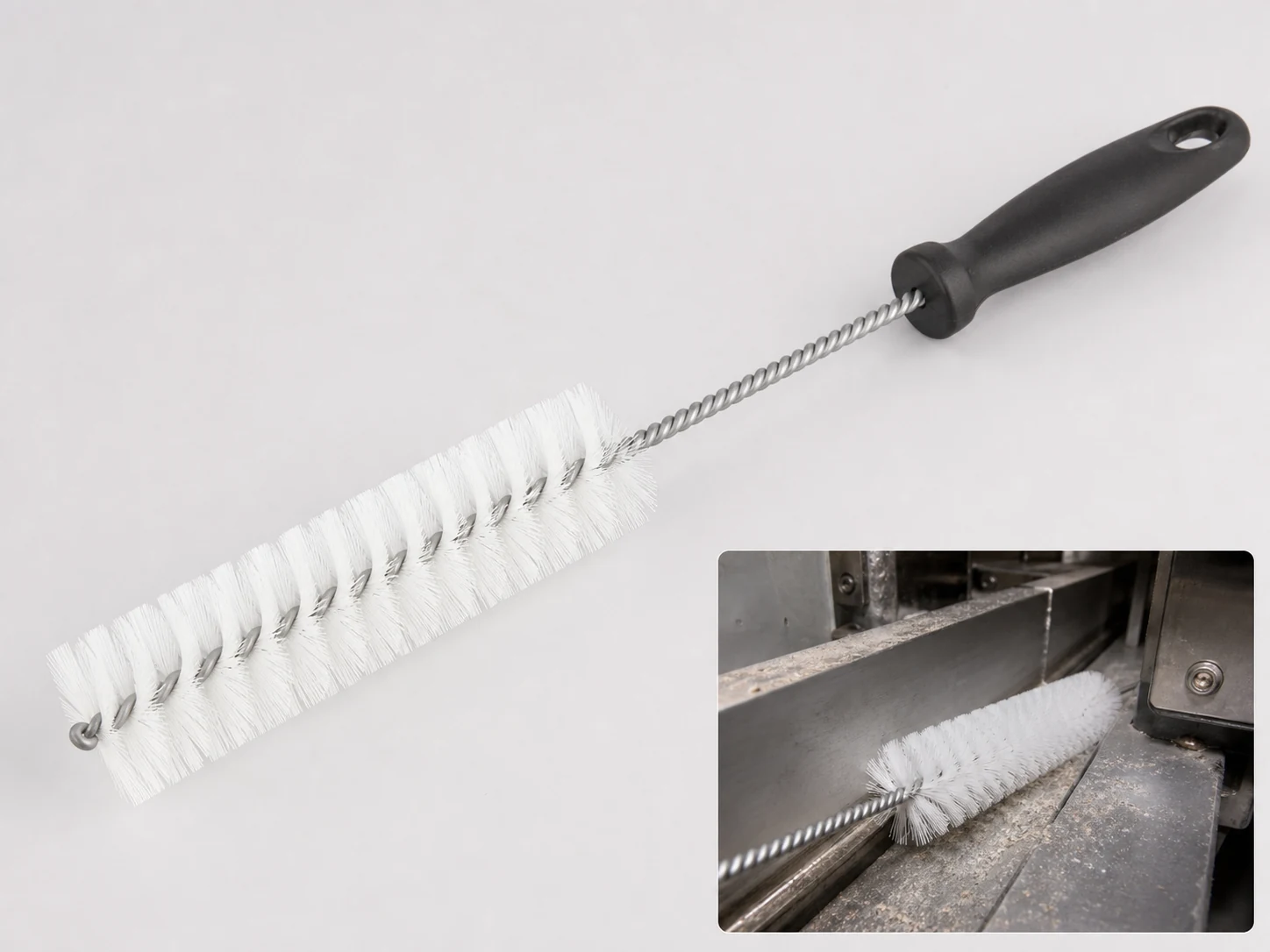
Medium brush
100 pcs
Minimum order
Worked with two hands or on a pole: chimney, gutter and pond-filter brushes, discs, cups and tank brushes.
Production lead time, once the specification is confirmed
- Up to 100 pcsWithin 7 days
- 101–5,000 pcsWithin 14 days
- 5,001–50,000 pcsWithin 21 days
- Over 50,000 pcsConfirmed with your quotation
Peak season can extend these times; the shipping date is confirmed in writing with your quotation. Sampling and shipping are quoted separately.
This industrial nylon cleaning brush removes oil, chips, dust, and process residue from machine parts, panels, slots, and accessible equipment surfaces without the scratching or metal transfer typical of wire brushes. Filament diameter, trim length, head width, and mounting are configured to the surface and the cleaning method.
What can this brush do for you?
Remove Oil, Chips, and Process Dust Without Metal Transfer
Nylon PA filament sweeps and scrubs machining chips, oil film, and dust from machine ways, housings, panels, and fixtures. The non-metallic tips do not leave steel or brass particles that can contaminate bearings, hydraulic circuits, or painted finishes, so the brush removes one contaminant without introducing another.
Reach Into Slots, Fins, Threads, and Recessed Areas
Trim lengths up to 100 mm and narrow head widths let the filament tips contact T-slots, cooling fins, tapped holes, and deep recesses where a cloth or flat pad cannot reach. The brush can be sized so the working end contacts the bottom and both side walls of a slot in one pass.
Hold Stiffness in Oil and Solvent
Nylon keeps its stiffness and recovery when wet with water, oil, or common solvent degreasers. Unlike natural-fiber brushes, it does not soften, rot, or shed fibers during repeated industrial cleaning cycles, so cleaning quality stays consistent from first use to replacement.
Set the Aggressiveness to the Surface
Filament diameter from 0.05 mm to 1.20 mm and fill density from 20 to 200 tufts per 100 cm² let you move from light dusting of precision surfaces to heavier scrubbing of cast housings and guard panels. Fine, soft filaments protect anodized and painted surfaces; thicker filaments provide the force needed for stubborn oil and chip residue.
Choose the Mounting That Fits the Process
Handles cover operator cleaning, ferrules suit extension tools, strips fit linear brush fixtures, wheels and plates work in rotary cleaning heads, and stems or shafts suit hand-held detail work or powered cleaning machines. One filament system can be adapted to manual, semi-automatic, or machine-assisted cleaning.
What is a Nylon Cleaning Brush?
A Nylon Cleaning Brush is a cleaning tool with nylon PA filament tufts set into a handle, block, ferrule, strip, wheel, plate, stem, or shaft. It is used to sweep, scrub, and dislodge dry particles, oil film, chips, and soft process residue from accessible industrial surfaces. The working end is formed by groups of nylon monofilaments, cut to a specified trim length, and placed at a controlled fill density.
In manual cleaning, the operator uses push, pull, and rotating strokes to move the filament tips across the surface. In fixture or machine use, the brush is mounted so the tips contact the part as it passes or rotates. The brush is typically chosen for machine maintenance, pre-assembly cleaning, and general equipment cleaning where surface preservation and contamination removal are both required.
This is not a wire brush substitute for rust, paint, or weld scale, and it is not intended for continuous use on hot surfaces. Nylon has excellent resistance to oils and mild cleaning chemicals, but it should not be exposed to strong concentrated acids, phenols, or boiling water for extended periods.
Technical Specifications
Dimensions, filament diameter, density, and mounting are configured for each project. The values below represent the standard working range for industrial nylon cleaning brushes.
| Parameter | Value / Options |
|---|---|
| Filament material | Nylon PA6 or PA6.6; other nylon grades available by project |
| Filament diameter | 0.05–1.20 mm |
| Trim length | 5–100 mm |
| Head width | 10–400 mm |
| Overall length | 100–800 mm; handheld reference 180–350 mm |
| Fill density | 20–200 tufts per 100 cm² |
| Mounting options | Handle, ferrule, strip, wheel, plate, stem, or shaft |
| Backing / block material | Polypropylene, wood, aluminum, or stainless steel, selected for the mounting and environment |
| Operating temperature | Avoid continuous use above 90°C (194°F); verify for short-term exposure |
| Chemical exposure | Resistant to most mineral oils, greases, neutral detergents, and common solvent degreasers; not for strong concentrated acids, phenols, or boiling water/steam |
| Brush type | Custom Handheld Detail Brushes |
| How it is driven | Hand-guided |
| Cleaning target | machine tool, press and forming equipment, and engine and hydraulic component cleaning |
| Surface or part | panels, slots, housings, metal, accessible equipment surfaces, frames, machine parts, and fixtures |
| Residue or debris | oil, chips, dust, process residue, product residue, paint, rust, and scale |
| Mounting / connection | Handle, ferrule, strip, wheel, plate, stem, or shaft |
Handheld configurations typically fall within 180–350 mm overall length and 20–100 mm head width. Roller, disc, and plate variants are quoted as separate configurations to match the existing shaft, bore, or mounting pattern.
Where does this brush work best?
- Machine tools — cleaning T-slots, guideways, chip trays, spindle noses, and control panels after machining, where loose chips and cutting oil collect.
- Presses and forming equipment — removing stamping oil, die lubricant, and blanking chips from dies, beds, guards, and bolster areas.
- Engine and hydraulic components before assembly — clearing oil galleries, flange faces, threads, and housing interiors of dust and process residue.
- Conveyors and packaging lines — wiping dust, product residue, and oil mist from rails, rollers, sensor surfaces, and machine frames.
- Injection molding and plastics machinery — removing plastic dust, purging compound, and oil from platens, ejector areas, and safety gates.
- General equipment maintenance — cleaning motors, gearboxes, pumps, and access covers without abrasive damage to seals or mating surfaces.
How do I choose the right one?
Start with the surface and residue, then work through filament diameter, trim length, density, and mounting.
1. Match filament diameter to surface sensitivity
| Surface / residue condition | Recommended filament diameter |
|---|---|
| Precision, anodized, painted, or sealed surfaces; light dust | 0.05–0.30 mm |
| General machine frames, panels, and cast housings; oil and chips | 0.30–0.60 mm |
| Non-critical surfaces with heavy oil, gum, or packed chips | 0.60–1.20 mm |
Finer filaments give more contact points per tuft and are gentler. Thicker filaments are stiffer and apply more mechanical force per tip, but they can still be less aggressive than wire.
2. Set trim length and head geometry to the access
Short trim lengths of 5–20 mm provide a firmer working face for flat surfaces. Medium trims of 20–50 mm cover general hand cleaning. Long trims of 50–100 mm reach into deep slots, bores, fins, and inside housings. Narrow head widths are needed when the brush must enter a slot or gap; wider heads clear larger panels and machine beds faster.
3. Select fill density for the cleaning action
Higher fill density puts more filament tips in contact and holds cleaning solution longer, which helps with wet oil removal. Lower density gives each tuft more room to flex and release chips, making it easier to avoid clogging when cleaning dry, chunky debris. Choose medium density for mixed residue.
4. Choose the mounting for the process
Handles suit operator-cleaned surfaces. Ferrules allow the brush to fit extension tools or fixtures. Strips are used in linear cleaning stations. Wheels and plates belong in rotary cleaning heads or powered brushes. Stems and shafts suit manual detail work and motorized cleaning machines. The interface must match your existing holder or shaft before the brush is built.
5. Confirm the operating environment
Nylon works well in oil, water, and mild solvent conditions, but continuous heat above 90°C, strong concentrated acids, phenols, or boiling water will damage the filament. If the process includes these conditions, cool the part first or specify a different filament material, such as PBT, or use a wire brush when the surface allows it.
Use a different brush when: the surface has rust, paint, or weld scale that requires abrasive or metallic contact; the process involves sustained high temperature; or the cleaning application needs a single-use, lint-free tool. In those cases, a wire brush, PBT brush, or disposable cleaning product is the more suitable choice.
Can I customize this brush?
Nylon cleaning brushes are configured around the actual surface, residue, and mounting. To quote a custom brush, we need the part material, residue type, cleaning chemical, process temperature, required head width and trim length, and the mounting interface drawing or dimensions. A sample part or photo of the contamination helps us confirm the filament choice.
We can adjust:
- Head and trim — head width, overall length, trim length, and tuft pattern for the contact area.
- Filament — nylon grade (PA6, PA6.6, or other), diameter, crimped or straight filament, color, and optional abrasive-impregnated nylon for extra scrubbing action.
- Fill — tuft density, row spacing, and edge profile to control stiffness and chip release.
- Mounting / body — handle shape and material, ferrule size, strip backing dimensions and hole pattern, wheel OD and bore, plate OD, stem diameter and length, or shaft interface.
- Backing material — polypropylene, wood, aluminum, or stainless steel, selected for chemical and moisture exposure.
- Marking and packaging — handle marking, color coding, bulk packing, individual bags, or project-specific labeling.
If your project requires material declarations, inspection reports, or third-party testing, we can support those requirements during the customization process.
Which filament survives the cleaning chemicals a nylon cleaning brush meets?
Can this brush be used with solvent degreasers and alkaline cleaners?
Yes, nylon resists most mineral oils, greases, neutral detergents, and common solvent degreasers at ambient temperature. Avoid prolonged exposure to strong concentrated acids, phenols, and boiling water or steam, which can embrittle or hydrolyze the filament. If your cleaning chemical is unusual, send the safety data sheet so the filament can be checked against it.
How can I tell whether the brush is too aggressive for a painted or anodized surface?
Test the brush on a hidden area first using the same pressure and stroke as production. If the tips leave visible fine scratches or dull the finish, reduce the filament diameter, lower the fill density, or shorten the trim length. Also keep the surface wet with cleaning solution; dry brushing can press existing particles across the finish and cause secondary scratching.
What should I check during routine brush inspection?
Look for filament ends that are flattened, split, bent, or melted, and check for tufts that have pulled out or become matted. Press the tips sideways; they should spring back. Check the handle, ferrule, strip, or wheel body for cracks or loosening. Replace the brush when cleaning takes visibly longer or when the filaments no longer stand upright under normal load.
Does brushing replace solvent cleaning or degreasing?
No. Brushing loosens and moves oil, chips, and dust, but the loosened material still needs to be rinsed, wiped, or vacuumed away. Use the brush first, then wipe with a clean solvent or dry cloth. In an automated process, pair the brush with air blow-off or a rinse stage.
Can I use this brush on hot surfaces right after machine shutdown?
Wait until the surface is below 90°C (194°F) before brushing. Above that, nylon can soften, smear, or stick to the part, and the brush can take a permanent set. For hot-surface cleaning, specify a different filament material or allow the equipment to cool.
Will nylon filaments generate static when cleaning electronic parts or solvent areas?
Dry nylon brushing can build a static charge. In static-sensitive or flammable-vapor areas, use an anti-static-treated or conductive filament option, dampen the brush with an appropriate cleaner, and ensure the workpiece and operator are properly grounded.
Guides that go deeper on this
Abrasive Nylon Brush for Edge Deburring: Wheel, Cup or Disc?
Read this guideGuideAbrasive Nylon Brush for Finish Control: What to Compare
Read this guideGuideAbrasive Nylon Brush Grit Selection for Multi-Stage Finishing
Read this guideGuideAbrasive Nylon Brush Wear: When to Replace vs Re-trim
Read this guideGuideAbrasive Nylon Brush: Silicon Carbide, Aluminum Oxide or Diamond?
Read this guideGuideAbrasive Nylon Brush: What Decides Grit, Filament and Form?
Read this guideGuideAre Scratch-Sensitive Parts Safe With an Abrasive Nylon Brush?
Read this guideGuideEdge Deburring: Which Abrasive Nylon Brush Avoids Rounding?
Read this guideGuideHow Does an Abrasive Nylon Brush Control Surface Finish?
Read this guideGuideMultipurpose Nylon Brush Mistakes on Scratch-Sensitive Parts
Read this guideGuideMultipurpose Nylon Brush vs Standard: Wet Cleaning
Read this guideGuideMultipurpose Nylon Brush: Which Nylon Resists Chemicals?
Read this guide26 guides are indexed against this one. The rest are in the technical resources library.
Custom Manufacturing RFQ
Describe Your Application
An accurate custom quote starts with the dimensions, working surface, residue, material choice, connection, quantity, and reference files.
Drawing or photo optional — it speeds things up, it does not gate the enquiry.
Custom Brush RFQ
Send Your Brush Project
Upload a drawing, product photo, or sample photo and provide the core dimensions and cleaning conditions.
“We need a brush to remove wet residue from a stainless steel conveyor, about 800mm wide. The current brush wears quickly. We can send photos.”
“We sell drinkware and need a cleaning brush to include with the product. Quantity around 5,000 pieces.”