
Custom Cleaning Brush
Cleaning Brush Mold
Head widths 10 to 100 mm and trim 10 to 50 mm reach rib details, vent slots and ejector pockets, lifting release agent without scratching plated steel.
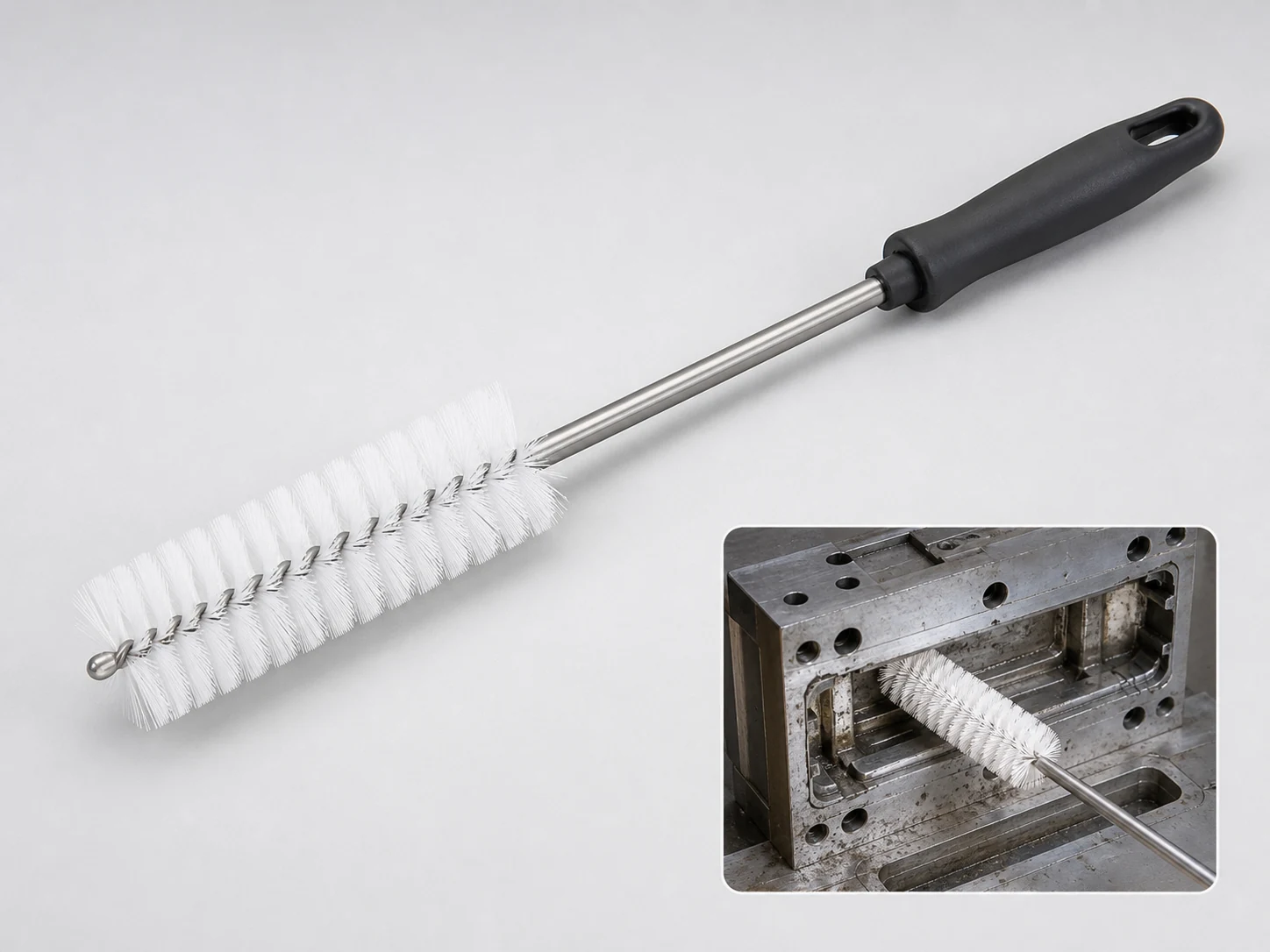
Small brush
500 pcs
Minimum order
Held in one hand: tube, bottle, detail and swab brushes — including long-handled ones with a small head.
Production lead time, once the specification is confirmed
- Up to 500 pcsWithin 7 days
- 501–50,000 pcsWithin 14 days
- Over 50,000 pcsWithin 21 days
Peak season can extend these times; the shipping date is confirmed in writing with your quotation. Sampling and shipping are quoted separately.
A nylon-filament handheld brush for cleaning injection molds, dies, and precision tooling. Sized to enter cavities, parting lines, vents, and textured faces, it lifts release agents, light flash, dust, and soft baked films without scratching polished or plated mold surfaces.
What can this brush do for you?
Reaches tight mold geometry without scraping the steel
Head widths from 10 mm to 100 mm and trim lengths from 10 mm to 50 mm fit into rib details, ejector pin pockets, vent slots, and shut-off edges. You clean the feature that is causing the defect, instead of working around it with an oversized brush.
Lifts release agent and flash instead of burnishing it into the surface
Nylon PA filaments flex under pressure and carry away accumulated release agent, light polymer flash, dust, and oil from cavity walls and parting lines. Because the filament is non-abrasive, the mold’s polished finish and etched texture stay unchanged.
Keeps vents open and part geometry stable
Blocked vents cause gas burns, short shots, and dimensional drift. The narrow trim reaches into vent channels and clear-out slots, so venting stays consistent from shot to shot. Regular vent cleaning with the right brush reduces unplanned mold pulls.
Works at press side without a full mold teardown
Short and long handle options let the operator reach angled surfaces, core pins, slides, and ejection areas while the mold is in the press or on the bench. Cleaning can happen between runs, during color changes, or at the first sign of residue transfer.
Replaceable and shapeable for each mold’s critical zones
The head, filament material, and handle length can be set to the cavity that is actually causing trouble. When one configuration wears out or a new mold arrives, the brush can be re-specified without changing the cleaning procedure.
What is a Cleaning Brush Mold?
A Cleaning Brush Mold is a hand-guided nylon-filament brush made for cleaning injection mold cavities, die and tool surfaces, parting lines, vents, and related fixtures. The product name puts the words ‘cleaning brush’ first, but the tool is a brush for molds—not the metal mold used to manufacture brush blocks.
In daily mold maintenance, release agents, polymer films, moisture, dust, and burnt material build up on cavity walls, shut-off surfaces, and vent channels. This brush uses rows of nylon PA filaments set into a compact head to remove that material by flexing and lifting, not by grinding. The brush moves across the mold surface with short strokes and controlled pressure, following the cavity profile and clearing the geometries where defects begin.
It is not a substitute for solvent wiping, ultrasonic cleaning, or a wire brush when heavy carbon or scale has formed. It is the first-line mechanical step for keeping polished, textured, and plated mold surfaces free of the light residue that changes part appearance and tool function. Standard nylon PA is suited to mold surfaces at or below about 120°C and to common mold-cleaning solvents; higher-temperature or aggressive-solvent situations require a different filament grade.
Technical Specifications
| Parameter | Value / Options |
|---|---|
| Product form | Handheld mold-cleaning brush; custom machine-mounted configurations available |
| Fill material | Nylon PA (PA6 / PA6.6, selected for the residue and solvent environment) |
| Head width | 10–100 mm, matched to the narrowest cavity, slot, or vent opening |
| Trim length | 10–50 mm; longer trim for reach and conformability, shorter trim for firmer edge action |
| Overall length | 150–400 mm, sized for press-side reach or bench use |
| Filament diameter | 0.10–0.50 mm; finer for polished/textured surfaces, heavier for stubborn film |
| Head profile | Flat block, chisel/angled, round, pencil, or custom profile matched to the cavity geometry |
| Handle / ferrule | Polypropylene, wood, or stainless steel handle with metal ferrule as needed |
| Service temperature | Standard nylon PA for intermittent contact up to approximately 120°C (248°F); higher-temperature filament options on request |
| Solvent exposure | Compatible with common mold release agents, mineral spirits, and mild alkaline cleaners; confirm aggressive solvent compatibility during selection |
| Brush type | Custom Handheld Detail Brushes |
| How it is driven | Machine-driven, mounted in the equipment |
| Cleaning target | injection mold cavity surface, parting line and shut-off face, and vent channel and clear-out slot cleaning |
| Surface or part | molds, cavities, vents, parting lines, tooling, dies, channel, and slots |
| Residue or debris | mold, release agent, dust, carbon, oil, coolant residue, scale, and chips |
| Mounting / connection | Fixed |
Head width, trim, and overall length are the three dimensions buyers usually confirm first. The other values can be adjusted for the mold’s surface finish, access space, and residue type.
Where does this brush work best?
- Injection mold cavity surfaces between production runs, color changes, or material changes, where release agent film and light flash need to be removed without altering the steel.
- Parting lines and shut-off faces where polymer film or release residue changes the tool’s sealing and causes flash or dimensional variation.
- Vent channels and clear-out slots that plug with dust, gas residue, or fine polymer debris and lead to burns or short shots.
- Textured and etched mold faces where a fine nylon filament cleans into the pattern depth but does not polish the texture flat.
- Die casting dies and adjacent tooling with light oxide, carbon dust, oil, and coolant residue in cooler zones; heavy baked carbon still requires a metal brush.
- Fixture jaws, slides, and tool interfaces where chips, oil, and release agent build up on locating surfaces and affect alignment.
How do I choose the right one?
Start with the narrowest opening. Measure the smallest cavity, slot, vent, or recess the brush must enter. The head width must pass through that opening without forcing, while still leaving enough filament contact against the surface. For ribs and pin pockets, a 10–20 mm head is often correct; for large open cavity faces, a 50–100 mm head covers more area per stroke.
Match trim length to the job. Long trim (30–50 mm) reaches deep features and wraps into curved or textured surfaces, but it bends more and applies lighter pressure. Short trim (10–20 mm) stays stiffer for parting line edges, shut-off faces, and film that needs more mechanical action. Choose the shortest trim that still reaches the bottom of the feature you are cleaning.
Select filament grade and diameter for the surface finish. Highly polished or diamond-finished molds need fine filaments (0.10–0.20 mm) or softer nylon grades. Textured surfaces can accept medium filaments (0.20–0.35 mm). Heavier release agent films or edge flash may call for larger filament diameters, but the resulting pressure must still stay below the mold surface’s scratch threshold.
Confirm temperature and solvent exposure. Standard nylon PA works for warm molds and common hydrocarbon or mild alkaline cleaners. If the mold is cleaned above about 120°C, or if aggressive solvents such as chlorinated cleaners or strong acids are used, ask us to select a different filament material or a heat-stabilized grade.
Know when a different brush fits better. Use a brass wire brush when stuck release or light oxidation needs more cutting action on steel molds, but test on a non-critical area first because it can leave marks. Use a stainless or carbon steel wire brush only for heavy scale and carbon on non-appearance surfaces. Use an anti-static or metal-free filament version when cleaning electronics molds or food-contact tooling where metallic particle contamination is a concern.
Can I customize this brush?
The standard cleaning brush mold is built around nylon PA fill, but the head, filament, handle, and overall geometry are configurable to the mold that causes the problem. To define a custom configuration, provide the cavity or recess width, depth, surface finish (e.g., SPI or VDI), residue type, cleaning chemical, maximum mold temperature, and the operator’s reach distance. A photo or sketch of the mold feature is often enough to start.
We can adjust:
- Head geometry — flat block, chisel angle, round, pencil, curved face, or a profile copied from the cavity section
- Filament material — Nylon PA6/PA6.6, heat-stabilized nylon, PBT, polypropylene, anti-static nylon, or brass for a more aggressive option when permitted
- Filament diameter and trim — fine to heavy, short to long, with straight or angled cuts to match the cleaning angle
- Handle — straight, bent, ergonomic grip, extended reach, hanging hole, or color coding by mold or production cell
- Ferrule and attachment — stainless steel ferrule, interchangeable heads, or a machine-mounted configuration for automated cleaning cycles
- Marking and packaging — laser marking, pad printing, bulk cartons, individual bags, or mold-specific cleaning kits
If your project needs material declarations, inspection records, or third-party testing for a specific mold cleaning SOP, we can support those requirements during the customization process.
When is a cleaning brush mold worn out rather than just dirty?
How do I confirm the brush will not scratch my polished mold?
Check the filament material first. The standard nylon PA filament is softer than mold steel and even aluminum, so it removes residue by flexing rather than cutting. Before use, inspect the brush for embedded metal particles, hardened debris, or melted filament tips. Any trapped particle can scratch a polished surface, so run a test stroke on a non-critical area if the mold finish is critical.
Can I use this brush on a mold while it is still warm?
Standard nylon PA is suitable for intermittent contact up to approximately 120°C (248°F). For hotter molds, allow the surface to cool to the safe range or request a heat-stabilized filament. If nylon melts onto the mold, it can leave a film that is difficult to remove from textured areas.
What residue is this brush intended to remove, and what should I use another tool for?
It removes release agent film, light polymer flash, dust, oil, carbon dust, and light oxide. It is not the right tool for baked-on carbon, heavy scale, or cured deposits that need grinding or aggressive metal brushing. For those, use a brass or stainless wire brush, or a solvent soak/ultrasonic step before hand brushing.
How should I clean and store the brush between mold changes?
Rinse the filaments with a compatible solvent or wipe them with a clean cloth to remove loosened residue. Remove any shed or matted filaments. Store the brush in a sealed bag or clean container away from grinding dust and metal chips, and keep one brush dedicated to each mold or material if cross-contamination matters.
When should I replace a mold cleaning brush?
Replace it when the filaments are permanently bent, matted, melted, or contaminated with metal particles. Also replace it when the trim has worn unevenly and the brush no longer reaches the bottom of the cavity with even pressure. A worn brush can leave a different contact pattern and missed areas.
Does brushing replace the solvent wipe or release agent removal step?
No. Brushing loosens and lifts the residue, but the loosened material still needs to be wiped or rinsed away with the appropriate solvent. Brushing is one step in the mold cleaning sequence, not a replacement for solvent wiping, drying, or re-application of the correct release agent.
Guides that go deeper on this
Custom Manufacturing RFQ
Describe Your Application
For an accurate quotation, please provide the main dimensions, material preference, working surface, residue, quantity, and a drawing or photo.
Drawing or photo optional — it speeds things up, it does not gate the enquiry.
Custom Brush RFQ
Send Your Brush Project
Upload a drawing, product photo, or sample photo and provide the core dimensions and cleaning conditions.
“We need a brush to remove wet residue from a stainless steel conveyor, about 800mm wide. The current brush wears quickly. We can send photos.”
“We sell drinkware and need a cleaning brush to include with the product. Quantity around 5,000 pieces.”