
What Is a Multipurpose Nylon Cleaning Brush?
A multipurpose nylon cleaning brush uses synthetic nylon filaments—available in various grades of stiffness, diameter, and abrasive content—to clean a wide range of surfaces. Nylon brushes are valued for their chemical resistance, durability, and controlled stiffness. Unlike wire brushes, nylon filaments can be engineered to be non-scratch when matched correctly to the substrate, making them popular for industrial, food-processing, medical, and precision cleaning tasks.
Why Scratch-Sensitive Parts Require Special Attention
Scratch-sensitive parts include any component where surface integrity directly affects performance, aesthetics, hygiene, or safety. Examples include:
- Polished stainless steel equipment (cosmetic panels, hygienic connectors)
- Coated or plated surfaces (anodized aluminum, painted casings, chrome-plated fittings)
- Soft metals (copper, brass) or alloys prone to galling
- Laboratory glassware, optical lenses, and transparent plastics
- Food-contact surfaces requiring smooth, non-porous finishes for CIP (clean-in-place) compliance
Using the wrong brush—even one made of nylon—can introduce scratches that become harborage points for bacteria, reduce component life, or fail a quality inspection. The key is understanding that not all nylon brushes are safe for every surface.
Common Mistakes When Using Multipurpose Nylon Brushes on Scratch-Sensitive Parts
Many of these mistakes originate during brush specification or ordering, not just during use. Below are the most prevalent errors and how to avoid them.
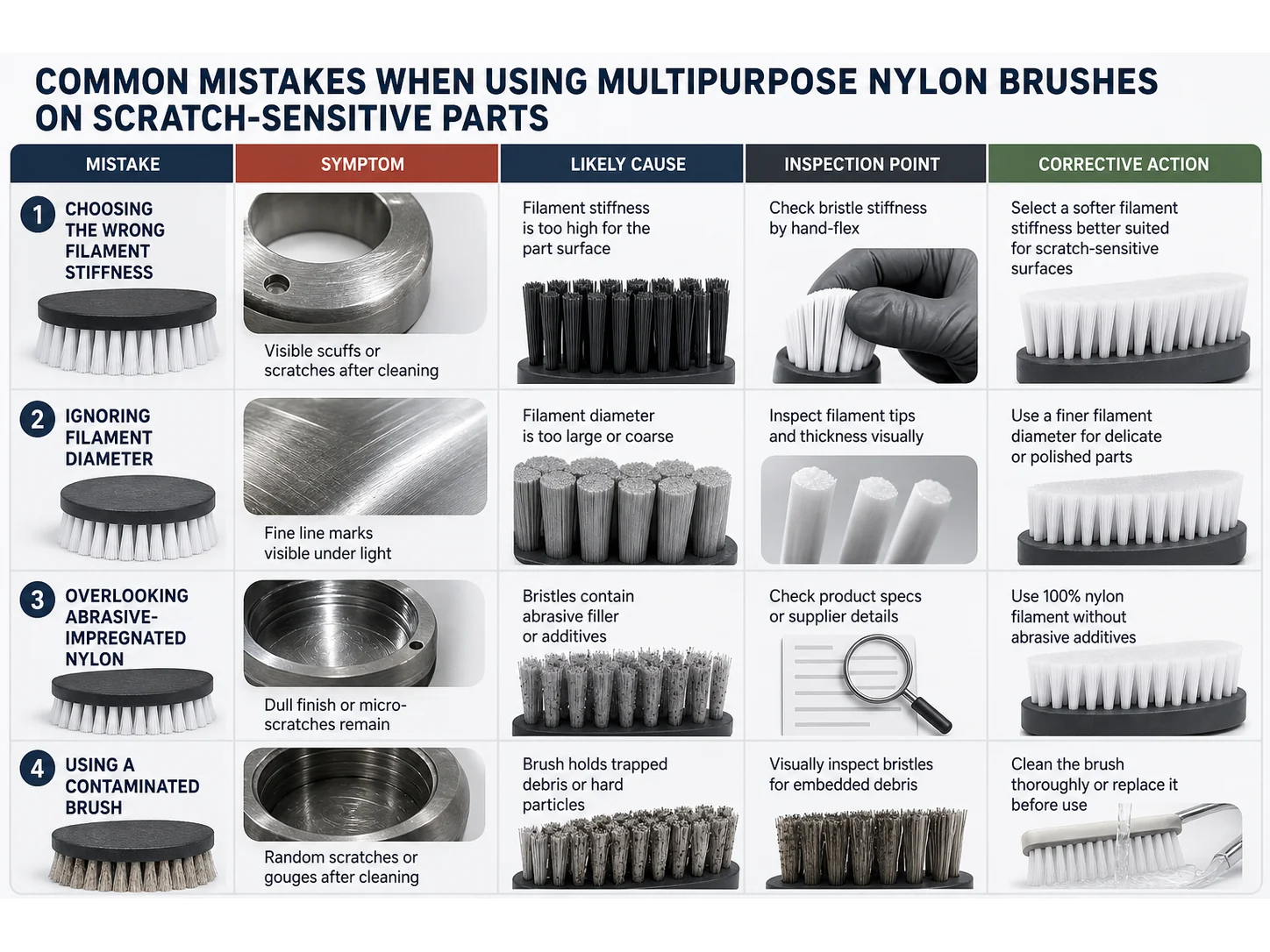
1. Choosing the Wrong Filament Stiffness
Nylon filaments range from very soft (like toothbrush bristles) to extra-stiff (resembling a hard broom). On a scratch-sensitive surface, a stiff filament can act like sandpaper. Always verify the surface hardness and required cleaning aggression before selecting stiffness. Use the softest filament that still removes the residue.
2. Ignoring Filament Diameter
Diameter directly affects cutting action. A larger-diameter filament concentrates more force per tip, increasing scratch potential. For delicate parts, look for brushes with fine filaments (0.10–0.25 mm) and rounded or flagged tips that provide a gentle scrubbing action.
3. Overlooking Abrasive-Impregnated Nylon
Some nylon brushes contain abrasive grit (silicon carbide, aluminum oxide) molded into the filament. These are excellent for deburring but will scratch polished or sensitive surfaces. Always confirm whether a brush is non-abrasive or if abrasive content is suitable for the application.
4. Using a Contaminated Brush
Reusing a brush across different parts, especially from rough to sensitive surfaces, can transfer embedded metal particles, grit, or hardened residues that cause scratches. Dedicate brushes to specific cleanliness zones and inspect filaments regularly for contamination.
5. Excessive Pressure or Speed
Even a soft nylon brush can scratch if too much pressure or rotational speed is applied. Follow the manufacturer’s recommended operating parameters, and train operators to let the brush tips do the work.
6. Wrong Mounting or Handle Interface
An improperly secured brush can wobble, causing uneven contact and unintended scratching. Whether a stem-mounted power brush, a twisted-in-wire tube brush, or a hand-held wide-face brush, ensure the core and arbor are compatible with the cleaning equipment and that mounting is rigid.
How to Choose the Right Multipurpose Nylon Brush for Scratch-Sensitive Applications
Answer the following seven questions to define a safe, effective brush specification:
- Residue type: Is it loose dust, baked-on grease, mild oxidation, or sterile material? Match aggression to the film strength.
- Surface sensitivity: What is the substrate material, hardness, and coating? Use a brush with lower stiffness and no abrasive filler for delicate surfaces.
- Equipment interface: Will the brush be used in a hand-held manual operation, mounted on a power tool, guided through a tube, or integrated into an automated system? Select the correct core and shank.
- Wet or chemical exposure: Nylon absorbs water and can soften in high-humidity or solvent environments. Specify stabilized nylon (e.g., type 6.6, heat-set) if dimensions must remain stable.
- Hygiene expectations: For food, pharmaceutical, or cleanroom use, require non-absorbent, easy-to-sanitize materials and avoid metal cores that can harbor contaminants.
- Maintenance frequency: How often will brushes be cleaned, inspected, or replaced? In critical applications, single-use or quick-change designs reduce cross-contamination.
- Custom size requirements: Off-the-shelf diameters may not fit complex geometries. Consider custom filament pattern, trim length, and core design to reach tight radii without excessive pressure.
Comparison of Multipurpose Nylon Brush Options for Scratch-Sensitive Parts
| Option | Filament Material | Typical Stiffness | Common Diameter Options (mm) | Handle/Core Style | Mounting | Scratch Risk | Best For |
|---|---|---|---|---|---|---|---|
| Soft flagged nylon brush | Nylon 6.6, unflagged tips | Very soft | 0.10–0.20 | Block, side, or hand grip | None (hand-held) | Minimal | Light dusting, final polish on optics, lab glass |
| Medium nylon stem brush | Nylon 6.12, straight | Medium | 0.20–0.35 | Stem with hex or round shank | Power tool arbor | Low–medium | Removing light carbon, paint prep on aluminum |
| Micro-abrasive nylon tube brush | Nylon with SiC grit | Stiff | 0.30–0.60 | Twisted-in-wire (single or double stem) | Drill chuck | High if misapplied | Deburring cross-holes, non-sensitive surfaces |
| Non-abrasive nylon bottle brush | Nylon 6.6, food-grade | Soft–medium | 0.15–0.30 | Handle with hanging loop | None (hand-held) | Low | Cleaning carboys, tanks, food containers |
| Nylon cup brush (flagged) | Nylon 6.12, flagged tips | Soft | 0.20–0.30 | Cup with threaded nut | Angle grinder | Low | Cleaning large flat surfaces, sheet metal prep |
| Custom-diameter nylon tube brush | Specified nylon, round or flat | Custom | 2.0–20.0+ | Single- or double-stem, loop, or handle | Flexible shaft or manual | Controlled by design | Proprietary ID cleaning, unique geometries |
When a Multipurpose Nylon Brush Is the Wrong Choice
Even with careful selection, nylon brushes have limits. Consider alternatives or additional steps when:
- Residue is harder than nylon: Fully cured epoxy, heavy scale, or baked-on carbon may require a more aggressive media (e.g., brass, stainless steel brush) but only after confirming the surface can withstand it.
- Surface requires zero contact scratching: For Class A cosmetic surfaces, pair a nylon brush with a protective masking film or switch to a non-contact cleaning method (ultrasonic, CO₂ blasting).
- Geometry is extremely complex: Blind holes with sharp internal edges may catch and break filaments. A sample part test with the intended brush is mandatory.
- Regulatory or certification demands: Some industries require bristle-free cleaning tools to eliminate foreign object debris (FOD) risk. Validate whether a nylon brush is acceptable under your quality system.
- Hygiene cannot be not Help confirmd: Single-use or autoclavable brushes may be required; standard nylon may degrade under repeated sterilization.
If scratch risk cannot be fully eliminated by brush selection alone, request a supplier drawing review and request test samples to verify surface finish before full-scale ordering. A professional brush manufacturer can recommend filament polymer, tip treatment, and density adjustments to minimize damage.
Final Takeaway: Preventing Scratches with the Right Nylon Brush Selection
The most common multipurpose nylon cleaning brush mistakes in scratch-sensitive parts are not just user errors—they often start at the purchasing or specification stage. By matching filament stiffness, diameter, abrasive content, mounting interface, and handling practices to the exact part sensitivity, you can avoid costly rework and part failure. Always validate with a sample test and consider contamination control as part of the process. When in doubt, start with the softest, non-abrasive nylon brush and increase aggression only if necessary.
Frequently Asked Questions
Can I use a multipurpose nylon brush on stainless steel without scratching?
Yes, if the brush uses a soft, non-abrasive nylon filament and the stainless steel has a durable surface finish (e.g., 2B or higher). On polished or mirror finishes, test first with light pressure and a clean brush to avoid micro-scratches.
Is a stiffer nylon brush always more effective for tough residues?
Not on scratch-sensitive parts. Stiffer filaments may remove residue faster but can also mark the surface. Sometimes a softer brush paired with a longer cleaning time or a mild chemical cleaner is safer.
How do I test whether a nylon brush will scratch my part?
Perform a test on a sample or non-critical area using the same pressure, speed, and environment as production. Inspect the surface under light at multiple angles and, if possible, measure surface roughness (Ra) before and after cleaning.
What is the difference between abrasive and non-abrasive nylon brushes?
Abrasive-impregnated nylon filaments contain grit particles that cut or abrade surfaces, making them unsuitable for scratch-sensitive parts. Non-abrasive nylon relies on filament stiffness and tip action alone to dislodge residues without cutting the substrate.
Can I use the same nylon brush for different cleaning tasks?
Avoid cross-contamination. Dedicate brushes by area or contamination level. Using a brush that previously cleaned a gritty surface on a polished part can embed particles in the filament and cause scratches.
Does wet cleaning reduce the scratch risk with nylon brushes?
Often yes. Water or cleaning solutions can lubricate the bristle tips, reducing friction and scratch potential. However, wet conditions may soften nylon, so ensure the filament material is suitable for prolonged fluid exposure.
When should I consider a custom-sized nylon brush instead of an off-the-shelf one?
When the part geometry includes tight curves, multi-diameter bores, or requires very even cleaning force distribution. A custom brush can optimize filament density, trim length, and core design to minimize localized pressure and scratch risk.
Are there any standards for verifying brush scratch safety?
While no universal standard exists, many industries adopt internal test protocols based on surface finish requirements. For critical components, request a supplier’s test report or perform in-house validation with a profilometer or visual inspection under controlled lighting.
Technical References
Which bristle material fits this job — Nylon PA, Abrasive Nylon or AISI 304 Stainless Steel Wire?
| Material | Continuous temperature (°C) | Peak temperature (°C) | Water absorption | Hardness |
|---|---|---|---|---|
| Nylon PA | 93 | 121 | 0.3–9% by PA grade and conditioning | Medium to firm; filament diameter and trim length control bending force. |
| Abrasive Nylon | 120 | 150 | 0.1–1.0% | Abrasive filament; stiffness and cutting level is controlled by PA base, grit type, grit size, filament diameter and trim height. |
| AISI 304 Stainless Steel Wire | 400 | 500 | 0% | Rockwell B 70–95 depending on temper and cold work |
| PA6 Nylon | 80–100 | 130–160 | 1.5–3.0% | Shore D 75–85 |
| PBT | 120–140 | 160–180 | 0.05–0.20% | Shore D 80–90 |
Figures as published by Brushtec / DuPont; Perlon; Alleima. Confirm the exact grade against the supplier datasheet before ordering.
What should replace Handheld Detail Brushes for nylon cleaning brush?
- Handheld Detail Brushes — Handheld detail brushes cover general precision cleaning; auto-detailing brushes impose tighter controls for painted, polished, leather, display, and trim surfaces.
- Nylon PA — Compare Nylon PA with PP, PBT, PET. Change material when wet stiffness, temperature, chemical resistance, conductivity, particle shedding, or surface marking becomes the limiting factor.
- Abrasive Nylon — Compare Abrasive Nylon with PP, PBT, PET. Change material when wet stiffness, temperature, chemical resistance, conductivity, particle shedding, or surface marking becomes the limiting factor.
- AISI 304 Stainless Steel Wire — Use AISI 316 stainless steel wire for chloride, marine, dairy, beverage, chemical washdown, or higher pitting-resistance requirements. Use carbon steel for dry aggressive cutting and brass or abrasive nylon for lower marking risk.