
What Is a Multipurpose Nylon Cleaning Brush?
A multipurpose nylon cleaning brush is defined by its filament material—nylon—and its design for use across different surfaces and soil types without causing damage. Nylon offers a controlled level of stiffness, excellent chemical resistance to common wet cleaning agents, and good recovery memory so the bristles maintain their shape after repeated soaking and flexing. The “multipurpose” label means the brush is built to clean a range of surfaces (stainless steel, plastic, glass, ceramic) without switching tools frequently, which matters in environments like commercial kitchens, laboratories, and maintenance workshops where wet cleaning is routine.
Key Differences: Multipurpose Nylon Brush vs Standard Cleaning Brush
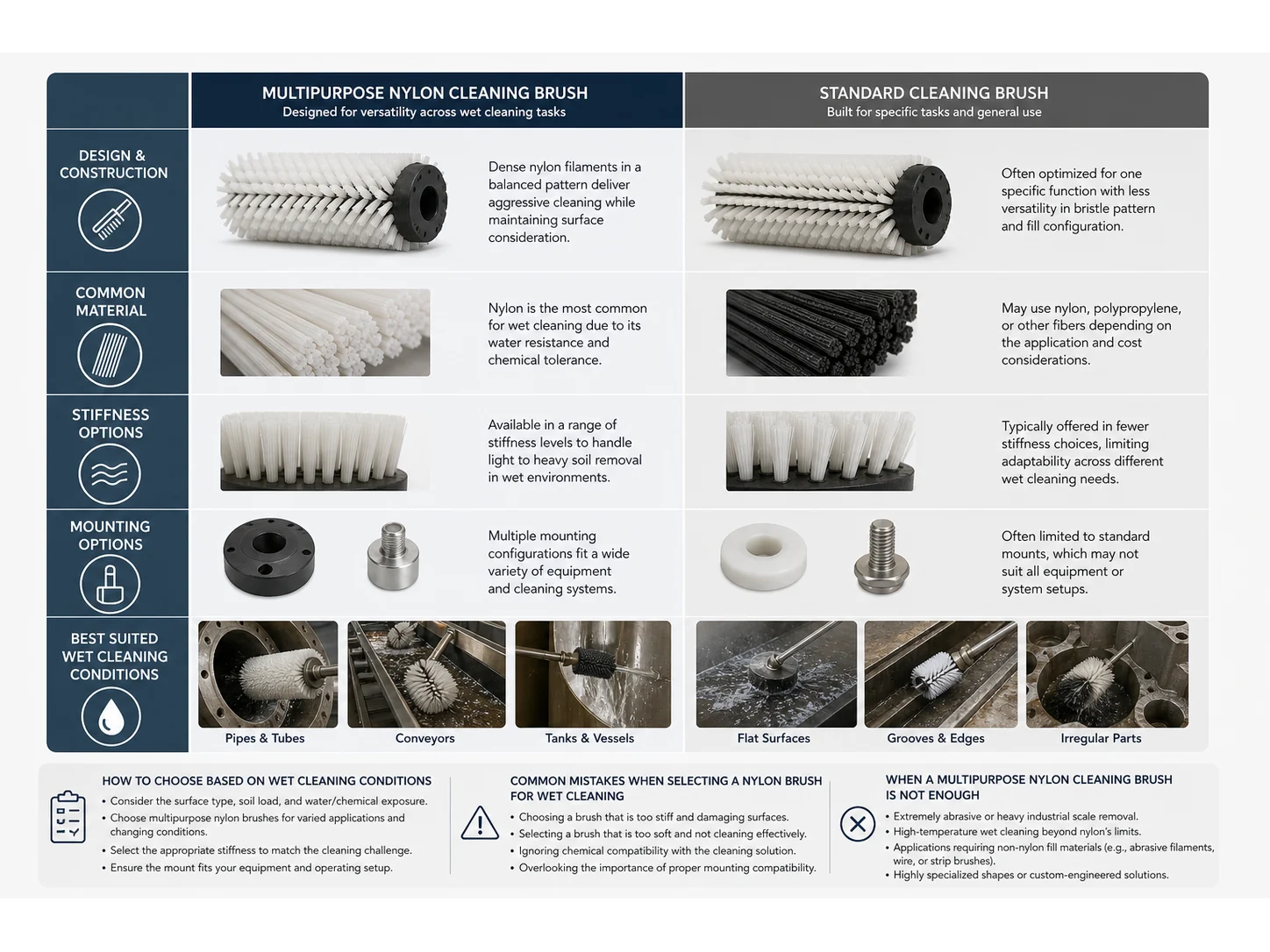
Standard cleaning brushes can include wire brushes, natural‑fiber brushes (tampico, palmyra), or single‑application nylon brushes designed for one specific task. The table below highlights where a true multipurpose nylon brush stands apart in wet cleaning scenarios.
| Factor | Multipurpose Nylon Brush | Standard Cleaning Brush (Non‑Nylon) |
|---|---|---|
| Material | Nylon filament (often type 6 or 6.12) | Steel, brass, natural fiber, polyester, or low‑cost nylon blend |
| Surface safety | Non‑abrasive to most metals, glass, plastics; reduces scratching risk | Wire brushes risk gouging; natural fibers can trap bacteria or swell |
| Wet performance | Excellent; nylon does not absorb water, resists swelling, dries quickly | Steel rusts unless stainless; natural fibers absorb water and degrade |
| Chemical resistance | Good against mild acids, alkalis, detergents, and sanitizers common in wet cleaning | Varies widely; steel corrodes in acids; natural fibers break down in strong alkalis |
| Temperature tolerance | Up to ~200°F (93°C) continuous; higher for specialized heat‑stabilized nylon | Steel handles higher heat but damages surfaces; natural fibers may char |
| Stiffness options | Available in soft, medium, and stiff grades (controlled by diameter and crimping) | Often fixed stiffness; steel is extremely aggressive with no soft option |
| Hygiene | Non‑porous, resists bacterial growth, compatible with sanitizer immersion | Wire bristles trap debris; natural bristles can harbor pathogens |
| Mounting options | Handheld, long handle, spiral, tube, disc, wheel, and custom configurations | Typically limited to simple handles or wheel shapes |
Common Material, Stiffness, and Mounting Options
A multipurpose nylon cleaning brush is not one product but a family of tools built from the same base filament. Choosing the right variant depends on the wet cleaning interface, residue type, and machine or manual use.
- Filament grade: Standard nylon 6 or 6.12 is typical; heat‑stabilized nylon is used near warm rinse water. Crimped nylon adds scrubbing power without harder filaments.
- Stiffness (diameter): Soft (0.15–0.25 mm) for delicate surfaces; medium (0.30–0.45 mm) for general scrubbing; stiff (0.50–0.80 mm) for baked‑on food residues.
- Handle/core: Handheld short handle, long handle for reach, tube brushes with twisted‑in‑wire core (stainless or galvanized), bore‑style for pipe interiors, and disc/wheel brushes for machine mounting.
- Custom size and trim patterns: Many suppliers offer custom length, overall diameter, and trim (flat, pointed, tapered) to match specific equipment like bottle washers or conveyor scrubbers.
How to Choose Based on Wet Cleaning Conditions
When cleaning involves water, detergents, or chemical sanitizers, the brush must hold up physically and not introduce contamination. Use this decision sequence to narrow your choice:
- Identify the residue: Light oil or film → soft to medium nylon; baked carbon or dried food → medium to stiff nylon; heavy scale → nylon alone may not be enough (see boundary section).
- Assess surface sensitivity: Glass, coated surfaces, plastic → soft nylon only; stainless steel or ceramic → medium to stiff nylon acceptable.
- Determine equipment interface: Hand‑held for manual scrubbing; long handle for tanks and vats; tube brush for pipe interior diameters; wheel or cup brush for powered scrubbers.
- Check chemical exposure: Nylon resists most common wet cleaning chemicals, but if using strong oxidizers or bleach at high concentrations, confirm filament compatibility with supplier data.
- Hygiene expectations: For food contact, choose a brush with an FDA‑compliant nylon filament (often listed as nylon 6/12 or food‑grade nylon) and a sealed, non‑absorbent handle core.
- Maintenance frequency: If brushes are soaked in sanitizer between uses, solid plastic handles or stainless cores are better than wood, which can crack and trap bacteria.
Common Mistakes When Selecting a Nylon Brush for Wet Cleaning
Even with the right material, real‑world performance can be undermined by a few avoidable errors:
- Choosing by cost drivers or size alone: A low-cost nylon brush may use low‑quality filament that softens prematurely in hot water or breaks off, creating contamination risks.
- Ignoring filament diameter: Using “soft” nylon when the bristle diameter is actually 0.50 mm (stiff) can scratch surfaces, while too thin a filament may fold and fail to clean.
- Using a damp brush for aggressive tasks: Nylon loses stiffness when wet; pressure that works with a wire brush will not translate. Excessive force just wears out the bristles.
- Skipping the core material check: A twisted‑wire brush with a non‑stainless core in a wet, sanitizing environment will rust quickly and stain surfaces.
- Mixing tools across incompatible chemistries: While nylon resists many chemicals, residual strong acids left on a brush can corrode the next surface—always rinse thoroughly.
When a Multipurpose Nylon Cleaning Brush Is the Wrong Choice
A multipurpose nylon cleaning brush is effective for routine wet cleaning, light to moderate deposits, and hygiene‑sensitive areas, but it has limits.
- Heavy scale or hard carbon: Nylon cannot cut through mineral scale or heavy carbon buildup the way a brass or stainless‑steel wire brush can. In these cases, a more aggressive brush or chemical soak first is needed.
- Extreme temperatures: Continuous exposure above 200°F will soften standard nylon, causing bristles to mushroom and lose cleaning action. High‑temp grades extend the range but are not standard in multipurpose lines.
- Deep‑crevice cleaning: For threads, narrow gaps, or complex geometries, a nylon brush may not have the reach or stiffness to dislodge embedded debris; a specialized profile or test sample may be required.
- When you cannot verify material compatibility: If the brush will contact exotic chemicals or be autoclaved repeatedly, supplier drawing review and lab simulation of the full exposure cycle (temperature, chemical, mechanical) are advisable before committing to a bulk order.
Final Takeaway
For most wet cleaning tasks involving water, detergents, and light to moderate soils on sensitive surfaces, a multipurpose nylon cleaning brush outperforms standard wire or natural‑fiber brushes in safety, hygiene, and longevity. The real choice comes down to matching filament stiffness, handle design, and core material to your specific wet environment. When the cleaning challenge involves heavy scale, extreme heat, or abrasive requirements, a hybrid approach—starting with nylon and only moving to more aggressive tools when necessary—often gives the best balance of surface protection and effective cleaning.
Frequently Asked Questions
Can a multipurpose nylon brush replace a wire brush for all wet cleaning?
No. It can replace wire brushes where surface scratching is a concern and residues are soft. For heavy rust, scale, or baked‑on carbon, a wire brush or chemical pretreatment is still needed.
What does “multipurpose” actually mean in a nylon brush?
It generally means the brush is designed to clean multiple surface types (metal, plastic, glass) without switching tools. The filament grade and stiffness are chosen to balance cleaning power with safety across a range of common wet cleaning tasks.
How do I choose the right stiffness for a wet cleaning nylon brush?
Match stiffness to both the residue and the surface. Soft nylon (fine diameter) for glass and coated surfaces; medium for general scrubbing; stiff for removing dried food or light scale on tough surfaces like stainless steel. When in doubt, start softer and test.
Are nylon brushes safe for food‑contact surfaces in a wet environment?
Yes, if the filament is explicitly rated as food‑grade. Many nylon 6/12 filaments are compliant with FDA regulations and resist bacterial growth. The brush handle and core should also be non‑absorbent and easy to sanitize.
Can I use a multipurpose nylon brush with bleach or strong sanitizers?
Nylon generally resists diluted bleach and common quaternary ammonium sanitizers. However, prolonged exposure or high concentrations can degrade the filament over time. Always rinse the brush after sanitizing and check supplier chemical resistance charts for your specific chemical.
Why does my nylon brush feel softer after soaking in hot water?
Nylon absorbs a small amount of water and loses some stiffness when wet and hot. This is normal. The brush returns to its original stiffness once dry. For tasks requiring consistent stiffness in hot water, consider a heat‑stabilized nylon grade.
Is a long handle nylon brush better for wet cleaning than a handheld one?
It depends on reach and ergonomics. Long handles help clean deep tanks, vats, or pipes without submerging hands, but they offer less precision for small parts. Choose based on the equipment you need to access.
What is the difference between a tube brush and a standard nylon brush?
A tube brush has bristles wound around a central twisted wire, often with a loop or handle at one end. It is designed to clean the inner diameters of pipes, tubes, and fittings, while a standard handheld or long‑handle brush is for open surfaces.
Which bristle material fits this job — Nylon PA, AISI 304 Stainless Steel Wire or PA6 Nylon?
| Material | Continuous temperature (°C) | Peak temperature (°C) | Water absorption | Hardness |
|---|---|---|---|---|
| Nylon PA | 93 | 121 | 0.3–9% by PA grade and conditioning | Medium to firm; filament diameter and trim length control bending force. |
| AISI 304 Stainless Steel Wire | 400 | 500 | 0% | Rockwell B 70–95 depending on temper and cold work |
| PA6 Nylon | 80–100 | 130–160 | 1.5–3.0% | Shore D 75–85 |
| PBT | 120–140 | 160–180 | 0.05–0.20% | Shore D 80–90 |
Figures as published by Brushtec / DuPont; Alleima; Perlon. Confirm the exact grade against the supplier datasheet before ordering.
What should replace Handheld Detail Brushes for nylon cleaning brush?
- Handheld Detail Brushes — Handheld detail brushes cover general precision cleaning; auto-detailing brushes impose tighter controls for painted, polished, leather, display, and trim surfaces.
- Nylon PA — Compare Nylon PA with PP, PBT, PET. Change material when wet stiffness, temperature, chemical resistance, conductivity, particle shedding, or surface marking becomes the limiting factor.
- AISI 304 Stainless Steel Wire — Use AISI 316 stainless steel wire for chloride, marine, dairy, beverage, chemical washdown, or higher pitting-resistance requirements. Use carbon steel for dry aggressive cutting and brass or abrasive nylon for lower marking risk.
- PA6 Nylon — Compare PA6 Nylon with PA66, PP, PBT. Change material when wet stiffness, temperature, chemical resistance, conductivity, particle shedding, or surface marking becomes the limiting factor.