
What Is a Machine Guard Strip Brush?
A machine guard strip brush consists of a dense row of bristles crimped into a rigid or semi-rigid channel—usually aluminum, galvanized steel, or stainless steel. It is installed along the edge of a moving door, sliding panel, or fixed frame so that the bristle tips make light, consistent contact with the opposing surface. In door gaps, the brush blocks airborne dust, liquid splash, light, or spray while still allowing the door to open and close without binding. It is not a hermetic seal; it is a practical barrier for everyday industrial environments where zero-gap solutions are not required.
Common Types and Configurations
Machine guard strip brushes come in several basic forms. Understanding the range helps you avoid the mistake of ordering a one-size-fits-all product.
- Aluminum holder with nylon bristles – the most common general-purpose option; good for dry dust and light splash.
- Stainless steel holder with polypropylene bristles – suitable for wet areas, washdowns, and food-grade zones where corrosion resistance matters.
- Flexible PVC holder – bends around curved doors or irregular openings.
- Conductive or anti-static bristles – used where static build-up can attract dust or create a spark hazard.
- High-temperature materials (e.g., Nomex, carbon-infused) – for ovens, dryers, or hot process chambers.
Bristle diameter, height, and density further affect how the brush performs. Finer bristles seal better against fine powder but wear faster; thicker bristles are more durable but leave larger microscopic gaps.
Quick Comparison: Material, Stiffness, and Mounting
| Brush Material | Typical Stiffness | Moisture Resistance | Temperature Range | Cost Factor | Best Use |
|---|---|---|---|---|---|
| Nylon 6.6 | Medium-firm | Good (absorbs some moisture) | -40°F to 210°F | Low | Dry dust, general machine guarding |
| Polypropylene | Soft-medium | Excellent | -40°F to 180°F | Low | Wet environments, mild chemical splash |
| Horsehair | Soft | Poor (absorbs water) | Up to 150°F | Medium | Sensitive polished surfaces, fine dust |
| Conductive Nylon | Firm | Good | -40°F to 200°F | High | Static-sensitive electronics, explosive dust |
| Stainless Steel Wire | Very stiff | Excellent | Up to 700°F | High | Extreme heat, heavy abrasion |
How to Choose the Right Brush for Your Door Gap
Instead of guessing, follow a simple decision path:
- Measure the gap – both static and dynamic. A brush should have bristle length at least 20–30% longer than the gap to ensure constant contact even if the door misaligns slightly.
- Identify what you’re sealing against – dry dust needs a dense, soft brush (nylon or horsehair); wet spray calls for polypropylene and stainless holder; abrasive swarf may require thicker, stiffer bristles.
- Check the mounting surface – flat metal edges suit rigid aluminum channels; curved edges need a flexible holder that can be bent on site.
- Consider cleaning and hygiene – in food or pharmaceutical areas, avoid materials that can absorb moisture or shed bristles. Look for FDA-friendly polypropylene or stainless steel bristles with a fully enclosed channel.
- Define maintenance access – if the brush cannot be easily inspected or replaced, choose the longest-lasting material even if initial cost is higher.
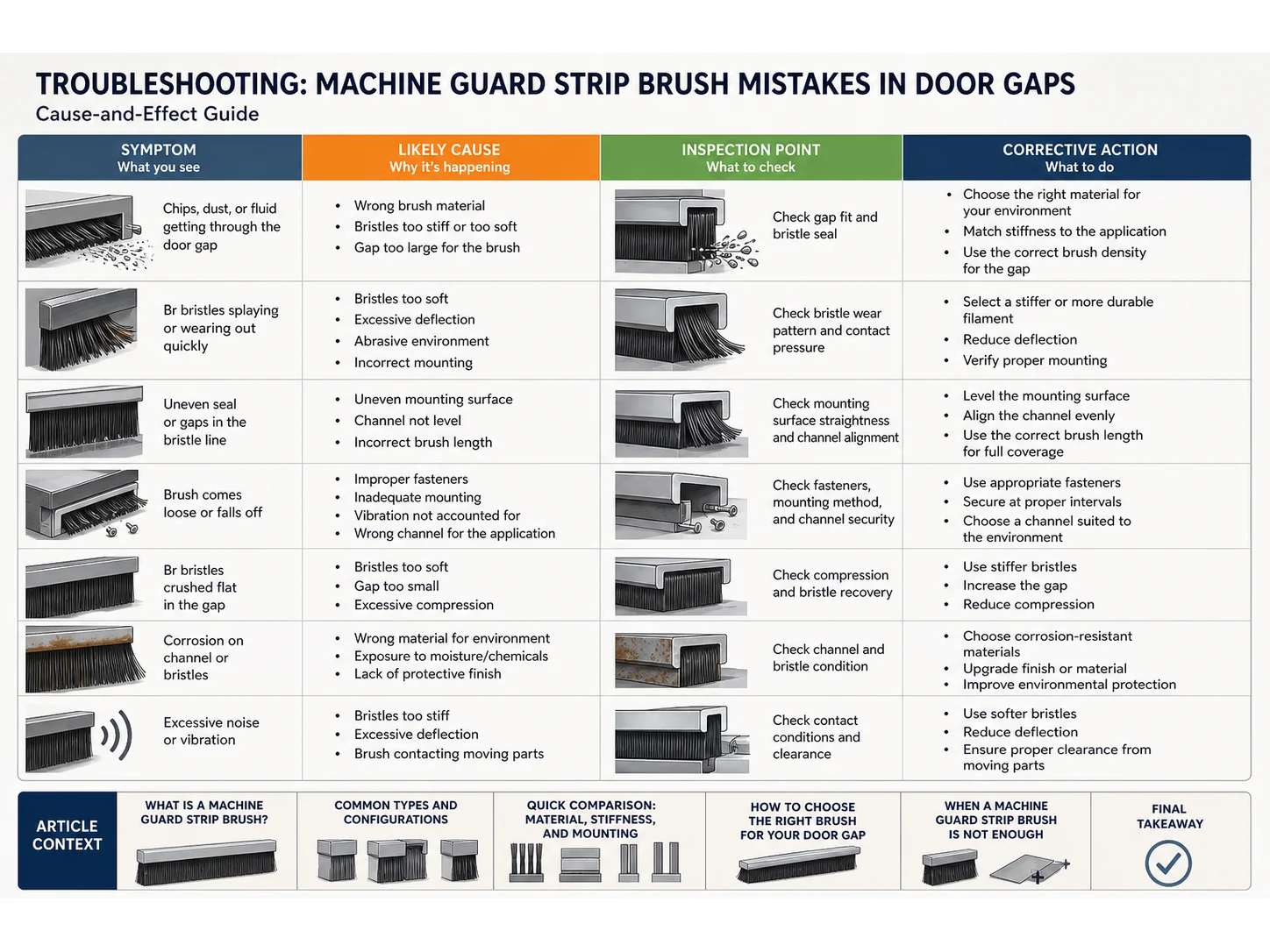
Common Mistakes in Machine Guard Strip Brush Selection and Installation
Even a high-quality brush fails when the wrong choice is made. Avoid these frequent errors:
- Ignoring bristle material compatibility – putting a nylon brush in constant wet conditions leads to swelling and loss of stiffness. Polypropylene would have been correct.
- Ordering by “looks right” instead of gap measurement – too-short bristles leave a gap; too-long bristles create excessive drag and premature wear.
- Using the same brush for every door – a sliding door on a machining center sees different debris than an electrical cabinet door. One size does not fit all.
- Skipping the mounting backer – screwing the channel directly into thin sheet metal without a backing plate can cause warping and uneven bristle contact.
- Failing to specify brush density – sparse bristles let dust blow through; overly dense bristles create friction that hampers door movement. Ask for a density recommendation based on particle size.
- Neglecting static electricity – in electronics or powder handling areas, static buildup can attract contaminants or create a spark. Conductive brushes solve this, but they must be properly grounded.
- Ordering from a stock photo without a drawing review – especially for custom lengths or odd-angle mountings, always ask your supplier for a dimensional drawing before bulk ordering.
When a Machine Guard Strip Brush Is the Wrong Choice
Strip brushes are excellent for dry or light-splash service, but they have clear limits. In the following scenarios, you may need a different sealing approach:
- High-pressure washdowns (over 100 psi) – the bristles will deflect and allow water to pass. A compression seal or inflatable gasket may be required.
- Zero-leakage requirements – if the application demands hermetic sealing (e.g., vacuum chambers, gas containment), a brush alone will not work.
- Very fine sub-micron particulates – while dense brushes help, HEPA-filtered enclosures with lip seals are more appropriate for cleanrooms or sensitive optics.
- Doors that move faster than 2 m/s – at high speeds, bristle flutter can reduce effectiveness. Reinforced holder profiles or a multi-stage brush arrangement might be needed.
Final Takeaway
A machine guard strip brush is a simple but engineered component. Getting it right means matching bristle material, length, density, and holder configuration to the real conditions of your door gap—not what the catalog thumbnail suggests. Measure the gap, define the environment, talk through the technical requirements with your supplier, and insist on a sample or drawing review before committing to a large order. Avoiding the mistakes above will save downtime, protect operators, and extend the life of your equipment.
Frequently Asked Questions
Can I cut a machine guard strip brush to the exact length I need?
Yes. Most strip brushes with an aluminum or steel holder can be cut with a hacksaw or bandsaw using a fine-tooth blade. After cutting, file any sharp edges and ensure the remaining bristles are fluffed to restore even contact.
How do I clean a brush strip that’s clogged with oily debris?
Remove the brush if possible, soak it in warm water with a mild degreaser, then rinse and allow it to dry completely before reinstalling. Avoid strong solvents that could degrade nylon or polypropylene bristles.
How often should machine guard strip brushes be replaced?
Inspection intervals depend on usage: heavy dust areas may need a check every month; clean environments every quarter. Replace when bristles become permanently bent, worn to less than 50% of original length, or when the channel shows corrosion that prevents secure mounting.
Are brush strips suitable for bottom-of-door gaps on outdoor enclosures?
They can be, provided the material resists UV and moisture. Polypropylene bristles with stainless steel holder work well. For heavy rain exposure, add a drip shield or companion rubber seal to prevent water wicking along the bristles.
What’s the difference between a door brush strip and a full rubber door seal?
A brush strip allows some airflow and movement while blocking most particles and light splash. A rubber seal provides near-complete closure against water, dust, and air exchange but may cause more friction and can tear if misaligned. Choose a brush when you need protection without sacrificing easy door operation.
Can I use a machine guard strip brush in a food processing area?
Yes, if you select materials that meet food safety guidelines: polypropylene or FDA-approved nylon bristles with a stainless steel or fully encapsulated holder. Avoid horsehair or any material that absorbs moisture and can harbor bacteria.
What if my door gap isn’t uniform—narrow at the top and wide at the bottom?
Some suppliers can provide stepped-bristle profiles or tapered strips. More commonly, you would use a constant-length brush designed for the widest gap and accept slightly more drag at the narrow sections, or shim the mounting channel to follow the gap contour.
Technical References
Which bristle material fits this job — AISI 304 Stainless Steel Wire, Nylon PA or Horsehair?
| Material | Continuous temperature (°C) | Peak temperature (°C) | Water absorption | Hardness |
|---|---|---|---|---|
| AISI 304 Stainless Steel Wire | 400 | 500 | 0% | Rockwell B 70–95 depending on temper and cold work |
| Nylon PA | 93 | 121 | 0.3–9% by PA grade and conditioning | Medium to firm; filament diameter and trim length control bending force. |
| Horsehair | 60–80 | 100–120 | 8–15% | — |
| Rubber | 100 | 130 | very low | Specified by compound and Shore hardness; published TPE families can span roughly 50–80 Shore A, but that is a product-family example rather than a universal rubber range. |
| AISI 316 Stainless Steel Wire | 400 | 500 | 0% | Rockwell B 70–95 depending on temper and cold work |
Figures as published by Alleima; Brushtec / DuPont. Confirm the exact grade against the supplier datasheet before ordering.
What should replace Strip Seal Brushes for strip brush?
- Strip Seal Brushes — Strip brushes create a linear barrier or guide; machine-table brush plates distribute load and support products over a broad area. Closest alternative: Machine Table Brush Plates.
- AISI 304 Stainless Steel Wire — Use AISI 316 stainless steel wire for chloride, marine, dairy, beverage, chemical washdown, or higher pitting-resistance requirements. Use carbon steel for dry aggressive cutting and brass or abrasive nylon for lower marking risk.
- Nylon PA — Compare Nylon PA with PP, PBT, PET. Change material when wet stiffness, temperature, chemical resistance, conductivity, particle shedding, or surface marking becomes the limiting factor.
- Horsehair — Compare Horsehair with Boar bristle, goat hair, microfiber. Change material when wet stiffness, temperature, chemical resistance, conductivity, particle shedding, or surface marking becomes the limiting factor.