
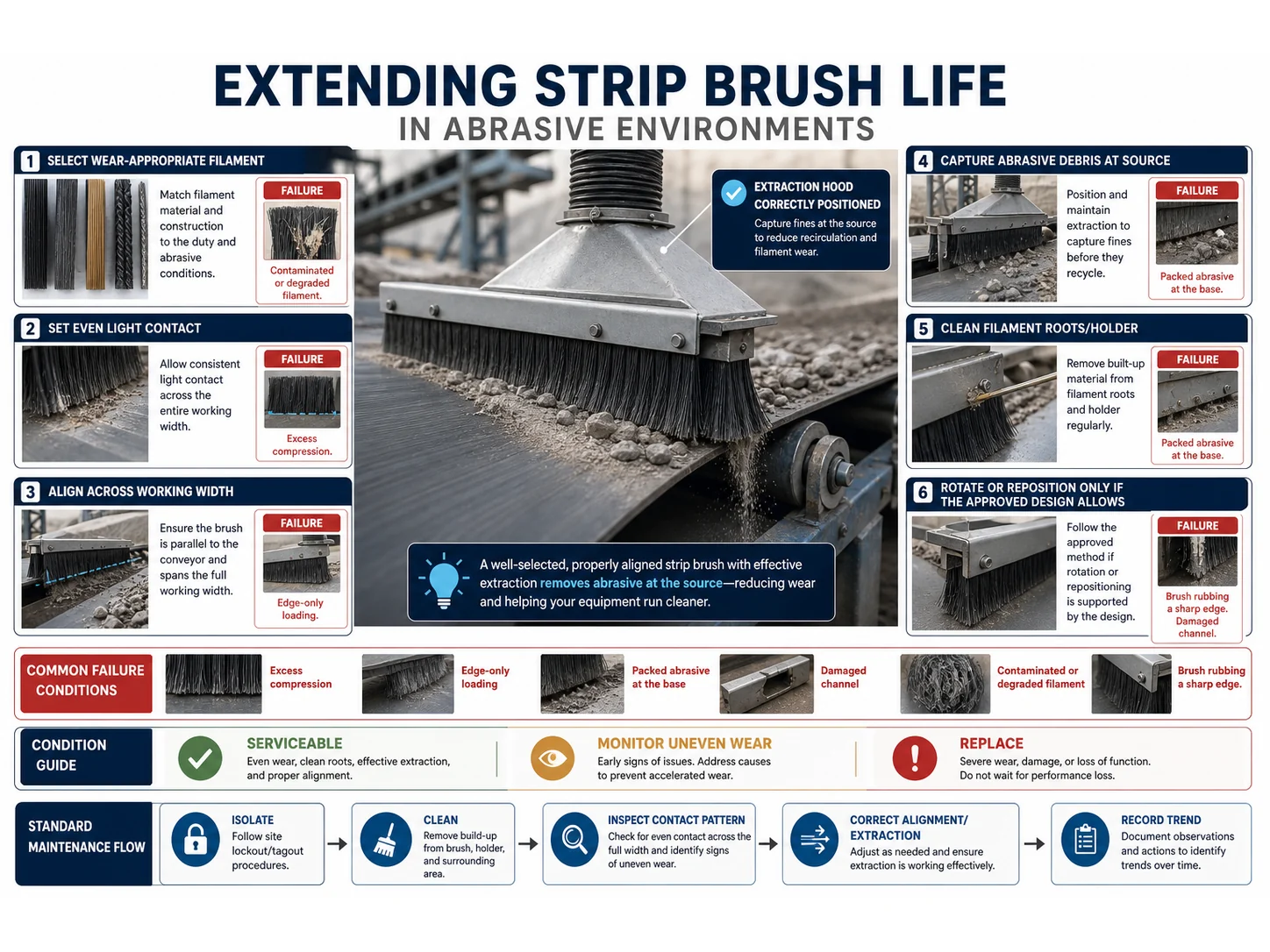
What Is a Strip Brush in an Abrasive Environment?
A strip brush is a linear brush with a metal channel holding a row of bristles, often used for wiping, sealing, conveying, or cleaning product surfaces. An abrasive environment adds particles—sand, metal chips, glass fibers, or hardened debris—that grind down bristles faster than gentle contact would. The challenge is not only wear from the main application but also secondary abrasion from contaminants packed into the brush face or carried in the air stream.
For mechanical surface finishing, buffing, polishing, abrasive finishing, surface preparation, and wear context, this article cites ASM Handbook, Volume 5: Surface Engineering, ASM International, 1994; mechanical finishing, buffing, polishing, and surface preparation sections.
Common Material Options for Abrasive-Resistant Strip Brushes
Not every bristle material handles abrasion the same way. Here are the most common types used when extended life is a priority:
- Standard Nylon 6/6: Good general-purpose material with moderate abrasion resistance. Often the baseline choice.
- Abrasive Nylon: Nylon impregnated with silicon carbide or aluminum oxide grit. It is self-sharpening and can handle high-wear applications because the grit continues to work even as the filament wears.
- Polypropylene: Softer and more chemical-resistant, but less abrasion-resistant than nylon. Usually not ideal for abrasive conditions unless chemical attack is the main concern.
- Stainless Steel Wire: Excellent for heavy abrasion and high temperatures. Stiff and aggressive, but can scratch or mark delicate surfaces.
- Natural Tampico or Herringbone Fiber: Used in some wet or oily abrasive settings. Good water absorption and flexibility, but lower wear life compared to synthetics in dry grit.
- Specialty Blends: Sometimes manufacturers offer hybrid filaments, such as nylon with PTFE or other additives, to reduce friction and heat buildup while improving wear life.
Material Comparison for Abrasive Environments
| Bristle Material | Abrasion Resistance | Cost Level | Typical Use Case | Limitations |
|---|---|---|---|---|
| Standard Nylon 6/6 | Moderate | Low | General wiping, dust sealing | Wears quickly against sharp grit |
| Abrasive Nylon (impregnated) | High | Medium-High | Deburring, heavy cleaning, edge radiusing | Can act as an abrasive on product surface if not managed |
| Stainless Steel Wire | Very High | High | Hot, sharp, or heavy particulate environments | Rigid, may scratch; corrosion risk if wrong alloy |
| Polypropylene | Low | Low | Chemical washdown areas with light grit | Poor mechanical wear life |
| Natural Fiber (Tampico) | Low-Moderate | Medium | Wet/damp abrasive environments | Dries out and becomes brittle without moisture |
Rotation and Cleaning Strategies That Extend Brush Life
Even the best material can fail early if not maintained properly. Two simple operational changes can make a big difference:
Rotation Practices
Strip brushes often wear unevenly, especially if the abrasive flow is directional or concentrated on one area. Regularly rotating the brush end-for-end or flipping the mounting orientation redistributes wear. For brushes in continuous lines, consider a schedule that rotates brushes every X production hours—this can double overall service life without any change to the brush itself.
Cleaning Methods That Reduce Abrasive Accumulation
Embedded particles act like sandpaper inside the bristle pack. Cleaning methods include:
- Compressed Air: Blow out lodged debris during routine line stops. Beware of pushing particles deeper; use directional nozzles.
- Vacuum Extraction: More effective for fine dust, especially when combined with gentle brushing agitation.
- Water or Solvent Rinse: In wet applications, a periodic rinse keeps grit from drying and hardening. Match the cleaning fluid to the bristle material to avoid chemical damage.
- Mechanical Shaking/Tapping: Automatic or manual knockers can dislodge heavy buildup; common in mining or aggregate handling.
Wear Pattern Analysis for Predictive Replacement
Instead of replacing on a fixed calendar, observe how the brush wears. Signs to monitor:
- Shortened Bristle Length: Measure the free-length periodically; a 30-50% reduction often signals replacement depending on application tolerance.
- Changed Tip Geometry: If the bristle ends are no longer even or have become pointed/frayed, sealing or wiping performance will degrade.
- Channel Deformation: A bent or worn metal channel can misalign bristles and cause uneven contact.
- Heat Discoloration: Especially in synthetic bristles, if tips show melting or shiny spots, friction has exceeded the material’s melting point.
Track these measurements on a simple log. A predictable wear trend allows you to order replacement brushes just before failure, avoiding unplanned downtime without replacing too early.
Common Mistakes That Shorten Strip Brush Life in Abrasive Environments
- Choosing Bristle Material by cost Only: A low-cost standard nylon brush may need replacement five times more often than an abrasive nylon version, costing more in labor and downtime.
- Ignoring Contaminant Particle Size: Fine dust accumulates, while large irregular chips may cut individual bristles. Brushes need different filament diameters or densities for each.
- Running Brushes Dry Without Monitoring: In high-friction abrasive applications, heat softens synthetics, accelerating wear. Intermittent operation or cooling can help.
- Assuming All Abrasive Environments Are the Same: Silica sand, aluminum oxide, and steel grit all behave differently. A brush that handles one may fail quickly against another.
- Forgetting the Mounting System: A loose or misaligned holder increases vibration and side loading, dramatically shortening life even for a well-chosen brush.
When the Environment Is Too Harsh for Any Strip Brush
There are points where even the best-maintained strip brush cannot survive. Consider alternative approaches when:
- Temperatures consistently exceed 500°F (260°C), melting or degrading most synthetics and weakening steel.
- Chemical attack is severe and no filament material can withstand both the chemical and the abrasion.
- Continuous high-pressure slurry removes bristles faster than they can wear evenly, causing rapid channel exposure.
- The product surface requires zero contact face change—even abrasive nylon brushing might alter surface finish beyond tolerance.
In these cases, look at contactless seals, air knives, hard metallic scrapers, or segmented roller systems instead. The strip brush is not the only tool; knowing when it’s not suitable prevents lost time and damaged products.
Final Takeaway: A Lifespan Strategy Instead of a Quick Fix
Extending strip brush life in abrasive environments is less about finding one magic material and more about building a consistent care routine. Match the bristle material to the specific abrasive type, rotate brushes to even out wear, clean embedded grit before it grinds, and let wear patterns tell you when to swap. This approach turns brush replacement from an emergency into a planned, budget-friendly maintenance task.
Frequently Asked Questions
What is the difference between abrasive nylon and standard nylon strip brushes?
Abrasive nylon filament has hard mineral grit embedded throughout the nylon strand. As the bristle wears, new grit is constantly exposed, maintaining a cutting or cleaning action. Standard nylon is smooth and wears away without the self-sharpening effect, making it less durable in gritty conditions.
How often should I rotate strip brushes in an abrasive line?
There is no universal number, but a good starting point is to check uneven wear after based on wear condition, operating load, and the equipment maintenance plan of operation and rotate when one end shows noticeably less length than the other. In highly abrasive environments, some plants rotate daily or after each shift to maximize life.
Can cleaning really double brush life?
Yes, especially when fine abrasive dust packs into the bristle base. That packed grit eats away at the filament from the inside and can cut through the channel. Simple compressed air or vacuum cleaning at regular intervals often extends life by 30–100%, depending on the application.
What is the best bristle diameter for abrasive applications?
Thicker filaments (0.020–0.040 in or larger) generally resist breaking and offer longer life, but they are stiffer. Choose the thickest diameter that still provides the needed flexibility for your application, and consider crimped or wavy filaments to reduce stiffness if needed.
How do I know when to replace a strip brush instead of cleaning it?
If the bristle length is below 50% of its original free length, or if the channel is exposed for more than a short section, replacement is usually more cost-effective than continued cleaning. Also, if the brush no longer maintains consistent contact pressure due to permanent set or missing bristles, it’s time for a new one.
Are stainless steel wire brushes always better for high-abrasion areas?
Stainless steel wire handles extreme heat and sharp debris better than nylon, but it can be too aggressive, mar product surfaces, and if corrosion occurs, it can contaminate the work. It also costs more. Use steel only when synthetic materials fail or when surface finishing is needed.
Does spraying water on a strip brush help in abrasive conditions?
In some dry, dusty environments, a light water mist can reduce static and knock down dust, decreasing the abrasive load. However, water can create a slurry that accelerates wear if the abrasive particles become mud. Test small adjustments and monitor bristle wear closely.
What temperature limits should I watch for with nylon strip brushes?
Standard nylon 6/6 softens around 200°F (93°C) and melts near 480°F (249°C). For sustained heat above 250°F (121°C), consider heat-stabilized nylon or switch to stainless steel. Even abrasive nylon loses its impregnated grit effectiveness if the base resin softens.
Technical References
- OSHA — Machine Guarding
- OSHA — 1910.147 Control of Hazardous Energy
- OSHA — Personal Protective Equipment
- American Brush Manufacturers Association — Brush Lingo
Which bristle material fits this job — Nylon PA, Abrasive Nylon or AISI 304 Stainless Steel Wire?
| Material | Continuous temperature (°C) | Peak temperature (°C) | Water absorption | Hardness |
|---|---|---|---|---|
| Nylon PA | 93 | 121 | 0.3–9% by PA grade and conditioning | Medium to firm; filament diameter and trim length control bending force. |
| Abrasive Nylon | 120 | 150 | 0.1–1.0% | Abrasive filament; stiffness and cutting level is controlled by PA base, grit type, grit size, filament diameter and trim height. |
| AISI 304 Stainless Steel Wire | 400 | 500 | 0% | Rockwell B 70–95 depending on temper and cold work |
| AISI 316 Stainless Steel Wire | 400 | 500 | 0% | Rockwell B 70–95 depending on temper and cold work |
| Horsehair | 60–80 | 100–120 | 8–15% | — |
Figures as published by Brushtec / DuPont; Perlon; Alleima. Confirm the exact grade against the supplier datasheet before ordering.
When are Strip Seal Brushes the wrong choice for surface finishing?
- Strip Seal Brushes — Use rubber lips, foam, labyrinth seals, air curtains, or rigid scrapers when pressure sealing or liquid containment is required.
- Nylon PA — The nylon family spans several grades, so heat, moisture and chemical limits should follow the selected PA resin rather than a generic nylon value.
- Abrasive Nylon — Exposed grit can change a surface finish, and high heat or aggressive chemicals can weaken the polymer carrier.
- AISI 304 Stainless Steel Wire — Avoid using AISI 304 as the default in marine, brine, hypochlorite, and persistent chloride environments; use AISI 316 when higher pitting and crevice-corrosion resistance is required.
What should replace Strip Seal Brushes for surface finishing?
- Strip Seal Brushes — Strip brushes create a linear barrier or guide; machine-table brush plates distribute load and support products over a broad area. Closest alternative: Machine Table Brush Plates.
- Nylon PA — Compare Nylon PA with PP, PBT, PET. Change material when wet stiffness, temperature, chemical resistance, conductivity, particle shedding, or surface marking becomes the limiting factor.
- Abrasive Nylon — Compare Abrasive Nylon with PP, PBT, PET. Change material when wet stiffness, temperature, chemical resistance, conductivity, particle shedding, or surface marking becomes the limiting factor.
- AISI 304 Stainless Steel Wire — Use AISI 316 stainless steel wire for chloride, marine, dairy, beverage, chemical washdown, or higher pitting-resistance requirements. Use carbon steel for dry aggressive cutting and brass or abrasive nylon for lower marking risk.