
What Are Abrasive Nylon Brushes?
Abrasive nylon brushes are flexible brushing tools with abrasive grit bonded to nylon filaments. They are used for controlled material removal, deburring, edge rounding, and surface conditioning across metal, composite, and plastic workpieces. Unlike rigid abrasive wheels, the filaments flex to conform to part contours, but this flexibility also makes them sensitive to operating parameters that affect wear rate and lifespan.
How Technique Affects Brush Wear
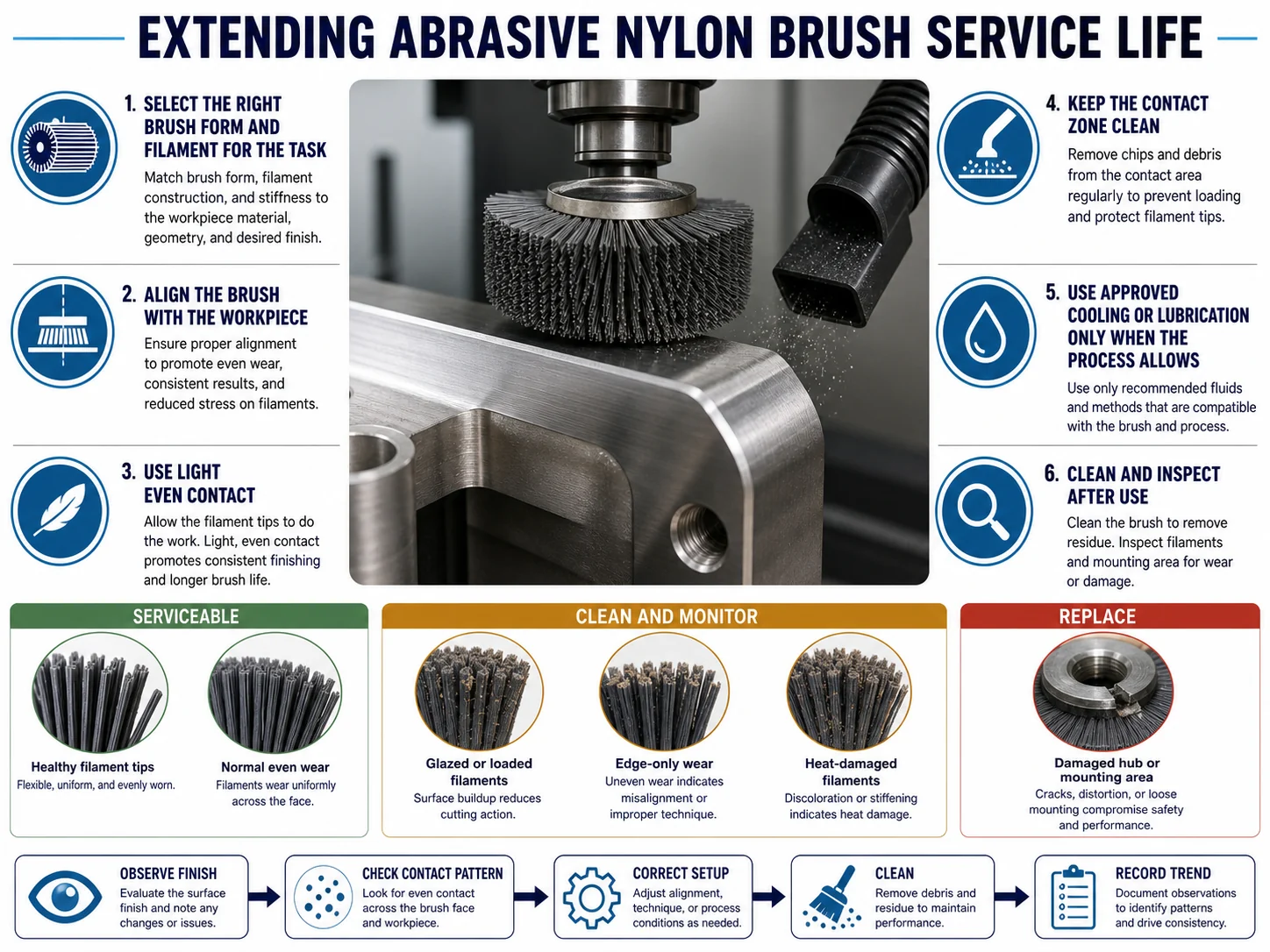
The rate and pattern of abrasive nylon brush wear are directly influenced by machine settings and operator technique. Uneven wear—such as cupping, tapering, or localized filament breakage—leads to premature replacement because only a portion of the abrasive is consumed. The four primary parameters that govern wear are surface speed, brush pressure, feed rate, and oscillation. Adjusting these within optimal ranges helps wear the brush evenly across its face and down the filament length, a key part of abrasive nylon life extension.
Adjusting Surface Speed for Longer Brush Life
Surface speed, measured in surface feet per minute (SFPM) or meters per second, controls how fast the brush tips contact the workpiece. Running too fast generates excessive heat, softening the nylon matrix and accelerating grit loss. Too slow a speed may cause inefficient cutting and grooving wear. To extend brush life, consult the brush manufacturer’s recommended speed range and stay near the lower end for heavy stock removal or near the upper end for fine finishing. In production environments, even a 15% speed reduction can often extend life without a proportional loss in cycle time.
Controlling Brush Pressure to Reduce Excessive Wear
Brush pressure—how hard the filaments press against the part—determines the depth of cut and abrasive engagement. Over-pressure crushes the filaments, causes rapid grit shedding, and can deform the brush face. Under-pressure may lead to glazing and inefficient cutting. To maximize life, use light but consistent pressure that allows the filament tips to do the work. If a brush wears into a taper or cup shape quickly, pressure is likely too high or uneven. Pressure control systems, such as mechanical overload protection and load-sensing power feeds, can help maintain optimal pressure in automated applications.
Optimizing Feed Rate for Uniform Abrasive Consumption
Feed rate—the speed at which the part or brush traverses across the workpiece—affects the dwell time of each filament on the part. A slow feed rate concentrates wear on a small band of filaments, creating grooves or steps in the brush face. An excessively fast feed rate may not allow enough material removal, leading operators to increase pressure, which shortens life. The ideal feed rate strikes a balance where the entire brush face contacts the part evenly over time. Start with manufacturer recommendations and adjust to achieve a uniform brush face across the width. Observing the wear pattern after a few cycles can guide fine-tuning.
Using Oscillation to Prevent Uneven Wear
Oscillation moves the brush or workpiece back and forth laterally to distribute wear across the full brush face. Without oscillation, the brush tends to wear in a narrow groove, wasting most of the abrasive surface. Adding a programmed oscillation stroke—typically 10–25 mm at a low frequency—can dramatically extend brush life by ensuring all filaments share the work. On CNC machines, oscillation can be implemented via a synchronized axis or an auxiliary oscillating unit. For manual operations, a simple swaying motion can serve a similar purpose, though automated oscillation yields consistent results.
Proper Brush Storage and Maintenance
Beyond operational technique, brush life depends on correct storage and handling. Keep brushes in a dry, temperature-controlled environment to prevent nylon filament degradation. Avoid stacking heavy objects on top of brushes, which can permanently deform the filaments. Before installing, inspect for embedded debris that could break filaments upon startup. Regular dressing with a brush-cleaning stick or abrasive dresser can remove loading and expose fresh abrasive, restoring cutting performance and extending usable life.
Conclusion
Extending abrasive nylon brush life is a matter of disciplined technique: moderate surface speeds, light pressure, balanced feed rates, and consistent oscillation. Combined with proper storage and occasional dressing, these practices maximize tool value and reduce overall finishing costs. By monitoring wear patterns and adjusting parameters accordingly, any shop can achieve substantial abrasive nylon life extension.
Technique Checklist for Longer Abrasive Nylon Brush Life
| Technique Factor | Human Check | Why It Helps |
|---|---|---|
| Pressure | The brush should work with the filament tips, not crushed side contact. | Reduces heat and uneven filament breakage. |
| Feed rate | The result should be consistent without repeated unnecessary passes. | Prevents overworking one area. |
| Brush cleaning | Dust and chips should not stay packed in the fill. | Keeps cutting action consistent. |
| Inspection | Replace based on result, wear pattern, and machine behavior. | Avoids both early replacement and unsafe overuse. |
When an Abrasive Nylon Brush Is the Wrong Choice
This brush is not enough when the main problem is blocked access, unsafe working conditions, damaged equipment, incompatible chemicals, or a process setting that keeps recreating the residue. In those cases, review base material, burr or oxide level, target finish, brush speed, pressure, and acceptable surface change and confirm the surrounding cleaning method before increasing brush stiffness or contact pressure.
How to Check the Result
After brushing, inspect both the cleaned area and the brush. A good result removes the target soil while leaving the surface, bristles, mounting, and nearby components in acceptable condition. If cleaning improves only when pressure is increased sharply, the brush specification or the surrounding process should be reviewed.
Bottom Line
The best result comes from matching extending the life of abrasive nylon brushes with proper technique to the real cleaning task rather than forcing one brush to solve every condition. Confirm access, residue, surface limits, and replacement routine first; then use a small trial or inspection step before scaling the method into daily work.
Frequently Asked Questions
What should I check before choosing extending the life of abrasive nylon brushes with proper technique?
Start with the surface you need to clean or finish, the material being removed, the available space, and how the brush will be mounted. A brush that looks correct in a catalog can still fail if the trim length, filament stiffness, or holder style does not match the real machine.
Does a new abrasive nylon brush need breaking in?
Yes, and skipping it distorts every measurement that follows. A new brush has square, unopened filament tips and cuts slowly for the first minutes until the tips open and the grit at the face is exposed. Judging cut rate or setting a penetration depth from that first pass gives a figure that will be wrong for the rest of the brush’s life. Run it on scrap until the rate steadies, then set the process.
Does coolant or mist extend brush life?
It extends it by removing the heat that softens the nylon matrix and lets grit release early, which is the main wear mechanism at speed. The trade is that the fluid carries removed material into the filament pack, so it has to be filtered and the brush flushed — a loaded brush polishes instead of cutting, and the operator usually answers that by raising pressure, which brings the heat straight back.
What does the wear pattern on the face tell me?
It is the most direct diagnostic available. A crowned face — short in the middle, long at the edges — means the centre is carrying the load, so reduce penetration or add oscillation. Short at the edges means a part edge is riding the brush. A tapered face across the width points at misalignment between the brush axis and the work. Reading the face costs nothing and points at the setting that is actually wrong.
Can an abrasive nylon brush be re-trimmed to true the face?
The face can be trimmed true, and the brush still cuts afterwards, because the grit runs through the whole filament rather than sitting on the tip. What changes is stiffness: a shorter filament is stiffer, so at the same penetration it cuts harder and heats faster. After trimming, reduce penetration rather than expecting the previous setting to give the previous result.
When is an Abrasive Nylon Brush the wrong choice?
A standard brush may not be enough when the machine has a special holder, the contact area is narrow, the material is sensitive, or the process needs controlled stiffness, conductivity, chemical resistance, or documentation for a specific use.
Technical References
- World Stainless — Corrosion Resistance of Stainless Steels
- British Plastics Federation — Thermoplastics
Which abrasive filament fits this job — Abrasive Nylon, Silicon Carbide Abrasive Nylon or Aluminum Oxide Abrasive Nylon?
| Filament | Continuous temperature (°C) | Peak temperature (°C) | Water absorption | Hardness |
|---|---|---|---|---|
| Abrasive Nylon | 120 | 150 | 0.1–1.0% | Abrasive filament; stiffness and cutting level is controlled by PA base, grit type, grit size, filament diameter and trim height. |
| Silicon Carbide Abrasive Nylon | 80–120 | 140–170 | 0.3–2.0% | Carrier Shore D 70–85; SiC Mohs Hardness Approximately 9.2 |
| Aluminum Oxide Abrasive Nylon | 80–120 | 140–170 | 0.3–2.0% | Carrier Shore D 70–85; Al2O3 Mohs Hardness Approximately 9 |
| Ceramic Abrasive Fiber | 80–120 | 140–170 | 0.3–2.0% | Carrier Shore D 72–86; Ceramic Grain Mohs Hardness Approximately 9 |
| Diamond Abrasive Filament | 80–120 | 140–170 | 0.3–2.0% | Carrier Shore D 72–86; Diamond Mohs Hardness 10 |
Figures as published by Perlon. Confirm the exact grade against the supplier datasheet before ordering.
What should replace Abrasive Nylon when it stops working?
- Abrasive Nylon — Compare Abrasive Nylon with PP, PBT, PET. Change material when wet stiffness, temperature, chemical resistance, conductivity, particle shedding, or surface marking becomes the limiting factor.
- Nylon PA — Compare Nylon PA with PP, PBT, PET. Change material when wet stiffness, temperature, chemical resistance, conductivity, particle shedding, or surface marking becomes the limiting factor.