
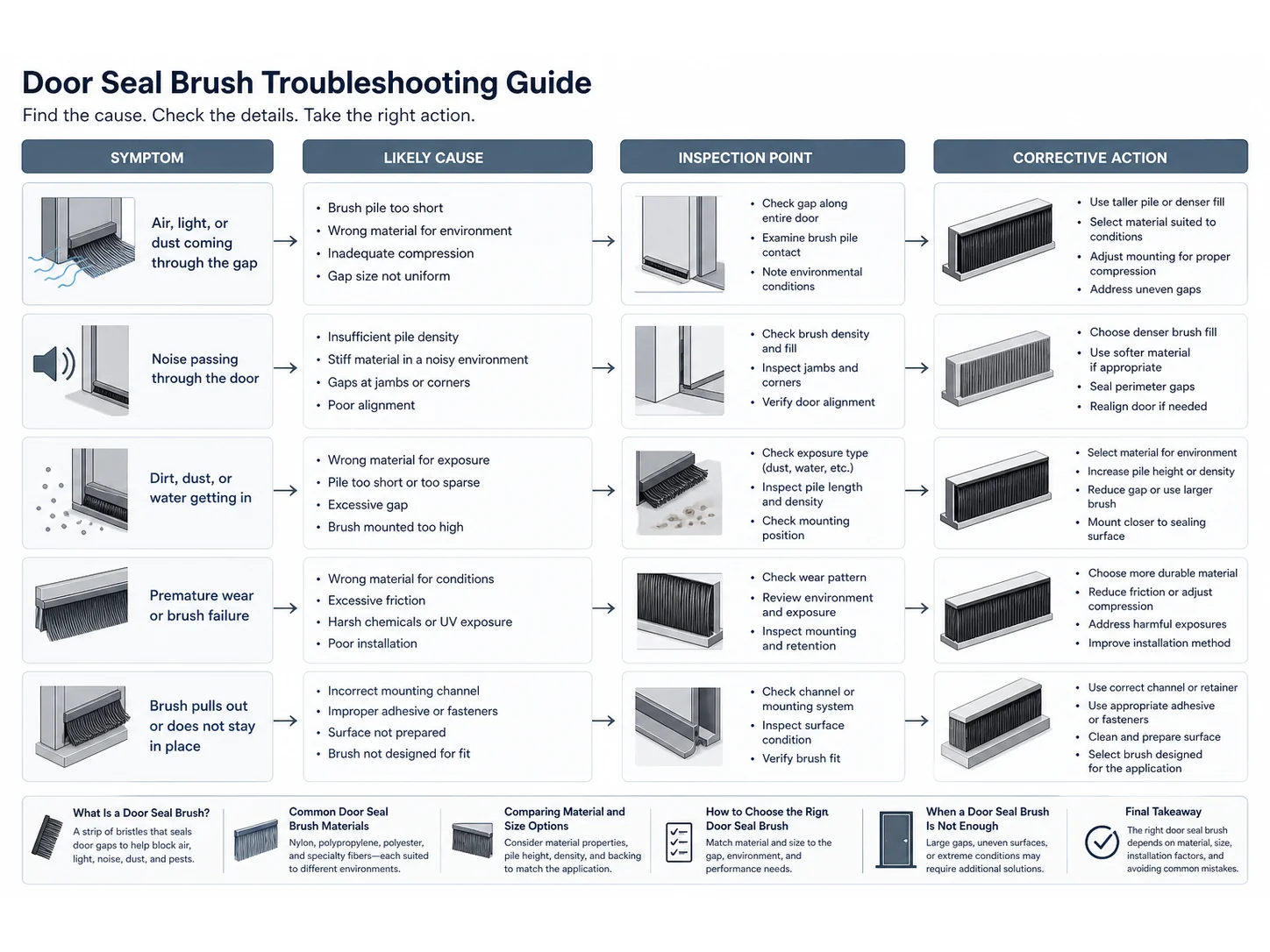
What Is a Door Seal Brush?
A door seal brush is a sealing strip that uses densely packed filaments to form a barrier against drafts, dust, light, sound, insects, and moisture. Unlike solid rubber or vinyl sweeps, brush seals conform to uneven floors and thresholds while allowing the door to open and close smoothly. The bristles sweep across the surface, compensating for small fluctuations in gap height. This makes brush seals especially useful on sliding doors, garage doors, commercial entryways, and anywhere floors are not perfectly level.
Common Door Seal Brush Materials
The bristle material determines heat resistance, chemical tolerance, wear life, and friction. The backing or holder material—often aluminum, PVC, or stainless steel—affects mounting, rigidity, and corrosion resistance. Below are the most common filament types used in industrial and commercial door seals:
- Nylon 6 or 6.6 – Durable, good abrasion resistance, moderate temperature range. Common for general-purpose sealing.
- Polypropylene (PP) – More rigid than nylon, excellent chemical and moisture resistance, often used in wet or washdown areas.
- Horsehair – Soft, traditional material used for light sweeping and where scratching sensitive floors must be avoided. Not suitable for wet conditions.
- Abrasive nylon (e.g., silicon carbide impregnated) – Designed for cleaning or scrubbing as the door moves, used in escalators or specialized equipment.
- Mixed fiber blends – Combine properties like stiffness with gentle contact; often tailored for niche applications.
Holders typically come in aluminum (lightweight, corrosion-resistant), PVC (economical, good for light-duty), or stainless steel (food-grade, chemical-resistant). Self-adhesive backing strips are available for quick installation on smooth door surfaces.
Comparing Material and Size Options
Selecting the right combination of filament material, diameter, and brush height is critical. The table below outlines typical characteristics to guide your choice. Note that exact specifications vary by manufacturer; always review technical data sheets.
| Material | Best For | Avoid For | Durability | Moisture Resistance | Typical Filament Diameter | Common Strip Heights | Cost Level |
|---|---|---|---|---|---|---|---|
| Nylon 6 / 6.6 | General indoor/outdoor, moderate traffic, dry to damp conditions | Highly acidic/alkaline environments, extreme heat >100°C | High | Good | 0.3–0.8 mm | 15–60 mm | $$ |
| Polypropylene | Wet areas, food processing, chemical splash zones | Very high friction or abrasive floors | Medium-High | Excellent | 0.5–1.0 mm | 10–50 mm | $$ |
| Horsehair | Historical restoration, delicate floors, light draft sealing | Outdoor, damp, high-traffic, or hygienic settings | Low-Medium | Poor | 0.1–0.3 mm (fine) | 10–40 mm | $$$ |
| Abrasive Nylon | Cleaning/sweeping applications, escalator skirting | Sealing alone; it wears surfaces if not intended | High | Good | 0.5–1.2 mm | Varies | $$$ |
| Mixed Fibers | Specific blends for balanced properties, light-medium duty | Unknown unless tested; verify specification | Varies | Varies | Varies | 15–50 mm | $$–$$$ |
Note: “Height” refers to the effective bristle length from holder to tip. Always allow extra height to accommodate uneven floors—typically 30–50% more than the maximum gap.
How to Choose the Right Door Seal Brush
Follow this practical checklist to narrow down options:
- Measure the gap – Accurately measure the largest and smallest gap along the door’s travel path. Uneven floors need brush height that covers the maximum gap plus extra flex.
- Identify the environment – Will the seal get wet (rain, washdown), exposed to chemicals, or experience temperature extremes (freezers, ovens)? Match material accordingly.
- Assess door type and movement – Swinging, sliding, or overhead? Heavy or frequent operation needs durable backing and secure mounting.
- Consider surface sensitivity – Soft bristles (horsehair, fine nylon) protect polished wood or stone; stiff polypropylene is safe on concrete.
- Check for hygiene requirements – In food or pharma settings, choose non-absorbent, easy-to-clean materials like polypropylene or nylon, and stainless steel holders.
- Verify mounting method – Screw-on, clip-in, or self-adhesive? The door material (wood, metal, glass) and required strength dictate the choice.
- Plan maintenance access – Brushes collect debris; design for easy removal and cleaning.
Common Mistakes When Specifying a Door Seal Brush
Even experienced buyers order the wrong brush. Avoid these errors:
- Choosing by cost drivers alone – Cheaper filaments wear out fast, creating a false economy.
- Ignoring floor unevenness – A brush too short leaves gaps; one too long drags and wears quickly.
- Using outdoor materials indoors – For example, horsehair in a damp kitchen will quickly degrade.
- Overlooking mounting compatibility – Self-adhesive might fail on rough or cold surfaces; screw-on requires door material able to hold threads.
- Confusing stiffness with sealing quality – Very stiff bristles can damage soft floors and increase opening force.
- Neglecting chemical exposure – Standard nylon may break down under frequent contact with cleaning agents.
- Forgetting about thermal movement – In large doorways, expansion and contraction can change gap size; a flexible brush helps but still needs to be sized for extremes.
When a Door Seal Brush Is the Wrong Choice
A brush seal is versatile, but it has limits. Consider alternative or supplementary sealing if:
- Fire-rated integrity is required – Fire doors need intumescent strips that expand under heat; a brush alone will not prevent flame spread.
- Absolute airtightness is critical – Cleanrooms, laboratories, or sound studios often require compression seals and automatic door bottoms.
- High-pressure wash-down – In some dairy or meat processing plants, even polypropylene may allow water ingress; special gasket seals are needed.
- Extreme temperature differences – For freezer doors, thermal breaks and insulated panels are necessary alongside the brush.
- Heavy pest pressure – Rodents can push through some brush densities; use metal reinforcement or integrated barriers.
When in doubt, request a sample and test in your actual doorway. For custom applications, share detailed drawings with your supplier to get a seal engineered to your specific gap profile and environment.
Final Takeaway
Choosing a door seal brush doesn’t have to be guesswork. Focus on three things: the right material for your environment, a brush height that handles floor variation without dragging, and a holder that mounts firmly to your door. By avoiding the common mistakes above and testing when unsure, you’ll achieve an effective, long-lasting seal. Keep this guide handy for your next procurement or maintenance refresh.
Frequently Asked Questions
Can I cut a door seal brush to the exact length I need?
Yes, most brush strips can be cut with a hacksaw or tin snips. Remove the brush from the holder before cutting the aluminum or PVC backer to avoid bending bristles. File sharp edges clean.
What is the best brush height if my floor is very uneven?
Measure the deepest point of the gap and add at least 50% extra height. For example, a 20 mm maximum gap may need a 30 mm or taller brush. The bristle tips should flex enough to fill hollows without excessive drag on high spots.
Are self-adhesive door seal brushes strong enough for exterior doors?
Self-adhesive strips work well on smooth, clean surfaces under light to moderate use. For heavy, exterior, or frequently used doors, screw-on or clip-in holders provide more reliable long-term attachment. Exposure to sun, moisture, and temperature swings weakens adhesive over time.
How do I clean and maintain a door seal brush?
Vacuum or brush out accumulated dust and debris regularly. For greasy or chemical residues, use a mild detergent compatible with the filament material. Avoid wire brushes or high-pressure water that could deform the bristles or dislodge the holder.
Can door seal brushes block insects and small pests?
When the bristles are dense enough and the gap is fully covered, brush seals can deter crawling insects and reduce ingress. However, for not Help confirmd pest exclusion, combine with a rubber sweep or threshold plate, especially against rodents.
How long should a door seal brush last before replacement?
Life expectancy depends on traffic, floor abrasion, and environment. In a busy commercial doorway, expect 1–3 years; in low-traffic areas, 5+ years. Replace when bristles become permanently matted, flattened, or missing sections.
What is the difference between a brush seal and a rubber sweep?
Rubber sweeps create an airtight seal on smooth, even floors but can drag or catch on uneven surfaces. Brush seals tolerate irregular floors and are quieter on sliding doors, but they are less airtight. Choose based on your priority: complete air sealing or forgiving operation.
Technical References
Which bristle material fits this job — Nylon PA, Horsehair or Rubber?
| Material | Continuous temperature (°C) | Peak temperature (°C) | Water absorption | Hardness |
|---|---|---|---|---|
| Nylon PA | 93 | 121 | 0.3–9% by PA grade and conditioning | Medium to firm; filament diameter and trim length control bending force. |
| Horsehair | 60–80 | 100–120 | 8–15% | — |
| Rubber | 100 | 130 | very low | Specified by compound and Shore hardness; published TPE families can span roughly 50–80 Shore A, but that is a product-family example rather than a universal rubber range. |
| AISI 304 Stainless Steel Wire | 400 | 500 | 0% | Rockwell B 70–95 depending on temper and cold work |
Figures as published by Brushtec / DuPont; Alleima. Confirm the exact grade against the supplier datasheet before ordering.
What should replace Nylon PA for door gaps?
- Nylon PA — Compare Nylon PA with PP, PBT, PET. Change material when wet stiffness, temperature, chemical resistance, conductivity, particle shedding, or surface marking becomes the limiting factor.
- Horsehair — Compare Horsehair with Boar bristle, goat hair, microfiber. Change material when wet stiffness, temperature, chemical resistance, conductivity, particle shedding, or surface marking becomes the limiting factor.
- Rubber — Compare Rubber with Silicone elastomer, TPE, PVC profile, PVA sponge. Change material when wet stiffness, temperature, chemical resistance, conductivity, particle shedding, or surface marking becomes the limiting factor.
- AISI 304 Stainless Steel Wire — Use AISI 316 stainless steel wire for chloride, marine, dairy, beverage, chemical washdown, or higher pitting-resistance requirements. Use carbon steel for dry aggressive cutting and brass or abrasive nylon for lower marking risk.