
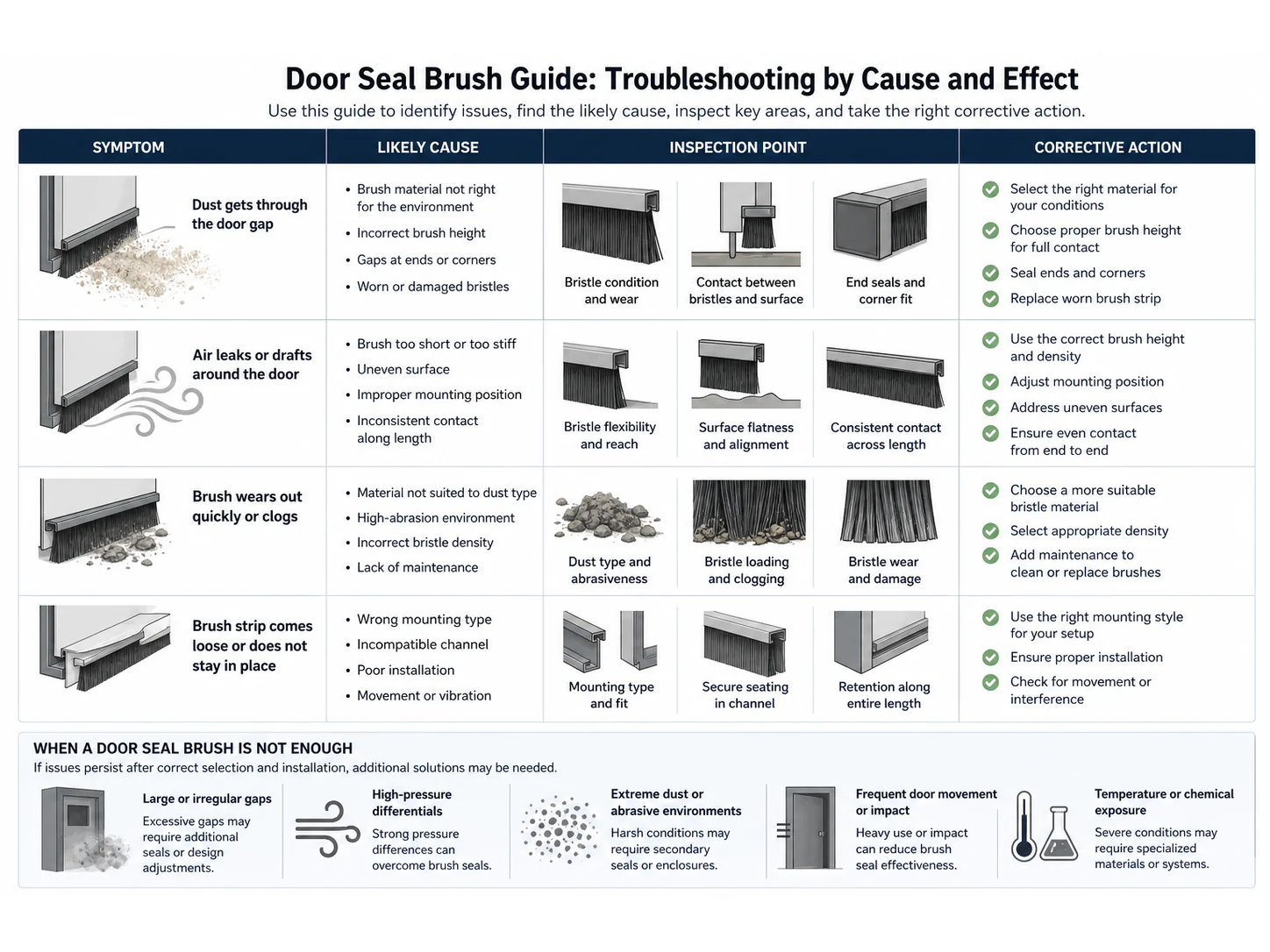
What Is a Door Seal Brush?
A door seal brush is a flexible sealing strip made of dense bristles held in a rigid or semi-rigid backing. The backing—typically aluminum, PVC, or stainless steel—mounts along the bottom, side, or top of a door leaf to fill irregular gaps. Unlike solid rubber or vinyl sweeps, brush bristles bend easily over uneven floors, grates, or tracks, making them the preferred choice for sliding doors, roller shutters, and industrial enclosures where a flexible, dust‑blocking barrier is needed.
Key Material Options for Door Seal Brushes
The performance of a door seal brush depends heavily on its bristle material. The table below summarizes the most common options and where they work best.
| Bristle Material | Typical Characteristics | Best Used In |
|---|---|---|
| Polypropylene (PP) | Good chemical resistance, moderate stiffness, low moisture absorption, economical. | General industrial doors, interior dust sealing, light chemical exposure. |
| Nylon (PA6 / PA6.6) | High abrasion resistance, good stiffness recovery, up to 80°C, good against oils and solvents. | Heavy‑traffic doors, machinery enclosures, environments with oils and fuels. |
| Polyester (PBT) | Excellent chemical stability, very low moisture pick‑up, high stiffness, good UV resistance. | Wet areas, food processing zones, outdoor doors, high‑humidity facilities. |
| Horsehair (natural) | Very fine dust capture, natural antistatic properties, limited moisture tolerance. | Fine‑dust sealing in woodshops, textile mills, or heritage buildings where conductivity is not a concern. |
| Static‑Dissipative (conductive) nylon | Contains carbon or metal fibers to drain static charges; surface resistance typically 10³–10⁹ Ω. | Electronics cleanrooms, server rooms, explosive‑atmosphere areas where static control is critical. |
The backing material is equally important. Anodized aluminum holders work well in most indoor applications; PVC holders offer lower cost and easier cutting for lighter doors; stainless steel is preferred where hygiene, washdown, or corrosion resistance matters.
Common Types of Door Seal Brush Strips
Buyers will encounter several mounting styles. The choice depends on the door edge profile, installation access, and whether the seal must be replaced frequently.
- Standard aluminum holder with brush insert: A slotted channel that accepts a replaceable brush strip. Common on commercial and industrial doors.
- Self‑adhesive brush strip (peel‑and‑stick): Comes with a pre‑applied high‑bond adhesive backing. Quick to install on clean, flat surfaces but less suited to heavy mechanical wear.
- Slide‑in/retainer brush strip: The brush and holder slide into a pre‑mounted aluminum or PVC base, simplifying future brush replacement without removing the holder.
- Flame‑retardant brush strip: Made with treated bristles meeting ASTM E84 or similar spread‑rate tests; used in fire‑rated openings.
- ESD‑safe brush strip: Incorporates conductive fibers grounded through the holder to prevent static buildup.
How to Choose the Right Size and Fit
Getting size right avoids gaps or excessive drag. Follow this simple measurement sequence:
- Measure the door gap height (clearance between door bottom and floor). This is the maximum unsupported height the bristles must fill.
- Select brush height (bristle length from holder face to tip). The brush height should be 1–2 mm taller than the gap. This creates a light interference fit (compression) without causing the bristles to buckle or wear quickly.
- Check holder width and mounting surface. The holder must fit flatly on the door edge. Aluminum holders commonly come in widths of 15–30 mm.
- Determine bristle row density and diameter. A single row with thick bristles (e.g., 0.5 mm diameter) blocks larger debris; multiple fine‑bristle rows (0.15–0.3 mm) capture fine dust better.
- Match the overall length. Standard stock lengths (e.g., 1 m, 2.5 m) can be cut; custom lengths reduce waste if ordering in volume.
Choosing Based on Dust Type and Operating Conditions
Not every dust is the same. A flour mill’s airborne powder behaves differently than a metal‑grinding shop’s coarse swarf. Use the decision logic below to narrow your choice.
| Condition | Recommended Approach |
|---|---|
| Fine, clinging dust (flour, toner, gypsum) | High‑density polyester or antistatic nylon; multiple fine rows. |
| Coarse, heavy debris (metal chips, wood shavings) | Stiff nylon or PP bristles; single heavy row may suffice. |
| Wet or washdown environment | Polyester bristles with stainless steel or aluminum holder; avoid natural fibers. |
| Chemical splash (acids, solvents) | Nylon 6.6 or PBT; verify chemical compatibility chart for your specific agent. |
| High foot‑traffic / sliding movement | Hard‑wearing nylon bristles; consider a retainer style for easy replacement. |
| Static‑sensitive equipment nearby | Conductive fiber brush grounded to the door; ESD‑safe holders. |
Common Mistakes When Selecting Door Seal Brushes
- Choosing by cost drivers alone. A low-cost brush that wears out in three months or fails to seal fine dust often costs more in downtime and replacement labor.
- Ignoring bristle density. A sparse brush leaves air paths. Check the “fill density” or bristles per linear inch; higher density equals tighter seal.
- Overlooking chemical compatibility. Nylon degrades in strong acids; PP softens above 60 °C. Always match the material to the worst‑case chemical and temperature your door sees.
- Mounting a self‑adhesive strip on uneven or dirty surfaces. Adhesive failure is the top return reason. Surface must be dry, clean, and flat.
- Using a standard brush under a door with a grating or step. A brush cannot compensate for a gap that changes dramatically; use a combined brush‑and‑rubber sweep or adjust the floor plate.
- Not ordering a sample for custom runs. Bristle stiffness, row pattern, and holder profile can look correct on a drawing but behave differently in real conditions.
When a Door Seal Brush Is the Wrong Choice
A door seal brush works well for moderate dust ingress prevention and low‑pressure differentials. However, it reaches its limits when:
- The gap is deeper than 30 mm. Long unsupported bristles lose form and cannot push back effectively.
- You need a watertight or airtight seal. Brush seals are not hermetic; use bulb or compression‑type rubber profiles for water/air tightness.
- Pressure differential exceeds 10 Pa. In high‑pressure cleanrooms or pharmaceutical suites, a brush alone may leak; active air curtains or double‑seal systems may be required.
- Rodent or insect protection must be absolute. Fine‑mesh metal or brush‑and‑wiper combinations are often necessary to meet pest‑control standards.
- The floor is extremely irregular or has deep grooves. A brush can handle minor unevenness, but if the floor varies by more than 3–4 mm across the door width, you may need a floating holder or a different sealing strategy.
When the application approaches these boundaries, review the requirements with the brush supplier and consider a physical sample test before rolling out the specification.
Final Takeaway
Selecting a door seal brush starts with three numbers: the gap height, the amount of dust in the air, and the chemical‑thermal personality of the room. Match a bristle material that resists whatever it touches, pick a holder that fits the door edge and installation constraints, and size the brush to compress lightly into the floor. A 10‑minute review of these factors and a small sample order will save far more time than correcting a building‑wide installation of the wrong strip.
Frequently Asked Questions
What is the difference between a door seal brush and a rubber door sweep?
A brush seal uses flexible bristles that conform to uneven floors without dragging, making it ideal for sliding doors and dusty environments. A rubber sweep presses firmly against the floor and provides a tighter liquid or air seal, but it wears faster on rough surfaces and can scuff flooring.
Can I use a door seal brush on sliding doors?
Yes. In fact, sliding doors benefit most from a brush seal because the bristles slide smoothly over tracks and reduce the friction and noise that solid sweeps create.
How do I install a self‑adhesive brush strip door seal?
Clean the mounting surface thoroughly with isopropyl alcohol, let it dry, cut the strip to length, peel the backing, and press firmly into place along the door edge. Avoid touching the adhesive with bare fingers. For heavy‑traffic doors, supplement with mechanical fasteners if the strip sees significant side load.
What bristle material traps the finest dust?
High‑density polyester bristles (often 0.15–0.2 mm diameter) or natural horsehair work best for fine airborne dust. When static attraction is a concern, static‑dissipative nylon is preferred because it prevents dust from clinging to the bristles themselves.
Are door seal brushes suitable for exterior doors?
Yes, but choose a UV‑resistant material like PBT/polyester and a corrosion‑resistant holder such as anodized aluminum or 304 stainless steel. In freezing climates, avoid materials that absorb moisture and become brittle.
How long does a door seal brush last?
Life depends on traffic, contamination, and bristle material. In a clean indoor office, a good brush can last 5–10 years. In an abrasive, high‑cycle sliding door, replacement may be needed every 1–2 years. Retainer‑type holders make scheduled replacement faster.
Can a door seal brush help with energy savings?
Yes, to a point. A door seal brush reduces air exchange across the door opening, which helps keep conditioned air inside. However, it is not as airtight as a rubber compression seal. For HVAC‑priority areas, consider a dual brush‑and‑wiper system.
How should I clean a door seal brush?
Regular vacuuming with a soft brush attachment removes surface dust. For oily or sticky residue, use a mild detergent and water on synthetic bristles; avoid solvents unless the bristle material is rated for them. Horsehair brushes should be cleaned dry to prevent deterioration.
Technical References
Which bristle material fits this job — Nylon PA, Rubber or AISI 304 Stainless Steel Wire?
| Material | Continuous temperature (°C) | Peak temperature (°C) | Water absorption | Hardness |
|---|---|---|---|---|
| Nylon PA | 93 | 121 | 0.3–9% by PA grade and conditioning | Medium to firm; filament diameter and trim length control bending force. |
| Rubber | 100 | 130 | very low | Specified by compound and Shore hardness; published TPE families can span roughly 50–80 Shore A, but that is a product-family example rather than a universal rubber range. |
| AISI 304 Stainless Steel Wire | 400 | 500 | 0% | Rockwell B 70–95 depending on temper and cold work |
| Horsehair | 60–80 | 100–120 | 8–15% | — |
Figures as published by Brushtec / DuPont; Alleima. Confirm the exact grade against the supplier datasheet before ordering.
What should replace Nylon PA for dust sealing?
- Nylon PA — Compare Nylon PA with PP, PBT, PET. Change material when wet stiffness, temperature, chemical resistance, conductivity, particle shedding, or surface marking becomes the limiting factor.
- Rubber — Compare Rubber with Silicone elastomer, TPE, PVC profile, PVA sponge. Change material when wet stiffness, temperature, chemical resistance, conductivity, particle shedding, or surface marking becomes the limiting factor.
- AISI 304 Stainless Steel Wire — Use AISI 316 stainless steel wire for chloride, marine, dairy, beverage, chemical washdown, or higher pitting-resistance requirements. Use carbon steel for dry aggressive cutting and brass or abrasive nylon for lower marking risk.
- Horsehair — Compare Horsehair with Boar bristle, goat hair, microfiber. Change material when wet stiffness, temperature, chemical resistance, conductivity, particle shedding, or surface marking becomes the limiting factor.