
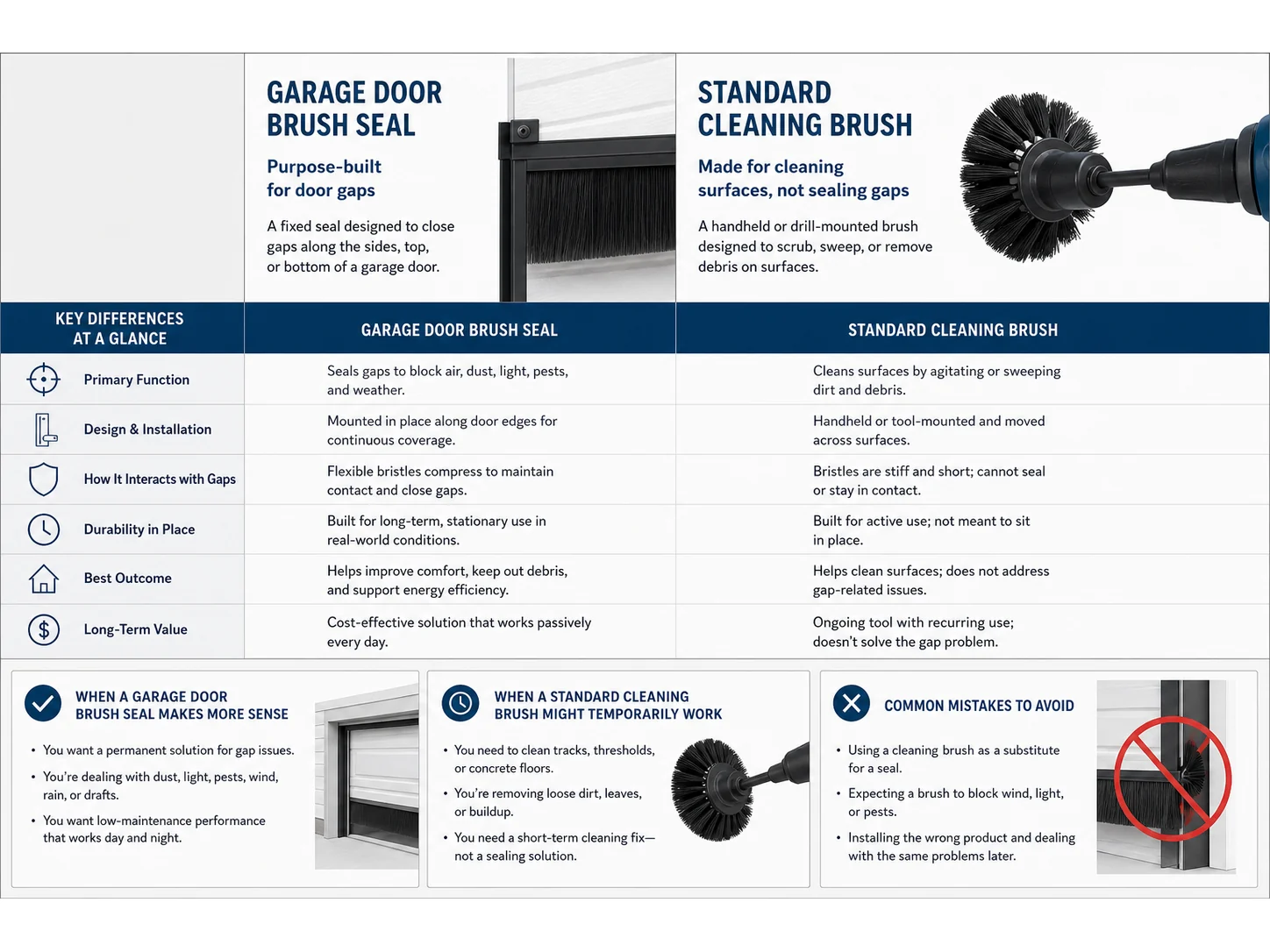
What Is a Garage Door Brush Seal?
A garage door brush seal is an engineered component designed specifically for sealing perimeters of sectional, rolling, and sliding doors. It consists of a dense bristle strip held in a continuous aluminum, galvanized steel, or rigid PVC holder. Unlike a standalone brush, the holder includes a mounting base or clip that fastens to the door bottom, sides, or header. Common bristle materials include nylon (abrasion-resistant, good for uneven floors), polypropylene (cost-effective, good moisture resistance), and natural fibers like horsehair (gentle on delicate surfaces). Heights range from 15 mm to over 100 mm, and the seal can be cut to length on site.
What Are Standard Cleaning Brushes?
Standard cleaning brushes encompass a wide category of tools meant for manual or mechanical scrubbing, sweeping, or surface preparation. They typically have a handle, a central core (wood, plastic, or wire), and bristles that are crimped or tufted. Examples include long-handle wire brushes, boiler tube cleaning brushes, chimney brushes, and bottle brushes. These are optimized for removing residues, not for sustained gap sealing. They lack an integrated mounting channel, have lower bristle density relative to seal brushes, and are not engineered for constant flexing against a moving door.
Key Differences at a Glance
| Feature | Garage Door Brush Seal | Standard Cleaning Brush |
|---|---|---|
| Primary purpose | Gap sealing with minimal friction | Scrubbing, sweeping, or cleaning |
| Bristle density | High (often 3-6 rows, tightly packed) | Low to medium (sparse for cleaning action) |
| Mounting method | Integrated carrier with screw slots, clip, or adhesive | Handle or threaded hole; not designed for permanent wall/door attachment |
| Length availability | Continuous up to several meters; field-cuttable | Fixed lengths (usually under 1 m for handheld) |
| Bristle stiffness control | Precisely controlled by filament diameter and grade | Varies widely; often not rated for consistent flex |
| Durability in weather | UV-stabilized polymers and corrosion-resistant holders | Typically not UV/weather rated; core may rust |
| Seal integrity | Designed for uniform contact on uneven surfaces | Gaps appear quickly as bristles splay permanently |
When a Garage Door Brush Seal Makes More Sense
Choose a dedicated brush seal when the door gap must be managed permanently and reliably. Residue type: fine dust, leaves, and light debris are easily stopped by a dense nylon brush strip. Surface sensitivity: a brush seal with soft polypropylene or horsehair bristles will not scratch painted floors or coated metal panels. Equipment interface: automated garage doors need a low-friction seal that doesn’t bind the motor; brush seals deflect smoothly. Wet or chemical exposure: stainless steel or anodized aluminum holders with synthetic bristles resist corrosion. Hygiene expectations: in food or pharma environments, FDA-compliant brush seals can be specified; a cleaning brush cannot meet these standards. Maintenance frequency: a brush seal may need only occasional inspection, whereas a cleaning brush used as a sweep will require constant re-adjustment. Custom size requirements: brush seals can be ordered to exact millimeter lengths and angled holders can accommodate unusual door tracks.
When a Standard Cleaning Brush Might Temporarily Work
A standard cleaning brush can serve as a temporary fix for a small, rarely opened door—like a shed or a manual sliding hatch—where appearance and constant sealing are not critical. However, even then, the lack of a secure mounting system means the brush will shift, bristles will permanently deform, and the seal will fail quickly. It is not a recommended long-term solution for any commercial or residential garage door.
Common Mistakes to Avoid
- Using a wire brush for a door sweep: metal bristles score concrete and provide no meaningful seal.
- Ignoring holder material compatibility: an untreated steel holder in a coastal garage will rust and fail.
- Choosing bristle stiffness without testing: overly stiff bristles create excessive friction; too soft allows gaps under wind pressure.
- Assuming a brush seal fills all gaps: uneven floors or bent door panels may still leave small gaps—use a combination of brush and rubber where needed.
- Measuring only the visible gap: always measure the highest point of the floor within the door path; the brush must compress at that point without dragging elsewhere.
- Skipping the mounting surface check: self-adhesive brush strips may not bond to oily or dusty surfaces; mechanical fasteners are more reliable for heavy doors.
When a Garage Door Brush Seal Is the Wrong Choice
A brush seal is not a structural repair. If the door frame is misaligned or the bottom edge is warped, no brush will seal it. Large gaps (>100 mm) may require a multi-layer sealing system—brush on the exterior, rubber flap or threshold inside. For extreme pest pressure (rats, snakes), a brush seal alone may not suffice; metal exclusion plates or fine mesh combined with a brush seal are necessary. In high-pressure washdown areas, a rubber blade seal often outperforms a brush seal, as water can blow through bristles. Finally, if the door operates in an environment with heavy debris (gravel, metal chips), periodically check whether bristles are trapping debris that could scratch the door or floor—in such cases, a sample installation and supplier drawing review can confirm if a brush seal or an alternative seal type is the safer long-term choice.
Final Takeaway: How to Decide Without Overbuying
If your door gap is a permanent feature of a frequently used garage or industrial bay, invest in a purpose-made garage door brush seal. It will provide consistent sealing with minimal maintenance. Reserve standard cleaning brushes for their intended cleaning tasks. For one-time or irregular gaps, a temporary cleaning brush rig may seem cheaper, but the time spent re-adjusting and the inferior sealing almost never justify the minor upfront savings.
Frequently Asked Questions
Can I use a boiler tube cleaning brush to seal a garage door gap?
No. A boiler tube brush has twisted wire bristles designed for scraping inside tubes. It has no flat mounting base, low bristle density, and metal bristles will damage floor coatings without sealing the gap.
What bristle material is best for outdoor garage door brush seals exposed to rain?
Nylon or UV-stabilized polypropylene are the most common choices. Nylon offers better wear resistance and tolerance to moisture, while polypropylene is more economical for lighter-duty applications. Avoid natural fibers like horsehair in constantly wet conditions.
How do I measure my door gap for a brush seal?
Measure the vertical distance from the floor to the lowest point of the closed door at several positions across the width. Record the largest gap. Add 3–5 mm to ensure the bristles compress slightly without excessive drag.
Are self-adhesive brush strip door seals reliable for heavy garage doors?
They can work for light doors with smooth, clean mounting surfaces. For heavy rolling or sectional doors exposed to vibration, mechanical fastening (screws through the holder) is far more durable.
What’s the difference between a brush strip door seal and a regular brush?
A brush strip door seal is a continuous length of bristles captured in a rigid carrier that bolts or clips onto a door edge. A regular brush has a handle and is used manually. The continuous strip provides uniform sealing; a regular brush cannot.
When should I replace a garage door brush seal?
Replace it when bristles are permanently flattened, you can see daylight through the brush, a significant number of bristles have broken off, or the holder has corroded. Visual inspection twice a year is usually sufficient.
Can a wire brush with a long handle be used as a door sweep?
No. Wire bristles are abrasive and will scratch paint, wood, and concrete. They also form a poor air seal and can damage the door finish as it moves. Stick to brush seals with synthetic or natural fibers designed for this purpose.
Technical References
Which bristle material fits this job — Nylon PA, Horsehair or Rubber?
| Material | Continuous temperature (°C) | Peak temperature (°C) | Water absorption | Hardness |
|---|---|---|---|---|
| Nylon PA | 93 | 121 | 0.3–9% by PA grade and conditioning | Medium to firm; filament diameter and trim length control bending force. |
| Horsehair | 60–80 | 100–120 | 8–15% | — |
| Rubber | 100 | 130 | very low | Specified by compound and Shore hardness; published TPE families can span roughly 50–80 Shore A, but that is a product-family example rather than a universal rubber range. |
| AISI 304 Stainless Steel Wire | 400 | 500 | 0% | Rockwell B 70–95 depending on temper and cold work |
Figures as published by Brushtec / DuPont; Alleima. Confirm the exact grade against the supplier datasheet before ordering.
What should replace Nylon PA when it stops working?
- Nylon PA — Compare Nylon PA with PP, PBT, PET. Change material when wet stiffness, temperature, chemical resistance, conductivity, particle shedding, or surface marking becomes the limiting factor.
- Horsehair — Compare Horsehair with Boar bristle, goat hair, microfiber. Change material when wet stiffness, temperature, chemical resistance, conductivity, particle shedding, or surface marking becomes the limiting factor.
- Rubber — Compare Rubber with Silicone elastomer, TPE, PVC profile, PVA sponge. Change material when wet stiffness, temperature, chemical resistance, conductivity, particle shedding, or surface marking becomes the limiting factor.
- AISI 304 Stainless Steel Wire — Use AISI 316 stainless steel wire for chloride, marine, dairy, beverage, chemical washdown, or higher pitting-resistance requirements. Use carbon steel for dry aggressive cutting and brass or abrasive nylon for lower marking risk.