
What Is a Garage Door Brush Seal?
A garage door brush seal is a static sealing component consisting of a rigid backing (aluminum, PVC, or galvanized steel) embedded with densely packed synthetic brush filaments. Common filament materials include polypropylene, nylon, or polyester blends. Engineered for continuous contact with moving door edges, these seals block airborne dust, insects, and light moisture while minimizing friction. Unlike a cleaning brush, a brush seal is not intended for scrubbing; its purpose is to maintain a flexible barrier in a fixed position over thousands of door cycles.
How Standard Cleaning Brushes Differ
Standard cleaning brushes—such as wire brushes with long handles, laboratory test tube brushes, BBQ cleaning brushes, or chimney brushes—are designed for manual or mechanical cleaning of surfaces. Their bristle materials (steel, brass, Tampico fiber, abrasive nylon) and backing construction are optimized for scrubbing actions, repeated washing, and chemical exposure. When repurposed as a static seal, they often lack the consistent filament density, weather resistance, and mounting provision needed for effective long-term dust sealing.
Key Differences: Garage Door Brush Seal vs Standard Cleaning Brushes
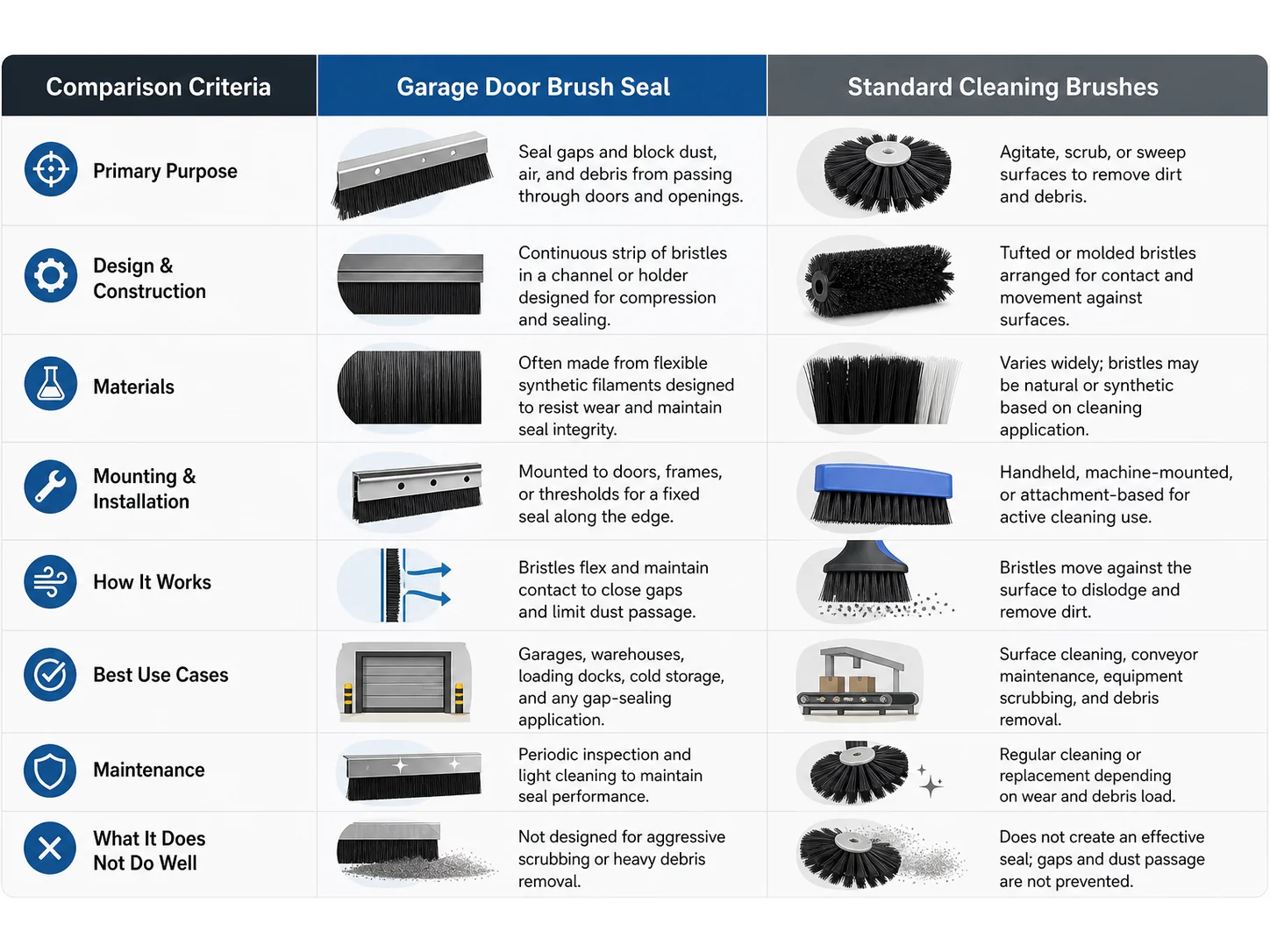
The table below highlights the practical differences between a dedicated garage door brush seal and a standard cleaning brush when used for dust sealing.
| Feature | Garage Door Brush Seal | Standard Cleaning Brush |
|---|---|---|
| Primary Function | Static edge sealing against dust, drafts, pests | Manual or mechanical surface cleaning |
| Bristle Material | Polypropylene, nylon, polyester; may include UV‑stabilized, flame‑retardant, or FDA‑compliant grades | Assorted: wire (carbon steel, stainless, brass), synthetic, natural fiber |
| Bristle Density / Stiffness | Engineered for an optimal seal fill rate; consistent density per inch with calibrated stiffness | Varies widely; often less uniform, designed for aggressive cleaning action |
| Mounting / Backing | Rigid aluminum, PVC, or galvanized steel holders; available with self‑adhesive tape or bolt‑on channels | Usually no integral mounting; requires custom holders, clamps, or operator handling |
| Durability Under Continuous Contact | Tested for thousands of door cycles; bristles resist splaying and wear | Not rated for permanent contact; bristles may bend, break, or lose effectiveness quickly |
| Weather & Chemical Resistance | UV‑stabilized, moisture‑resistant; many grades tolerate mild chemicals | Varies; many metals rust, natural fibers absorb moisture and rot |
| Typical Applications | Garage doors, industrial roll‑up doors, vehicle sealing, cleanroom pass‑throughs | Surface cleaning, boiler tube cleaning, lab equipment, BBQ grills, chimney sweeping |
| Cost & Sourcing | Available in standard and custom lengths from industrial brush suppliers | Widely available at retail stores; low per‑unit cost |
How to Choose the Right Brush for Dust Sealing
When deciding between a garage door brush seal and a cleaning brush for dust sealing, evaluate these factors:
- Seal performance requirements: If you need a consistent, long‑term barrier against fine dust, a garage door brush seal with the correct filament density and trim length is the reliable choice. Standard cleaning brushes rarely provide uniform edge contact.
- Mounting method: For quick retrofit, a self‑adhesive brush strip door seal may work for light‑duty residential doors. In heavy industrial settings, a bolt‑on aluminium door seal with brush strip offers greater stability. Standard brushes require custom mounting that often compromises the seal.
- Surface sensitivity: Soft polypropylene or nylon brush seals protect painted or coated door surfaces. Wire or abrasive cleaning brushes can scratch and quickly damage edges.
- Environmental exposure: If the seal will face rain, sun, or washdown chemicals, choose a UV‑stabilized, chemical‑resistant brush seal. Standard brushes with metal or natural fibers will corrode or degrade.
- Hygiene and compliance: Food, pharmaceutical, or electronics cleanrooms often require FDA‑compliant or anti‑static filaments. Garage door brush seals can meet these specs; standard cleaning brushes may not.
- Dimension and custom sizing: Brush seals can be ordered to exact door widths and even include corner pieces. Standard brushes rarely match the required length without unsightly gaps. If a custom profile is needed, a supplier may ask for a drawing or test tube brush drawing to confirm dimensions.
Common Mistakes When Selecting a Brush for Dust Sealing
- Choosing by cost drivers alone: A low‑cost standard brush may seem economical but will likely fail within weeks when used as a stationary seal, leading to higher replacement effort and poorer dust control.
- Ignoring bristle density specifications: Sparse filaments allow fine dust to pass through even if the brush fills the gap visually. Always check the manufacturer’s fill density rating.
- Using the wrong mounting approach: Adhesive‑only strips can peel under heat or moisture. For long‑term reliability, mechanical fasteners are recommended.
- Not accounting for floor unevenness: A brush must be sized to cover the maximum gap, not just the smallest point. Many installers measure only at the center and end up with a brush that leaves gaps at the ends.
- Assuming one brush works for all conditions: High‑temperature, wet, or corrosive environments require specific filament and backing materials; a standard polypropylene brush may melt or soften in hot exhaust areas.
- Neglecting maintenance: Even the best brush seal collects dust and debris over time. Periodic cleaning with compressed air or a soft brush extends its useful life.
When a Garage Door Brush Seal Is the Wrong Choice
A garage door brush seal is a practical solution for general dust exclusion, but it has limits.
- High‑pressure washdown environments: Brush seals are not watertight. Where direct high‑pressure water jets are used, combine the brush with a compression rubber seal.
- Hazardous or respirable dust: For toxic dust such as silica or asbestos, a brush seal alone does not provide containment. A sealed enclosure with negative‑pressure ventilation is required.
- Extreme temperature applications: In cold storage or near heat sources, standard brush filaments may become brittle or lose shape. Specialized high‑ or low‑temperature brush materials are available from industrial suppliers.
- High‑speed industrial doors: Rapid‑roll doors can wear brush seals quickly. Work with the door manufacturer to specify a heavy‑duty brush strip designed for high cycle rates.
- Custom machinery integration: When sealing around moving parts on custom equipment, off‑the‑shelf brush seals may not fit. In such cases, provide the supplier with a detailed drawing (sometimes called a test tube brush drawing in laboratory contexts) to fabricate a custom brush profile that matches the equipment interface exactly.
Final Takeaway
Choose a garage door brush seal when you need a durable, engineered solution for continuous dust sealing on doors and stationary gaps. A standard cleaning brush is better suited as a temporary gap filler or for its intended cleaning purpose. Always match the brush material, density, mounting, and trim length to your specific environment and gap dimensions. When standard options fall short, consult an industrial brush supplier and provide detailed drawings to obtain a custom solution that will perform reliably over time.
Frequently Asked Questions
Can I use a standard cleaning brush as a door seal?
You can temporarily, but it is not a recommended long‑term solution. Standard cleaning brushes lack the dense, consistent filaments and weather‑resistant backing needed for effective, durable dust sealing. They are also difficult to mount securely without additional hardware.
What bristle material is best for a dusty garage?
Polypropylene is a cost‑effective choice for dry, dusty environments. For outdoor exposure to sunlight, UV‑stabilized nylon or polyester blends offer better longevity. Ensure the brush has a high filament count per inch for good dust blockage.
How do I measure for a garage door brush seal?
Measure the largest gap between the door and the floor or frame when the door is closed. Select a brush with a trim length about 10–20% longer than this gap to compensate for unevenness. Also measure the total length required, including returns on the sides.
Is an aluminum backing better than PVC for brush seals?
Aluminum provides superior strength, impact resistance, and resistance to UV and temperature extremes. PVC is lighter and cheaper, but it may warp in high heat. For industrial and heavy‑duty doors, aluminum is typically the best choice.
Can a garage door brush seal keep out water?
No, brush seals are not waterproof. They can resist light moisture, but for flood‑prone areas or washdown applications, combine the brush seal with a rubber or silicone water seal.
How often should I replace a garage door brush seal?
Replacement frequency depends on usage, environment, and filament quality. In a typical residential garage with moderate use, a quality brush seal may last several years. Inspect annually for splayed or missing bristles and replace when gaps appear.
Can I use a brush seal for a sliding patio door?
Yes, brush seals are commonly used on sliding doors to block dust and insects. Just ensure the seal allows smooth door movement and the backing profile fits the door track.
Where can I get a custom brush seal size?
Many industrial brush manufacturers offer custom lengths and profiles. Provide them with a detailed drawing of your door profile and gap dimensions, along with any special environmental requirements.
Technical References
Which bristle material fits this job — Nylon PA, PVC or Rubber?
| Material | Continuous temperature (°C) | Peak temperature (°C) | Water absorption | Hardness |
|---|---|---|---|---|
| Nylon PA | 93 | 121 | 0.3–9% by PA grade and conditioning | Medium to firm; filament diameter and trim length control bending force. |
| PVC | 50–70 | 75–90 | 0.04–0.40% | Shore A 70–95 or Shore D 70–85 |
| Rubber | 100 | 130 | very low | Specified by compound and Shore hardness; published TPE families can span roughly 50–80 Shore A, but that is a product-family example rather than a universal rubber range. |
| Abrasive Nylon | 120 | 150 | 0.1–1.0% | Abrasive filament; stiffness and cutting level is controlled by PA base, grit type, grit size, filament diameter and trim height. |
| AISI 316 Stainless Steel Wire | 400 | 500 | 0% | Rockwell B 70–95 depending on temper and cold work |
Figures as published by Brushtec / DuPont; Perlon; Alleima. Confirm the exact grade against the supplier datasheet before ordering.
What should replace Strip Seal Brushes when they stop working?
- Strip Seal Brushes — Strip brushes create a linear barrier or guide; machine-table brush plates distribute load and support products over a broad area. Closest alternative: Machine Table Brush Plates.
- Nylon PA — Compare Nylon PA with PP, PBT, PET. Change material when wet stiffness, temperature, chemical resistance, conductivity, particle shedding, or surface marking becomes the limiting factor.
- PVC — Compare PVC with PE board, PP, elastomer, aluminum holder. Change material when wet stiffness, temperature, chemical resistance, conductivity, particle shedding, or surface marking becomes the limiting factor.
- Rubber — Compare Rubber with Silicone elastomer, TPE, PVC profile, PVA sponge. Change material when wet stiffness, temperature, chemical resistance, conductivity, particle shedding, or surface marking becomes the limiting factor.