
What Is a Warehouse Floor Brush?
A warehouse floor brush is a specialized brush—often used manually or mounted on sweepers/scrubbers—engineered to agitate, collect, or direct dry and wet residues on industrial flooring. It typically consists of a brush block with filament bristles and may feature a handle, a core for machine mounting, or a custom bracket. The key differentiating factors are filament material, stiffness, brush diameter, and core design.
Common Warehouse Floor Brush Types and Their Applications
Understanding the main brush categories helps avoid choosing a type that works against the cleaning task. Below are typical options found in warehouse environments.
- Polypropylene (PP) Brushes: Stiff, chemical-resistant, and ideal for heavy dust and wet conditions. Common in manual scrubbing and scrubber machines.
- Nylon Brushes: Abrasive-resistant, less water-absorbent, and suitable for fine dust on smooth floors. Often used where surface scratching is a concern.
- Wire Brushes: Aggressive for caked-on debris or metal shavings. Not recommended for delicate floor coatings.
- Horsehair or Tampico Brushes: Soft, natural fibers for fine particle pickup on sensitive surfaces. Common in food-grade or antique flooring contexts.
- Blended Bristle Brushes: Mixed filaments to balance sweeping efficiency and surface protection.
Comparing Key Brush Options for Warehouse Dust
| Brush Type | Best For | Surface Sensitivity | Wet/Dry Use | Maintenance Needs |
|---|---|---|---|---|
| Polypropylene | Heavy dust, uneven floors, wet conditions | Low—can be abrasive | Both, excellent wet | Rinse, inspect for matting |
| Nylon | Fine particulate, coated floors | Medium—moderate abrasion | Dry preferred | Clean debris from base |
| Wire (steel/brass) | Stubborn debris, metal shavings | Very low—scratches easily | Dry only | Oil to prevent rust |
| Horsehair/Tampico | Gentle dusting, smooth, sensitive surfaces | Very high—non-scratch | Dry only (wet degrades) | Keep dry, replace if shedding |
| Blended (PP+abrasive) | Versatile, light scrubbing + dust removal | Medium | Dry, some wet | Inspect for filament loss |
How to Choose a Warehouse Floor Brush Based on Residue and Surface
Selection must start with the interaction between residue and floor material. Key decision factors:
- Residue Type: Fine dust requires softer, denser bristles for capture; gritty particles need stiffer, scrub-resistant filaments.
- Surface Sensitivity: Epoxy or polished concrete demands non-abrasive materials like nylon or horsehair; bare concrete can tolerate polypropylene.
- Wet or Chemical Exposure: Many warehouses use wet scrubbers with chemicals. Ensure the filament (especially natural fibers) is compatible—polypropylene and nylon handle moisture and mild chemicals well.
- Equipment Interface: Floor scrubber brushes (disc or cylindrical) require precise core and diameter specs. Manual brushes need ergonomic handles and correct block size.
- Hygiene Expectations: Food or pharma grade facilities may necessitate non-absorbent, sanitizable brush materials (often solid polypropylene or stainless steel cores).
- Maintenance Frequency: High-throughput operations benefit from brushes that resist matting and can be cleaned quickly.
- Custom Size Requirements: Off-the-shelf sizes may not match older machines or unique aisle widths; custom diameter, hole pattern, or bristle length may be necessary.
Common Mistakes When Selecting and Using Warehouse Floor Brushes
Avoid these errors that directly impact cleaning effectiveness and floor longevity:
- Using Overly Stiff Bristles on Coated Floors: This scratches and degrades epoxy or paint, leading to costly refinishing.
- Ignoring Chemical Compatibility: Some natural bristles swell or break down when in contact with cleaning agents, reducing life and performance.
- Choosing a Brush Only by cost drivers or Generic Size: Without checking filament density, mount type, and core specs, the brush may not fit the machine properly, causing uneven cleaning or damage.
- Assuming One Brush Fits All Cleaning Tasks: Fine dust capture and heavy debris scrubbing rarely succeed with the same brush.
- Neglecting Break-In Period for New Brushes: Many brushes need a short run-in to align bristles and optimize dust pickup.
- Overlooking Block or Core Condition: Worn hub holes or cracked blocks lead to wobble, uneven wear, and potential machine damage.
When a Standard Warehouse Floor Brush Is the Wrong Choice
Standard brushes have limits. These scenarios call for a different approach:
- Extreme Static-Sensitive Environments: Anti-static brush filaments and grounding cores are needed to prevent static discharge that could ignite dust or damage electronics.
- Cleanroom or Aseptic Areas: Validated materials and sealed brush designs with no particle shedding are mandatory—standard warehouse brushes won’t comply.
- Unusual Machine Mounts or Legacy Equipment: If a machine’s manufacturer instructions brush is discontinued, a custom brush engineered from a supplier drawing and sample test may be required.
- Highly Aggressive Chemicals or Extreme Temperatures: Standard PP or nylon may fail; specialty filaments like PTFE or stainless steel wire should be evaluated.
- When Dust Collection Is Part of a Certified Process: If cleaning effectiveness must be documented (e.g., for FDA or ISO audits), engage a supplier for performance data and validation support beyond an off-the-shelf product.
Final Takeaway
Choosing the right warehouse floor brush means matching the brush material, stiffness, and mount to the dust type, floor surface, and cleaning method. Diagnostic mistakes like ignoring chemical exposure or using one brush for all tasks lead to poor cleaning, floor damage, and higher long-term costs. When standard options don’t meet the specification, involve a technical supplier early for a custom drawing review and sample trial.
Frequently Asked Questions
Can I use the same warehouse floor brush for wet and dry cleaning?
It depends on the filament material. Polypropylene and certain nylon blends work well in wet and dry conditions, but natural fibers like horsehair degrade when wet. Always verify your brush material’s moisture tolerance before combining tasks.
How often should I replace a warehouse floor brush?
Replace when bristles are matted, worn to less than 50% of original length, or the block/core is damaged. In high-use settings, inspect weekly and budget for replacement every 3–6 months, but actual lifespan varies by floor roughness and chemical exposure.
What is the best filament material for fine dust on smooth concrete?
Nylon or a soft polypropylene blend works well—dense, fine filaments capture and hold dust without scratching. For extremely fine dust (like powder coatings), a high-density horsehair or Tampico brush may provide the gentlest, most effective pickup.
How do I know if I need a custom brush size?
If your floor scrubber manufacturer no longer offers a compatible brush, or if your cleaning width, core hole pattern, or bristle length doesn’t match standard diameters (like 17, 20, or 28 inches), a custom brush is likely necessary. A drawing review with exact machine measurements is the best first step.
Can a standard floor brush be used on food-grade surfaces?
Not usually. Food-grade cleaning often requires brushes with solid polypropylene blocks, stainless steel cores, and bristles that are non-absorbent and resistant to sanitizing chemicals. Standard brushes may harbor bacteria or shed fibers. Always confirm the brush meets your facility’s hygiene protocols.
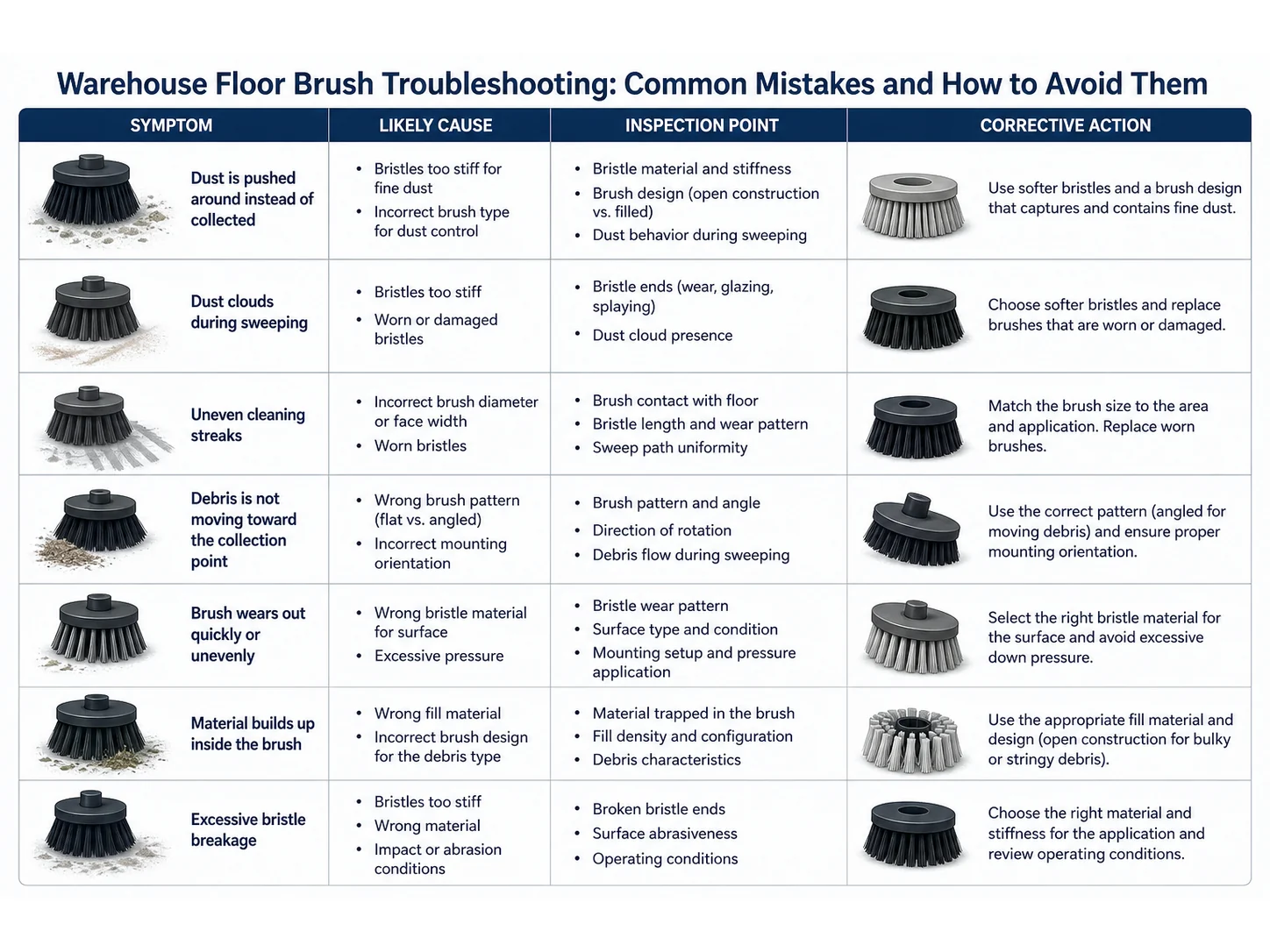
Why does my new brush seem to push dust instead of pick it up?
This often occurs because the brush is too stiff for fine dust, the bristles haven’t had a break-in period to develop a “sweeping edge,” or the brush height/pressure is incorrectly set. Let the brush run for a short period, and adjust machine settings. If the problem persists, try a softer, denser filament.
Is a wire brush safe for all concrete warehouse floors?
No. Wire brushes are abrasive and can groove or scratch concrete, especially if it’s sealed or polished. They’re meant for removing caked-on residues or metal debris where surface damage is acceptable. Test on an inconspicuous area first, and consider a less aggressive polypropylene/nylon blend if surface integrity matters.
Technical References
Which bristle material fits this job — Nylon PA, Horsehair or AISI 304 Stainless Steel Wire?
| Material | Continuous temperature (°C) | Peak temperature (°C) | Water absorption | Hardness |
|---|---|---|---|---|
| Nylon PA | 93 | 121 | 0.3–9% by PA grade and conditioning | Medium to firm; filament diameter and trim length control bending force. |
| Horsehair | 60–80 | 100–120 | 8–15% | — |
| AISI 304 Stainless Steel Wire | 400 | 500 | 0% | Rockwell B 70–95 depending on temper and cold work |
| Polypropylene PP | 80–100 | 120–140 | ≤0.03% | Shore D 65–75 |
Figures as published by Brushtec / DuPont; Alleima; Perlon. Confirm the exact grade against the supplier datasheet before ordering.
What should replace Nylon PA when it stops working?
- Nylon PA — Compare Nylon PA with PP, PBT, PET. Change material when wet stiffness, temperature, chemical resistance, conductivity, particle shedding, or surface marking becomes the limiting factor.
- Horsehair — Compare Horsehair with Boar bristle, goat hair, microfiber. Change material when wet stiffness, temperature, chemical resistance, conductivity, particle shedding, or surface marking becomes the limiting factor.
- AISI 304 Stainless Steel Wire — Use AISI 316 stainless steel wire for chloride, marine, dairy, beverage, chemical washdown, or higher pitting-resistance requirements. Use carbon steel for dry aggressive cutting and brass or abrasive nylon for lower marking risk.
- Polypropylene PP — Compare Polypropylene PP with Nylon, PBT, PET. Change material when wet stiffness, temperature, chemical resistance, conductivity, particle shedding, or surface marking becomes the limiting factor.