
What Is a Washing Machine Cleaning Brush?
A washing machine cleaning brush is a small, often angled or flexible brush whose bristles are designed to safely dislodge buildup without abrading rubber, plastic, or stainless steel components. Unlike general-purpose kitchen or garage brushes, a proper washing machine brush balances stiffness and surface compatibility, often featuring non-metallic bristles and a handle that allows reach into narrow gaps like dispenser cavities and door boots.
Common Brush Types Found in Home Maintenance Kits
Pre-packaged maintenance kits often include one or more of these brush profiles. Recognizing what you have is the first step toward using it correctly.
- Small detail brush: Short, stiff bristles on a plastic or metal core—useful for scrubbing dispenser trays but risky on soft gaskets.
- Flexible long-reach brush: Twisted wire stem with nylon or polyester bristles, often used for drain channels and pump filters.
- Stiff scrub brush: Heavy-duty bristles intended for tub cleaning; can leave micro-scratches if used aggressively on stainless steel.
- Sponge-ended or non-woven pad brush: Gentle on surfaces but may retain moisture and harbor bacteria if not dried.
- Microfiber coil brush: Designed to trap fine particles without scratching, but may lack stiffness for caked-on residue.
Material and Design Comparison
Choosing the wrong material or stiffness is the most frequent cause of damage. Use this table to match brush characteristics with cleaning tasks.
| Brush Feature | Option A (Gentle) | Option B (Moderate) | Option C (Aggressive) | Best Use Case |
|---|---|---|---|---|
| Bristle Material | Microfiber, nylon (soft) | Polyester, flagged nylon | Stiff nylon, polypropylene | Soft for gaskets/displays; stiff for hard plastic dispensers |
| Core/Handle | Flexible plastic, twisted wire | Rigid plastic | Metal wire core | Flexible cores for drains; metal cores only where scratching is not a risk |
| Diameter Range | 0.5–1.0 inch | 1.0–2.0 inches | 2.0+ inches | Narrow for dispenser channels; larger for drum interior |
| Stiffness Level | Soft | Medium | Firm | Soft for rubber; firm for plastic crannies; never firm on gasket folds |
| Mounting/Style | Handheld, single piece | Interchangeable heads | Drill-attachment | Handheld for control; power attachments risk overheating or scratching |
| Typical Kit Pairing | Delicate/gasket brush | General scrub brush | Abrasive pad or wire brush | Reserve abrasive options for tough tub stains only if surface allows |
How to Choose a Washing Machine Cleaning Brush by Use Case
Instead of grabbing whatever is in the kit, evaluate the real cleaning conditions. Match the brush to the residue type, surface sensitivity, and equipment interface.
- Residue type: Powdery detergent residue needs a moderately stiff brush to break it up without scratching. Mold or biofilm requires a brush that can be sanitized (non-porous, heat-resistant). Lint and hair need bristles that trap without shedding.
- Surface sensitivity: Rubber door boots and dispensers scratch easily—use only flagged-tip nylon or microfiber. Stainless steel drums can handle medium stiffness but not steel wire. Plastic dispenser trays can accept firm bristles.
- Equipment interface: Brushes that insert into drain holes or pump filters must have a flexible, non-shedding stem and a diameter that fits the opening without forcing. Check manufacturer clearance recommendations.
- Wet or chemical exposure: Many cleaning routines involve bleach, vinegar, or commercial cleaners. Avoid brushes with metal cores or adhesives that corrode. Polyester and nylon are generally compatible.
- Hygiene expectations: Brushes used for food-related areas (e.g., coffee machine cleaning brushes) differ from appliance cleaning. Do not cross-use; keep washing machine brushes dedicated to avoid cross-contamination.
- Maintenance frequency: For weekly wipe-downs, a soft microfiber brush suffices. For monthly deep cleans, invest in a multi-brush set that covers all zones without risking damage.
- Custom size requirements: If standard kit brushes do not fit your model, request technical drawings from the supplier to verify reach, diameter, and stiffness before ordering, especially for commercial or hard-to-service machines.
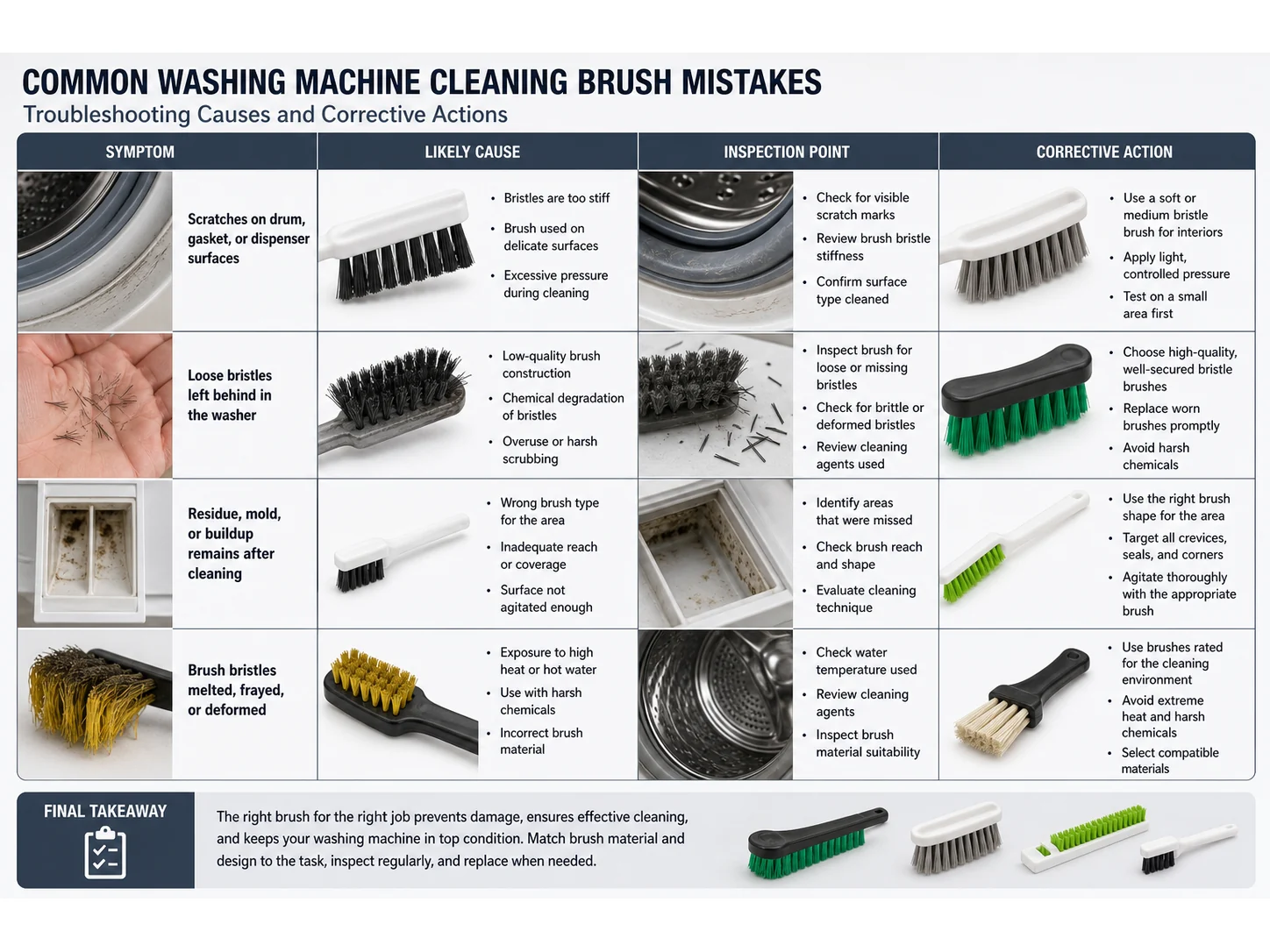
Common Washing Machine Cleaning Brush Mistakes
Learning to spot these errors will extend the life of both your brush and your machine.
- Using a wire brush on rubber or plastic. Even a soft wire brush can tear door seals or leave metal particles that oxidize. Stick to non-metallic bristles on any surface that is not bare metal.
- Ignoring bristle retention. Low-quality brushes shed bristles quickly. Lost bristles can clog drain pumps or sensors. Choose brushes with tightly anchored, chemical-set bristles.
- Assuming “stiff” means “cleaner.” Aggressive scrubbing with hard bristles removes residues faster but also removes surface finishes or creates micro-scratches where future buildup anchors. Use the mildest effective brush.
- Using the same brush for all zones. Cross-contaminating a gasket brush on a soiled dispenser spreads mold spores. Dedicate brushes by area or color-code them.
- Neglecting brush hygiene after use. Rinsing with water is not enough. Brushes used with bleach or detergents must be rinsed thoroughly, air-dried, and stored dry to prevent bacterial growth.
- Skipping the fit check. Forcing an oversized brush into a dispenser or drain channel can crack plastic or push debris deeper. Always match brush diameter to the opening without resistance.
- Overlooking chemical compatibility. Some brush materials degrade when exposed to chlorine bleach. Verify that bristles and adhesives withstand your cleaning agents; nylon 6.12 or polyester are safer choices.
- Storing brushes improperly. Tossing a damp brush in a closed kit box promotes mold. Let brushes air-dry completely before storage, and replace them if they develop a musty odor.
When a Washing Machine Cleaning Brush Is the Wrong Choice
A cleaning brush can maintain visible surfaces, but there are situations where it should not be your only tool—or where a different brush type or professional review is necessary.
- Deep internal contamination: If machine odor persists after thorough manual cleaning, the issue may be inside the outer tub or behind the drum, which a surface brush cannot reach. You may need disassembly or a commercial cleaning service.
- Heavily scaled or mineralized deposits: In hard-water areas, a brush alone won’t remove thick limescale. Consider a descaling cycle with an approved cleaner before or after brushing.
- Damaged gaskets or seals: Brushes can worsen existing tears. If you see cracks, replace the seal before resuming brush cleaning.
- Electronic or sensor areas: Never insert a brush—even a soft one—into control panel gaps or near sensors unless the manufacturer explicitly allows it. Use a damp microfiber cloth instead.
- Commercial or high-volume machines: Industrial washers may require brushes with specific stiffness, chemical resistance, or FDA-compliant materials. Request a sample for trial and a technical drawing from the supplier before bulk ordering.
- When a different brush type is needed: For example, a tube brush with a precise diameter (like a test tube brush) might better serve narrow drain lines, while a long-handled wire brush is safer for external condenser coils but never inside the wash cabinet.
Final Takeaway
Surfaces, not muscle, do the cleaning. The right washing machine cleaning brush works with your machine’s materials and soils instead of against them. Before your next maintenance session, audit your kit: remove any metal-core or wire brushes, match bristle stiffness to each zone, and replace any brush that sheds or smells. A few minutes of correct selection and care prevent costly repairs and keep your machine hygienic between deep services.
Frequently Asked Questions
Can I use a general-purpose kitchen brush to clean the washing machine drum?
It is not recommended. Kitchen brushes often have abrasives or bristles that are too harsh for stainless steel or rubber seals. They can leave scratches that trap detergent and foster mold. Use a brush explicitly labeled for appliance cleaning, with soft to medium nylon or polyester bristles.
How often should I replace my washing machine cleaning brush?
Replace your brush when bristles begin to fray, flatten, or shed, or if it develops a persistent odor even after drying. For a household that cleans the machine monthly, a quality brush can last a year or more. Inspect it before each use.
What is the best brush material for cleaning rubber door boot seals?
Flagged (split-ended) nylon or microfiber-covered brushes are safest. They are gentle enough not to tear thin rubber yet effective at lifting biofilm. Avoid any bristle that feels sharp to the touch or has a metal core.
Can I use a wire brush if I’m careful?
Even careful use of wire brushes inside a washing machine is risky. Metal bristles can scratch stainless steel, gouge plastic, and damage critical rubber seals. Once a seal is compromised, water and detergent can leak into bearings. If you must use a wire brush on external metal parts only, ensure it is stainless steel and thoroughly remove any loose bristles afterward.
My washing machine brush kit came with a drill attachment. Should I use it?
Power attachments multiply the risk of surface damage and localized heat buildup. Hand-controlled brushing allows you to feel resistance and stop before harm occurs. For most home washing machines, manual cleaning is sufficient and much safer.
How can I tell if a brush will shed bristles before I buy it?
You cannot fully test without a sample, but look for brushes where the bristles are set with a chemical or thermal bond rather than simple friction-fitting. Ask the supplier for a technical drawing or bristle retention test report if you are buying in bulk for commercial use.
Is a separate “coffee machine cleaning brush” safe for my washing machine?
While some coffee machine brushes are small and food-safe, they are designed for different residues and may lack the stiffness needed for detergent buildup. More importantly, you risk cross-contamination of coffee oils and machine cleaners. Keep brushes dedicated to each appliance.
What should I do if a bristle breaks off inside the drain pump area?
Turn off and unplug the machine. If you can see the bristle, try to retrieve it with tweezers or a vacuum crevice tool. If it disappears into the pump, run a short drain cycle and listen for unusual noise. A lodged bristle can jam the pump impeller; you may need to remove the pump housing to clear it.
Technical References
- U.S. Department of Energy — Air Conditioner Maintenance
- EPA — Should You Have the Air Ducts in Your Home Cleaned
- EPA — Particulate Matter Basics
- OSHA — 1910.147 Control of Hazardous Energy
- EPA — Mold Cleanup in Your Home
- NIST — Metric SI
Which bristle material fits this job — Nylon PA, Rubber or AISI 304 Stainless Steel Wire?
| Material | Continuous temperature (°C) | Peak temperature (°C) | Water absorption | Hardness |
|---|---|---|---|---|
| Nylon PA | 93 | 121 | 0.3–9% by PA grade and conditioning | Medium to firm; filament diameter and trim length control bending force. |
| Rubber | 100 | 130 | very low | Specified by compound and Shore hardness; published TPE families can span roughly 50–80 Shore A, but that is a product-family example rather than a universal rubber range. |
| AISI 304 Stainless Steel Wire | 400 | 500 | 0% | Rockwell B 70–95 depending on temper and cold work |
| Microfiber | 80–120 | 140–170 | 0.2–1.0%Material Itself ; Structure Can Absorb 3–7 Times Its Own Weight | — |
Figures as published by Brushtec / DuPont; Alleima. Confirm the exact grade against the supplier datasheet before ordering.
What should replace Nylon PA for coffee machine cleaning?
- Nylon PA — Compare Nylon PA with PP, PBT, PET. Change material when wet stiffness, temperature, chemical resistance, conductivity, particle shedding, or surface marking becomes the limiting factor.
- Rubber — Compare Rubber with Silicone elastomer, TPE, PVC profile, PVA sponge. Change material when wet stiffness, temperature, chemical resistance, conductivity, particle shedding, or surface marking becomes the limiting factor.
- AISI 304 Stainless Steel Wire — Use AISI 316 stainless steel wire for chloride, marine, dairy, beverage, chemical washdown, or higher pitting-resistance requirements. Use carbon steel for dry aggressive cutting and brass or abrasive nylon for lower marking risk.
- Microfiber — Compare Microfiber with Cotton yarn, wool, felt, soft PBT filament. Change material when wet stiffness, temperature, chemical resistance, conductivity, particle shedding, or surface marking becomes the limiting factor.