
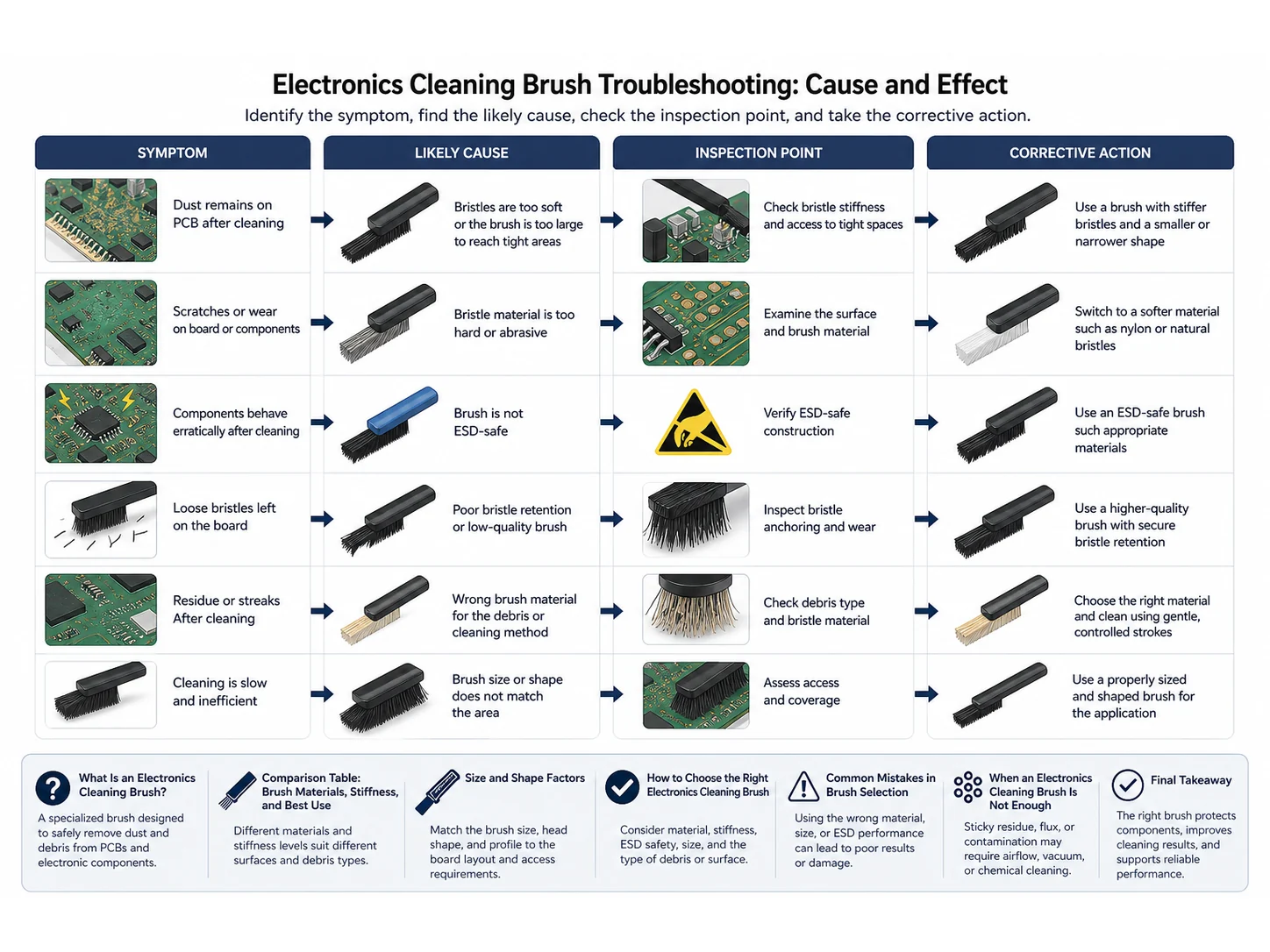
What Is an Electronics Cleaning Brush?
An electronics cleaning brush is a brush engineered for use on static‑sensitive devices and precision surfaces. Unlike a general‑purpose brush, it typically features conductive or static‑dissipative bristles, a handle that resists chemicals, and a construction that minimizes particle shedding. The main functions are dry dust removal from PCBs, pre‑soldering cleaning, post‑reflow residue loosening, and maintenance of automated optical inspection (AOI) equipment.
Common Materials and Their Properties
The bristle material defines how the brush interacts with the board surface.
- Natural horsehair – soft, good for loose dust, but can absorb moisture and is not inherently static‑safe.
- Goat hair – very soft, often used in cleanroom wipers; low particle shedding but limited chemical resistance.
- Nylon (standard) – durable, chemical‑resistant, but prone to generating static without additives.
- Conductive nylon – impregnated with carbon or metal fibers; dissipates static charges, suited for ESD‑sensitive work.
- Antistatic polyester – often used in cleanroom brushes; low particle release and good chemical compatibility.
- Metal fibers (brass, stainless, copper) – for aggressive cleaning of heavy flux or corrosion, but can scratch pads and must be used with extreme caution on powered circuits.
Comparison Table: Brush Materials, Stiffness, and Best Use
| Material | Typical Stiffness | ESD Safety | Best Use Case | Wet/Dry Suitability |
|---|---|---|---|---|
| Natural horsehair | Soft – medium | Poor (insulator) | Loose dust on non‑ESD‑sensitive assemblies | Dry only |
| Goat hair | Very soft | Poor | Optical lens, sensor cleaning without pressure | Dry / mild solvent |
| Standard nylon | Medium – firm | Poor (static buildup) | General cleaning where ESD is not critical | Wet / dry |
| Conductive nylon | Medium – firm | Excellent (surface resistivity 10³–10⁶ Ω) | PCB dust removal, flux brushing near components | Wet / dry |
| Antistatic polyester | Soft – medium | Good (static dissipative) | Cleanroom, class 100/ISO 5 environments | Wet / dry |
| Metal fibers (brass/SS) | Hard | Conductive, but can short circuits | Removing hardened flux or corrosion on unpowered boards | Dry, some solvents |
Size and Shape Factors
Brush dimensions must match the target area and equipment interface:
- Bristle length and diameter – short, stiff bristles scrub better; longer, softer bristles reach into connectors without bending pins.
- Overall length and handle design – ergonomic handles for manual use; threaded or press‑fit ends for automated spindles.
- Roller brushes (dust cleaning brush roller) – used in inline PCB cleaners; outer diameter, core material, and bristle density determine the cleaning footprint and RPM limits.
- Custom sizes – for tight spaces like between tall capacitors, narrow brush heads prevent shorting and allow targeted cleaning.
How to Choose the Right Electronics Cleaning Brush
Go beyond “soft or not soft” and evaluate these factors:
- Residue type – loose dust needs soft bristles; dried solder paste or flux needs stiffer, chemically compatible bristles.
- Surface sensitivity – bare copper or gold‑plated pads scratch easier than solder‑masked areas.
- Equipment interface – if the brush mounts on a robotic arm or cleaning machine, check shank diameter and rotation direction.
- Wet or chemical exposure – verify bristle and handle material resistance to isopropyl alcohol (IPA), detergents, or solvent‑based cleaners.
- Hygiene and particle requirements – cleanroom use demands washable, low‑lint materials with documented particle release data.
- Maintenance frequency – frequent use benefits from durable synthetic bristles that do not shed or deform quickly.
- Custom size requirements – when off‑the‑shelf brushes do not fit, work with a supplier that can provide a drawing review and a sample batch before full production.
Common Mistakes in Brush Selection
- Ignoring ESD safety. Using a standard nylon brush on a powered‑down board can still transfer a static charge stored in the bristles, damaging CMOS components. Always verify surface resistivity.
- Choosing stiffness by feel alone. A brush that feels “soft” at your fingertip can still be too aggressive on delicate leadless packages or exposed bond wires.
- Overlooking handle/ferrule material. A wooden handle may shed splinters or absorb solvents; a metal ferrule can scratch or short if it contacts traces.
- Assuming one brush works for all chemistries. A brush excellent for IPA may swell or disintegrate in stronger solvents like acetone. Confirm chemical compatibility data.
- Neglecting bristle retention. Low‑cost brushes may use adhesive that fails under heated drying or ultrasonic cleaning, leaving bristles on the board.
- Using the wrong size for the gap. A brush too wide for a connector cavity can bend pins; too narrow, it misses the contact point entirely.
- Relying solely on catalogs without a sample test. Always request a drawing and test sample for high‑volume or critical applications to validate fit and performance.
When an Electronics Cleaning Brush Is the Wrong Choice
Brushes excel at dry particulate removal and light wet wiping. Recognize situations where they need to be supplemented or replaced:
- Heavy, baked‑on contamination may require an ultrasonic bath, spray‑in‑air system, or CO₂ snow cleaning.
- Fine‑pitch components with underfill or tight BGA gaps often call for automated spray flux removal with under‑stencil cleaning equipment, not manual brushing.
- Continuous high‑speed production justifies in‑line brush rollers with vacuum extraction rather than periodic hand brushing.
- Cleanroom protocols may demand documented particle counts and static decay times that only certified brush assemblies can meet. If the supplier cannot provide test data, the brush may not satisfy audit requirements.
- When ESD vulnerability is extreme (e.g., laser diode assemblies), even a static‑dissipative brush may need to be combined with ionizing blowers and grounded work surfaces.
- If the shape or material is highly unusual, a custom brush manufacturer should provide an engineering drawing for your team to review before any commitment.
Final Takeaway
Select an electronics cleaning brush by matching the bristle material and stiffness to the residue and surface sensitivity, verifying ESD safety, and ensuring the size and mounting interface fit the manual or automated cleaning station. Test a sample under real process conditions before finalizing the specification. A well‑chosen brush protects yield; a generic brush creates rejects.
Frequently Asked Questions
Can I use a regular paintbrush to clean a PCB?
It is not recommended. Paintbrushes often have metal ferrules that can short traces, and their bristles are rarely static‑dissipative, creating an ESD risk. They may also shed loose bristles and absorb solvents unpredictably.
What does “static‑dissipative” mean in a brush?
Static‑dissipative means the material has a surface resistivity typically between 10⁶ and 10⁹ ohms, which allows static charges to bleed off in a controlled manner without sparking. Conductive brushes (<10⁶ Ω) can discharge quickly but may also conduct current if they bridge two points.
How often should I replace an electronics cleaning brush?
Replacement depends on wear, contamination buildup, and bristle shedding. In production, inspect brushes daily for bent or missing bristles, and replace when cleaning effectiveness drops or particle shedding increases. Some cleanrooms replace brushes weekly as a preventive measure.
Are metal bristle brushes safe for electronics?
Brass, stainless steel, or copper bristles are used only on unpowered boards for aggressive flux or corrosion removal. They can scratch pads, leave conductive particles, and short if not fully removed. Avoid using them near sensitive traces or in automated processes without thorough post‑cleaning inspection.
Can I clean a brush for electronics with IPA or other solvents?
Yes, if the bristle and handle material are chemically compatible. Conductive nylon and polyester typically withstand IPA, but always check the manufacturer’s data sheet. Prolonged soaking may degrade adhesives or wood handles.
What is the difference between a dust cleaning brush roller and a manual brush?
A dust cleaning brush roller is a cylindrical brush mounted on a shaft, designed for continuous in‑line cleaning of PCBs or flat surfaces. It rotates against a counter‑plate or vacuum slot. A manual brush is handheld and used for spot cleaning or inspection benches.
Do I need an antistatic brush if my workstation has an ionizer?
Ionizers reduce static, but they do not eliminate the risk if the brush itself is highly insulating. Using an antistatic or static‑dissipative brush adds a second layer of protection and is a best practice for ESD‑sensitive devices.
How do I verify a brush’s ESD performance before purchasing?
Ask the supplier for a surface resistivity measurement report (typically per ANSI/ESD S20.20 or IEC 61340‑5‑1) and, if possible, request a sample to test with a megohmmeter. For critical applications, perform a static decay test in your actual cleaning environment.
Technical References
- EOS/ESD Association — ESD Fundamentals
- EOS/ESD Association — Principles of ESD Control
- OSHA — Combustible Dust
- EPA — Particulate Matter Basics
- NIST — Metric SI
Which bristle material fits this job — Conductive Nylon, Nylon PA or Goat Hair?
| Material | Continuous temperature (°C) | Peak temperature (°C) | Water absorption | Hardness |
|---|---|---|---|---|
| Conductive Nylon | 80–110 | 130–160 | 0.5–2.5% | Shore D 75–88 |
| Nylon PA | 93 | 121 | 0.3–9% by PA grade and conditioning | Medium to firm; filament diameter and trim length control bending force. |
| Goat Hair | 50–70 | 90–110 | 12–20% | — |
| Horsehair | 60–80 | 100–120 | 8–15% | — |
Figures as published by Brushtec / DuPont. Confirm the exact grade against the supplier datasheet before ordering.
What should replace Conductive Nylon for dust removal?
- Conductive Nylon — Compare Conductive Nylon with Anti-static filament, carbon fiber, stainless conductive filament, standard PA6. Change material when wet stiffness, temperature, chemical resistance, conductivity, particle shedding, or surface marking becomes the limiting factor.
- Nylon PA — Compare Nylon PA with PP, PBT, PET. Change material when wet stiffness, temperature, chemical resistance, conductivity, particle shedding, or surface marking becomes the limiting factor.
- Goat Hair — Compare Goat Hair with Boar bristle, goat hair, microfiber. Change material when wet stiffness, temperature, chemical resistance, conductivity, particle shedding, or surface marking becomes the limiting factor.
- Horsehair — Compare Horsehair with Boar bristle, goat hair, microfiber. Change material when wet stiffness, temperature, chemical resistance, conductivity, particle shedding, or surface marking becomes the limiting factor.