
What Is an Angle Grinder Wire Brush for Pipeline Surface Prep?
An angle grinder wire brush is a rotary tool accessory that uses high‑speed rotating steel wires to clean, deburr, or profile metal surfaces. In oil and gas pipeline work, these brushes remove corrosion, old paint, and weld slag to prepare the substrate for inspection, welding, or coating. They mount on standard angle grinders and come in two main working‑end shapes: wheels and cups, each built for a different kind of surface contact.
Common Types: Twisted Wire Wheels vs Cup Brushes
Wire brushes for pipeline prep split into two families based on how the bristles are arranged and how they attack the workpiece.
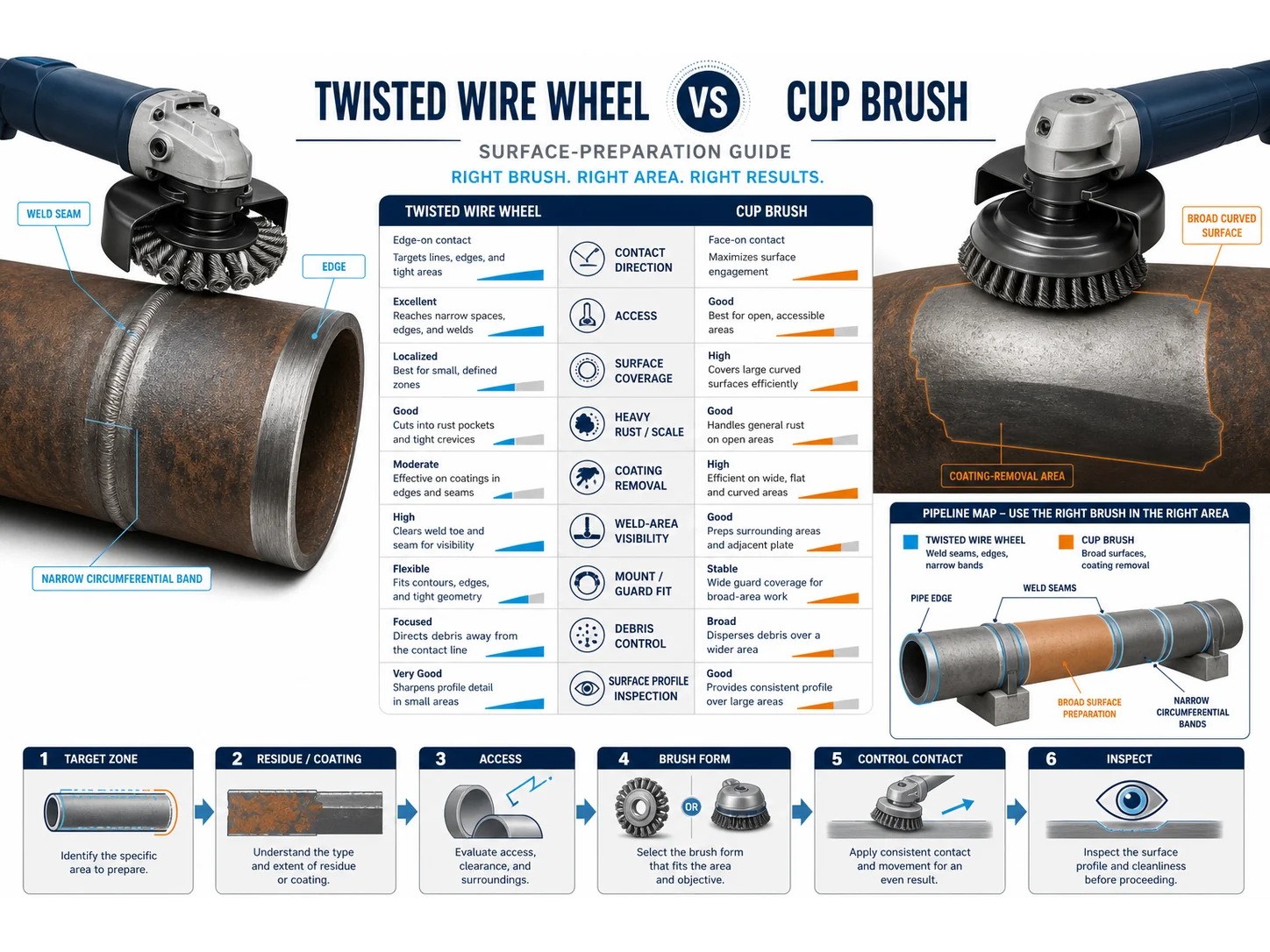
Twisted Wire Wheels (also called knot‑type wheels) are built from bundles of wire that are twisted into tight knots and anchored radially around a center ring. The result is a narrow, aggressive brushing edge that focuses energy on a small contact area. They excel at heavy stock removal on flat or gently curved pipe bodies, quickly stripping thick rust or stubborn coatings.
Cup Brushes have bristles that fan out in a ring from a cup‑shaped hub, creating a broader, more conformable brushing face. The open center and flexible wire arrangement let the brush follow irregular contours—critical for cleaning around weld crowns, girth welds, flange faces, and pipe ends where a wheel would skip or gouge. Cup brushes spread the load over a larger area, making them less aggressive than twisted wheels but far better at blending and surface finishing in tight or curved spaces.
Twisted Wire Wheel vs Cup Brush: At a Glance
| Feature | Twisted Wire Wheel | Cup Brush |
|---|---|---|
| Best for | Flat pipe bodies, heavy rust, thick coatings | Weld seams, edges, contoured surfaces, blending |
| Aggressiveness | High – narrow contact point delivers concentrated impact | Moderate – broader contact spreads force over more wires |
| Surface contact | Thin line along the wheel edge | Circular ring, up to several inches in diameter |
| Typical wire arrangement | Knots of twisted wire, spaced around a center ring | Individual wires or small bundles fanned out in a cup shape |
| Common field use | Pre‑weld cleaning on straight runs, removing mill scale | Post‑weld cleaning, weld blending, pipe‑end bevel cleaning |
| Risk if misapplied | Gouging, uneven profile on curved surfaces, snagging | Slow material removal on flat, heavy‑scale areas |
How to Choose the Right Brush for Your Oil and Gas Surface Prep Task
Matching the brush to the task prevents rework and keeps the crew safe. Ask these questions before picking up a grinder:
- What is the surface shape? Flat or large‑radius pipe bodies lean toward twisted wire wheels. Weld zones, tees, elbows, and flange areas almost always need a cup brush.
- How thick or bonded is the coating? For thick, well‑adhered epoxy or heavy rust scale, start with a twisted knot wheel. If you just need a light flash rust removal or a final white‑metal blend, a fine‑wire cup brush may be enough.
- What base metal and coating profile are required? Aggressive wheels can cut too deep into soft steel. Cup brushes with thinner wire gauge can achieve a smoother anchor profile.
- What angle grinder and RPM will you use? The brush diameter and maximum safe RPM must match your grinder’s no‑load speed (see next sections).
- Are you working near stainless steel or in a corrosion‑critical area? Choose compatible wire material (carbon steel vs stainless steel) to avoid cross‑contamination or pitting.
Wire Gauge and Coating: Why They Matter
Not all wire is the same. Two technical details influence brush life, surface finish, and contamination risk.
Wire Gauge: Thicker wire (smaller gauge number, e.g., .020″ to .030″) is more aggressive and durable—good for heavy‑duty removal. Thinner wire (larger gauge number, e.g., .014″ to .018″) provides a finer finish and conforms better to surface irregularities but wears faster. On pipeline work, a medium‑coarse knot wheel (.020″) often balances cut and life. Finer cup brushes (.014″) are common for final cleaning before coating.
Coating and Material: Most economy brushes use carbon steel wire with a zinc‑plated coating to slow rusting of the brush itself. Zinc‑plated brushes work well on carbon steel pipe but can leave a zinc residue that interferes with some high‑end coatings or welding. For stainless steel pipe or where iron contamination must be avoided, stainless steel wire is mandatory. Stainless wire brushes are non‑magnetic, softer, and often more expensive, but they prevent pitting corrosion on stainless substrates. Brass wire, occasionally seen in angle grinder cup brushes, is too soft for pipeline‑grade prep and is typically limited to light cleaning on non‑ferrous metals.
Speed Limits and PPE: Staying Safe with Wire Brushes
Wire brushes are safe only when used within their rated speed and with correct protective equipment. Every angle grinder cup brush or wheel carries a maximum RPM marking. Exceeding that speed can fling wires outward at high velocity.
- Speed limit check: Match the brush’s max RPM to your grinder’s no‑load speed. A typical 4½‑inch angle grinder may run at 11,000‑12,000 RPM. Many wire brushes for this size are rated for 12,500‑14,000 RPM—always verify. A 6‑inch cup brush might be rated for 9,000 RPM; using it on a grinder that spins 11,000 RPM is an accident waiting to happen.
- Mandatory PPE: A full‑face shield over safety glasses is the minimum eye and face protection. Wire fragments can snap off and penetrate skin or eyes. Heavy‑duty leather or cut‑resistant gloves, long‑sleeved clothing, and hearing protection are standard. A dust mask or respirator may be required depending on the coating being removed (lead‑based paint, silica, etc.).
- Tool guard: Never remove the angle grinder’s safety guard. Adjust it to deflect wire fragments away from the operator. The guard may need repositioning frequently as the working angle changes, but it must remain in place.
- Workpiece security: The pipe must be firmly supported or clamped. A spinning wire brush can catch an edge and throw the tool or the workpiece.
Common Mistakes When Using Wire Brushes for Pipeline Prep
Even experienced crews can fall into these traps:
- Grabbing the wrong brush for the contour: Trying to clean a girth weld root pass with a twisted wheel often leads to gouging, uneven cleaning, or a brush that bounces off the surface.
- Exceeding the speed rating: Over‑speeding turns a wire brush into a fragmentation grenade. Always check the RPM rating before mounting.
- Skipping PPE or running without a guard: Eye injuries and embedded wire fragments are common when operators get complacent.
- Mixing wire types on stainless: Using carbon steel brushes on stainless pipe leaves iron particles that rust later, causing pitting. Dedicated stainless‑only brushes should be labeled and stored separately.
- Pressing too hard: Wire brushes rely on tip speed, not pressure. Excessive force bends the wires, reduces cut rate, and overheats the brush, leading to premature wire breakage.
- Neglecting brush direction: A cup brush works best when the tool is tilted 10‑15 degrees to the surface so the edge of the wire ring does the work. Holding it flat reduces cutting action and increases operator fatigue.
When Sandblasting Is a More Efficient Choice
Wire brushes are portable and fast for small, targeted areas, but they have limits. Sandblasting (abrasive blasting) becomes the better option when:
- Large surface areas need uniform cleaning—brushing an entire 40‑foot joint with a grinder is painfully slow and inconsistent.
- Thick, multi‑layer coatings resist practical wire brush removal. Epoxy coats and coal‑tar enamels often require blast media.
- A deep, angular anchor profile is specified. Wire brushes can create a profile, but it tends to be shallower and less uniform than blasting.
- Service conditions demand the highest cleanliness (SSPC‑SP 10 near‑white blast or SP 5 white metal blast). Wire brushes alone struggle to meet these standards on pitted steel.
- Time and labor savings justify the equipment. On a large spread, renting or contracting a blast setup may be cheaper and faster than days of manual grinding.
Wire brushes are a great complementary tool: use blasting for the main run and wire brushes for touch‑ups, weld seams, and hard‑to‑reach spots where blasting is awkward.
Final Takeaway: Matching the Tool to the Task
There’s no single “best” brush for oil and gas surface prep—only the right one for the shape, coating condition, base metal, and safety requirements in front of you. For aggressive, flat‑surface cleaning, reach for a twisted wire wheel with an appropriate wire gauge and coating. For weld seams, corners, and final blending, a cup brush is the smarter, safer choice. Respect speed ratings, wear full PPE, and know when to put the grinder down and call in the blast crew.
Frequently Asked Questions
Can I use a cup brush on flat pipe surfaces?
Yes, a cup brush works on flat surfaces, but it will be slower and less aggressive than a twisted wire wheel. It is better suited for blending and light cleaning than heavy stock removal.
What’s the difference between crimped wire and twisted wire brushes?
Crimped wire brushes have individual wires that are loosely wavy, making them more flexible and less aggressive. Twisted (knot) wire brushes have bundles twisted together for maximum cutting force. For pipeline prep, twisted knot brushes are typically preferred for heavy work; crimped wire cup brushes are often used for lighter cleaning and final finishing.
Is a stainless steel brush always required for stainless steel pipe?
Yes, if you want to avoid ferrous contamination that leads to pitting corrosion. Use a brush with stainless steel wire and confirm it has never been used on carbon steel. Some specs also require passivation after mechanical cleaning.
What RPM is safe for a 4‑inch cup brush?
Always check the marking on the brush. Many 4‑inch cup brushes are rated for 12,500‑14,000 RPM. Your 4½‑inch angle grinder typically spins at 11,000‑12,000 RPM, so the combination is safe if the brush rating meets or exceeds the grinder’s no‑load speed. Never guess.
Do I need to keep the guard on my angle grinder when using a wire brush?
Yes. The guard protects you from flying wires and accidental contact. Adjust it between the brush and your body. Some wire brushes come with a built‑in trimmer or matting ring, but that is not a substitute for the grinder guard.
How do I know if sandblasting is a better option for my job?
If you are facing large surface areas, thick or multi‑layer coatings, a need for a deep anchor profile, or a specification requiring white‑metal cleanliness (SSPC‑SP 10 or SP 5), sandblasting will likely be more efficient and consistent. Wire brushes are ideal for local repairs, weld seams, and touch‑up.
Can wire brushes remove weld spatter?
Light spatter can sometimes be knocked off with a coarse twisted wire wheel. Heavier spatter usually requires a chipping hammer, needle scaler, or grinder with an abrasive disc. Wire brushes are best for cleaning the surface, not breaking off hardened spatter balls.
Technical References
- ABMA — ANSI B165.1 Power Brush Safety Slips
- OSHA — 1910.242 Hand and Portable Powered Tools
- OSHA — 1910.215 Abrasive Wheel Machinery
- OSHA — Personal Protective Equipment
Which bristle material fits this job — AISI 304 Stainless Steel Wire, Carbon Steel Wire or Brass Wire?
| Material | Continuous temperature (°C) | Peak temperature (°C) | Water absorption | Hardness |
|---|---|---|---|---|
| AISI 304 Stainless Steel Wire | 400 | 500 | 0% | Rockwell B 70–95 depending on temper and cold work |
| Carbon Steel Wire | 200–300 | 350–450 | 0% | Rockwell C 40–60 |
| Brass Wire | 150–200 | 250–300 | 0% | Rockwell B 40–90 |
Figures as published by Alleima. Confirm the exact grade against the supplier datasheet before ordering.
When is AISI 304 Stainless Steel Wire the wrong choice for pipeline prep?
- AISI 304 Stainless Steel Wire — Avoid using AISI 304 as the default in marine, brine, hypochlorite, and persistent chloride environments; use AISI 316 when higher pitting and crevice-corrosion resistance is required.
- Carbon Steel Wire — Not for soft plastic, glass, PCB, coated solar glass or polished paint.
- Brass Wire — Avoid on stainless surfaces where copper contamination is restricted and on delicate coatings that mark under metal contact.
What should replace AISI 304 Stainless Steel Wire for pipeline prep?
- AISI 304 Stainless Steel Wire — Use AISI 316 stainless steel wire for chloride, marine, dairy, beverage, chemical washdown, or higher pitting-resistance requirements. Use carbon steel for dry aggressive cutting and brass or abrasive nylon for lower marking risk.
- Carbon Steel Wire — Compare Carbon Steel Wire with Carbon steel wire, brass wire, abrasive nylon. Change material when wet stiffness, temperature, chemical resistance, conductivity, particle shedding, or surface marking becomes the limiting factor.
- Brass Wire — Compare Brass Wire with Steel wire, stainless wire, nylon. Change material when wet stiffness, temperature, chemical resistance, conductivity, particle shedding, or surface marking becomes the limiting factor.