
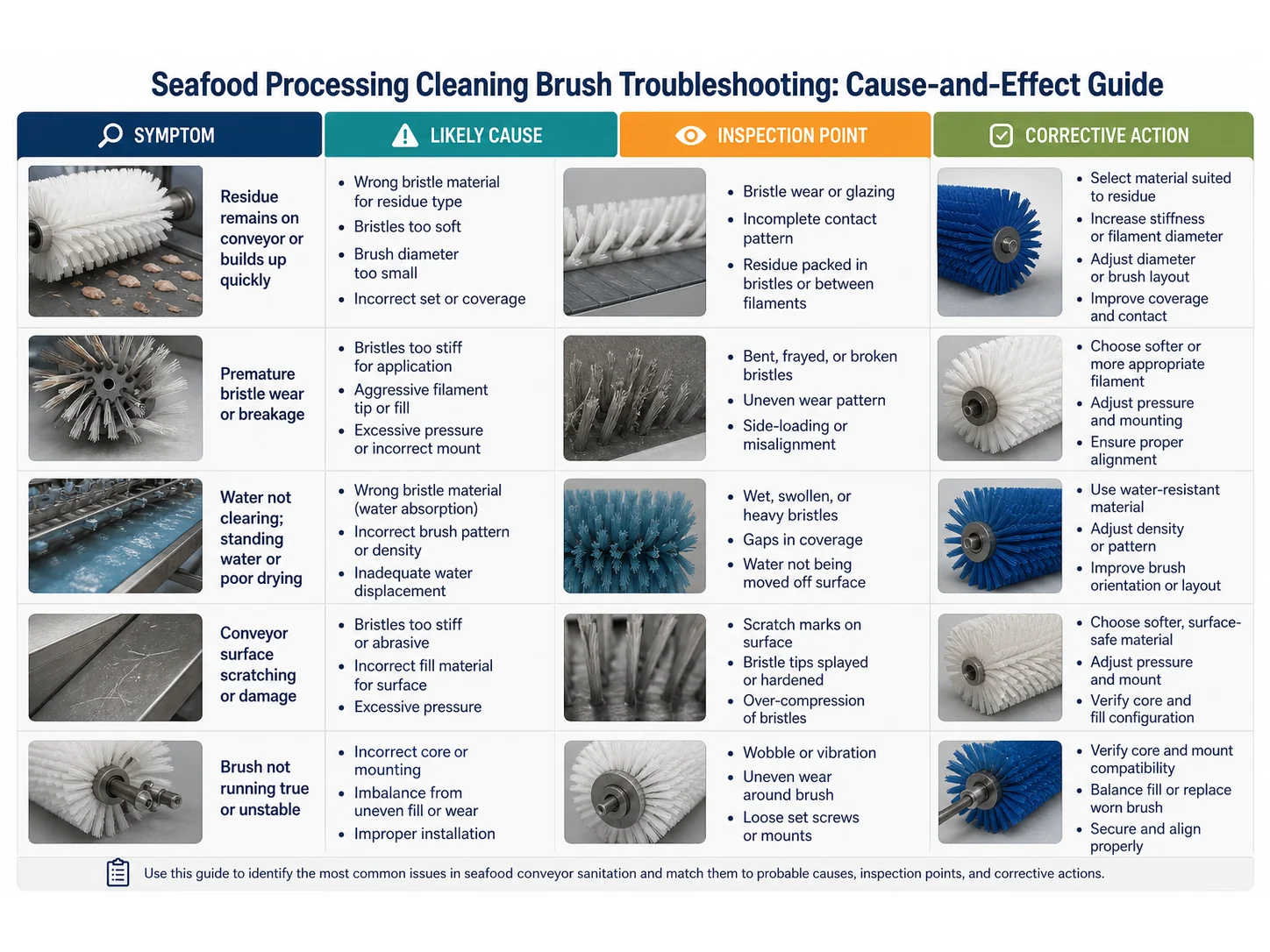
What Is a Seafood Processing Cleaning Brush?
In high-moisture protein processing, a seafood processing cleaning brush is a rotating or stationary brush assembly engineered for continuous or intermittent conveyor belt and slat cleaning during production or between CIP cycles. Unlike general industrial brushes, these brushes must withstand aggressive washdown chemicals, high-pressure hot water, chlorinated sanitizers, and direct exposure to edible products. They are often mounted inside enclosed belt scrapers, motorized brush rollers, or manual wand systems, and their bristle material, density, and diameter directly affect sanitation effectiveness, belt life, and compliance with food safety standards.
Common Brush Materials for Seafood Sanitation
The choice of filament material determines how a brush handles sticky protein, fat, scales, and slime without scratching plastic modular belts, stainless steel slats, or urethane coatings. Below are the most common materials found in seafood conveyor cleaning applications:
- Food-grade nylon (PA 6/12): Good stiffness, high heat resistance up to 250°F, excellent chemical resistance. Ideal for heavy residues but can absorb moisture over time.
- Polypropylene (PP): Excellent chemical resistance, low moisture absorption, FDA-compliant. Softer than nylon, suitable for light-to-medium cleaning on sensitive belts.
- Polyester (PBT/PET): Stiffness between nylon and PP, good abrasion resistance, low water absorption. Often used in medium-duty conveyor cleaning with hot water and mild detergents.
- TPE/TPU (thermoplastic elastomer/urethane): Flexible, non-scratch, excellent for delicate surfaces. Used where metal-detectable properties or ultra-clean scraping is required.
- Stainless steel wire: For heavy scraping of baked-on debris or carbonized residues, but risks belt damage and is usually avoided in direct food contact unless fully enclosed and monitored.
Material Comparison Table
| Material | Stiffness | Chemical Resistance | Moisture Tolerance | Best For | Cost Factor |
|---|---|---|---|---|---|
| Nylon (PA 6/12) | High | Good (avoid strong acids) | Moderate (absorbs water) | Heavy scale, protein buildup | Medium |
| Polypropylene | Low–Medium | Excellent | Excellent | Light residues, sensitive belts | Low |
| Polyester (PBT) | Medium | Very Good | Excellent | General conveyor cleaning | Medium |
| TPE/TPU | Low | Good | Excellent | Non-scratch, metal-detectable | High |
| Stainless Steel | Very High | Excellent | Excellent | Baked-on char, heavy scraping | High |
Size and Fit Factors for Conveyor Systems
A brush that fits poorly either leaves dead zones or wears out the belt. Key dimensions to match include:
- Overall diameter (OD): Must match the brush housing or allow enough interference with the belt without jamming. Common ranges are 4–12 inches, but custom sizes are typical.
- Face width or length: Should cover the full belt width plus over-travel on both sides to prevent edge buildup.
- Shaft or core diameter: Must fit the existing drive shaft, end plates, or mounting clamps.
- Trim length: The free bristle length affects stiffness and wear. Too short and it loses flexibility; too long and it may bend and miss the surface.
How to Choose Based on Residue and Surface Sensitivity
Start by characterizing the residue type and the belt material, not the brush cost drivers:
- Identify the dominant residue: Protein paste, fat, scales, slime, breading, or carbonized char.
- Assess belt sensitivity: Plastic modular belts (soft) vs. stainless steel slats (hard) vs. urethane-coated belts (very sensitive).
- Choose material stiffness: Soft residues → soft or medium bristles (PP, polyester). Hard or sticky residues → medium-stiff nylon. Abrasive scale → stainless, but only on hard belts.
- Confirm chemical exposure: Check sanitizer compatibility. Some filaments degrade rapidly in quaternary ammonium or peracetic acid solutions.
- Verify temperature range: Automated CIP systems may push water at 180°F+. Nylon and polyester handle it; PP softens early.
Stiffness, Core, and Handle Options
Beyond material, the brush’s construction influences cleaning performance and service life:
- Bristle stiffness (gauge): Measured by filament diameter; thicker = stiffer. In seafood, 0.012–0.040 inches are common. Too stiff wears the belt; too soft fails to scrub.
- Core material: Stainless steel (304/316) is standard for washdown. Polypropylene or PVC cores offer lightweight alternatives but may lack structural strength at longer lengths.
- Mounting type: Shaft-mount with keyway, end-disc with bolts, or quick-change snap-in designs. Quick-change designs reduce downtime during sanitation shifts.
Common Mistakes When Specifying a Seafood Conveyor Cleaning Brush
- Buying by size and cost drivers alone: A low-cost brush that swells, sheds bristles, or degrades in sanitizer costs more in downtime and foreign-material recalls.
- Ignoring moisture absorption: Nylon can swell 2–3% in wet environments, tightening the fit and causing motor overload or belt scoring.
- Using the same brush for all zones: Raw receiving, cook, and freezer tunnels have very different residue and temperature profiles.
- Forgetting metal-detectable requirements: In the final consumer-ready line, any brush fragment must be detectable. Standard nylon or PP are invisible to metal detectors.
- Overlooking drive torque: A stiff brush against a wide belt requires proper sizing of the motor drive; undersized drives stall or fail prematurely.
When a Standard Cleaning Brush Is the Wrong Choice
No brush solves every sanitation challenge. Recognize the limits:
- Biofilm-embedded surfaces: Brushes alone may not remove mature biofilm. They must be paired with chemical pre-soak and chemical dwell time.
- Complex or recessed belt geometry: Specialty belts with deep flights or recessed rods may need custom-shaped brush profiles or supplemental water jets.
- Ultra-high sanitation lines: In ready-to-eat (RTE) zones with Listeria control, you may need fully washable, autoclavable brush assemblies with validation data.
- Rapid changeover environments: If you change brush types for different species multiple times per shift, a quick-change system is essential, not optional.
If your documentation requires evidence of suitability, ask the brush manufacturer for FDA compliance letters, material certifications, and third-party chemical resistance data instead of assuming “food grade” is enough.
Final Takeaway: Matching Brush to Sanitation Goal
Specifying the right seafood processing cleaning brush means matching the filament material, stiffness, dimensions, and core to your specific residue, belt type, and washdown conditions. Start by analyzing the residue, not the brush catalog. Validate with a trial sample, watch for moisture swelling, and plan for quick changeover if your line processes multiple species. A well-matched brush reduces belt wear, improves sanitation consistency, and lowers the risk of foreign-material incidents.
Frequently Asked Questions
How often should a seafood conveyor cleaning brush be replaced?
Replacement frequency depends on bristle wear from abrasion and chemical degradation. Many plants find that bristles lose effective length after 3–6 months of heavy use. A good rule: replace when the trim length drops below 75% of the original or when the brush no longer makes full belt contact.
Can I use the same brush for raw shrimp and cooked shrimp lines?
Sanitation separation principles usually require different brush sets or validated cleaning between zones to prevent cross-contamination. Even if the brush materials are compatible, dedicate brushes to raw and cooked areas or use color-coding and a stringent cleaning protocol between uses.
What is the difference between a conveyor cleaning brush and a belt scraper?
A conveyor cleaning brush uses rotating or oscillating bristles to scrub and dislodge residues, while a belt scraper is a static blade that shears off bulk material. Brushes are better for fine particles, stubborn film, and delicate belts; scrapers are better for heavy, wet sludge. Many systems combine both.
Do I need a metal-detectable brush in my seafood plant?
In any final processing line after the last metal detector, any brush fragment that falls onto the product must be detectable. Consider using metal-detectable additives in the filament or using a fully enclosed brush unit above the product path. In raw receiving areas, the requirement is less strict but still recommended.
How do I prevent the brush from slinging water and debris everywhere?
An enclosed brush housing with a drip pan and proper splash guarding is essential, especially in high-speed lines. Adjust brush speed and interference to minimize atomization. For manual wand brushes, train operators to direct spray away from open product zones.
Can I order a custom diameter or length for my existing conveyor?
Yes, many industrial brush manufacturers will build to your specific shaft dimensions, brush length, and overall diameter. Provide an engineering drawing with keyway details, bearing points, and tolerances. Ordering a custom size is standard in seafood processing because conveyor widths vary widely.
Should I choose natural fiber bristles for seafood brushes?
Natural fibers like Tampico or horsehair are rarely used in seafood because they absorb water, harbor bacteria, and degrade quickly in alkaline detergents. Stick with synthetic food-grade filaments that can be fully sanitized and dried.
Technical References
- FDA — Food Code
- eCFR — 21 CFR 177.1500 Nylon Resins
- eCFR — 21 CFR 177.1520 Olefin Polymers
- eCFR — 21 CFR 177.1630 Polyethylene Phthalate Polymers
- OSHA — Machine Guarding
- eCFR — 21 CFR Part 117 Human Food CGMP and Preventive Controls
Which bristle material fits this job — Nylon PA, AISI 304 Stainless Steel Wire or PBT?
| Material | Continuous temperature (°C) | Peak temperature (°C) | Water absorption | Hardness |
|---|---|---|---|---|
| Nylon PA | 93 | 121 | 0.3–9% by PA grade and conditioning | Medium to firm; filament diameter and trim length control bending force. |
| AISI 304 Stainless Steel Wire | 400 | 500 | 0% | Rockwell B 70–95 depending on temper and cold work |
| PBT | 120–140 | 160–180 | 0.05–0.20% | Shore D 80–90 |
| Polypropylene PP | 80–100 | 120–140 | ≤0.03% | Shore D 65–75 |
Figures as published by Brushtec / DuPont; Alleima; Perlon. Confirm the exact grade against the supplier datasheet before ordering.
What should replace Nylon PA for sanitation?
- Nylon PA — Compare Nylon PA with PP, PBT, PET. Change material when wet stiffness, temperature, chemical resistance, conductivity, particle shedding, or surface marking becomes the limiting factor.
- AISI 304 Stainless Steel Wire — Use AISI 316 stainless steel wire for chloride, marine, dairy, beverage, chemical washdown, or higher pitting-resistance requirements. Use carbon steel for dry aggressive cutting and brass or abrasive nylon for lower marking risk.
- PBT — Compare PBT with Nylon, PP, PET. Change material when wet stiffness, temperature, chemical resistance, conductivity, particle shedding, or surface marking becomes the limiting factor.
- Polypropylene PP — Compare Polypropylene PP with Nylon, PBT, PET. Change material when wet stiffness, temperature, chemical resistance, conductivity, particle shedding, or surface marking becomes the limiting factor.