
What Is a Side Broom?
A side broom is a driven brush assembly that rotates in contact with the ground, usually at an angle between 15° and 30° from horizontal. It sweeps dust, sand, leaves, gravel, and light litter from surfaces that a machine cannot reach with its main brush alone—especially along curbs, expansion joints, and narrow aisles. The broom’s core (also called a hub or flange) attaches to a motor, while the fill material—bristles, wire, or abrasive filaments—does the mechanical work of dislodging and moving debris.
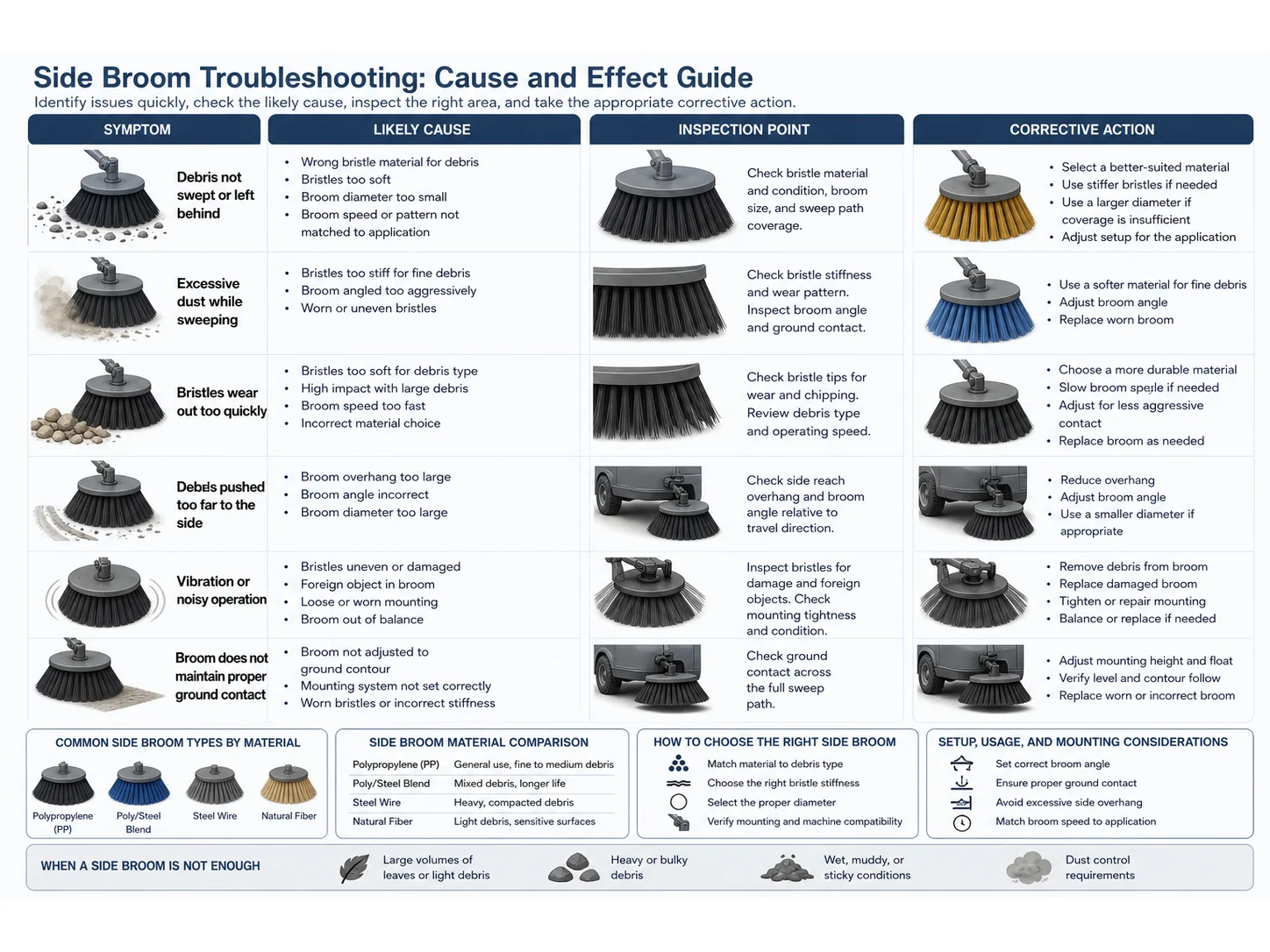
Common Side Broom Types by Material
Most side brooms are categorized by fill material, because that determines what the broom can handle and how aggressively it treats the surface.
- Polypropylene (PP): All‑purpose synthetic bristle, often crimped for stiffness. Good for concrete, asphalt, and general outdoor sweeping. Handles light wet debris but may mat down in heavy moisture.
- Nylon: More abrasion‑resistant and heat‑tolerant than polypropylene. Performs well on hot surfaces or where chemical/oil exposure is common. Often used in food plants, parking garages, and industrial bays.
- Wire: Steel or stainless‑steel wire for heavy‑duty outdoor debris—mud, packed sand, stubborn leaves, ice, and snow. Stainless versions add corrosion resistance. Wire brooms are aggressive and can scar soft surfaces.
- Natural Fiber (Tampico, Bassine, Palmyra): Plant‑based fibers that are finer and more flexible. Ideal for fine dust on sensitive surfaces like decorative brick, flagstone, or polished concrete. Tampico holds water well, making it useful for wet‑dust control.
- Combination / Hybrid: Blended fills such as poly‑plus‑wire or poly‑plus‑abrasive grit. These try to balance agitation and surface protection; common on municipal sweepers that face changing seasonal debris.
Side Broom Material Comparison
| Material | Best For | Surface Sensitivity | Wet/Chemical Resistance | Typical Durability | Relative Cost | Notes |
|---|---|---|---|---|---|---|
| Polypropylene | General outdoor dust, sand, leaves | Low–moderate; can lightly abrade soft asphalt | Good in light moisture; fair chemical resistance | Medium | Low to medium | Most common manufacturer instructions spec for walk‑behind sweepers |
| Nylon | Oily/greasy floors, hot surfaces, high‑cycle use | Moderate; slightly firmer than PP | Excellent; resists oil, grease, and many solvents | High | Medium to high | Long service life in harsh environments |
| Wire | Heavy packed debris, snow, ice, matted leaves | Aggressive; can scratch concrete, score asphalt | Good (stainless) to fair (carbon steel) | High | High | Requires careful height adjustment to avoid surface damage |
| Natural fiber | Fine dust, historical surfaces, polished concrete | Very gentle; safe for decorative finishes | Fair; fibers can degrade when constantly wet | Low to medium | Medium | Holds water well for dust suppression |
| Combination | Mixed seasonal debris, municipal sweeping | Moderate; depends on blend | Varies by blend; wire portion needs attention | Medium to high | Medium to high | Often a compromise; test before full fleet adoption |
How to Choose the Right Side Broom
Start with the debris, not the machine. List the worst‑case material the broom will encounter each week—dry leaves, wet sand, icy curbs, or heavy stone dust. Then work through these factors:
- Debris type and size: Fine dust needs a dense, flexible fill; heavy chunks need stiff or wire fill that won’t bend permanently.
- Surface material: Sealed concrete, asphalt, pavers, and polished floors tolerate different levels of abrasion. Wire on decorative pavers is a quick way to create warranty‑voiding scratches.
- Wet or dry operation: Wet debris loads bristles faster. Nylon or poly‑with‑drain holes may outperform natural fiber in constant dampness. Wire resists matting but can rust without stainless wire.
- Chemical exposure: De‑icing salts, fertilizers, and cleaning agents can attack natural fibers and carbon‑steel wire. Nylon or stainless wire is safer.
- Hygiene expectations: Food, pharmaceutical, or retail entryways may require non‑absorbent fills that can be washed and sanitized.
- Mounting interface: Core shape, bolt pattern, and drive mechanism must match the sweeper. Even a perfect fill material is useless if the broom won’t fit the hub.
- Diameter and clearance: Larger diameters cover more ground per revolution but may interfere with machine guards, skirts, or curbs. Check the manufacturer’s clearance data.
- Maintenance frequency: High‑cycle operations that change brooms daily may prioritize low‑cost polypropylene; a remote site that changes brooms quarterly might justify a longer‑life nylon or wire.
- Custom sizes: Off‑shelf sizes cover 90% of equipment, but custom diameters, fill patterns, or core recesses can solve unique fleet problems. Ordering custom often requires a drawing review with the supplier.
Setup, Usage, and Mounting Considerations
Even the best material can fail early if the broom is mounted incorrectly. Pay attention to:
- Rotation direction: The broom should push debris toward the machine’s center, not fling it outward. Verify rotation before confirming the order.
- Height adjustment: The lowest bristle tips should barely kiss the surface. Over‑compression eats power, wears the broom, and can lift the machine or scrub the surface raw.
- Bolt pattern and core type: Some cores are keyed, some are threaded, others use a friction plate. Measure the old broom’s inner diameter, bolt circle, and recess depth.
- Skirt and flap clearance: Check that the broom’s sweep path is not blocked by worn or misaligned rubber skirts that can trap debris and overload the broom.
- Storage: Polypropylene and nylon can take a set if left under constant pressure. Whenever possible, lift side brooms off the ground when the machine is parked overnight.
Common Mistakes When Specifying a Side Broom
- Choosing by diameter alone: A 20‑inch poly broom and a 20‑inch wire broom are not interchangeable when the surface changes from asphalt to pavers. Always specify the fill material, not just the size.
- Ignoring fill density: More bristles per square inch (dense fill) can improve sweeping on smooth floors but may clog with wet leaves. Ask for a fill‑density specification if the manual omits it.
- Using a wire brush where it isn’t needed: Operators sometimes request “the toughest brush” for everyday dust. The result is unnecessary surface wear, higher cost, and no cleaning benefit.
- Overlooking core compatibility: A standard “D‑core” on one brand may have a different bolt spacing on another. Always take a photo or sketch of the old core before ordering.
- Skipping a sample test: For custom blends or new working conditions and process limits, a single test broom run for a few days can prevent hundreds of dollars in mismatched inventory. Many brush manufacturers will supply a no‑charge sample if the potential volume is reasonable.
- Neglecting chemical exposure: A yard that uses de‑icing salts heavily in winter will destroy natural fiber and carbon‑steel wire in a single season. Plan the broom material around the chemicals present, not just the weather.
- Assuming one size fits all machines: Even within the same manufacturer, a larger sweeper model may require a different core offset or thicker bristle trim. Always quote the exact model and serial number.
When a Side Broom Is the Wrong Choice
A side broom improves edge‑to‑edge coverage but has real limits:
- Packed, bonded debris: Hard‑packed mud, frozen litter, or embedded gravel may need a heavy wire main brush or a scarifier attachment before the side broom can be effective.
- High‑volume, high‑speed sweeping: On road‑shoulder sweepers running above 15 mph, side brooms alone cannot manage the thrown dust and may be replaced by full‑width gutter brooms or vacuum‑only nozzles.
- Very narrow aisles or tight machinery: When clearance is less than the broom’s diameter, a side broom can’t rotate freely. In such cases, consider a smaller‑diameter front broom or a narrower walk‑behind machine.
- Explosion‑dust environments: Natural fiber brooms can generate static or ignite if not properly rated. Applications handling combustible dusts (grain, wood, chemicals) must use anti‑static or ATEX/NFPA‑compliant components—a standard side broom may be unsafe.
- When brush drawing and engineering review are mandatory: For large fleets or custom‑made brooms, a supplier’s CAD drawing should be reviewed to confirm fill interference, hub stress, and sweep pattern. Do not rely on verbal descriptions for custom orders.
Final Takeaway
The right side broom is determined by the worst debris it must move, the surface it touches, and the machine it fits. Start with material, then check size, stiffness, and core details. A few minutes measuring the old broom and discussing conditions with a technical brush supplier can eliminate the most common reorder failures.
Frequently Asked Questions
How do I measure the diameter of my existing side broom?
Measure across the center of the broom, from the tip of one bristle to the tip of the opposite bristle while the broom is off the machine. If the broom is worn, add a note to your inquiry—it helps the supplier suggest the original size.
Can I use the same side broom for both wet and dry outdoor sweeping?
Polypropylene and nylon work adequately in both conditions if the debris is light. For heavy wet sweeping (mud, wet leaves), consider a wire fill or a stiff poly‑wire blend. Keep in mind that wire needs stainless steel to avoid rust in constant moisture.
What does “fill density” mean and why does it matter?
Fill density is the number of bristle tips per square inch of the broom face. A higher density gives better fine‑dust pickup but can clog with stringy or wet debris. A lower density lets bulky material flow through but may miss fine particles.
My polypropylene side broom wears out after a few hours. Am I doing something wrong?
Check the height adjustment—excessive down‑pressure grinds bristles quickly. Also confirm the broom is rotating in the correct direction and that it is rated for the surface abrasion and operating temperature you are exposing it to.
Is a wire side broom safe for decorated concrete or stamped asphalt?
Generally no. Steel wire will scratch and dull decorative surfaces. Use a softer poly, nylon, or tampico fill if the surface appearance matters. Some suppliers offer a “mixed” filament with a gentle outer layer, but always test on an inconspicuous area first.
How do I know if my side broom core is standard or custom?
Measure the inner diameter, bolt‑hole circle, number of bolts, and any recess or step in the core. Compare your measurements against the drawings or spec sheets of off‑the‑shelf brooms. If nothing matches, contact a brush manufacturer with your sketch and machine model.
Can I wash a side broom and reuse it?
Yes, synthetic fills (poly, nylon) can be hosed off and allowed to dry. Wire brooms should be dried thoroughly to prevent rust. Natural fiber brooms may be damaged by high‑pressure water; rinse gently and dry completely before storage.
What information should I include in a side broom RFQ?
Include outer diameter, fill material, desired stiffness (soft/medium/stiff), core type and dimensions, sweeper make and model, and a description of the debris and surface conditions. A photo of the old broom next to a ruler often saves time on both sides.
Technical References
Which bristle material fits this job — Nylon PA, AISI 304 Stainless Steel Wire or Carbon Steel Wire?
| Material | Continuous temperature (°C) | Peak temperature (°C) | Water absorption | Hardness |
|---|---|---|---|---|
| Nylon PA | 93 | 121 | 0.3–9% by PA grade and conditioning | Medium to firm; filament diameter and trim length control bending force. |
| AISI 304 Stainless Steel Wire | 400 | 500 | 0% | Rockwell B 70–95 depending on temper and cold work |
| Carbon Steel Wire | 200–300 | 350–450 | 0% | Rockwell C 40–60 |
| Polypropylene PP | 80–100 | 120–140 | ≤0.03% | Shore D 65–75 |
Figures as published by Brushtec / DuPont; Alleima; Perlon. Confirm the exact grade against the supplier datasheet before ordering.
What should replace Nylon PA for outdoor debris?
- Nylon PA — Compare Nylon PA with PP, PBT, PET. Change material when wet stiffness, temperature, chemical resistance, conductivity, particle shedding, or surface marking becomes the limiting factor.
- AISI 304 Stainless Steel Wire — Use AISI 316 stainless steel wire for chloride, marine, dairy, beverage, chemical washdown, or higher pitting-resistance requirements. Use carbon steel for dry aggressive cutting and brass or abrasive nylon for lower marking risk.
- Carbon Steel Wire — Compare Carbon Steel Wire with Carbon steel wire, brass wire, abrasive nylon. Change material when wet stiffness, temperature, chemical resistance, conductivity, particle shedding, or surface marking becomes the limiting factor.
- Polypropylene PP — Compare Polypropylene PP with Nylon, PBT, PET. Change material when wet stiffness, temperature, chemical resistance, conductivity, particle shedding, or surface marking becomes the limiting factor.