
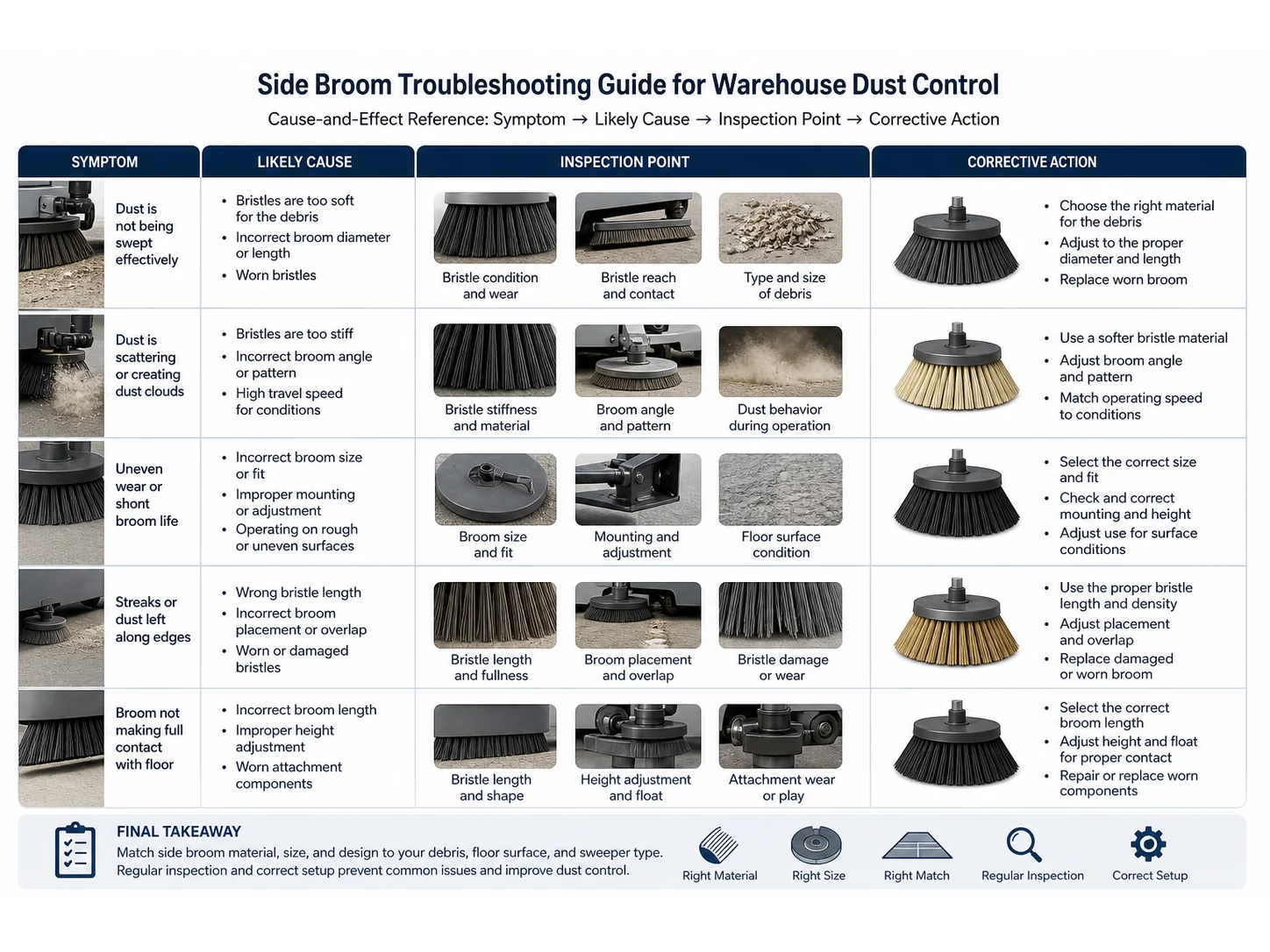
What Is a Side Broom and How Is It Used in Warehouse Dust Control?
A side broom is a driven brush assembly that works together with the main broom or vacuum system. It sweeps dust and small debris away from walls, rack legs, and perimeter areas toward the center suction or collection hopper. In distribution centers, food storage, or manufacturing warehouses, fine dust can settle in hard-to-reach places. The side broom’s bristle material, stiffness, diameter, and rotational speed determine whether it captures that dust or simply kicks it into the air.
Common Side Broom Materials and Properties
Material choice directly affects dust pickup, bristle life, and surface safety. Typical options include:
- Polypropylene (PP): Good stiffness and moisture resistance; works well for general warehouse dust on sealed concrete. Resists most chemicals but can be noisy on rough floors.
- Nylon (PA): Strong, resilient, and more flexible than PP. Holds less water; suitable for slightly damp environments. Abrasion-resistant, making it a good choice for dusty, high-wear areas.
- Wire (steel or stainless): Aggressive cleaning for heavy debris or compacted dust. Not recommended for fine dust or painted/epoxy floors—will scratch surfaces and generate sparks on concrete.
- Natural fiber (tampico, horsehair, palmyra): Soft and gentle; picks up fine dust without scratching. Used in food processing or areas with sensitive flooring. Absorbs moisture, so not for wet or washdown applications.
- PET or recycled polyester: A middle ground between nylon and PP. Often used in food-grade environments. Good chemical resistance and moderate stiffness.
Material Comparison Table
| Material | Stiffness | Moisture Tolerance | Surface Sensitivity | Typical Warehouse Dust Application |
|---|---|---|---|---|
| Polypropylene | Medium–High | Excellent | Moderate (may mar soft floors) | General dry dust on sealed concrete; packaging areas |
| Nylon | Medium | Good | Good for most smooth floors | Light dust, frequent use; slightly damp warehouses |
| Steel Wire | Very High | Excellent | Aggressive—will scratch | Compacted debris, outdoor-to-indoor transition zones |
| Natural Fiber | Low–Medium | Poor (absorbs water) | Very gentle | Fine dust on sensitive or waxed floors; food-grade areas |
| PET/Recycled Polyester | Medium | Good | Gentle on most floors | Food warehouses, consistent fine dust; washdown-ready options |
How to Choose the Right Side Broom for Your Warehouse
Start with the dust type and floor surface, then work through equipment compatibility and operating conditions:
- Residue type: Fine, light dust needs softer bristles that won’t flick particles into the air. Heavier, gritty dust may require stiffer material or mixed bristle patterns.
- Surface sensitivity: Polished concrete, epoxy, or coated floors demand non-abrasive materials. Use wire or aggressive synthetics only on untreated industrial concrete or asphalt.
- Equipment interface: Check your sweeper model’s mounting system—ring, keyed, threaded, or quick-release. The side broom’s core diameter and drive mechanism must match exactly. Verify rotation direction and speed range.
- Wet or chemical exposure: Washdown areas, condensation, or occasional chemical contact favor polypropylene, nylon, or sealed hub designs. Avoid natural fibers and unsealed metal cores.
- Hygiene expectations: Food, pharma, and clean warehouses often require non-absorbent, FDA-compliant materials and metal-detectable bristles. Side broom design should minimize bristle loss.
- Maintenance frequency: If you run sweepers continuously, pick a durable material and stock replacements that are easy to install without pulling the machine out of service.
- Custom size requirements: Not all brooms are off-the-shelf. If your machine has an odd mounting pattern or needs a non-standard diameter to clear obstacles, a custom side broom with CAD drawing approval is safer than a close match that underperforms or damages the machine.
Common Mistakes When Specifying Side Brooms
- Choosing by cost drivers alone: A low-cost broom that wears out quickly or damages a $50,000 floor coating is a false economy.
- Ignoring bristle stiffness for fine dust: Overly stiff brooms can aerosolize fine dust, worsening air quality instead of cleaning it.
- Mismatching mounting hardware: Assuming all side brooms fit because the diameter looks right leads to hub bore, keyway, or drive pin issues.
- Overlooking moisture or chemical resistance: Using natural fiber in a damp warehouse causes bristle swelling, rot, and early failure.
- Skipping a sample or drawing review: Ordering in bulk without testing one broom on your floor and machine can lock in the wrong specification.
When a Side Broom Is the Wrong Choice
A side broom handles edge dust, but it cannot replace a properly sized main broom or vacuum system. If your warehouse has excessive airborne dust, look upstream at dust generation points, ventilation, or entryway matting. Side brooms also struggle with large debris, sticky residues, or very rough floors. In those cases, you may need a pre-sweep attachment, a larger diameter main broom, or a different brush type entirely—such as a cup brush or strip brush—designed for heavy or clingy material.
Final Takeaway
Selecting a side broom for warehouse dust means matching bristle material to dust type and floor sensitivity, verifying mounting and size compatibility with your equipment, and avoiding common specification shortcuts. Test one sample before committing to a full order. When the specification is right, a side broom becomes a low-cost, high-impact tool for keeping warehouse edges clean and dust-free.
Frequently Asked Questions
Can I use the same side broom for wet and dry conditions?
It depends on the material. Polypropylene and nylon handle occasional dampness, but for continuous wet or washdown areas, choose a broom with a stainless hub and non-absorbent fill like polypropylene. Natural fibers and wood cores will fail quickly in moisture.
How do I measure my existing side broom to order a replacement?
Record the overall diameter, working width, hub bore diameter, keyway or drive pin size, and mounting style (ring, threaded, or keyed). If the broom has a specific hub offset or flange pattern, include that as well. Provide these dimensions to your supplier along with the machine make and model.
What bristle stiffness is best for fine dust on painted warehouse floors?
Soft to medium stiffness is usually ideal. Nylon or natural fiber blends pick up fine dust without scratching paint or epoxy. Avoid wire and high-stiffness polypropylene unless the floor is uncoated industrial concrete.
How often should side brooms be replaced in a dusty environment?
There is no single interval—it depends on usage hours, bristle material, and floor roughness. A good practice is to check bristle length and wear pattern weekly. Replace the broom when bristles are worn to half their original length or when side-sweeping performance drops noticeably.
Can a side broom damage my coated concrete floor?
Yes, if you use a wire or overly stiff synthetic broom on a polished or coated surface. Always match bristle material to floor sensitivity. A sample test in a low-visibility area can confirm compatibility.
Is there a standard size that fits most warehouse sweepers?
No universal standard exists. Diameters range from about 300 mm to over 600 mm, and mounting patterns vary by manufacturer. Always check your machine’s manual or existing broom specifications before ordering.
What should I look for in a side broom for a food-grade warehouse?
Look for non-absorbent bristle materials (polypropylene or PET), sealed hub designs, metal-detectable and FDA-compliant fills, and minimal bristle shedding. Verify with your supplier that the product meets relevant food-safety material requirements.
Can I extend side broom life by reversing the rotation direction?
Only if the broom is designed for bidirectional use. Some brooms have a directional bristle pattern and reversing can cause tangling or reduced cleaning efficiency. Consult the manufacturer’s recommendation before changing rotation.
Technical References
Which bristle material fits this job — Nylon PA, Polypropylene PP or Horsehair?
| Material | Continuous temperature (°C) | Peak temperature (°C) | Water absorption | Hardness |
|---|---|---|---|---|
| Nylon PA | 93 | 121 | 0.3–9% by PA grade and conditioning | Medium to firm; filament diameter and trim length control bending force. |
| Polypropylene PP | 80–100 | 120–140 | ≤0.03% | Shore D 65–75 |
| Horsehair | 60–80 | 100–120 | 8–15% | — |
Figures as published by Brushtec / DuPont; Perlon. Confirm the exact grade against the supplier datasheet before ordering.
What should replace Nylon PA for warehouse dust?
- Nylon PA — Compare Nylon PA with PP, PBT, PET. Change material when wet stiffness, temperature, chemical resistance, conductivity, particle shedding, or surface marking becomes the limiting factor.
- Polypropylene PP — Compare Polypropylene PP with Nylon, PBT, PET. Change material when wet stiffness, temperature, chemical resistance, conductivity, particle shedding, or surface marking becomes the limiting factor.
- Horsehair — Compare Horsehair with Boar bristle, goat hair, microfiber. Change material when wet stiffness, temperature, chemical resistance, conductivity, particle shedding, or surface marking becomes the limiting factor.